
Zutto meaning: one long, unbroken line
Picture zutto as a line that does not break. In time, the line runs from a point in the past to now, or from now into the future: the whole time, all along, ever since, forever. Between two things, the line is a big gap: much, far, by far.
Zutto is an adverb, and it is neutral in politeness. You can use it with friends, in polite conversation and in writing. These four lines cover its main jobs.
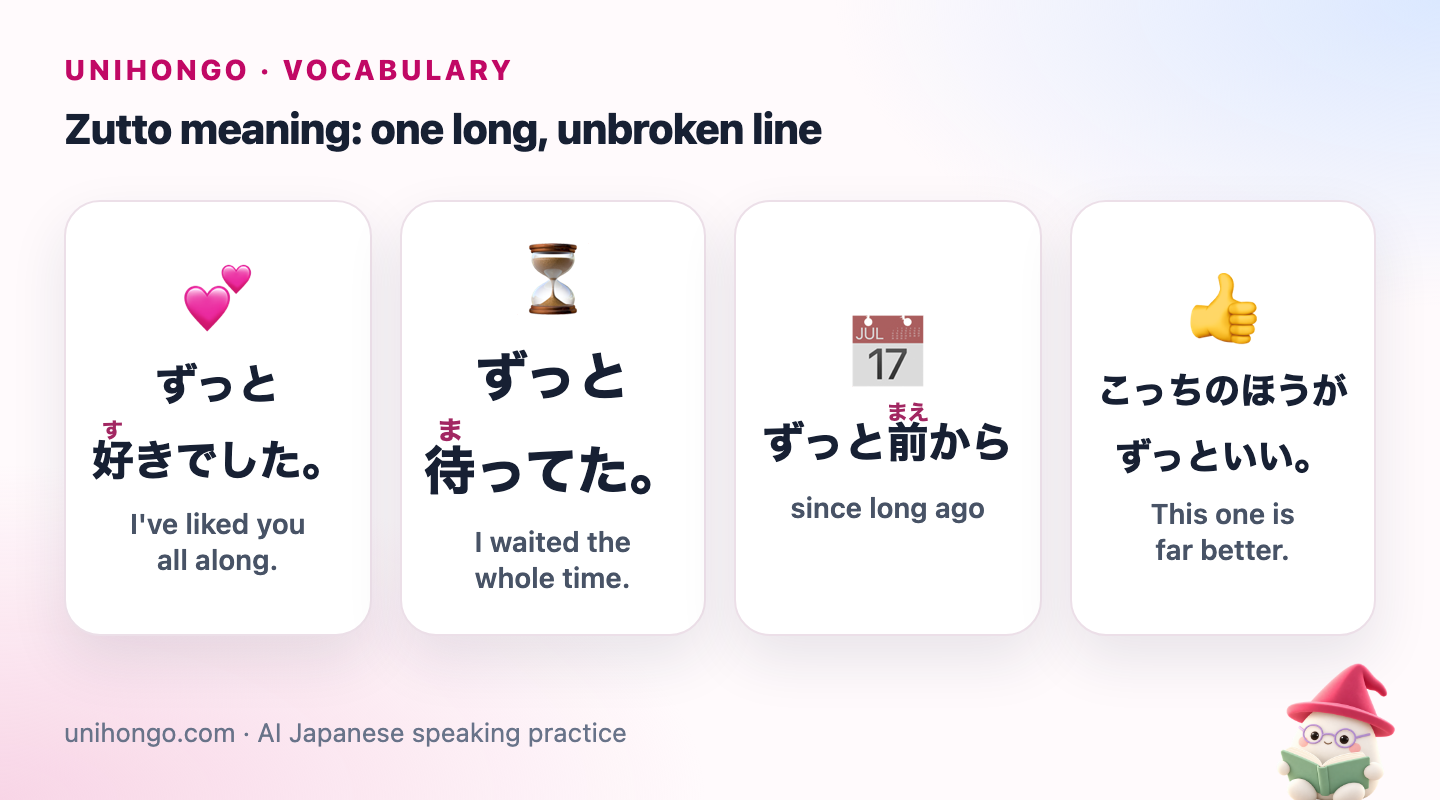
| Japanese | Romaji | Meaning |
|---|---|---|
| ずっと好きでした。 | Zutto suki deshita. | I've liked you all along. |
| ずっと待ってた。 | Zutto matteta. | I waited the whole time. |
| ずっと前から | zutto mae kara | since long ago |
| こっちのほうがずっといい。 | Kotchi no hō ga zutto ii. | This one is far better. |
Zutto suki deshita is a classic line of confession. In a confession, the past tense deshita usually does not mean the feeling has ended; it looks back over the whole time up to now, so it means I have liked you all this time.
Zutto for 'the whole time'
The basic use describes something that continued without a break. It goes naturally with -te iru (-teru in speech) for ongoing states and actions, and with a past tense for a period that has finished. With a negative, it means not for a long time: zutto atte nai, I haven't seen them in ages.
| Japanese | Romaji | Meaning |
|---|---|---|
| 昨日はずっと雨だった。 | Kinō wa zutto ame datta. | It rained all day yesterday. |
| 電車でずっと立ってた。 | Densha de zutto tatteta. | I stood the whole way on the train. |
| ずっと会ってないね。 | Zutto atte nai ne. | We haven't seen each other in ages. |
| 朝からずっと忙しいです。 | Asa kara zutto isogashii desu. | I've been busy since this morning. |
Zutto mae, zutto ato: far back and far ahead
Combine zutto with time and position words and it stretches the distance. Zutto mae is long ago, zutto ato is much later, and zutto saki is far ahead, in time or on a road. Zutto mae kara with a -tai form plus to omotte ita is the natural way to say you have wanted to do something for a long time.
| Japanese | Romaji | Meaning |
|---|---|---|
| ずっと前から行きたいと思ってた。 | Zutto mae kara ikitai to omotteta. | I've wanted to go for ages. |
| それはずっと後で知りました。 | Sore wa zutto ato de shirimashita. | I found that out much later. |
| 駅はこの道のずっと先です。 | Eki wa kono michi no zutto saki desu. | The station is a long way down this road. |
Omotte ita (omotteta in speech) means I had been thinking, and it is the right tense for a wish you have held over time. Ikitai to omou on its own sounds like a decision you are making now.
Zutto in comparisons: much, by far
In comparisons, zutto shows a big gap. Use it with no hō ga (the one that is more) or yori (than): A no hō ga B yori zutto ii, A is much better than B. It sounds natural and neutral, and it is far more common in speech than the written haruka ni.
Motto also appears in comparisons, but it means more, often pushing for an increase: motto yukkuri, more slowly. Zutto describes a gap that already exists.
| Japanese | Romaji | Meaning |
|---|---|---|
| 電車のほうがバスよりずっと速い。 | Densha no hō ga basu yori zutto hayai. | The train is much faster than the bus. |
| 前よりずっと上手になったね。 | Mae yori zutto jōzu ni natta ne. | You've got much better than before. |
| もっとゆっくり話してください。 | Motto yukkuri hanashite kudasai. | Please speak more slowly. |
| Word | Meaning in comparisons | Example idea |
|---|---|---|
| zutto (ずっと) | Much, by far: a big existing gap | The train is much faster than the bus |
| motto (もっと) | More: increase it further | Please speak more slowly |
| haruka ni (はるかに) | Far, vastly: formal or written | Far exceeds expectations |
| chotto (ちょっと) | A little: a small gap | This one is a little cheaper |
Zutto issho: promises, songs and how heavy they are
Talking about the future, zutto means always or forever, and this is where it gets emotional. Zutto issho ni iyō ne, let's always be together, is common between couples, close friends and in family moments. Kore kara mo zutto, from now on too, is a staple of farewell messages and wedding speeches.
Because it is a promise, zutto issho can feel heavy early in a relationship. Between friends, zutto tomodachi da yo is warm and sincere, often said at graduation or before someone moves away.
| Japanese | Romaji | Meaning |
|---|---|---|
| ずっと一緒にいようね。 | Zutto issho ni iyō ne. | Let's always be together. |
| これからもずっと友達だよ。 | Kore kara mo zutto tomodachi da yo. | We'll always be friends. |
| これからもずっと応援しています。 | Kore kara mo zutto ōen shite imasu. | I'll always be cheering for you. |
Common mistakes with zutto
- Using zutto for habits. I always drink coffee in the morning is itsumo, not zutto. Zutto would mean you drink it all morning without stopping.
- Mixing it with mada. Mada means still or not yet; zutto means continuously. Mada matte iru is I'm still waiting; zutto matte iru adds that you have waited the whole time.
- Using motto where you mean zutto. Kore wa are yori motto ii can sound like even better, implying both are good. For a clear, big gap, use zutto.
- Shortening the small tsu. Zuto with no pause sounds wrong; zutto needs a full beat of silence before the t.
Zutto for directions: keep going straight
Zutto also describes distance in space, and this is one of its most practical uses for travellers. When you ask the way, you will often hear zutto massugu, keep going straight, or kono michi o zutto itte, go all the way along this road. It means do not turn until told otherwise.
Listen for what comes after zutto in directions: a landmark, a corner or a traffic light. That is where the instruction changes.
| Japanese | Romaji | Meaning |
|---|---|---|
| この道をずっとまっすぐ行ってください。 | Kono michi o zutto massugu itte kudasai. | Please go straight along this road. |
| ずっと行くと、右に駅があります。 | Zutto iku to, migi ni eki ga arimasu. | Keep going and the station is on the right. |
| ずっとまっすぐですか。 | Zutto massugu desu ka. | Straight all the way? |
| 信号までずっと歩いてください。 | Shingō made zutto aruite kudasai. | Walk all the way to the traffic light. |
Mini dialogue: you've wanted to visit Hokkaido for ages
Over coffee, a friend asks about your plans for the winter holidays. Zutto lets you say how long you have dreamed of the trip and compare it with other options.

| Japanese | Romaji | Meaning |
|---|---|---|
| 冬休み、どこか行くの? | Fuyuyasumi, doko ka iku no? | Friend: Going anywhere for the winter break? |
| 北海道に行くんだ。 | Hokkaidō ni iku n da. | You: I'm going to Hokkaido. |
| ずっと前から行きたかったの。 | Zutto mae kara ikitakatta no. | You: I've wanted to go for ages. |
| いいね!冬はずっと寒いよ。 | Ii ne! Fuyu wa zutto samui yo. | Friend: Nice! It's cold the whole winter. |
| 大丈夫。東京よりずっと雪がきれいでしょう。 | Daijōbu. Tōkyō yori zutto yuki ga kirei deshō. | You: That's fine. The snow must be far prettier than in Tokyo. |
| 写真、送ってね。 | Shashin, okutte ne. | Friend: Send me photos. |