
The four jobs of chotto
Every use of chotto comes from the same core idea of smallness, but the thing being made small changes. Sometimes it is a quantity, sometimes it is the weight of your request, sometimes it is the size of the interruption you are making, and sometimes it is the problem you are politely refusing to name. Once you know which job is running, the sentence stops being ambiguous. Native listeners choose between them instantly using tone, position and whether the sentence finishes.
| Job | What it makes small | Example | English |
|---|---|---|---|
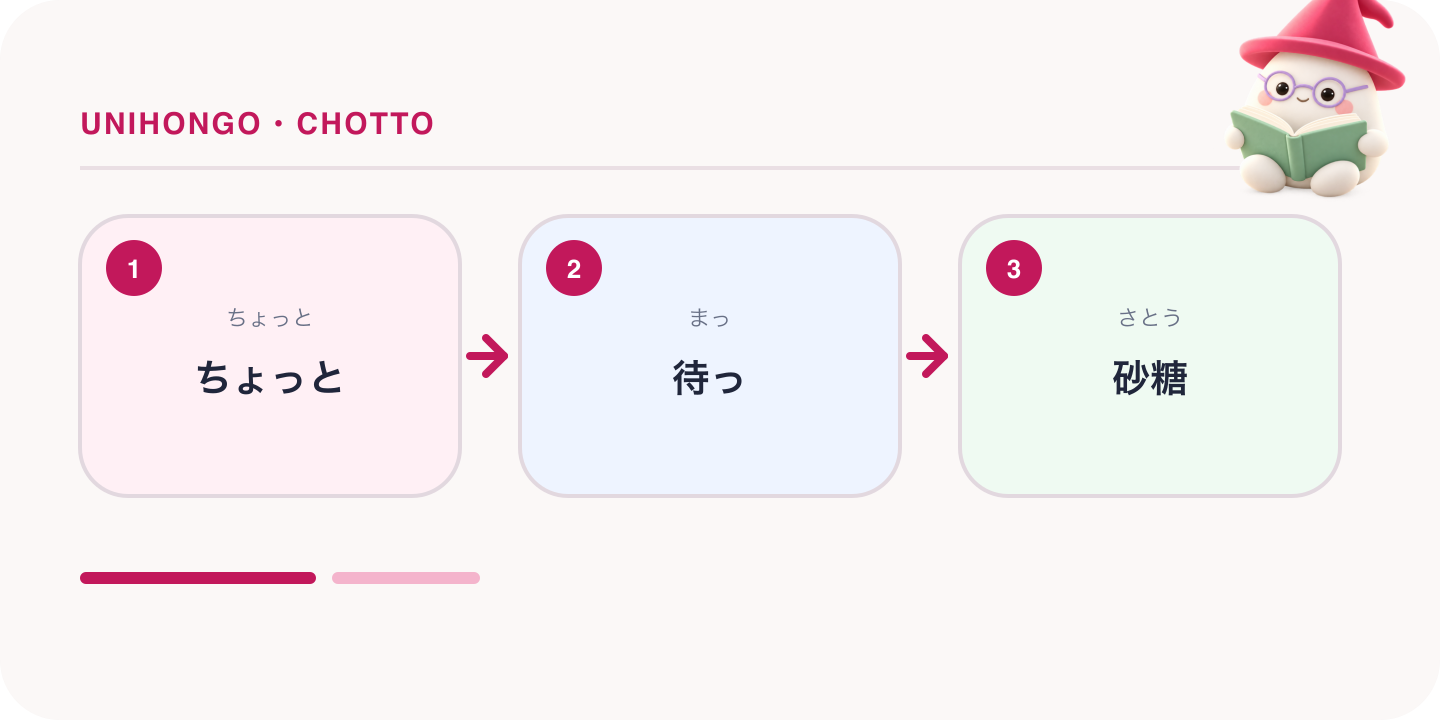
| Quantity or degree | An amount, a length of time, a level | ちょっと待ってください。 | Please wait a moment. |
| Softener | The weight of a request or an opinion | ちょっとお願いがあるんですが。 | I have a small favour to ask. |
| Attention | The size of the interruption | ちょっとすみません。 | Excuse me a second. |
| Refusal | The bad news you are not saying | それはちょっと…。 | That is a little... (meaning no) |
The first three are what textbooks teach. The fourth is the one that decides whether you understand a Japanese conversation, because it is used constantly and it never announces itself. Learn to hear the drop in the speaker's voice at the end of chotto, because that fall is the whole message.
Chotto as a small amount
In its plainest use chotto measures a little of something: a small quantity, a short time, or a mild degree of an adjective. It goes directly before the word it shrinks, and it works with verbs, adjectives and nouns alike. Mō chotto means a bit more, and chotto dake means just a little and nothing more. This is the use where chotto is doing nothing social at all, so tone is flat and the sentence finishes normally.
| Japanese | Romaji | Meaning |
|---|---|---|
| ちょっと待ってください。 | Chotto matte kudasai. | Please wait a moment. |
| 砂糖をちょっと入れます。 | Satō o chotto iremasu. | I will put in a little sugar. |
| ちょっとだけください。 | Chotto dake kudasai. | Just a little, please. |
| もうちょっとゆっくりお願いします。 | Mō chotto yukkuri onegaishimasu. | A little more slowly, please. |
| ちょっと疲れました。 | Chotto tsukaremashita. | I am a bit tired. |
| ちょっと寒くないですか。 | Chotto samuku nai desu ka? | Is it not a bit cold? |
| この店はちょっと高いですね。 | Kono mise wa chotto takai desu ne. | This shop is a bit pricey. |
Chotto as a softener on requests and opinions
Japanese prefers to make a request look small before asking for it. Chotto placed at the front of a request tells the listener that you are not about to take much of their time, and it turns an instruction into a favour. The same move works on opinions: chotto chigaimasu is far easier to receive than chigaimasu, because the disagreement has been shrunk before it arrives.
Notice that the size of the actual task is irrelevant. Chotto tetsudatte moraemasu ka can precede two minutes of help or an afternoon of it. What the word measures here is the social weight of asking, not the work. This is why removing chotto from these sentences makes them sound abrupt even when every other word is polite.
| Japanese | Romaji | Meaning |
|---|---|---|
| ちょっとお願いがあるんですが。 | Chotto onegai ga aru n desu ga. | I have a small favour to ask. |
| ちょっと手伝ってもらえますか。 | Chotto tetsudatte moraemasu ka? | Could you give me a hand? |
| ちょっと聞いてもいいですか。 | Chotto kiite mo ii desu ka? | May I ask you something? |
| ちょっと確認させてください。 | Chotto kakunin sasete kudasai. | Let me just check. |
| ちょっと違うと思います。 | Chotto chigau to omoimasu. | I think that is slightly off. |
| 説明がちょっと分かりにくいです。 | Setsumei ga chotto wakarinikui desu. | The explanation is a bit hard to follow. |
| ちょっと考えさせてください。 | Chotto kangaesasete kudasai. | Please let me think about it. |
The expected reply to a softened request is short and warm: hai, dōzo, or ii desu yo. If the answer starts with a slow ee to and a breath, you are about to be refused, and the rest of this guide is about that moment.
Chotto to get someone's attention
Before speaking to a stranger, a colleague at their desk, or a member of staff, Japanese opens with a small sound rather than a name. Chotto sumimasen is the standard version and works in a shop, on a street, or in an office. Chotto ii desu ka asks whether now is a convenient moment, and chotto yoroshii desu ka is the same question in more formal clothing.
Chotto used entirely alone as a call, as in chotto, wasuremono desu yo, is casual and slightly urgent. It is what you shout after someone who dropped a glove. Aimed at a superior it sounds sharp, so keep sumimasen in front of it whenever the person outranks you or you have never met.
| Japanese | Romaji | Meaning |
|---|---|---|
| ちょっとすみません。 | Chotto sumimasen. | Excuse me a second. |
| あ、ちょっといいですか。 | A, chotto ii desu ka? | Ah, do you have a moment? |
| ちょっとよろしいですか。 | Chotto yoroshii desu ka? | Might I have a moment? (formal) |
| すみません、ちょっとお時間いいですか。 | Sumimasen, chotto o-jikan ii desu ka? | Sorry, do you have a minute? |
| ちょっと、忘れ物ですよ。 | Chotto, wasuremono desu yo. | Excuse me, you have left something. (casual) |
| ちょっと待って。 | Chotto matte. | Hang on. (casual) |
The refusal that never finishes its sentence
This is the use that decides whether you can follow a real conversation. When a Japanese speaker wants to decline, they very often name the obstacle, add chotto, and stop. Kyō wa chotto means today is a bit, and the missing ending might be inconvenient, difficult, or impossible. Nobody supplies it, because supplying it would make the refusal explicit and force the other person to hear a no.
The sentence is not incomplete to a Japanese listener. It is finished, and it means no. The voice usually falls and slows on chotto, sometimes with a small intake of breath before it and a trailing ne after it. If you wait for the rest of the sentence, you will wait forever, and repeating your request at that point puts the other person in the uncomfortable position of having to be blunt.
| Japanese | Romaji | Meaning |
|---|---|---|
| 今日はちょっと…。 | Kyō wa chotto... | Today is a bit... (I cannot today) |
| それはちょっと…。 | Sore wa chotto... | That is a bit... (no) |
| ちょっと難しいですね。 | Chotto muzukashii desu ne. | That would be difficult. (a firm no) |
| 明日はちょっと予定が…。 | Ashita wa chotto yotei ga... | I have something on tomorrow... |
| ちょっと厳しいかもしれません。 | Chotto kibishii kamo shiremasen. | That may be a bit tight. (probably not) |
| お酒はちょっと…。 | O-sake wa chotto... | Alcohol is a bit... (I do not drink) |
| 値段がちょっと…。 | Nedan ga chotto... | The price is a bit... (too expensive) |
| ちょっと都合が悪くて。 | Chotto tsugō ga warukute. | It is a little inconvenient for me. |
| ちょっとね。 | Chotto ne. | It is a bit, you know. (evading, casual) |
| ちょっとご遠慮いただけますか。 | Chotto go-enryo itadakemasu ka? | Could I ask you to refrain? (please stop) |
The last line is worth memorising in reverse. If a member of staff says go-enryo kudasai or go-enryo itadakemasu ka to you, that is a rule being enforced politely, not a suggestion, and the correct response is to stop and say sumimasen.
How to answer a chotto refusal
Your job when you hear a trailing chotto is to close the subject quickly so the other person never has to finish the sentence. Acknowledge, release them, and offer a future door. Doing this smoothly is a small piece of social skill that native speakers notice, and it takes three seconds of prepared language.
| Japanese | Romaji | Meaning |
|---|---|---|
| そうですか、分かりました。 | Sō desu ka, wakarimashita. | I see, understood. |
| では、また今度お願いします。 | Dewa, mata kondo onegaishimasu. | Then let us do it another time. |
| 大丈夫です、気にしないでください。 | Daijōbu desu, ki ni shinaide kudasai. | It is fine, please do not worry about it. |
| じゃあ、別の日にしましょうか。 | Jā, betsu no hi ni shimashō ka? | Shall we make it another day then? |
| 無理しないでくださいね。 | Muri shinaide kudasai ne. | Please do not push yourself. |
Chotto shita and other set uses
Chotto shita is an adjective-shaped form meaning a small or slight something, and it modifies a noun directly. It is the phrase you use when handing over a modest gift or reporting a minor issue, and it deliberately plays the thing down. Chotto plus demo suggests a quick, casual version of an activity, as in chotto o-cha demo for a quick cup of tea.
| Japanese | Romaji | Meaning |
|---|---|---|
| ちょっとしたお土産です。 | Chotto shita o-miyage desu. | It is just a small souvenir. |
| ちょっとした問題があります。 | Chotto shita mondai ga arimasu. | There is a minor problem. |
| ちょっとしたことですよ。 | Chotto shita koto desu yo. | It is nothing much. |
| ちょっとお茶でもどうですか。 | Chotto o-cha demo dō desu ka? | How about a quick cup of tea? |
| ちょっと出かけてきます。 | Chotto dekakete kimasu. | I am popping out for a bit. |
| ちょっとそこまで。 | Chotto soko made. | Just up the road. (a vague answer to where are you going) |
Chotto soko made is a set answer that politely declines to give details. It is friendly rather than evasive, and it is a useful reply to a neighbour who asks where you are heading when you would rather not explain.
Sukoshi and shōshō for formal rooms
Chotto sits in the casual to neutral band. It is fine with friends, colleagues and shop staff, but it is light for a formal presentation, a first meeting with a client, or service language spoken to a customer. Sukoshi covers the same meaning with a neutral register that works in writing as well as speech, and shōshō is the formal version you hear from staff and on the telephone.
| Japanese | Romaji | Meaning |
|---|---|---|
| 少々お待ちください。 | Shōshō o-machi kudasai. | One moment, please. (staff to customer) |
| 少しお時間をいただけますか。 | Sukoshi o-jikan o itadakemasu ka? | Could I have a little of your time? |
| 少し休みましょう。 | Sukoshi yasumimashō. | Let us take a short break. |
| 少し熱があります。 | Sukoshi netsu ga arimasu. | I have a slight fever. |
| 少々お伺いしたいことがあります。 | Shōshō o-ukagai shitai koto ga arimasu. | There is something I would like to ask you. (formal) |
| Word | Register | Where you hear it | Example |
|---|---|---|---|
| ちょっと chotto | Casual to neutral | Friends, colleagues, everyday speech | ちょっと待って。 Chotto matte. |
| 少し sukoshi | Neutral, spoken and written | Safe almost anywhere, including reports | 少し待ってください。 Sukoshi matte kudasai. |
| 少々 shōshō | Formal | Service language, phone calls, business | 少々お待ちください。 Shōshō o-machi kudasai. |
| わずか wazuka | Formal, mostly written | Only a trifling amount, often with numbers | わずか三分です。 Wazuka san-pun desu. |
The swap is not automatic in both directions. Shōshō sounds stiff between friends, and it almost never appears in the refusal use, where chotto is the natural word at every level of politeness.
Using chotto without going vague
Chotto is genuinely useful for a learner, because it buys you the softness that your grammar cannot yet produce. A beginner who says chotto wakarimasen sounds thoughtful, while wakarimasen alone can sound like a wall. The risk arrives when chotto attaches to everything you say. If every opinion is chotto and every answer is chotto, nothing you say lands, and listeners stop being able to tell what you actually think.
- Use chotto on requests and disagreements, where the softening does real work.
- Drop it from factual answers: sanji ni ikimasu is better than chotto sanji ni ikimasu.
- Never use it on a compliment, since chotto oishii desu means only slightly tasty.
- Keep one clear positive per conversation with no hedge at all, so your yes still means yes.
- In formal settings, swap it for sukoshi in quantity uses and keep chotto only for the refusal.
- When you truly cannot do something, add a reason after the chotto if the person needs one.
Mistakes learners make
- Hearing kyō wa chotto as an unfinished sentence and asking the person to continue.
- Answering a chotto refusal with dōshite desu ka, which forces an explicit no.
- Using chotto sumimasen to a superior when sumimasen alone is smoother.
- Saying chotto matte kudasai to a customer, where shōshō o-machi kudasai is expected.
- Using shōshō with friends, which sounds like you are reading from a script.
- Hedging every sentence with chotto until your opinions become unreadable.