

How country names work in Japanese
The general rule is simple. Countries in East Asia have kanji names, and almost everyone else has a katakana name based on the English or the local pronunciation. Nihon or Nippon is Japan, Chūgoku is China, and Kankoku is South Korea. Most others are katakana: Amerika, Furansu, Doitsu, Betonamu.
Some katakana names are not what English speakers expect. Germany is Doitsu from the German Deutsch, the Netherlands is Oranda from Holland via Portuguese, and the UK is usually Igirisu, which historically came from Portuguese and Dutch words for English. Learning these few oddities early saves confusion on forms and menus.
The word for country is kuni, and the formal word is koku, which appears in compounds such as gaikoku, foreign countries, and bokoku, your home country.
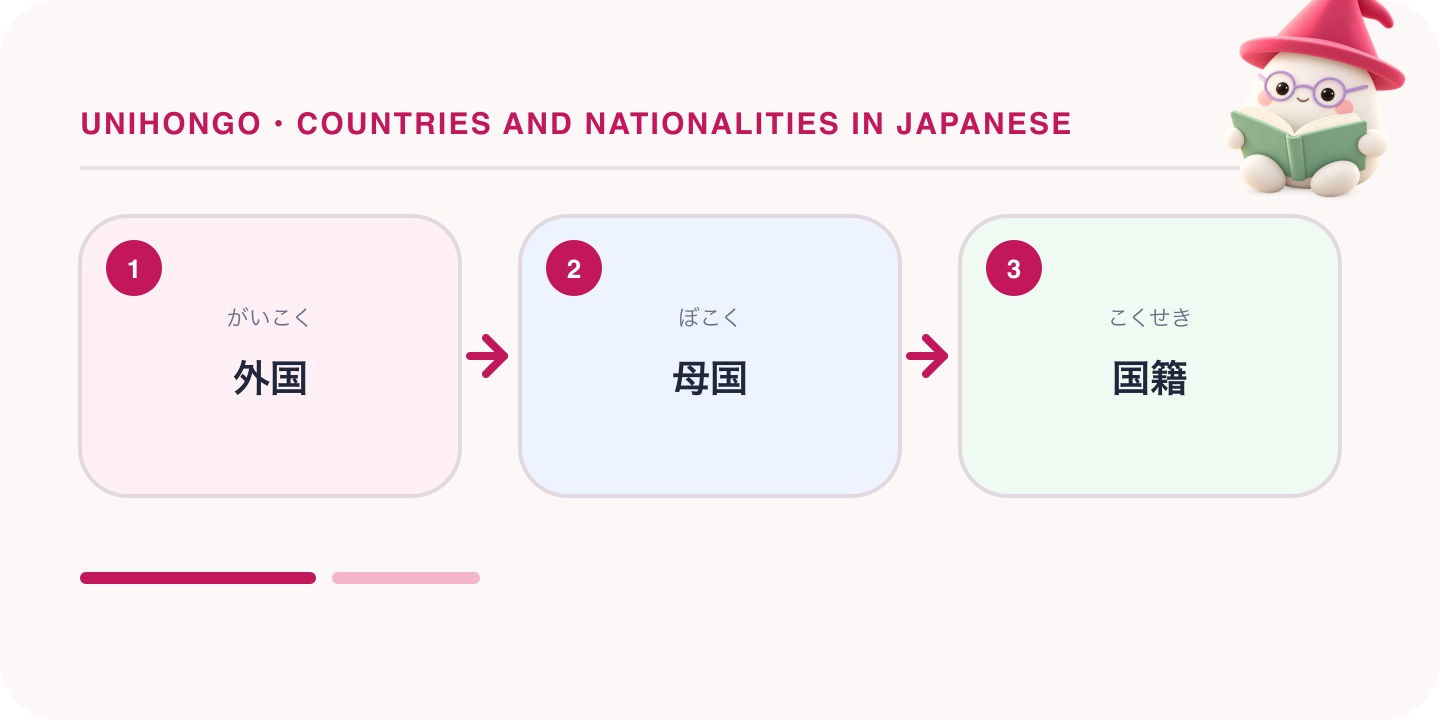
| Word | Reading | Meaning |
|---|---|---|
| 国 | kuni | Country |
| 外国 | gaikoku | Foreign country |
| 母国 | bokoku | Home country, mother country |
| 国籍 | kokuseki | Nationality, citizenship |
| 出身 | shusshin | Where one is from, origin |
| 海外 | kaigai | Overseas, abroad |
Country names by region
These are the names you will meet most often. Where a country also has a kanji short form used in the news, it is listed in the meaning column.
| Country | Reading | Meaning |
|---|---|---|
| 日本 | Nihon / Nippon | Japan (short form 日) |
| 中国 | Chūgoku | China (short form 中) |
| 韓国 | Kankoku | South Korea (short form 韓) |
| 台湾 | Taiwan | Taiwan |
| ベトナム | Betonamu | Vietnam |
| タイ | Tai | Thailand |
| フィリピン | Firipin | The Philippines |
| インドネシア | Indoneshia | Indonesia |
| インド | Indo | India |
| ネパール | Nepāru | Nepal |
| アメリカ | Amerika | USA (short form 米) |
| カナダ | Kanada | Canada |
| メキシコ | Mekishiko | Mexico |
| ブラジル | Burajiru | Brazil |
| イギリス | Igirisu | UK (short form 英) |
| フランス | Furansu | France (short form 仏) |
| ドイツ | Doitsu | Germany (short form 独) |
| イタリア | Itaria | Italy |
| スペイン | Supein | Spain |
| オランダ | Oranda | The Netherlands |
| オーストラリア | Ōsutoraria | Australia (short form 豪) |
| ニュージーランド | Nyūjīrando | New Zealand |
People and languages: -jin and -go
Add -jin, written 人, to a country name to make a person from that country: Nihonjin, Amerikajin, Burajirujin. Add -go, written 語, to make the language: Nihongo, Chūgokugo, Furansugo. The pattern is almost fully regular, which makes this one of the easiest vocabulary sets in Japanese.
The exceptions are all on the language side, because languages do not map one to one onto countries. English is eigo, not Igirisugo or Amerikago. People from the US, Australia and Canada speak eigo, and people from Mexico or Argentina speak supeingo. Brazilians speak porutogarugo, Portuguese. Some countries have more than one common language, so ask rather than guess.
Gaikokujin, foreign person, follows the same -jin pattern, and so does the region: Ajiajin, Asian person, Yōroppajin, European person.
| Country | Person | Language |
|---|---|---|
| 日本 Nihon | 日本人 Nihonjin | 日本語 Nihongo |
| 中国 Chūgoku | 中国人 Chūgokujin | 中国語 Chūgokugo |
| 韓国 Kankoku | 韓国人 Kankokujin | 韓国語 Kankokugo |
| ベトナム Betonamu | ベトナム人 Betonamujin | ベトナム語 Betonamugo |
| フランス Furansu | フランス人 Furansujin | フランス語 Furansugo |
| ドイツ Doitsu | ドイツ人 Doitsujin | ドイツ語 Doitsugo |
| アメリカ Amerika | アメリカ人 Amerikajin | 英語 eigo |
| イギリス Igirisu | イギリス人 Igirisujin | 英語 eigo |
| オーストラリア Ōsutoraria | オーストラリア人 Ōsutorariajin | 英語 eigo |
| ブラジル Burajiru | ブラジル人 Burajirujin | ポルトガル語 porutogarugo |
| メキシコ Mekishiko | メキシコ人 Mekishikojin | スペイン語 supeingo |
Asking and answering where someone is from
There are several ways to ask, from casual to polite. Doko kara kimashita ka, where did you come from, is common and friendly. O-kuni wa dochira desu ka is more polite and very natural with someone you have just met. Shusshin wa doko desu ka asks where someone is from and works for hometowns inside Japan too.
When answering, the simplest pattern is country plus kara kimashita, or country plus jin desu. If your nationality and where you grew up differ, shusshin lets you say where you are from without claiming a nationality. Follow up with a detail, because a one-word answer tends to stall the conversation.
| Japanese | Romaji | Meaning |
|---|---|---|
| どこから来ましたか。 | Doko kara kimashita ka. | Where are you from? (literally, where did you come from?) |
| お国はどちらですか。 | O-kuni wa dochira desu ka. | Which country are you from? (polite) |
| ご出身はどちらですか。 | Go-shusshin wa dochira desu ka. | Where are you from originally? (polite) |
| カナダから来ました。 | Kanada kara kimashita. | I'm from Canada. |
| オーストラリア人です。 | Ōsutorariajin desu. | I'm Australian. |
| 国籍はアメリカですが、育ちはドイツです。 | Kokuseki wa Amerika desu ga, sodachi wa Doitsu desu. | I'm American by nationality, but I grew up in Germany. |
| 何語を話しますか。 | Nanigo o hanashimasu ka. | What languages do you speak? |
| 英語とスペイン語を話します。 | Eigo to supeingo o hanashimasu. | I speak English and Spanish. |
| フランスのどこですか。 | Furansu no doko desu ka. | Where in France? |
Abbreviations in the news: Nichi-Bei and friends
Japanese news headlines save space by shortening countries to one kanji and joining them. Nichi-Bei, 日米, means Japan and the US, as in Nichi-Bei kankei, Japan-US relations. Nitchū, 日中, is Japan-China, and Nikkan, 日韓, is Japan-South Korea. Bei-Chū, 米中, is the US and China.
The short forms also appear in fixed words. Ōbei, 欧米, means Europe and America, roughly the West. Eikaiwa, 英会話, is English conversation. Waei and Eiwa are Japanese-English and English-Japanese dictionaries, using wa for Japan. Rai-Nichi, 来日, means coming to Japan and is used for visiting celebrities and officials; hō-Nichi means visiting Japan, often in a diplomatic sense.
| Japanese | Romaji | Meaning |
|---|---|---|
| 日米関係 | Nichi-Bei kankei | Japan-US relations |
| 日中首脳会談 | Nitchū shunō kaidan | Japan-China summit |
| 欧米 | Ōbei | Europe and America, the West |
| 訪日外国人 | hōnichi gaikokujin | Foreign visitors to Japan |
| 来日して三年になります。 | Rainichi shite san-nen ni narimasu. | It's been three years since I came to Japan. |
| 和英辞典 | waei jiten | Japanese-English dictionary |
Gaikokujin, gaijin and polite alternatives
Gaikokujin, person from a foreign country, is the neutral standard word used in news, government documents and everyday speech. Gaijin, literally outside person, is a shortened casual form. Many people say it with no bad intent, and some foreign residents use it about themselves, but others find it excluding because it can suggest a permanent outsider. Its effect depends heavily on tone and context.
For polite speech, gaikoku no kata, a person from abroad using the honorific kata, is warm and respectful. On official forms you will see gaikoku sekimin, foreign national, and in tourism, hōnichi ryokōsha or inbaundo, inbound visitors. If someone calls you gaijin, it is usually more useful to read their intent than the word itself.
| Word | Reading | Tone |
|---|---|---|
| 外国人 | gaikokujin | Neutral and standard |
| 外国の方 | gaikoku no kata | Polite and respectful |
| 外人 | gaijin | Casual; can sound excluding |
| 外国籍 | gaikokuseki | Foreign nationality, on forms |
| 留学生 | ryūgakusei | International student |
| 在日 | zainichi | Resident in Japan; also refers to long-settled Korean communities |
Common mistakes
- Saying Amerikago or Igirisugo for English: the word is always eigo.
- Confusing Tai (Thailand) with Taiwan, or dropping the long vowel in Ōsutoraria.
- Saying Doitsu no hito for a German person in formal contexts: Doitsujin is standard; Doitsu no kata is the polite form.
- Using kokuseki wa nan desu ka in small talk: it sounds like an immigration officer. Use o-kuni wa dochira desu ka.
- Writing country names in hiragana: katakana is standard for all non-kanji country names.
- Assuming Chūgoku always means China: it is also the name of the Chūgoku region of western Japan, including Hiroshima and Okayama, so check the context.
How to review country words
Country names are ideal for katakana reading practice, because you already know the meaning and only need to decode the sound. Read the international section of a news site, airline departure boards or the origin labels on imported food in a supermarket, where you will see Chiri-san, Nyūjīrando-san and similar, meaning made in Chile or New Zealand.
Unihongo's free learning games are a quick way to review the katakana and the -jin and -go words in short rounds until reading Oranda or Burajiru takes no effort. Then take the words into speech: tell the story of your own background, then the backgrounds of three friends, using -jin, -go and shusshin.
- Read ten country names in katakana each day, aloud
- Say the person and the language for each, catching the eigo exceptions
- Practise a thirty-second self-introduction with where you are from
- Decode one news headline a day that uses a kanji short form