
Two kinds of colour word
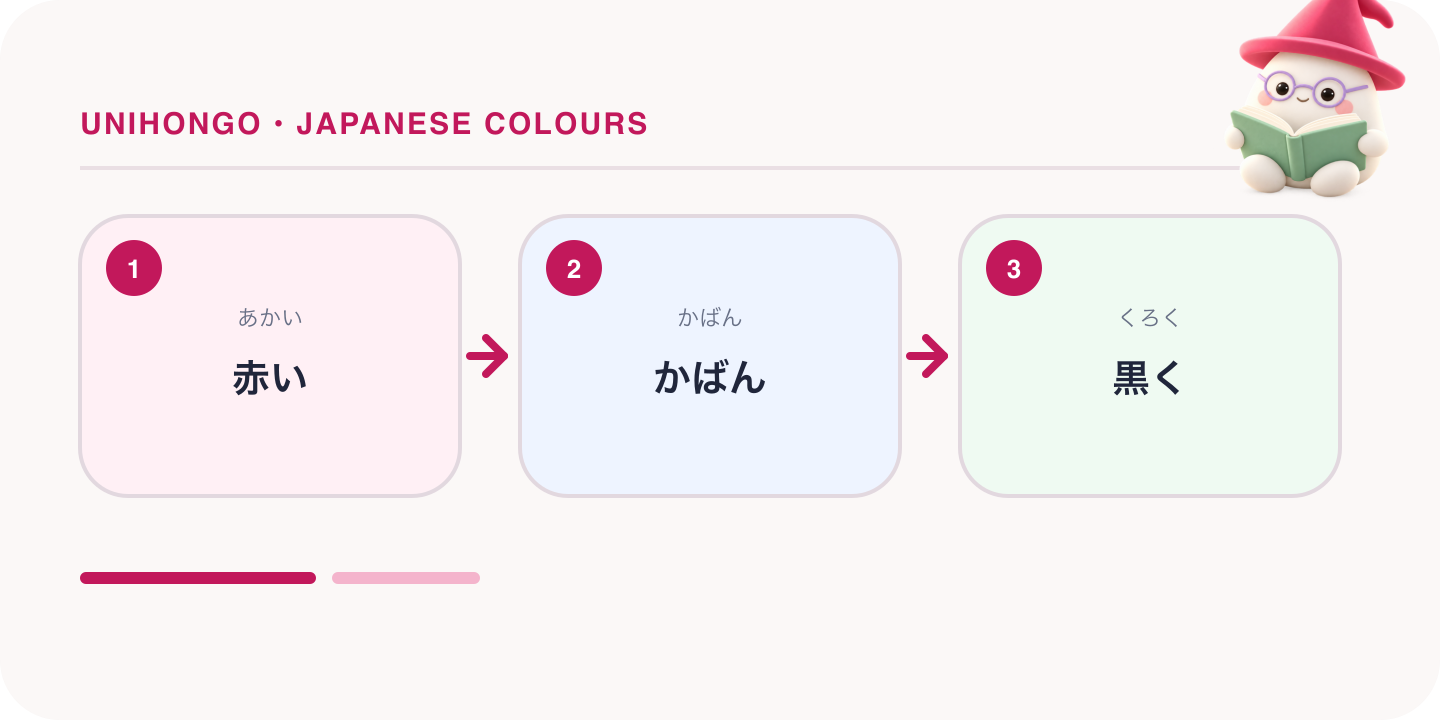
Japanese has two grammatical kinds of colour word, and the split does not follow anything you can see. Four colours are true i-adjectives: 赤い akai red, 青い aoi blue, 白い shiroi white and 黒い kuroi black. They sit directly in front of a noun, end a sentence on their own, and conjugate like any other i-adjective, so a red car is akai kuruma, it is not black is kuroku nai desu, and it was white is shirokatta desu.
Every other colour is a noun. Green, purple, orange, pink and grey link to a noun with の no and end a sentence with です desu: midori no kaban is a green bag, and kaban wa midori desu means the bag is green. The negative is the noun negative, midori ja nai desu. The learner mistake is to invent midorii or pinkui by analogy with akai. Those forms do not exist, and a Japanese listener hears them immediately.
| Japanese | Romaji | Meaning |
|---|---|---|
| 赤い車です。 | Akai kuruma desu. | It is a red car. |
| 車は赤いです。 | Kuruma wa akai desu. | The car is red. |
| 緑のかばんです。 | Midori no kaban desu. | It is a green bag. |
| かばんは緑です。 | Kaban wa midori desu. | The bag is green. |
| この靴は黒くないです。 | Kono kutsu wa kuroku nai desu. | These shoes are not black. |
| このかばんはピンクじゃないです。 | Kono kaban wa pinku ja nai desu. | This bag is not pink. |
Colour words at a glance
| Colour | Romaji | English | Before a noun |
|---|---|---|---|
| 赤 / 赤い | aka / akai | red | i-adjective: 赤い車 |
| 青 / 青い | ao / aoi | blue, and green in set words | i-adjective: 青い空 |
| 白 / 白い | shiro / shiroi | white | i-adjective: 白いシャツ |
| 黒 / 黒い | kuro / kuroi | black | i-adjective: 黒い猫 |
| 黄色 / 黄色い | kiiro / kiiroi | yellow | i-adjective form or 黄色の |
| 茶色 / 茶色い | chairo / chairoi | brown | i-adjective form or 茶色の |
| 緑 | midori | green | noun: 緑の |
| 紫 | murasaki | purple | noun: 紫の |
| オレンジ | orenji | orange | noun: オレンジの |
| ピンク | pinku | pink | noun: ピンクの |
| グレー / 灰色 | gurē / haiiro | grey | noun: グレーの |
| 水色 | mizuiro | light blue | noun: 水色の |
| 紺 | kon | navy | noun: 紺の |
| 黄緑 | kimidori | yellow-green | noun: 黄緑の |
| 金色 | kin'iro | gold | noun: 金色の |
| 銀色 | gin'iro | silver | noun: 銀色の |
| ベージュ | bēju | beige | noun: ベージュの |
| 桃色 | momoiro | peach pink | noun: 桃色の |
| 朱色 | shuiro | vermilion | noun: 朱色の |
| 藍色 | aiiro | indigo | noun: 藍色の |
| 透明 | tōmei | clear, transparent | na-adjective: 透明な |
| 濃い | koi | deep, dark (shade) | i-adjective: 濃い青 |
| 薄い | usui | pale, light (shade) | i-adjective: 薄いピンク |
| 明るい | akarui | bright | i-adjective: 明るい色 |
| 暗い | kurai | dark, sombre | i-adjective: 暗い色 |
| 派手 | hade | loud, flashy | na-adjective: 派手な |
| 地味 | jimi | plain, subdued | na-adjective: 地味な |
| 色 | iro | colour | noun |
| 何色 | nani-iro | what colour | question word |
| 色違い | irochigai | the same item in another colour | noun |
Several nouns carry 色 iro inside them: 黄色 kiiro is literally yellow colour, 茶色 chairo is tea colour, 水色 mizuiro is water colour, and 灰色 haiiro is ash colour. You can add iro to the katakana colours too, so オレンジ色 orenjiiro and ピンク色 pinkuiro are both common, and they behave exactly like the plain nouns.
The noun form of every colour
Even the four i-adjectives have a noun form, made by dropping the い: 赤 aka, 青 ao, 白 shiro, 黒 kuro. You need the noun whenever the colour is the thing you are talking about rather than a description of something else. Liking a colour, choosing a colour, and answering what colour something is all use the noun: aka ga suki desu, aka ni shimasu, aka desu. Answering nani-iro desu ka with akai desu is understood, but it sounds like a description rather than an answer, and it marks a learner.
| Japanese | Romaji | Meaning |
|---|---|---|
| 何色が好きですか? | Nani-iro ga suki desu ka? | What colour do you like? |
| 青が好きです。 | Ao ga suki desu. | I like blue. |
| どの色にしますか? | Dono iro ni shimasu ka? | Which colour will you go for? |
| 黒にします。 | Kuro ni shimasu. | I will go with black. |
| 白と黒、どちらがいいですか? | Shiro to kuro, dochira ga ii desu ka? | White or black, which is better? |
| 白のほうがいいです。 | Shiro no hō ga ii desu. | White is better. |
Note the reading of 何色. As a question about colour it is nani-iro. The same characters read nan-shoku mean how many colours, because 色 also works as a counter, as in 三色 sanshoku, three colours. Context settles it in conversation, but say nani-iro when you are asking what colour something is.
Kiiroi and chairoi, the halfway pair
黄色 kiiro and 茶色 chairo are nouns that end in iro, yet both have grown an i-adjective form: 黄色い kiiroi and 茶色い chairoi. In front of a noun the adjective form is the everyday choice, so a yellow flower is kiiroi hana and brown eyes are chairoi me. At the end of a sentence either form works: me wa chairo desu and me wa chairoi desu are both natural. No other iro noun does this. Mizuiroi and haiiroi do not exist, so treat the pair as an exception to memorise rather than a pattern to extend.
| Japanese | Romaji | Meaning |
|---|---|---|
| 黄色い花が咲いています。 | Kiiroi hana ga saite imasu. | Yellow flowers are in bloom. |
| 茶色い犬を飼っています。 | Chairoi inu o katte imasu. | I have a brown dog. |
| 目は茶色です。 | Me wa chairo desu. | My eyes are brown. |
| 黄色のTシャツはありますか? | Kiiro no tī-shatsu wa arimasu ka? | Do you have a yellow T-shirt? |
Why the green light is ao
Ao traditionally covered a range of colours that English splits into blue and green, and midori as a separate everyday colour name is comparatively recent. Modern speakers use midori for most green things, but ao survives in fixed words where it has always been used. The green traffic light is 青信号 aoshingō, green apples are 青りんご aoringo, leafy vegetables are 青野菜 aoyasai, and fresh spring leaves are 青葉 aoba. A learner who says midori shingō will be understood, but nobody says it.
Aoi also describes people. A face that has gone pale is 真っ青 massao, and someone inexperienced is まだ青い mada aoi, still green, exactly as in English. Keep these as set phrases, and use midori for anything new you want to call green, from a jumper to a mountainside.
| Japanese | Romaji | Meaning |
|---|---|---|
| 信号が青になりました。 | Shingō ga ao ni narimashita. | The light has turned green. |
| 青りんごをください。 | Aoringo o kudasai. | A green apple, please. |
| 顔が真っ青ですよ。大丈夫ですか? | Kao ga massao desu yo. Daijōbu desu ka? | You look really pale. Are you all right? |
| 緑の山がきれいですね。 | Midori no yama ga kirei desu ne. | The green mountains are beautiful, aren't they. |
Light, dark, and bright shades
Shades are built with ordinary adjectives in front of the colour noun. 薄い usui, thin, means pale or light: usui pinku, usui ao. 濃い koi, thick or strong, means deep or dark: koi ao, koi midori. 明るい akarui and 暗い kurai describe brightness rather than depth, so akarui iro is a bright, cheerful colour and kurai iro is a dark, sombre one. Because usui and koi are i-adjectives, you can compare with motto, more, and ask for mō sukoshi usui iro, a slightly lighter colour.
Japanese also has single words for common shades: 水色 mizuiro for light blue, 紺 kon for navy, 黄緑 kimidori for yellow-green. When one exists, speakers usually prefer it to a two-word description, so navy trousers are kon no zubon rather than koi ao no zubon, and a pale blue shirt is mizuiro no shatsu.
| Japanese | Romaji | Meaning |
|---|---|---|
| もう少し薄い色はありますか? | Mō sukoshi usui iro wa arimasu ka? | Do you have a slightly lighter colour? |
| 濃い青のほうが好きです。 | Koi ao no hō ga suki desu. | I prefer the dark blue. |
| 明るい色が似合いますね。 | Akarui iro ga niaimasu ne. | Bright colours suit you. |
| 水色のシャツを着ています。 | Mizuiro no shatsu o kite imasu. | He is wearing a light blue shirt. |
| 紺のスーツを買いました。 | Kon no sūtsu o kaimashita. | I bought a navy suit. |
Katakana colours in shops and fashion
Clothing labels, websites and shop staff often use katakana loanwords: ブラック burakku, ホワイト howaito, レッド reddo, ブルー burū, グリーン gurīn, ネイビー neibī, ベージュ bēju, グレー gurē, カーキ kāki. They are all nouns and take no. Some exist only in katakana, since there is no everyday native word for beige or khaki, while others sit beside a Japanese word: gurē and haiiro, buraun and chairo. In speech the Japanese word is always safe, and staff will switch to whichever you use.
When you buy something, the useful move is to name the item, then the colour, then ask arimasu ka. Staff reply with the colours in stock, often in keigo with gozaimasu, and you close with ni shimasu. The list they give you is your answer sheet, so repeat one of their words rather than translating your own.
| Japanese | Romaji | Meaning |
|---|---|---|
| このかばん、何色がありますか? | Kono kaban, nani-iro ga arimasu ka? | What colours does this bag come in? |
| 黒とベージュとネイビーがございます。 | Kuro to bēju to neibī ga gozaimasu. | We have black, beige and navy. (staff) |
| じゃあ、ネイビーにします。 | Jā, neibī ni shimasu. | Then I will take the navy. |
| これの白はありますか? | Kore no shiro wa arimasu ka? | Do you have this in white? |
| 色違いはありますか? | Irochigai wa arimasu ka? | Do you have it in other colours? |
| 黒いのを見せてください。 | Kuroi no o misete kudasai. | Please show me the black one. |
| 派手すぎますか? | Hade sugimasu ka? | Is it too loud? |
| いえ、よく似合っていますよ。 | Ie, yoku niatte imasu yo. | Not at all, it suits you well. |
Colours that change
To say something turns a colour, use naru, to become, and the form depends again on the word type. I-adjectives drop the い and add く: 赤くなる akaku naru, 白くなる shiroku naru. Nouns take に: 緑になる midori ni naru, ピンクになる pinku ni naru. The same split applies to the verbs that give colour: 塗る nuru, to paint, takes shiroku or shiro ni, and 染める someru, to dye, usually takes the colour noun with ni. Kami o chairo ni somemashita, I dyed my hair brown, is a sentence you will hear often.
| Japanese | Romaji | Meaning |
|---|---|---|
| 秋になると葉が赤くなります。 | Aki ni naru to ha ga akaku narimasu. | In autumn the leaves turn red. |
| 顔が赤くなりました。 | Kao ga akaku narimashita. | My face went red. |
| 髪を茶色に染めました。 | Kami o chairo ni somemashita. | I dyed my hair brown. |
| 壁を白く塗りました。 | Kabe o shiroku nurimashita. | We painted the wall white. |
| 空が暗くなってきました。 | Sora ga kuraku natte kimashita. | The sky is getting dark. |
Colour words in set expressions
Colour words carry a set of idioms that come up in offices, news and everyday chat. Red and black split money: 赤字 akaji is a loss and 黒字 kuroji is a profit, the same image as in the red in English. The prefix 真っ ma gives extremes: 真っ白 masshiro is pure white and, applied to your head, means your mind went blank, while 真っ赤 makka is bright red, usually a face. 白黒つける shirokuro tsukeru is to settle a matter one way or the other. 赤の他人 aka no tanin is a complete stranger, and 腹黒い haraguroi, black-bellied, means scheming.
Two everyday words hide the character 色 with the sense of variety rather than colour. 色々 iroiro means various or all sorts, and 十人十色 jūnin toiro, ten people ten colours, is the proverb for everyone being different. You will use iroiro in almost every conversation, so it is worth knowing where it comes from.
| Japanese | Romaji | Meaning |
|---|---|---|
| 今月は赤字です。 | Kongetsu wa akaji desu. | We are in the red this month. |
| 頭が真っ白になりました。 | Atama ga masshiro ni narimashita. | My mind went completely blank. |
| 恥ずかしくて真っ赤になりました。 | Hazukashikute makka ni narimashita. | I went bright red with embarrassment. |
| 彼は赤の他人です。 | Kare wa aka no tanin desu. | He is a complete stranger. |
| 色々ありがとうございました。 | Iroiro arigatō gozaimashita. | Thank you for everything. |
Asking and answering about colour
Colour is one of the fastest ways to identify something, so the questions are short and the answers are usually one noun. Nani-iro desu ka asks the colour of a known thing; donna iro desu ka invites a description when the colour is unusual. To ask the name of a colour you can see, point and say kono iro wa nan to iimasu ka. When you describe a person, the colour comes before the item of clothing and the item takes o kite iru, so the friend you are looking for is akai kōto o kite iru hito, the person wearing the red coat.
| Japanese | Romaji | Meaning |
|---|---|---|
| 車は何色ですか? | Kuruma wa nani-iro desu ka? | What colour is the car? |
| 白です。 | Shiro desu. | White. |
| どんな色ですか? | Donna iro desu ka? | What kind of colour is it? |
| 薄い紫です。 | Usui murasaki desu. | A pale purple. |
| この色は日本語で何と言いますか? | Kono iro wa Nihongo de nan to iimasu ka? | What is this colour called in Japanese? |
| 赤いコートを着ている人が私の友達です。 | Akai kōto o kite iru hito ga watashi no tomodachi desu. | The person in the red coat is my friend. |
| 好きな色は何ですか? | Suki na iro wa nan desu ka? | What is your favourite colour? |
A drill that fixes the two kinds
- Name ten things around you by colour, using the adjective form for akai, aoi, shiroi and kuroi and no for everything else.
- Say each of the ten in the negative: kuroku nai desu, midori ja nai desu. The negative is where the two kinds differ most.
- Turn five of them into changes with naru: akaku naru, pinku ni naru, and say each pair twice.
- Describe what three people near you are wearing, colour first, then the item, then o kite imasu.
- Run a shop exchange aloud: ask nani-iro ga arimasu ka, invent a three-colour reply in gozaimasu form, and choose with ni shimasu.
- Ask nani-iro desu ka about five objects and answer with a bare noun each time, never with the i-adjective.