
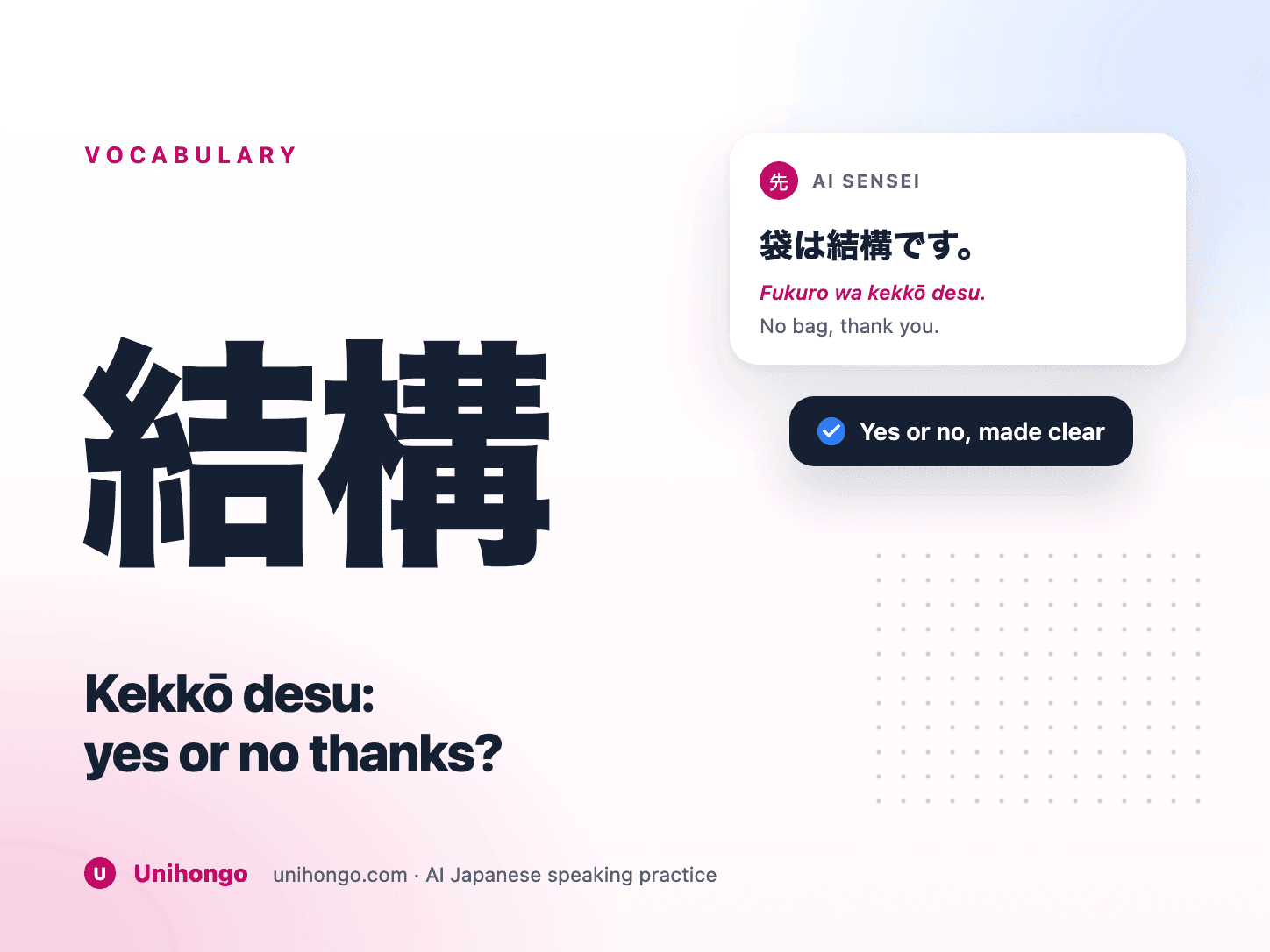
Two phrases, opposite answers
English has the same trap in a milder form. I am good can mean yes, things are good, or no, I do not need anything. Japanese leans on this pattern much more, and in everyday service exchanges it is the default way to decline.
The key is to look at the question. If someone offers you something, kekkō desu and ii desu mean you are fine without it. If someone asks whether something is acceptable, they mean it is fine, go ahead.
| Japanese | Romaji | Meaning |
|---|---|---|
| 袋はご利用ですか。 | Fukuro wa go-riyō desu ka. | Would you like a bag? |
| 袋は結構です。 | Fukuro wa kekkō desu. | No bag, thank you. |
| ここに座ってもいいですか。 | Koko ni suwatte mo ii desu ka. | May I sit here? |
| ええ、いいですよ。 | Ee, ii desu yo. | Yes, go ahead. |
| 砂糖は入れますか。 | Satō wa iremasu ka. | Do you take sugar? |
| いえ、いいです。 | Ie, ii desu. | No, I am fine. |
Kekkō desu as no thank you
Kekkō desu is the more formal of the two refusals and sounds firm without being impolite. You hear it at shops, from salespeople being politely turned away, and at the door when someone is selling something you do not want.
Its firmness is useful. A salesperson who hears ii desu may try again; kekkō desu with a small bow usually closes the topic.
| Japanese | Romaji | Meaning |
|---|---|---|
| いいえ、結構です。 | Iie, kekkō desu. | No, thank you. (firm and polite) |
| レシートは結構です。 | Reshīto wa kekkō desu. | I do not need the receipt. |
| もう結構です。 | Mō kekkō desu. | I have had enough, thank you. |
| お構いなく。 | O-kamai naku. | Please do not go to any trouble. |
| せっかくですが、結構です。 | Sekkaku desu ga, kekkō desu. | It is kind of you, but no thank you. |
Sekkaku desu ga softens the refusal by acknowledging the effort behind the offer. It is especially good when someone has gone out of their way.
Kekkō when it is not an answer
Outside yes and no, kekkō has two other everyday meanings. As a na-adjective it means fine, acceptable or even splendid in formal speech. As an adverb it means quite or considerably, and in this sense it is extremely common in casual conversation.
The adverb often carries a note of surprise: better, bigger or harder than you expected.
| Japanese | Romaji | Meaning |
|---|---|---|
| この日程で結構です。 | Kono nittei de kekkō desu. | This date is fine with me. |
| お支払いは来月で結構です。 | O-shiharai wa raigetsu de kekkō desu. | You can pay next month. |
| 結構おいしいですね。 | Kekkō oishii desu ne. | This is actually quite good. |
| 駅から結構遠かったです。 | Eki kara kekkō tōkatta desu. | It was quite far from the station. |
| 結構なお品をありがとうございます。 | Kekkō na o-shina o arigatō gozaimasu. | Thank you for such a fine gift. (formal) |
Ii desu in both directions
Ii desu follows the same logic but sounds lighter and more casual than kekkō desu. Its meaning also shifts with a small ending particle, which is where tone becomes visible in the words themselves.
Ii desu yo leans strongly towards yes, sure. Ii desu ne means that sounds good. Plain ii desu with a slight shake of the head leans towards no thanks.
| Japanese | Romaji | Meaning |
|---|---|---|
| いいですよ。 | Ii desu yo. | Sure, that is fine. |
| いいですね! | Ii desu ne! | That sounds great! |
| 大丈夫です、いいです。 | Daijōbu desu, ii desu. | I am fine, no thanks. |
| もういいです。 | Mō ii desu. | Forget it. (can sound annoyed) |
| それでいいです。 | Sore de ii desu. | That will do. |
Sore de ii desu can sound grudging, as in that will do, I suppose. Sore ga ii desu means I would like that one, which is the better choice when you are picking something you actually want.
How tone and gesture decide
Speakers disambiguate these phrases without thinking about it, mostly through the body. A refusal comes with a small wave of an open hand in front of the chest, a slight head shake or a step back. Acceptance comes with a nod and often a small bow.
When you are listening, watch the hands before you trust the words.
| What you notice | What it usually signals |
|---|---|
| A small wave of the hand in front of the chest | No thank you |
| A nod or a small bow | Yes, please |
| The phrase ends with a rising, friendly tone | Yes, go ahead |
| The phrase is short, flat and followed by silence | No, or the topic is closed |
| It follows an offer of something extra | Usually no thank you |
| It follows a question about a date, price or plan | Usually that is acceptable |
Saying it so nobody can misread you
When the answer matters, such as medication, allergies, a delivery time or a contract, do not rely on either phrase alone. Pair it with hai or iie, and name the thing you are accepting or refusing.
These versions sound natural and leave no room for doubt.
| Japanese | Romaji | Meaning |
|---|---|---|
| はい、お願いします。 | Hai, onegaishimasu. | Yes, please. |
| ぜひお願いします。 | Zehi onegaishimasu. | Yes, I would love that. |
| いいえ、袋はいりません。 | Iie, fukuro wa irimasen. | No, I do not need a bag. |
| 温めなくて大丈夫です。 | Atatamenakute daijōbu desu. | There is no need to heat it. |
| はい、その日で大丈夫です。 | Hai, sono hi de daijōbu desu. | Yes, that day works for me. |