
A job title or a field of work
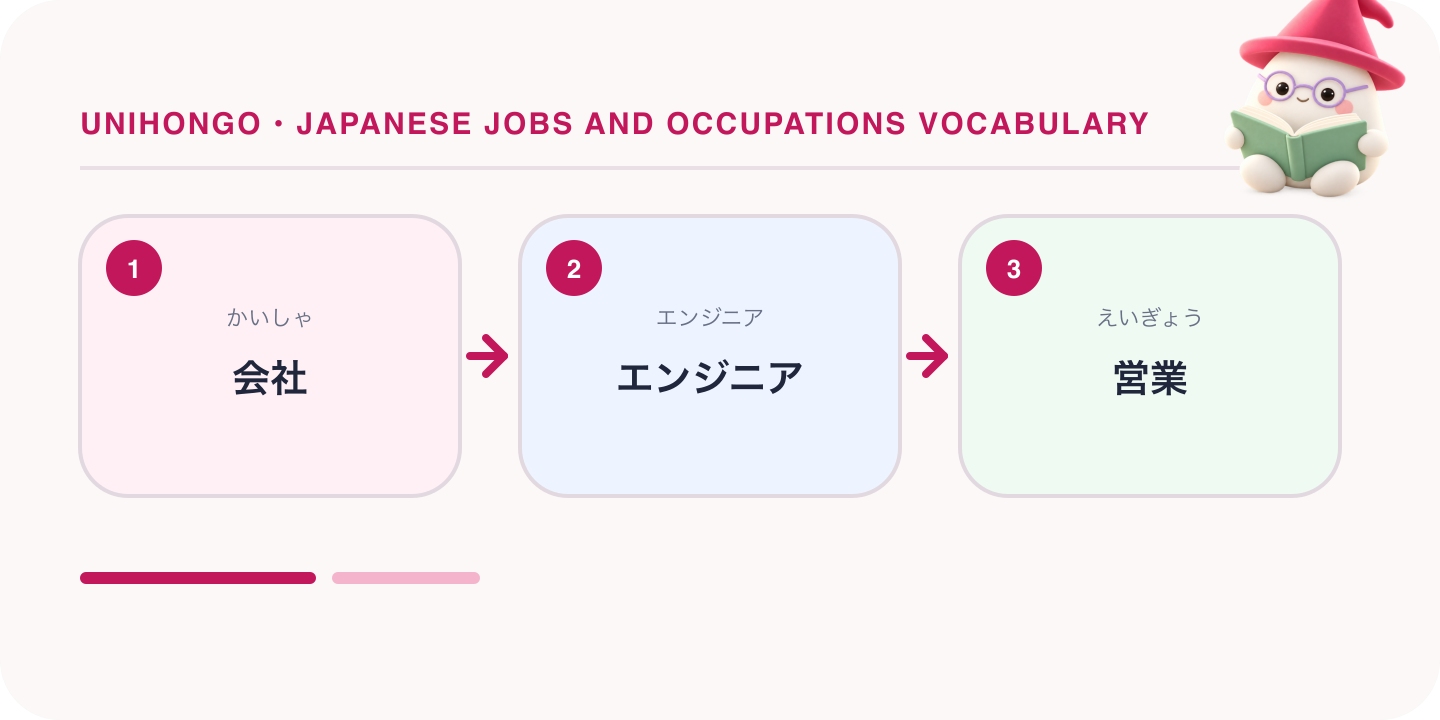
English speakers usually answer the question what do you do with a job title, and Japanese has titles too: isha, kyōshi, enjinia. But Japanese speakers just as often answer with a field or an activity, such as eigyō (sales), jimu (office work), or IT kankei no shigoto (IT-related work), and the grammar changes with the choice. A title is a noun you are, so it takes desu. A field is work you do, so it takes o shite imasu. Kaishain (company employee) sits between the two and is by far the most common first answer, even though it tells the listener almost nothing about what you actually do.
Learners often treat kaishain as evasive, but it is the normal opening move. A Japanese speaker says kaishain desu, waits for the follow-up, and only then explains the field. Copy that rhythm and your answer will sound like conversation rather than like a form being filled in.
| Japanese | Romaji | Meaning |
|---|---|---|
| 会社員です。 | Kaishain desu. | I work for a company. |
| エンジニアです。 | Enjinia desu. | I am an engineer. |
| 営業をしています。 | Eigyō o shite imasu. | I work in sales. |
| IT関係の仕事をしています。 | IT kankei no shigoto o shite imasu. | I do IT-related work. |
| 仕事は事務です。 | Shigoto wa jimu desu. | My job is office administration. |
Desu, o shite imasu, and de hataraite imasu
Three patterns cover almost every answer. Title plus desu states what you are. Field plus o shite imasu states what work you do, and the te imasu form matters because a job is an ongoing state, not a single action; eigyō o shimasu would sound like a one-off plan. Place plus de hataraite imasu says where you work, and the particle is de because working is an action that happens at the place. The slightly more formal tsutomete imasu takes ni instead, since it means being employed by an organisation rather than doing an activity there. Mixing these two particles is the most common error in the whole topic.
| Japanese | Romaji | Meaning |
|---|---|---|
| 銀行で働いています。 | Ginkō de hataraite imasu. | I work at a bank. |
| 貿易会社に勤めています。 | Bōeki-gaisha ni tsutomete imasu. | I am employed at a trading company. |
| 病院で看護師をしています。 | Byōin de kangoshi o shite imasu. | I work as a nurse at a hospital. |
| 高校で英語を教えています。 | Kōkō de eigo o oshiete imasu. | I teach English at a high school. |
Notice the third example: byōin de kangoshi o shite imasu combines a place and a title in one sentence, and it is how many people answer when they want to give both at once. The English at a hospital as a nurse is clumsy, but the Japanese is the everyday form and worth copying.
Asking about someone's work politely
The safest question is o-shigoto wa nan desu ka, with the polite o in front of shigoto because the work belongs to the listener. In real conversation people usually shorten it to o-shigoto wa? with rising intonation, letting the sentence trail off, which is softer than a full question. Shokugyō wa nan desu ka is grammatical but sounds like an official form, so keep it for paperwork. With a client or someone senior, dochira ni o-tsutome desu ka asks where they are employed without pressing for a title, and it is the version you will hear in business settings.
Once you have an answer, react before you ask the next thing. Sō desu ka, taihen sō desu ne, or omoshirosō na o-shigoto desu ne shows you were listening, and then nan-nen-me desu ka or a question about the workplace keeps the exchange going. Firing two questions in a row without a reaction is what makes a learner sound like an interviewer.
| Japanese | Romaji | Meaning |
|---|---|---|
| お仕事は何ですか? | O-shigoto wa nan desu ka? | What do you do for work? |
| お仕事は? | O-shigoto wa? | And your work is...? |
| どちらにお勤めですか? | Dochira ni o-tsutome desu ka? | Where do you work? |
| 何のお仕事をされていますか? | Nan no o-shigoto o sarete imasu ka? | What kind of work do you do? |
| 大変そうですね。 | Taihen sō desu ne. | That sounds demanding. |
| 面白そうなお仕事ですね。 | Omoshirosō na o-shigoto desu ne. | That sounds like interesting work. |
In and shain: members of an organisation
The ending 員 in means member, and it attaches to a place or organisation to name the person who works there: kaishain for a company, ginkōin for a bank, ekiin for a station, ten'in for a shop, and kōmuin for the public sector. These words describe your relationship to an institution rather than what you do all day, which is why kaishain is so common and so vague. Shain on its own means an employee of a particular company, so you hear it in seishain (full-time permanent employee) and shinnyū shain (new hire).
When you address one of these people directly, add san: ekiin-san, ten'in-san. Calling out ten'in on its own sounds like a label rather than a form of address, and learners do it more often than they realise when they are trying to get attention in a shop.
| Japanese | Romaji | Meaning |
|---|---|---|
| 駅員さんに聞いてみましょう。 | Ekiin-san ni kiite mimashō. | Let's ask the station staff. |
| すみません、店員さん。 | Sumimasen, ten'in-san. | Excuse me. (to a shop assistant) |
| 父は公務員です。 | Chichi wa kōmuin desu. | My father is a public servant. |
| 四月から正社員になりました。 | Shigatsu kara seishain ni narimashita. | I became a permanent employee in April. |
Ka, shi, sha, and nin: endings that hint at a profession
Several other endings turn up again and again, and knowing them lets you guess a new word's meaning before you have looked it up. Ka (家) tends to mark a person known for a creative or expert pursuit: sakka (writer), gaka (painter), mangaka, kenchikuka (architect). Shi (士 or 師) tends to mark a licensed or trained profession: bengoshi (lawyer), kangoshi (nurse), kaikeishi (accountant), kyōshi (teacher). Sha (者) means person and gives isha (doctor), kisha (journalist), and hon'yakusha (translator). Nin (人) also means person and appears in trade words such as ryōrinin (cook, chef).
These are tendencies, not rules; the endings were attached over centuries and do not sort neatly. The useful habit is recognising the family a word belongs to, not predicting the ending. One trap: kyōshi is what you call your own job, while sensei is what other people call you. Watashi wa sensei desu sounds self-important, and the same applies to doctors, who say isha desu but are addressed as sensei.
| Japanese | Romaji | Meaning |
|---|---|---|
| 教師です。小学校で働いています。 | Kyōshi desu. Shōgakkō de hataraite imasu. | I am a teacher. I work at a primary school. |
| 医者です。 | Isha desu. | I am a doctor. |
| 弁護士をしています。 | Bengoshi o shite imasu. | I work as a lawyer. |
| 料理人です。イタリア料理の店で働いています。 | Ryōrinin desu. Itaria ryōri no mise de hataraite imasu. | I am a chef. I work at an Italian restaurant. |
| 姉は画家で、兄は作家です。 | Ane wa gaka de, ani wa sakka desu. | My older sister is a painter and my older brother is a writer. |
Students and part-time work
Being a student is an occupation answer in Japanese, and gakusei desu is a complete reply. Add the type if you want: daigakusei (university student), kōkōsei (high-school student), ryūgakusei (international student), or the year with nensei. Part-time work is arubaito, shortened to baito in casual speech, and it is treated as an activity, so it takes o shite imasu with the workplace marked by de. Pāto is a separate word for part-time work done mainly by adults with other commitments, so a student says baito and a parent working mornings at a supermarket says pāto.
When a student is asked o-shigoto wa, the natural reply is gakusei desu, followed by the subject or the part-time job, since the asker usually wants to know how the person spends the day rather than a job title. Mentioning the subject or the workplace also gives them something to ask about next.
| Japanese | Romaji | Meaning |
|---|---|---|
| 学生です。大学で経済を勉強しています。 | Gakusei desu. Daigaku de keizai o benkyō shite imasu. | I am a student. I study economics at university. |
| 大学三年生です。 | Daigaku san-nensei desu. | I am a third-year university student. |
| コンビニでアルバイトをしています。 | Konbini de arubaito o shite imasu. | I work part-time at a convenience store. |
| 週に三日、バイトしています。 | Shū ni mikka, baito shite imasu. | I do part-time work three days a week. (casual) |
| スーパーでパートをしています。 | Sūpā de pāto o shite imasu. | I work part-time at a supermarket. |
| 今、就職活動をしています。 | Ima, shūshoku katsudō o shite imasu. | I am job hunting at the moment. |
Freelance, self-employed, and between jobs
Furīransu is the everyday word for freelance and it usually comes with a title after no: furīransu no dezainā, furīransu no hon'yakusha. Jieigyō means self-employed in a broader sense, including people who run a shop or a small business, and jieigyō desu is a perfectly complete answer. If you run the business you can also say keiei shite imasu with the type of business, which is more specific. Shufu (homemaker) works the same way, and it is a normal occupation answer, not an apology.
Being between jobs is easier to say than learners fear. Ima wa shigoto o sagashite imasu (I am looking for work right now) is neutral and common, and tenshoku shita bakari desu (I have just changed jobs) explains a recent move. The blunt word mushoku (unemployed) exists but sounds harsh about yourself, so leave it to forms.
| Japanese | Romaji | Meaning |
|---|---|---|
| フリーランスのデザイナーです。 | Furīransu no dezainā desu. | I am a freelance designer. |
| 自営業です。 | Jieigyō desu. | I am self-employed. |
| 小さいカフェを経営しています。 | Chiisai kafe o keiei shite imasu. | I run a small cafe. |
| 今は仕事を探しています。 | Ima wa shigoto o sagashite imasu. | I am looking for work at the moment. |
| 転職したばかりです。 | Tenshoku shita bakari desu. | I have just changed jobs. |
| 去年会社を辞めて、独立しました。 | Kyonen kaisha o yamete, dokuritsu shimashita. | I left my company last year and went independent. |
Describing your workplace
After the title comes the description, and this is where the conversation gets interesting. Shokuba is the workplace as a place; kaisha is the company as an organisation. Dōryō (colleagues), jōshi (boss), and buka (subordinates) are the people. Zangyō (overtime) and shutchō (business trips) are what people complain and ask about. Build sentences with wa and a simple adjective, since the shape is the same as describing anything else: shokuba wa eki kara chikai desu, dōryō wa yasashii desu. Joining a positive and a negative clause with ga makes you sound balanced rather than boastful or bitter.
| Japanese | Romaji | Meaning |
|---|---|---|
| 職場は駅から近いです。 | Shokuba wa eki kara chikai desu. | My workplace is close to the station. |
| 同僚はみんな優しいです。 | Dōryō wa minna yasashii desu. | My colleagues are all kind. |
| 残業が多いです。 | Zangyō ga ōi desu. | There is a lot of overtime. |
| 仕事は楽しいですが、忙しいです。 | Shigoto wa tanoshii desu ga, isogashii desu. | The work is enjoyable, but busy. |
| 週に二回、在宅勤務です。 | Shū ni nikai, zaitaku kinmu desu. | I work from home twice a week. |
Occupation words by field
| Field | Japanese | Romaji | English |
|---|---|---|---|
| Office | 会社員 | kaishain | company employee |
| Office | 公務員 | kōmuin | public servant |
| Office | 事務員 | jimuin | office clerk |
| Office | 営業 | eigyō | sales |
| Office | 秘書 | hisho | secretary |
| Office | 社長 | shachō | company president |
| Office | 経営者 | keieisha | business owner |
| Technology | エンジニア | enjinia | engineer |
| Technology | プログラマー | puroguramā | programmer |
| Technology | デザイナー | dezainā | designer |
| Medical | 医者 | isha | doctor |
| Medical | 看護師 | kangoshi | nurse |
| Medical | 薬剤師 | yakuzaishi | pharmacist |
| Medical | 歯医者 | haisha | dentist |
| Education | 教師 | kyōshi | teacher |
| Education | 保育士 | hoikushi | nursery teacher |
| Law and finance | 弁護士 | bengoshi | lawyer |
| Law and finance | 会計士 | kaikeishi | accountant |
| Law and finance | 銀行員 | ginkōin | bank employee |
| Service | 店員 | ten'in | shop assistant |
| Service | 駅員 | ekiin | station staff |
| Service | 美容師 | biyōshi | hairdresser |
| Service | 料理人 | ryōrinin | cook, chef |
| Service | 運転手 | untenshu | driver |
| Service | 受付 | uketsuke | receptionist |
| Creative | 作家 | sakka | writer |
| Creative | 画家 | gaka | painter |
| Creative | 漫画家 | mangaka | manga artist |
| Creative | 写真家 | shashinka | photographer |
| Creative | 音楽家 | ongakuka | musician |
| Creative | 俳優 | haiyū | actor |
| Creative | 記者 | kisha | journalist |
| Public safety and trades | 警察官 | keisatsukan | police officer |
| Public safety and trades | 消防士 | shōbōshi | firefighter |
| Public safety and trades | 農家 | nōka | farmer |
| Public safety and trades | 大工 | daiku | carpenter |
| Public safety and trades | 建築家 | kenchikuka | architect |
| Language | 通訳 | tsūyaku | interpreter |
| Language | 翻訳者 | hon'yakusha | translator |
| Status | 学生 | gakusei | student |
Most of these take desu directly. The two that do not are eigyō and jimu, which are fields rather than people, so they take o shite imasu. Notice how many rows end in in, shi, ka, and sha now that you know what to look for.
The full exchange about work
Here is the whole conversation as it usually runs between two adults meeting for the first time. The important move is the short reaction after each answer, and the turn Tanaka-san wa? which hands the question back with two words. Read both roles aloud, then swap, because the listening side (catching a job word inside a fast reply) is as much of the skill as producing your own line.
| Japanese | Romaji | Meaning |
|---|---|---|
| お仕事は何をされていますか? | O-shigoto wa nani o sarete imasu ka? | What do you do for work? |
| 会社員です。メーカーで営業をしています。 | Kaishain desu. Mēkā de eigyō o shite imasu. | I work for a company. I do sales at a manufacturer. |
| そうですか。何年目ですか? | Sō desu ka. Nan-nen-me desu ka? | I see. How many years have you been doing it? |
| 五年目です。田中さんは? | Go-nen-me desu. Tanaka-san wa? | This is my fifth year. And you, Tanaka-san? |
| 私は看護師です。 | Watashi wa kangoshi desu. | I am a nurse. |
| 大変そうですね。夜勤もありますか? | Taihen sō desu ne. Yakin mo arimasu ka? | That sounds demanding. Do you do night shifts too? |
| はい、週に一回あります。 | Hai, shū ni ikkai arimasu. | Yes, once a week. |
| お仕事、頑張ってください。 | O-shigoto, ganbatte kudasai. | Good luck with your work. |
Practising job vocabulary out loud
- Say your own job three ways: title with desu, field with o shite imasu, place with de hataraite imasu.
- Describe the jobs of five people you know, choosing between desu and o shite imasu for each.
- Read the table aloud and sort each word by its ending, saying the family name (in, shi, ka, sha, nin) after it.
- Ask o-shigoto wa? in a mirror and answer with kaishain desu plus one detail, then add one reaction line.
- Record the full exchange with yourself playing both roles, and listen for the particle after each place name.