
The core actions: dribble, pass, shoot, rebound
These four words carry most of a basketball conversation in Japanese, and they all come from English. Their pronunciation is the part to practise: doriburu has three beats where English has two, and shūto has a long vowel. Say them in the Japanese rhythm and they will be understood instantly in any gym.
Shūto is used for any attempt at the basket, not only jump shots. A jump shot is a janpu shūto, a three-pointer is a surī pointo shūto or simply surī, and a free throw is a furī surō.
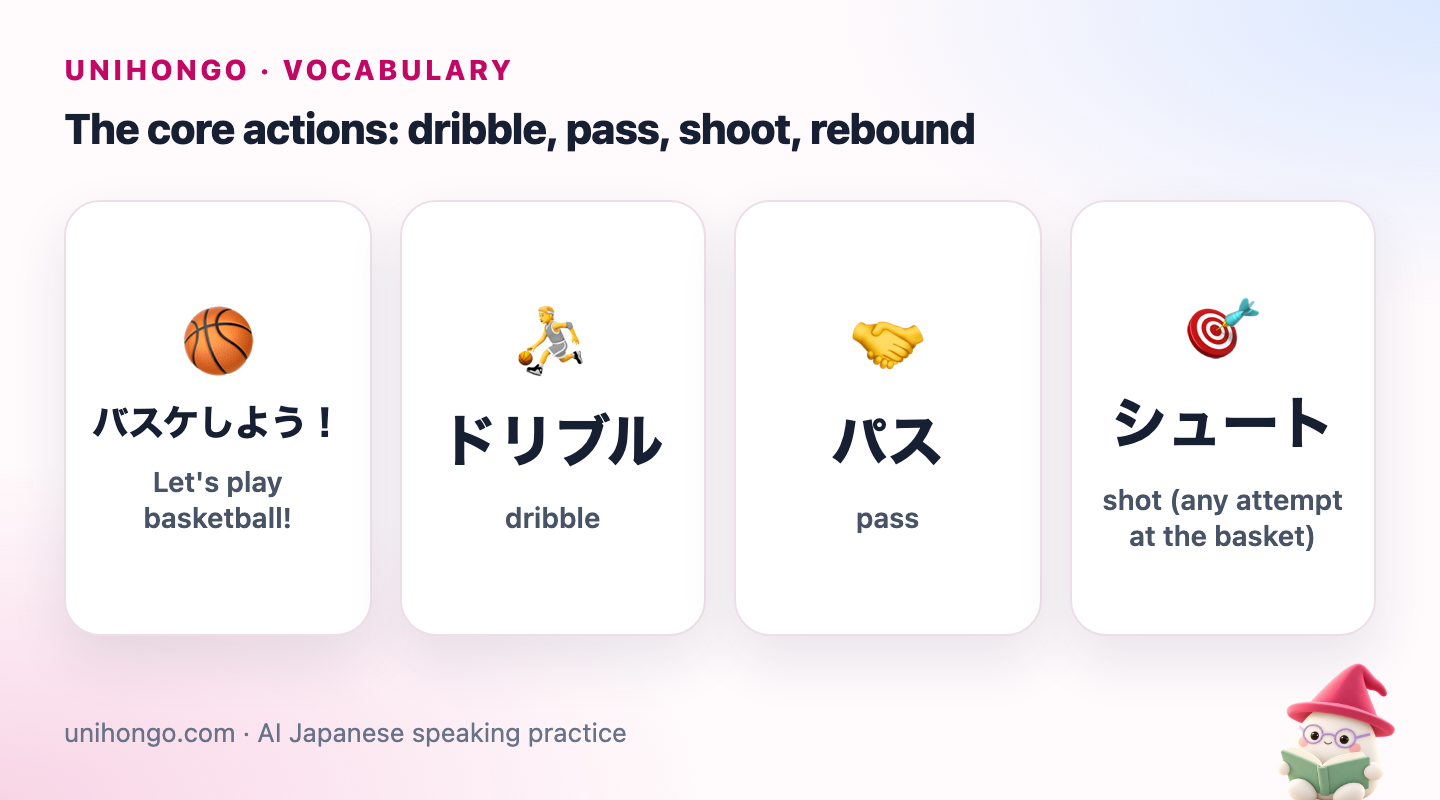
| Japanese | Romaji | Meaning |
|---|---|---|
| バスケしよう! | Basuke shiyō! | Let's play basketball! |
| ドリブル | doriburu | dribble |
| パス | pasu | pass |
| シュート | shūto | shot (any attempt at the basket) |
| リバウンド | ribaundo | rebound |
| スリー | surī | three-pointer |
| フリースロー | furī surō | free throw |
| ダンク | danku | dunk |
Verbs that make the words work
Katakana nouns become verbs with suru, but basketball Japanese also uses native verbs for many actions, and choosing the right one is what makes your sentences sound natural. The classic learner trap is the shot: you shoot it (utsu), but the ball goes in (hairu) or you miss it (hazusu). Shūto o shita is understood but sounds flat compared with shūto o utta.
| Japanese | Romaji | Meaning |
|---|---|---|
| シュートを打つ | shūto o utsu | to shoot |
| シュートが入る | shūto ga hairu | the shot goes in |
| シュートを外す | shūto o hazusu | to miss a shot |
| シュートを決める | shūto o kimeru | to make a shot (with success) |
| パスを出す | pasu o dasu | to make a pass |
| ディフェンスを抜く | difensu o nuku | to beat a defender |
| ボールを取る | bōru o toru | to get or steal the ball |
| しっかり守る | shikkari mamoru | to defend tightly |
Kimeru, to settle or decide, is the verb of finishing in Japanese sport. Kimeta! means he made it, she nailed it, and you will hear it in commentary for basketball, football and volleyball alike.
Places on the court
Court areas are mostly loanwords too, but a few are native and very common in coaching. Gōru shita, under the goal, is the area right next to the basket, and saido is the side. The three-point line is the surī pointo rain, and anything beyond it is simply soto, outside.
| Japanese | Romaji | Meaning |
|---|---|---|
| ゴール下 | gōru shita | under the basket |
| リング | ringu | the rim (often the whole hoop) |
| バックボード | bakkubōdo | backboard |
| フリースローライン | furī surō rain | free throw line |
| スリーポイントライン | surī pointo rain | three-point line |
| 外から打って! | Soto kara utte! | Shoot from outside! |
| 中に入れて! | Naka ni irete! | Get it inside! |
Coaches also talk about positions with numbers or katakana: pointo gādo, the point guard who runs the offence, is often called PG in writing but pointo gādo or simply gādo out loud. Sentā is the centre, the tallest player who works near gōru shita. In casual games nobody assigns positions, and the question is simply who guards whom.
If you watch professional games on TV, the commentator may say naka no shūto for a shot close to the basket and soto no shūto for one from distance. These simple inside and outside pairs are worth learning, because they appear in coaching, commentary and casual chat alike.
Fouls and violations
Referees in Japan use the international hand signals, so you can follow a game even without the words. Players, however, name the call out loud, often while arguing about it. Most names are English, pronounced in katakana. Note the difference between fauru, a foul involving contact, and baiorēshon, a violation such as travelling.
| Japanese | Romaji | Meaning |
|---|---|---|
| 今のファウルじゃない? | Ima no fauru ja nai? | Wasn't that a foul? (casual) |
| トラベリングだよ。 | Toraberingu da yo. | That's travelling. |
| ごめん、当たった。 | Gomen, atatta. | Sorry, I hit you. (admitting contact) |
| マイボール! | Mai bōru! | Our ball! |
| Call | Japanese | Meaning |
|---|---|---|
| Travelling | toraberingu | Moving without dribbling |
| Double dribble | daburu doriburu | Dribbling again after stopping |
| Foul | fauru | Illegal contact |
| Three seconds | san byō rūru, the three-second rule | Staying too long in the lane |
| Out of bounds | auto obu baunzu, or just auto | Ball goes off the court |
In pickup games without a referee, players usually call their own fouls. Saying gomen, atatta when you know you made contact keeps the game friendly. Mai bōru, my ball, is the common call for whose possession it is.
Defence and team calls
Talking on defence is half of team basketball, and Japanese players shout short, sharp words. Many are loanwords like suitchi (switch) and herupu (help), but two of the most important calls are native: modore!, get back, when the other team breaks, and sokkō!, fast break, when your team steals the ball.
Defence systems are named in katakana: mantsūman for man-to-man and zōn for a zone. Māku, from mark, means guarding a specific player: kare o māku shite means guard him.
| Japanese | Romaji | Meaning |
|---|---|---|
| 戻れ! | Modore! | Get back! (on defence) |
| 速攻! | Sokkō! | Fast break! |
| スイッチ! | Suitchi! | Switch! |
| ヘルプ! | Herupu! | Help! (help defence) |
| スクリーン! | Sukurīn! | Screen! (warning) |
| ナイスシュー! | Naisu shū! | Nice shot! |
| ドンマイ、次! | Donmai, tsugi! | Never mind, next one! |
Naisu shū, with the last syllable dropped, is how many Japanese players actually say nice shot in the heat of a game. Modore is the plain command form of modoru, to return; it sounds rough in daily life but is completely normal on court.
Joining a pickup game at a public court
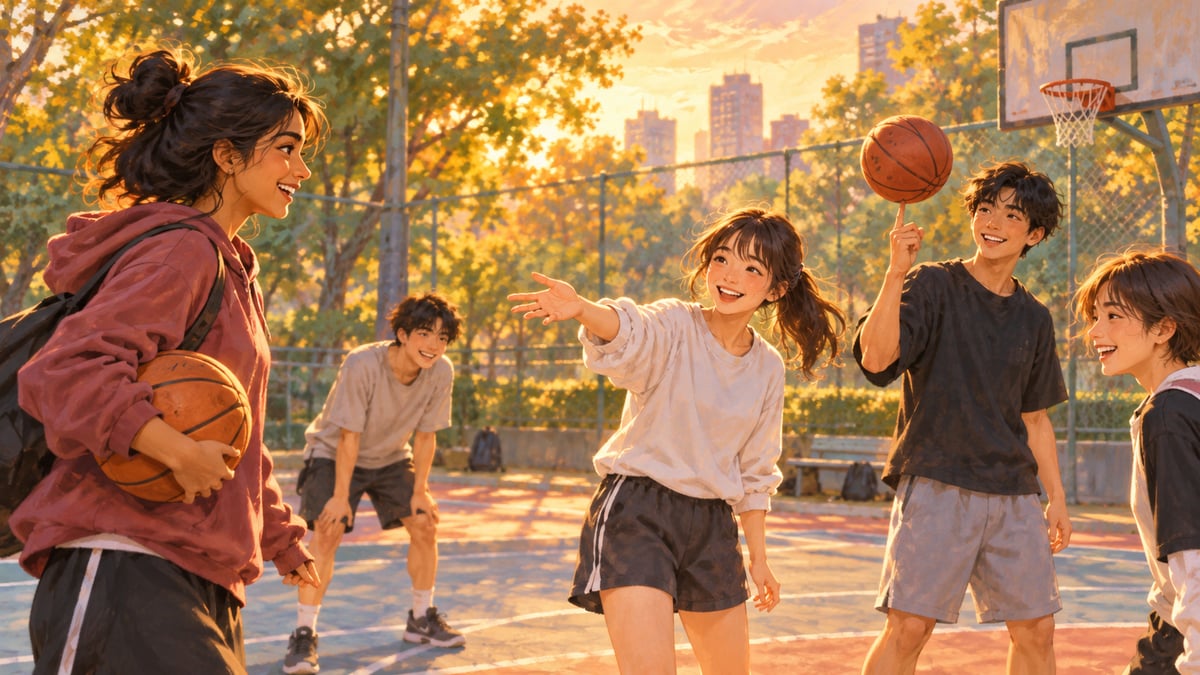
Outdoor courts in parks, and open sessions at public gyms, are where many learners first play basketball in Japan. The custom is similar to other countries: watch for a moment, walk over between games, and ask. A polite request with mazete, let me join, is the most natural way in, and once you are playing the talk becomes casual quickly.
Local rules vary from court to court: some games go to a fixed score, some to a time limit, and in many places the winning team stays on while the next group waits. Asking a short question about the rules before you start is polite and saves arguments later. If you are much taller or more experienced than the group, playing gently is appreciated, especially with students.
| Japanese | Romaji | Meaning |
|---|---|---|
| 混ぜてもらってもいいですか。 | Mazete moratte mo ii desu ka. | Do you mind if I join in? |
| 次、入ってもいいですか。 | Tsugi, haitte mo ii desu ka. | Can I play in the next game? |
| チームはどちらでもいいです。 | Chīmu wa dochira demo ii desu. | I'm fine on either team. |
| 何点までですか。 | Nanten made desu ka. | How many points do we play to? |
| 勝ったチームが残ります。 | Katta chīmu ga nokorimasu. | Player: The winning team stays on. |
| ありがとうございました、楽しかったです! | Arigatō gozaimashita, tanoshikatta desu! | Thank you, that was fun! |
Mini dialogue: after the game
| Japanese | Romaji | Meaning |
|---|---|---|
| さっきのスリー、すごかったね! | Sakki no surī, sugokatta ne! | Teammate: That three earlier was amazing! |
| ありがとう。でも、フリースローは全部外した。 | Arigatō. Demo, furī surō wa zenbu hazushita. | You: Thanks. But I missed all my free throws. |
| あるある。また来週もやる? | Aru aru. Mata raishū mo yaru? | Teammate: That happens. Playing again next week? |
| うん、土曜の夕方なら来られるよ。 | Un, doyō no yūgata nara korareru yo. | You: Yeah, I can come Saturday evening. |
Aru aru is casual for that's so typical, that happens to everyone. Yaru is a casual verb for playing a sport, very common among friends; suru is the neutral choice.
Turn the court words into a quick game
- Ask Mocchi: /vocab basketball words, the actions, court areas and calls from this post. It explains each word and notes which ones you hesitate on.
- Then ask it to /create-flashcards for the verbs, with a photo you pick for each: a ball dropping through the rim for hairu, a missed shot for hazusu.
- Play the deck in Mocchi Flight, guiding Mocchi through the gate with the right word, and review it later with /review-flashcards so the tricky verbs come back sooner.
Common learner mistakes
- Saying shūto o shita when you mean you made the shot. Use shūto ga haitta or shūto o kimeta.
- Calling the hoop basuketto. Say ringu or gōru.
- Using full polite sentences in the middle of a play. On court, one sharp word is what teammates expect.
- Shouting modore! at a stranger off the court. It is a rough command outside the game.
- Assuming sokkō is a loanword. It is native Japanese, written 速攻, and also means right away in casual speech.