
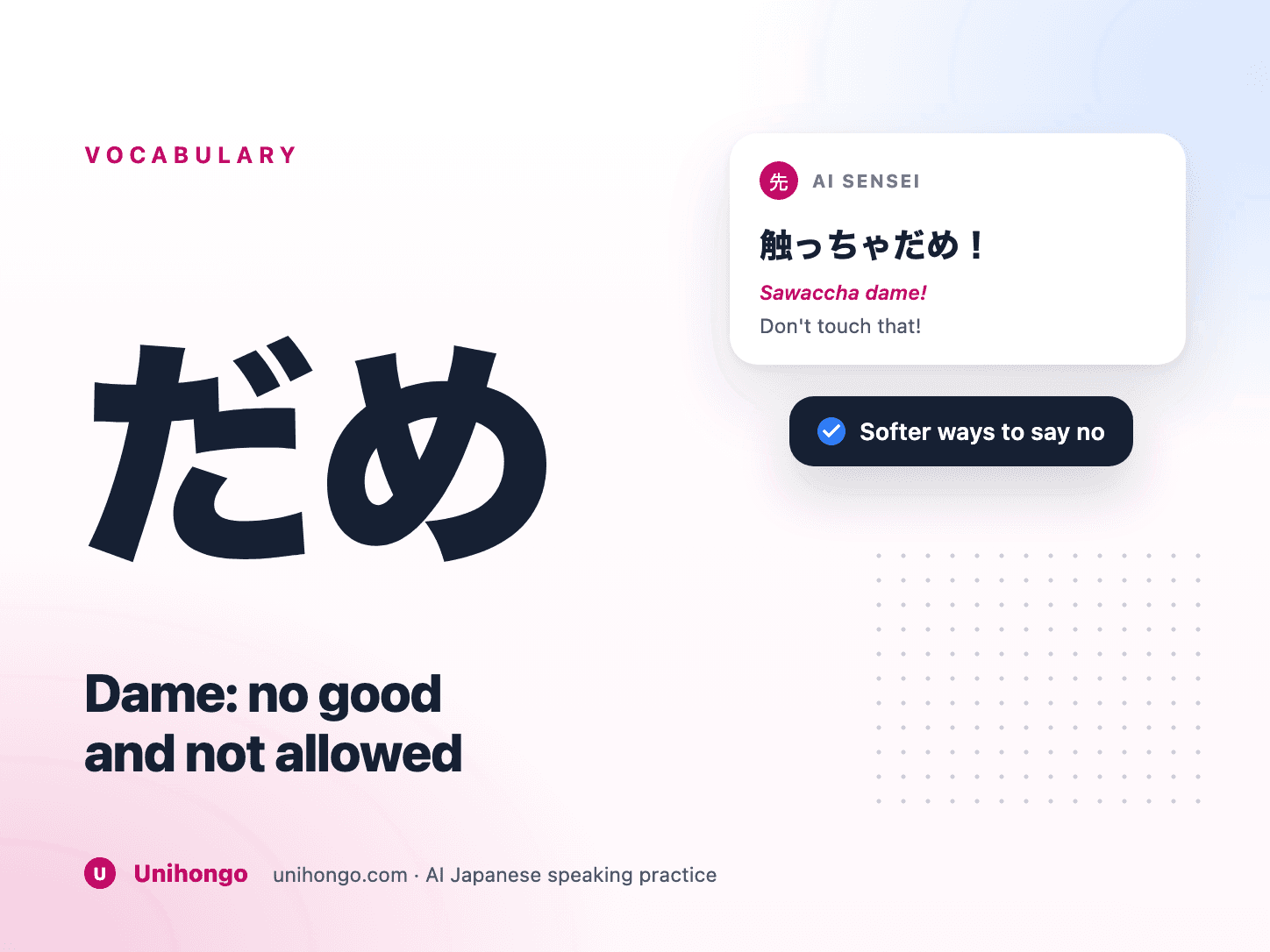
One word for no good
Dame is a na-adjective. It can end a sentence on its own, take desu for politeness, or describe a noun with na. It is written in hiragana most of the time, in katakana for emphasis on signs and in manga, and occasionally with the kanji 駄目.
Its core image is that something fails a standard: a rule, a function, an expectation. Which standard depends entirely on the situation.
| Japanese | Romaji | Meaning |
|---|---|---|
| だめ! | Dame! | No! Don't! |
| だめです。 | Dame desu. | That is not allowed. / That is no good. |
| だめだよ。 | Dame da yo. | You can't do that. (casual) |
| だめなんです。 | Dame nan desu. | It is just no good, I'm afraid. |
Dame as not allowed
The most common use is prohibition. Parents say it to children, friends say it to each other, and teachers say it in class. Built on a te form with wa or its contraction cha, it states a rule plainly.
Asking dame desu ka is a useful habit for learners, because it lets the other person refuse without having to use a strong word themselves.
| Japanese | Romaji | Meaning |
|---|---|---|
| ここで写真を撮ってはだめです。 | Koko de shashin o totte wa dame desu. | You can't take photos here. |
| 触っちゃだめ! | Sawaccha dame! | Don't touch that! (to a child) |
| これ、使ったらだめですか。 | Kore, tsukattara dame desu ka. | Would it be a problem if I used this? |
| 明日休んだらだめですか。 | Ashita yasundara dame desu ka. | Would it be all right if I took tomorrow off? |
| 一人で行っちゃだめだよ。 | Hitori de iccha dame da yo. | Don't go on your own. |
Dame as not working
Dame also describes things that do not function or plans that do not fit. A dead pen, a failed attempt, a day you cannot make: all of them are dame.
With naru, it describes something that has been spoiled or ruined.
| Japanese | Romaji | Meaning |
|---|---|---|
| このペン、だめだ。インクが出ない。 | Kono pen, dame da. Inku ga denai. | This pen is useless. The ink won't come out. |
| 明日はだめなんです。 | Ashita wa dame nan desu. | Tomorrow is no good for me. |
| 何度やってもだめです。 | Nando yatte mo dame desu. | It doesn't work no matter how many times I try. |
| 試験、だめだったよ。 | Shiken, dame datta yo. | The exam didn't go well. I failed. |
| 雨で洗濯物がだめになった。 | Ame de sentakumono ga dame ni natta. | The rain ruined the laundry. |
Dame about people
Applied to a person, dame means hopeless or useless. People say it about themselves all the time, usually lightly, after forgetting something or failing a small task.
Aimed at someone else it is a real criticism. Dame na hito, a useless person, is a phrase to understand rather than to use.
| Japanese | Romaji | Meaning |
|---|---|---|
| 私ってだめだなあ。 | Watashi tte dame da nā. | I'm hopeless, aren't I. |
| 朝はだめなんです。 | Asa wa dame nan desu. | I'm useless in the mornings. |
| 辛いものはだめなんです。 | Karai mono wa dame nan desu. | I can't handle spicy food. |
| そんなこと言っちゃだめだよ。 | Sonna koto iccha dame da yo. | You shouldn't say things like that. |
The pattern X wa dame nan desu is a gentle way to state a personal limit, such as food you cannot eat or a time you cannot manage. It explains rather than refuses.
Dame moto: nothing to lose
Dame moto is a cheerful expression built on failure. It comes from dame de motomoto, meaning it was a no from the start anyway, so trying costs nothing.
People use it before a long-shot request, a competitive application or a last-minute booking.
| Japanese | Romaji | Meaning |
|---|---|---|
| だめもとで聞いてみます。 | Damemoto de kiite mimasu. | I'll ask anyway. Nothing to lose. |
| だめもとで応募しました。 | Damemoto de ōbo shimashita. | I applied even though it's a long shot. |
| だめで元々だから、やってみよう。 | Dame de motomoto dakara, yatte miyō. | We've got nothing to lose, so let's try. |
How strong it sounds, and softer options
Dame is direct, and directness is exactly what customer-facing and business Japanese avoids. Staff rarely say dame to a customer, and a colleague refusing a request will usually hint rather than state the no.
These are the phrases that do the same job with more cushioning.
| Japanese | Romaji | Meaning |
|---|---|---|
| それはちょっと…。 | Sore wa chotto… | That's a little… (a soft no) |
| ちょっと難しいです。 | Chotto muzukashii desu. | That would be difficult. |
| ご遠慮ください。 | Go-enryo kudasai. | Please refrain. |
| 申し訳ありませんが、それはできかねます。 | Mōshiwake arimasen ga, sore wa dekikanemasu. | I'm sorry, but we are unable to do that. |
| Situation | What dame would sound like | What people usually do instead |
|---|---|---|
| A friend asks to borrow something | Normal and friendly | Use it freely |
| A customer asks for something against the rules | Blunt and unprofessional | Apologise and say it is difficult |
| A sign forbids an action | Too harsh for most signs | Ask people to refrain politely |
| A colleague proposes a date you cannot do | Abrupt | Say that day is a little difficult |
| A child reaches for something hot | Exactly right | Use it loudly and quickly |