Japanese Question Words: How to Ask Natural Questions
Question words turn memorised statements into real conversations. Learn where they sit and which particle follows, and you can ask far more than yes or no.
Japanese Question Words: How to Ask Natural Questions
Japanese question words stay in the position where the missing information belongs. Dare ga asks who as the subject, dare to asks with whom, and doko de asks where an action happens. The sentence usually keeps ordinary Japanese order and adds ka in polite speech. This guide maps the essential words, shows how particles change their role, and teaches follow-up questions that keep a conversation moving.
Put the question word where the answer would appear
The following particle tells you what kind of answer is needed
Dore stands alone while dono must modify a noun
Question word plus mo or ka creates useful forms such as nobody and someone
The essential question-word map
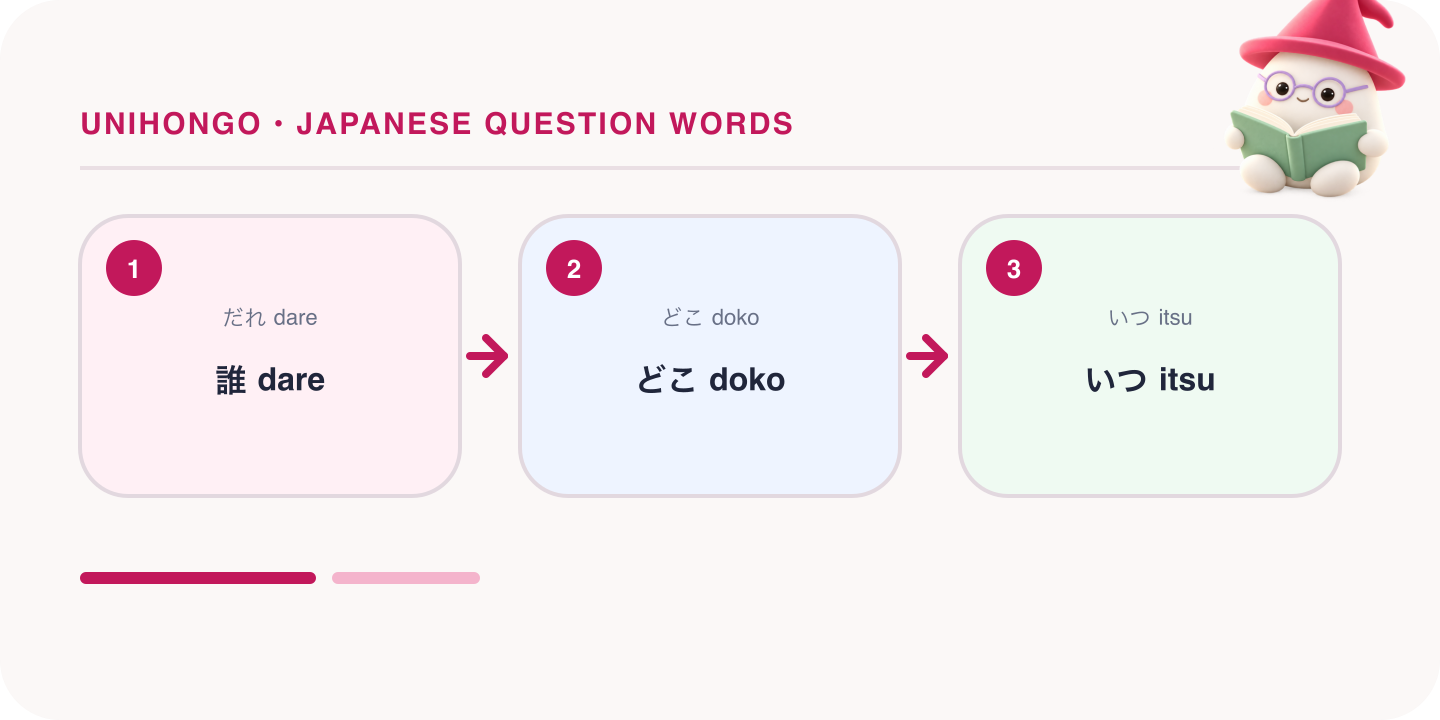
A visual learning path for Japanese Question Words: How to Ask Natural Questions, with three key Japanese study points.
Japanese
Meaning
Example cue
誰 dare
who
dare ga / dare to / dare ni
何 nani / nan
what
nani o / nan desu ka
どこ doko
where
doko de / doko ni
いつ itsu
when
itsu ikimasu ka
なぜ naze / どうして dōshite
why
dōshite desu ka
どう dō
how / what is it like
dō deshita ka
どれ dore
which one
dore desu ka
どの dono
which + noun
dono hon
いくら ikura
how much
ikura desu ka
いくつ ikutsu
how many / how old
ikutsu arimasu ka
Keep the question word in the answer slot
Japanese
Romaji
Meaning
田中さんが来ました。
Tanaka-san ga kimashita.
Tanaka came.
誰が来ましたか?
Dare ga kimashita ka?
Who came?
図書館で勉強します。
Toshokan de benkyō shimasu.
I study at the library.
どこで勉強しますか?
Doko de benkyō shimasu ka?
Where do you study?
The question is not created by moving who or where to the beginning. Replace the unknown chunk and keep its particle. This makes question building a substitution exercise rather than a new word-order rule.
Particles make one question word many
Japanese
Romaji
Meaning
誰と行きますか?
Dare to ikimasu ka?
Who will you go with?
誰に聞きましたか?
Dare ni kikimashita ka?
Who did you ask?
どこに住んでいますか?
Doko ni sunde imasu ka?
Where do you live?
どこで会いますか?
Doko de aimasu ka?
Where shall we meet?
何で行きますか?
Nan de ikimasu ka?
How / by what means will you go?
何を買いましたか?
Nani o kaimashita ka?
What did you buy?
Nani versus nan
Both are readings of 何. Nan is common before desu, counters, and words beginning with d or t: nan desu ka, nan-ji, nan-nin. Nani commonly appears before particles such as o and ga: nani o tabemasu ka. Fixed expressions must still be learned as whole phrases.
Japanese
Romaji
Meaning
何ですか?
Nan desu ka?
What is it?
何を食べますか?
Nani o tabemasu ka?
What will you eat?
何時ですか?
Nan-ji desu ka?
What time is it?
何人来ますか?
Nan-nin kimasu ka?
How many people will come?
Which one: dore, dono, and docchi
Japanese
Romaji
Meaning
どれが好きですか?
Dore ga suki desu ka?
Which one do you like?
どの映画が好きですか?
Dono eiga ga suki desu ka?
Which movie do you like?
どちらがいいですか?
Dochira ga ii desu ka?
Which would be better? (polite/neutral)
どっちがいい?
Docchi ga ii?
Which is better? (casual)
Dore stands alone, dono attaches to a noun, and dochira is a polite or neutral two-way choice that also means which direction. Docchi is its casual counterpart.
Question words with ka and mo
Pattern
Typical meaning
Example
誰か dare ka
someone
誰かいますか dare ka imasu ka
何か nani ka
something
何か食べますか nani ka tabemasu ka
どこか doko ka
somewhere
どこかに行きたい doko ka ni ikitai
誰も dare mo + negative
nobody
誰もいません dare mo imasen
何も nani mo + negative
nothing
何もありません nani mo arimasen
どこにも doko ni mo + negative
nowhere
どこにも行きません doko ni mo ikimasen
Follow-ups that create conversation
Japanese
Romaji
Meaning
どうして日本語を勉強していますか?
Dōshite nihongo o benkyō shite imasu ka?
Why are you studying Japanese?
いつから勉強していますか?
Itsu kara benkyō shite imasu ka?
Since when have you been studying?
どんな音楽が好きですか?
Donna ongaku ga suki desu ka?
What kind of music do you like?
日本はどうでしたか?
Nihon wa dō deshita ka?
How was Japan?
ほかには?
Hoka ni wa?
What else?
A good follow-up reuses one detail from the previous answer. It shows listening and makes the next question easier to form than jumping to a completely new topic.
Key points
A practical way to improve
Take one sentence such as nichiyōbi ni tomodachi to Kyōto de sushi o tabemashita. Replace one chunk at a time with itsu, dare to, doko de, and nani o. Ask Unihongo's AI teacher each version aloud in the immersive 3D classroom, then answer the teacher's follow-up questions without a script.
1
Choose one clear goal
Focus each session on a situation or skill you can actually use.
2
Practice actively
Say complete answers aloud instead of only reading or recognizing Japanese.
3
Review and repeat
Keep useful corrections and revisit the same skill until it feels natural.
FAQ
Frequently asked questions
What are the main Japanese question words?
The essentials are dare, nani or nan, doko, itsu, naze or dōshite, dō, dore, dono, ikura, and ikutsu. Particle combinations extend them further.
What is the difference between nani and nan?
They are readings of 何 selected largely by the sounds and counter pattern that follow. Nan commonly appears before d, t, and counters, as in nan desu ka and nan-ji; many other contexts use nani.
Do casual Japanese questions use ka?
Often they do not. A plain-form sentence with a question word and questioning intonation is common in casual speech. Polite questions normally keep ka.
What is the difference between dore and dono?
Dore means which one and stands by itself. Dono means which and must come directly before a noun, as in dono hon, which book.
Turn Japanese knowledge into speaking confidence
Practice with Unihongo's AI Sensei in an immersive 3D classroom, with roleplay missions, pronunciation coaching, useful feedback, and learning games that build your vocabulary while you play.