
How a Japanese recipe is laid out
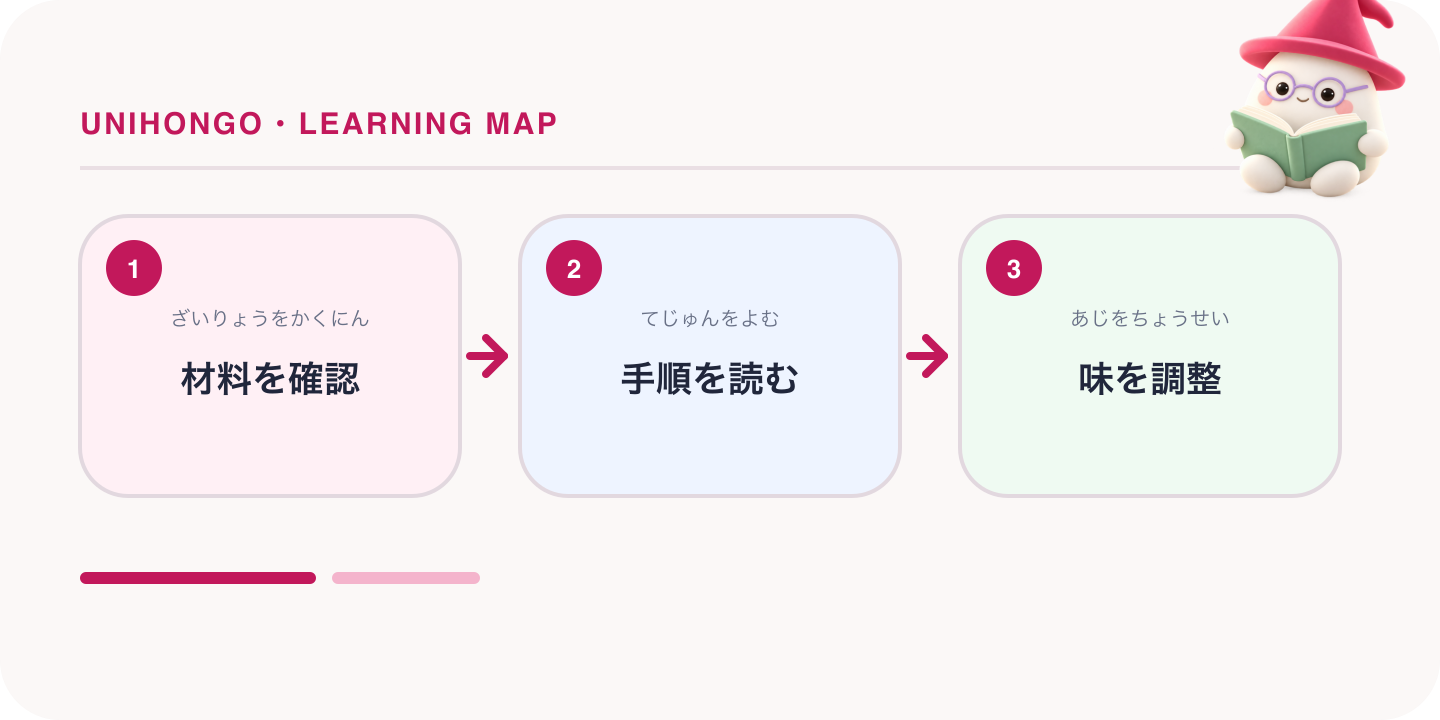
Almost every Japanese recipe has the same three blocks. First zairyō, the ingredients, with a serving note in brackets such as futari-bun for two people. Then tsukurikata or tejun, the method, written as numbered steps that each end in a plain instruction. Last comes a short finishing note about serving or storing. Anything before the ingredients is usually a comment from the writer and can be skipped while you are learning.
The steps are written in one of two styles. Recipe books and packets often use the dictionary form with a noun ending, as in tamanegi o usugiri ni suru, which reads like an instruction on a page. Spoken recipes and cooking programmes switch to polite -masu forms, as in usugiri ni shimasu, and add -te kudasai when addressing the viewer directly. Learn to read the first style and to say the second, because that is the one you will use when explaining a dish to somebody.
| Heading | Romaji | What it holds |
|---|---|---|
| 材料 | Zairyō | The ingredient list |
| 二人分 | Futari-bun | Quantities for two servings |
| 下ごしらえ | Shitagoshirae | Preparation before cooking starts |
| 作り方 | Tsukurikata | The method, in numbered steps |
| 手順 | Tejun | Steps, another common word for the method |
| 仕上げ | Shiage | The finishing touch at the end |
| ポイント | Pointo | The writer's tip for getting it right |
| 保存 | Hozon | How long it keeps and where |
Measurement words and how to say them
Japanese recipes measure by spoon, cup and gram rather than by feel, and the two spoons are abbreviated so heavily that they look like a different alphabet at first. Ōsaji is the tablespoon and kosaji the teaspoon; both are followed by a plain number, so ōsaji ni is two tablespoons. Half is written with the character for half, as in ōsaji hanbun. The cup, kappu, is a standard measuring cup and is not the mug on your shelf.
Two vague quantities appear constantly and confuse learners because they look precise. Tekiryō means as much as suits the dish, and shōshō means a very small amount, roughly a pinch, usually of salt or pepper. Neither is a mistake in the recipe: the writer is telling you to judge it. When you say these aloud, keep the number and the unit together as one chunk, ōsaji-ni, the way you would say two-tablespoons in English.
| Japanese | Romaji | Meaning |
|---|---|---|
| 材料(二人分) | Zairyō (futari-bun) | Ingredients (serves two) |
| 玉ねぎ 一個 | Tamanegi ikko | One onion |
| にんじん 一本 | Ninjin ippon | One carrot |
| じゃがいも 二個 | Jagaimo niko | Two potatoes |
| 豚肉 二百グラム | Butaniku nihyaku-guramu | 200 g of pork |
| 水 一カップ | Mizu ichi-kappu | One cup of water |
| 醤油 大さじ2 | Shōyu ōsaji ni | Two tablespoons of soy sauce |
| 砂糖 小さじ1 | Satō kosaji ichi | One teaspoon of sugar |
| 塩 少々 | Shio shōshō | A pinch of salt |
| サラダ油 適量 | Sarada-abura tekiryō | Cooking oil, as needed |
| Written | Romaji | Meaning |
|---|---|---|
| 大さじ1 | Ōsaji ichi | One tablespoon (about 15 ml) |
| 小さじ1 | Kosaji ichi | One teaspoon (about 5 ml) |
| 大さじ半分 | Ōsaji hanbun | Half a tablespoon |
| 1カップ | Ichi-kappu | One measuring cup |
| 100グラム | Hyaku-guramu | 100 grams |
| 200ミリリットル | Nihyaku-miririttoru | 200 millilitres |
| 適量 | Tekiryō | As much as suits the dish |
| 少々 | Shōshō | A very small amount, a pinch |
| ひとつまみ | Hitotsumami | A pinch held between the fingers |
| 少し | Sukoshi | A little |
| 一個 | Ikko | One item (round things such as an onion) |
| 一本 | Ippon | One long item (a carrot, a spring onion) |
| 一枚 | Ichi-mai | One flat item (a sheet of nori, a slice) |
| 一切れ | Hitokire | One cut piece (fish, cake) |
| 一束 | Hitotaba | One bunch (greens, noodles) |
| お好みで | Okonomi de | To taste, as you prefer |
Read the list itself aloud rather than scanning it, because the item comes first and the amount second, the opposite of the English habit of saying two onions: a Japanese list says tamanegi ikko, onion one-item. The gap between the item and the amount is a full-width space in the original, and on a printed card it may be a dotted line. Neither is punctuation you need to read. If a quantity is written as a fraction you will usually see it spoken as hanbun for half or yonbun no ichi for a quarter.
Cutting verbs and the shapes they make
This is the part of Japanese cooking vocabulary that has no tidy English equivalent, because the words name the finished shape rather than the knife action. Sengiri is not the act of julienning; it is the thin matchsticks you end up with. That is why the grammar looks odd at first: you say ninjin o sengiri ni shimasu, literally make the carrot into sengiri, using ni suru rather than a verb of cutting.
The pattern is worth drilling on its own, because it covers every shape word in the table below. Noun plus o, then shape plus ni shimasu. Learners who try to force kiru into the sentence produce sengiri o kirimasu, which sounds like cutting the matchsticks themselves. The plain verbs such as muku for peeling and suriorosu for grating behave normally and take a direct object.
| Japanese | Romaji | What it means |
|---|---|---|
| 切る | Kiru | To cut, the general verb |
| 薄切り | Usugiri | Thin slices |
| 千切り | Sengiri | Fine matchsticks |
| みじん切り | Mijingiri | Finely chopped, almost minced |
| 輪切り | Wagiri | Round slices across a cylinder |
| 半月切り | Hangetsugiri | Half-moons, a round slice halved |
| 乱切り | Rangiri | Rolling cut into irregular chunks |
| くし形切り | Kushigatagiri | Wedges, like comb teeth |
| 短冊切り | Tanzakugiri | Thin rectangles, like paper strips |
| ざく切り | Zakugiri | Rough, large pieces |
| 皮をむく | Kawa o muku | To peel |
| 種を取る | Tane o toru | To remove the seeds |
| すりおろす | Suriorosu | To grate finely |
| つぶす | Tsubusu | To mash or crush |
| 混ぜる | Mazeru | To mix or stir together |
| 和える | Aeru | To toss with a dressing |
| こねる | Koneru | To knead |
| 泡立てる | Awadateru | To whisk until foamy |
| 漬ける | Tsukeru | To soak or marinate |
| 水気を切る | Mizuke o kiru | To drain off the water |
Heat words, from weak flame to deep frying
Japanese recipes describe heat by strength first. Yowabi is a weak flame, chūbi a medium one and tsuyobi a strong one, with torobi for the barest simmer. The general word for the setting is hikagen, so hikagen ni ki o tsukete kudasai means watch the heat. Because these are compounds of hi, fire, they are also how you talk about an electric hob; nobody switches vocabulary for induction.
The methods then divide by what carries the heat. Yuderu is boiling in plain water, niru is simmering in seasoned liquid, and nikomu is simmering for a long time until things soften and merge. Yaku is the broadest of all and covers grilling, baking and dry pan cooking, while itameru is stir-frying in a little oil and ageru is deep frying. Musu is steaming, and taku is used for cooking rice and for certain simmered dishes.
| Japanese | Romaji | What it means |
|---|---|---|
| 弱火 | Yowabi | Low heat |
| 中火 | Chūbi | Medium heat |
| 強火 | Tsuyobi | High heat |
| とろ火 | Torobi | The lowest possible simmer |
| 火加減 | Hikagen | The heat setting |
| 火を止める | Hi o tomeru | To turn off the heat |
| ゆでる | Yuderu | To boil in water |
| 沸騰する | Futtō suru | To come to the boil |
| 煮る | Niru | To simmer in seasoned liquid |
| 煮込む | Nikomu | To simmer long and slowly |
| 煮詰める | Nitsumeru | To reduce a sauce |
| 焼く | Yaku | To grill, bake or pan-fry |
| 炒める | Itameru | To stir-fry in a little oil |
| 揚げる | Ageru | To deep-fry |
| 蒸す | Musu | To steam |
| 炊く | Taku | To cook rice |
| 温める | Atatameru | To warm through |
| 冷ます | Samasu | To let cool |
| アクを取る | Aku o toru | To skim the scum from the surface |
| 落とし蓋 | Otoshibuta | A lid dropped onto the food itself |
The seasoning order recipes assume
Japanese home cooking carries a memory aid called sashisuseso, made from the first syllable of five seasonings in the order they are commonly added: satō, shio, su, shōyu and miso. The se in the middle comes from an older spelling of shōyu, which is why the sequence looks slightly forced. The reasoning usually given is that sugar is slow to penetrate and needs to go in early, while soy sauce and miso lose their aroma if they boil hard, so they belong near the end.
You do not have to believe the chemistry to find the sequence useful, because recipes are written on the assumption that you know it. When a method says simply chōmiryō o irete nimasu, add the seasonings and simmer, it expects you to add them in that order. Practise saying the five nouns as a list, then say the two sentences that explain the reasoning, and the order will stay with you.
| Japanese | Romaji | Meaning |
|---|---|---|
| さしすせそ | Sa-shi-su-se-so | The seasoning order memory aid |
| 砂糖を先に入れます。 | Satō o saki ni iremasu. | Add the sugar first. |
| 塩は砂糖のあとです。 | Shio wa satō no ato desu. | Salt comes after the sugar. |
| 醤油は香りが飛ぶので、後から入れます。 | Shōyu wa kaori ga tobu node, ato kara iremasu. | Soy sauce loses its aroma, so it goes in later. |
| 最後に味噌を溶き入れます。 | Saigo ni miso o tokiiremasu. | Finally, dissolve the miso into the pot. |
| 味を見て、塩で調えます。 | Aji o mite, shio de totonoemasu. | Taste it and adjust with salt. |
| 味が薄いです。 | Aji ga usui desu. | The flavour is too weak. |
| 少し濃いですね。 | Sukoshi koi desu ne. | It is a little strong, isn't it. |
Note that usui and koi describe the strength of flavour, not the thickness of a sauce. A learner who says aji ga chiisai desu has translated word for word; the natural pair is usui and koi, and they are the words a Japanese cook will use when tasting your dish.
The numbered steps read aloud
Here is a complete simmered dish in the order a recipe would print it, converted into the polite forms you would actually say. Read the whole block from top to bottom in one go rather than sentence by sentence: a method is a sequence, and the connective -te forms in the middle are what make it flow as one process instead of a list of unrelated commands.
| Japanese | Romaji | Meaning |
|---|---|---|
| 玉ねぎを薄切りにします。 | Tamanegi o usugiri ni shimasu. | Slice the onion thinly. |
| にんじんを乱切りにしてください。 | Ninjin o rangiri ni shite kudasai. | Cut the carrot into rolling-cut chunks. |
| じゃがいもの皮をむいて、四つに切ります。 | Jagaimo no kawa o muite, yottsu ni kirimasu. | Peel the potatoes and cut them into four. |
| フライパンに油を熱します。 | Furaipan ni abura o nesshimasu. | Heat the oil in the frying pan. |
| 中火で五分炒めます。 | Chūbi de go-fun itamemasu. | Stir-fry over medium heat for five minutes. |
| 肉の色が変わるまで炒めてください。 | Niku no iro ga kawaru made itamete kudasai. | Fry until the meat changes colour. |
| 水を加えて、沸騰させます。 | Mizu o kuwaete, futtō sasemasu. | Add the water and bring it to the boil. |
| アクを取ります。 | Aku o torimasu. | Skim off the scum. |
| 調味料を入れて、落とし蓋をします。 | Chōmiryō o irete, otoshibuta o shimasu. | Add the seasonings and put on a drop lid. |
| 弱火で二十分煮込みます。 | Yowabi de nijuppun nikomimasu. | Simmer over low heat for twenty minutes. |
| 汁が少なくなるまで煮詰めます。 | Shiru ga sukunaku naru made nitsumemasu. | Reduce it until the liquid is nearly gone. |
| 火を止めて、粗熱を取ります。 | Hi o tomete, aranetsu o torimasu. | Turn off the heat and let it cool a little. |
| 器に盛り付けます。 | Utsuwa ni moritsukemasu. | Arrange it in a serving bowl. |
| お好みでごまをふります。 | Okonomi de goma o furimasu. | Sprinkle sesame on top if you like. |
| 出来上がりです。 | Dekiagari desu. | It is ready. |
The words printed on a packet
Supermarket packaging uses a narrow set of labels, and they are worth learning before the recipe words because they affect what you buy and how long it stays safe. The two dates are the pair that matters most: shōmi kigen is a best-before date about quality, while shōhi kigen is a use-by date on perishable food. Next to them sits hozon hōhō, the storage method, often reduced to a warning such as yō reizō.
Ready meals and part-cooked items add a short section headed o-meshiagarikata, how to serve, or atatamekata, how to heat. These are written in humble and honorific forms because the packet is addressing you as a customer, which is why the verb for eat appears as meshiagaru rather than taberu. You will only ever read these, never say them, so treat them as listening-style recognition vocabulary.
| Japanese | Romaji | Meaning |
|---|---|---|
| 賞味期限 2026年3月1日 | Shōmi kigen: nisen-nijūroku-nen san-gatsu tsuitachi | Best before 1 March 2026 |
| 消費期限 本日中 | Shōhi kigen: honjitsu-chū | Use by the end of today |
| 要冷蔵(10度以下) | Yō reizō (jū-do ika) | Keep refrigerated (10 degrees or below) |
| 直射日光を避けて保存してください。 | Chokusha nikkō o sakete hozon shite kudasai. | Store away from direct sunlight. |
| 開封後はお早めにお召し上がりください。 | Kaifūgo wa o-hayame ni o-meshiagari kudasai. | Once opened, please eat it soon. |
| 電子レンジで二分温めてください。 | Denshi renji de ni-fun atatamete kudasai. | Heat for two minutes in the microwave. |
| 原材料名をご確認ください。 | Genzairyōmei o go-kakunin kudasai. | Please check the list of ingredients. |
| 内容量 三百グラム | Naiyōryō: sanbyaku-guramu | Contents: 300 g |
Phrases you hear on cooking programmes
A Japanese cooking programme is close to ideal listening material for this vocabulary, because the presenter narrates every action as it happens and repeats the same connective phrases in every episode. The visual gives you the meaning, so you can concentrate on the sound. This is a different job from the food vocabulary you use in a restaurant, which is covered in the guide to ordering food; here the words are about producing the dish rather than choosing it.
| Japanese | Romaji | Meaning |
|---|---|---|
| 今日は肉じゃがを作ります。 | Kyō wa nikujaga o tsukurimasu. | Today we are making nikujaga. |
| 材料はこちらです。 | Zairyō wa kochira desu. | Here are the ingredients. |
| ここがポイントです。 | Koko ga pointo desu. | This is the key point. |
| 火加減に気をつけてください。 | Hikagen ni ki o tsukete kudasai. | Do watch the heat. |
| ひと煮立ちさせます。 | Hito-nitachi sasemasu. | Bring it to the boil just once. |
| あとは煮るだけです。 | Ato wa niru dake desu. | After that you only have to let it simmer. |
| とても簡単ですね。 | Totemo kantan desu ne. | It really is simple, isn't it. |
| 召し上がってみてください。 | Meshiagatte mite kudasai. | Please do try it. |
Two of these are worth stealing for your own speech. Ato wa X dake desu is a neat way to say that only one easy thing remains, in the kitchen or anywhere else. Koko ga pointo desu works whenever you want to flag the important part of an explanation to a colleague.
Talking about what you cooked
Cooking is one of the safest small-talk topics in Japanese because everybody has an opinion and nobody expects expertise. The core sentence is simple past tense with tsukurimashita, and the interesting part is what you attach to it: how it turned out, what went wrong, and whether anyone else liked it. Note that Japanese speakers routinely undersell their own cooking, so a modest comment lands better than a proud one.
| Japanese | Romaji | Meaning |
|---|---|---|
| 昨日、カレーを作りました。 | Kinō, karē o tsukurimashita. | I made curry yesterday. |
| 自分で作ってみました。 | Jibun de tsukutte mimashita. | I tried making it myself. |
| レシピ通りに作りました。 | Reshipi-dōri ni tsukurimashita. | I followed the recipe exactly. |
| 初めて作ったので、少し焦がしました。 | Hajimete tsukutta node, sukoshi kogashimashita. | It was my first time, so I burnt it slightly. |
| 味付けは醤油とみりんだけです。 | Ajitsuke wa shōyu to mirin dake desu. | The only seasoning is soy sauce and mirin. |
| 思ったより簡単でした。 | Omotta yori kantan deshita. | It was easier than I expected. |
| 家族に好評でした。 | Kazoku ni kōhyō deshita. | My family liked it. |
| 料理はあまり得意ではありません。 | Ryōri wa amari tokui de wa arimasen. | I am not very good at cooking. |
| 最近、自炊しています。 | Saikin, jisui shite imasu. | I have been cooking for myself lately. |
Asking someone how they made it
The single most useful question here is dō yatte tsukuru n desu ka, how do you make it. The n desu ending signals that you are asking about the background of something you have just seen or eaten, which is exactly the situation, and it sounds much warmer than the bare dō yatte tsukurimasu ka. If you want the recipe rather than a description, ask with tsukurikata o oshiete itadakemasu ka, a polite request that a colleague or a friend's parent will happily answer.
Expect the answer to be shorter than you hoped. Japanese cooks often reduce a whole method to one habit, such as slowly frying the onions or simmering it gently, so have a follow-up ready: a question about time, about heat, or about a substitute for an ingredient you cannot get. Those three follow-ups turn a one-line answer into a real conversation.
| Japanese | Romaji | Meaning |
|---|---|---|
| これ、どうやって作るんですか? | Kore, dō yatte tsukuru n desu ka? | How do you make this? |
| 作り方を教えていただけますか? | Tsukurikata o oshiete itadakemasu ka? | Could you tell me how to make it? |
| 何時間煮ましたか? | Nan-jikan nimashita ka? | How many hours did you simmer it for? |
| 味付けは何を使いましたか? | Ajitsuke wa nani o tsukaimashita ka? | What did you season it with? |
| 火加減はどのくらいですか? | Hikagen wa dono kurai desu ka? | How high should the heat be? |
| みりんの代わりに何を使えますか? | Mirin no kawari ni nani o tsukaemasu ka? | What can I use instead of mirin? |
| 玉ねぎをよく炒めるのがコツです。 | Tamanegi o yoku itameru no ga kotsu desu. | The trick is to fry the onions well. (their reply) |
| 弱火でゆっくり煮るだけですよ。 | Yowabi de yukkuri niru dake desu yo. | You just simmer it slowly over a low flame. (their reply) |
| 今度、作ってみます。 | Kondo, tsukutte mimasu. | I will try making it some time. |
| とてもおいしかったです。ごちそうさまでした。 | Totemo oishikatta desu. Gochisōsama deshita. | It was delicious. Thank you for the meal. |
A three-week plan for kitchen Japanese
- Week one: learn the sixteen measurement rows and read one ingredient list aloud every evening, counters included.
- Week two: add the cutting words, and say noun plus shape plus ni shimasu for every vegetable you prepare.
- Week three: add the heat words, and narrate one complete dish from heating the pan to dekiagari desu.
- Photograph one supermarket packet a day and read the two dates and the storage line before you put it away.
- Watch one short cooking clip with the sound on and no subtitles, and write down every instruction ending you catch.
- Finish each week by telling somebody, in Japanese, what you cooked and asking them how they would cook it.