
Four kinds of long word
Long Japanese words come in four flavours. Some are long in sound but tiny on paper: one kanji with a five-kana reading. Some are native verbs whose stem fills a whole breath. Some are kanji compounds, nouns bolted to nouns. And some are katakana loanwords, which grow because every consonant cluster in the source language needs extra vowels.
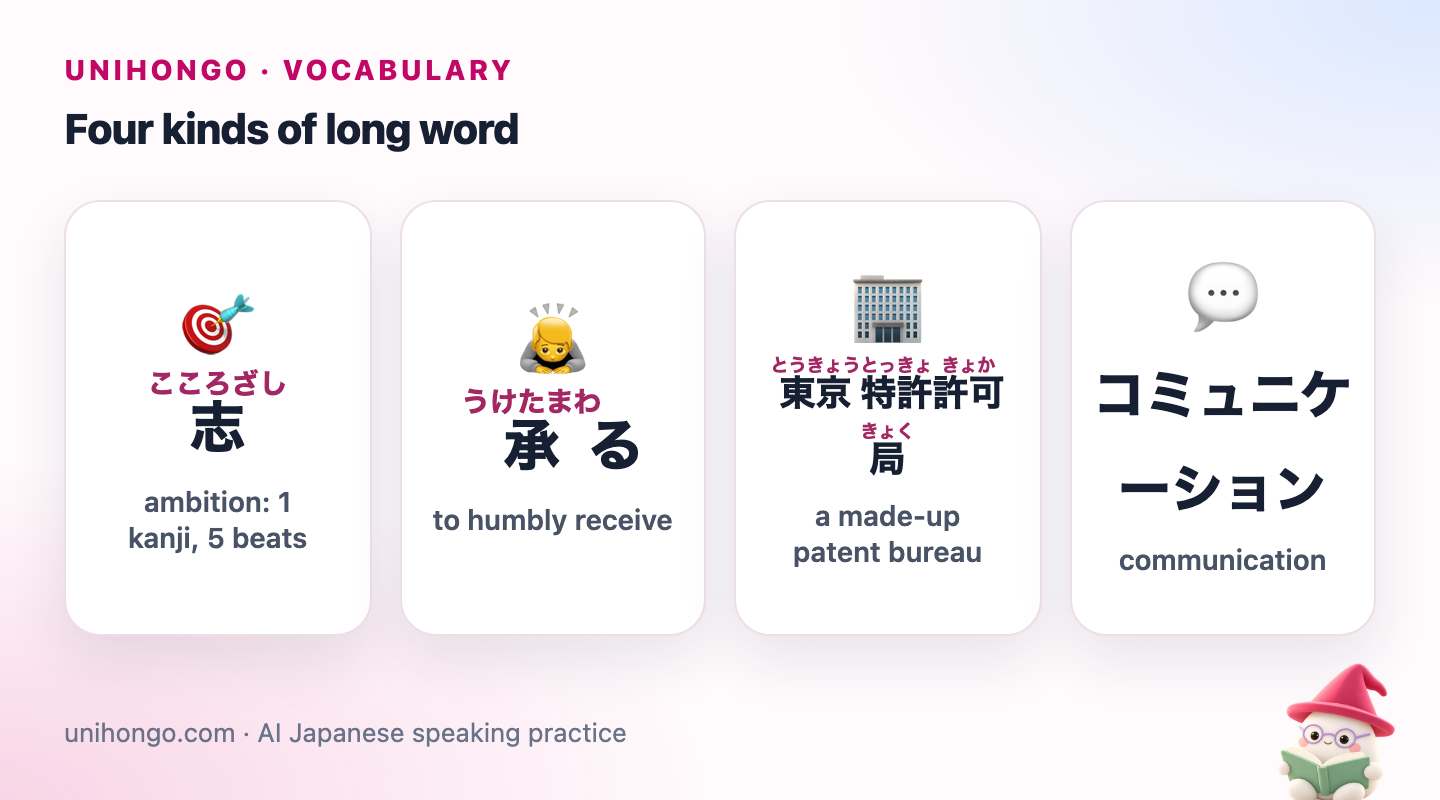
The four cards show one of each. Notice how little the written length tells you about the spoken length.
| Japanese | Romaji | Meaning |
|---|---|---|
| 志 | kokorozashi | ambition: 1 kanji, 5 beats |
| 承る | uketamawaru | to humbly receive |
| 東京特許許可局 | Tōkyō tokkyo kyokakyoku | a made-up patent bureau |
| コミュニケーション | komyunikēshon | communication |
Count mora, not letters
Romaji makes Japanese words look longer or shorter than they sound. The unit Japanese speakers feel is the mora, one beat. An ordinary kana is one mora. A small ya, yu or yo shares the beat of the kana before it, so kyo is one. A long vowel, a small tsu and n each take a beat of their own.
| Romaji | Letters | Mora |
|---|---|---|
| Tōkyō | 5 | 4 |
| kitte | 5 | 3 |
| kokorozashi | 11 | 5 |
| uketamawaru | 11 | 6 |
| komyunikēshon | 13 | 7 |
| Tōkyō tokkyo kyokakyoku | 21 | 11 |
This is the same counting used in haiku, where the famous five, seven, five are mora. It is also how a Japanese person would judge whether a word is long.
Long readings inside one kanji
Native Japanese words were matched to Chinese characters by meaning, so a long native word can sit under a single character. Kokorozashi (志), ambition or resolve, is five kana from one kanji. In uketamawaru (承る), the kanji covers うけたまわ, five kana, and only る is written out. Among the kanji taught for everyday use, five kana is about as long as a single reading gets.
Uketamawaru is not a museum piece. It is the humble verb shop and hotel staff use for taking an order, a booking or a message, so you will hear it often even if you rarely need to say it.
| Japanese | Romaji | Meaning |
|---|---|---|
| 詔 | mikotonori | imperial edict |
| 志が高い | kokorozashi ga takai | to aim high |
| ご注文を承ります。 | Go-chūmon o uketamawarimasu. | I will take your order. (humble) |
| 承りました。 | Uketamawarimashita. | Certainly, I have noted that. |
Compounds that grow, and the office that never existed
Kanji nouns join without spaces or linking words, so everyday objects get long names: a vending machine is an automatic-selling-machine, a driving licence is a driving-permission-certificate. Official names of laws and organisations can be much longer.
The best-known long compound is a fake. Tōkyō tokkyo kyokakyoku (東京特許許可局) would be the Tokyo patent licensing bureau, but no such office exists; it survives purely as a tongue twister. The real body is Tokkyochō (特許庁), the Japan Patent Office.
| Japanese | Romaji | Meaning |
|---|---|---|
| 自動販売機 | jidō hanbaiki | vending machine |
| 運転免許証 | unten menkyoshō | driving licence |
| 健康保険証 | kenkō hokenshō | health insurance card |
| 特許庁 | Tokkyochō | Japan Patent Office |
Long katakana loanwords and their clipped forms
Loanwords stretch because Japanese adds a vowel after most consonants. Strike is one syllable in English and five mora in Japanese: sutoraiku. The language answers by clipping, usually to four mora, and the clipped form quickly becomes the normal word.
| Japanese | Romaji | Meaning |
|---|---|---|
| パーソナルコンピューター | pāsonaru konpyūtā | personal computer |
| パソコン | pasokon | PC (clipped form) |
| コンビニエンスストア | konbiniensu sutoa | convenience store |
| コンビニ | konbini | convenience store (clipped) |
| スマートフォン | sumātofon | smartphone |
| スマホ | sumaho | smartphone (clipped) |
For a learner, the clipped forms are the ones to say. Asking for a konbiniensu sutoa is correct and understood, but it sounds like reading from a form.
Jugemu: the longest name in comedy
The most loved long word in Japanese is a name. In the rakugo story Jugemu (寿限無), a father asks a priest for a lucky name for his newborn son. The priest offers one auspicious phrase after another, the father cannot choose, and the boy receives all of them as a single name. The comedy comes from repetition: every time anyone calls the boy, scolds him or reports that he has fallen into trouble, the entire name must be recited, and by the time it is finished the moment has passed.
Japanese children learn the name by heart like a tongue twister. Its opening words are below; the full name runs on for many more phrases and ends with Chōsuke.
| Japanese | Romaji | Meaning |
|---|---|---|
| 寿限無、寿限無、五劫の擦り切れ | Jugemu, Jugemu, gokō no surikire | Limitless life, five aeons wearing away |
Verbs that grow by stacking endings
The longest words you will produce yourself are verbs. Japanese attaches causative, passive, wanting, negative and past endings one after another, and the result is written and felt as a single unit.
| Japanese | Romaji | Meaning |
|---|---|---|
| 食べる | taberu | to eat |
| 食べさせる | tabesaseru | to make someone eat |
| 食べさせられる | tabesaserareru | to be made to eat |
| 食べさせられたくない | tabesaseraretaku nai | not want to be made to eat |
| 食べさせられたくなかった | tabesaseraretaku nakatta | did not want to be made to eat |
The last line is twelve mora and every piece carries meaning. Read it in chunks: tabe, sase, rare, taku, nakatta.
How to say a long word without tripping
- Split it by meaning first: Tōkyō, tokkyo, kyoka, kyoku.
- Clap one beat per mora and keep the beats even.
- Build from the back: kyoku, kyokakyoku, tokkyo kyokakyoku, then the whole thing.
- Breathe before you start, not in the middle.
- If a clipped form exists, learn it too, and use it in conversation.