
Where the word comes from, and the rule that matters more
The explanation you will hear most often is that moshi moshi grew out of mōsu, a humble verb meaning to say or to tell, used in the polite form mōshimasu when you announce yourself. Repeated as mōshi mōshi and smoothed by generations of speakers, it became the two light syllables people say today. That account is widely repeated and reasonable, but it is a story about a very old word, so treat it as the usual explanation rather than proven history.
The practical point is that the word survives only in one place. Japanese kept it for the telephone and never let it spread into ordinary greeting. That is why a learner who says moshi moshi at a shop door gets a puzzled look, while the same learner saying it into a handset sounds completely natural. Learn it as a call-opening signal, not as a translation of hello, and you will place it correctly every time.
Moshi moshi is casual. Between friends, inside a family, with a delivery driver at the door of your building or with someone whose number you already know, it is the natural opener. In a workplace it is usually avoided on an outside line, because a company call is expected to identify the company in the first breath. Many offices also treat moshi moshi as a filler that delays the useful information the caller is waiting for.
There is one grey area worth knowing. Inside a company, on an internal extension between colleagues, moshi moshi is often heard and rarely criticised. The line to remember is simple: outside line, name the company; inside line or private phone, moshi moshi is fine. If you are unsure which you are on, the company name is never the wrong choice.
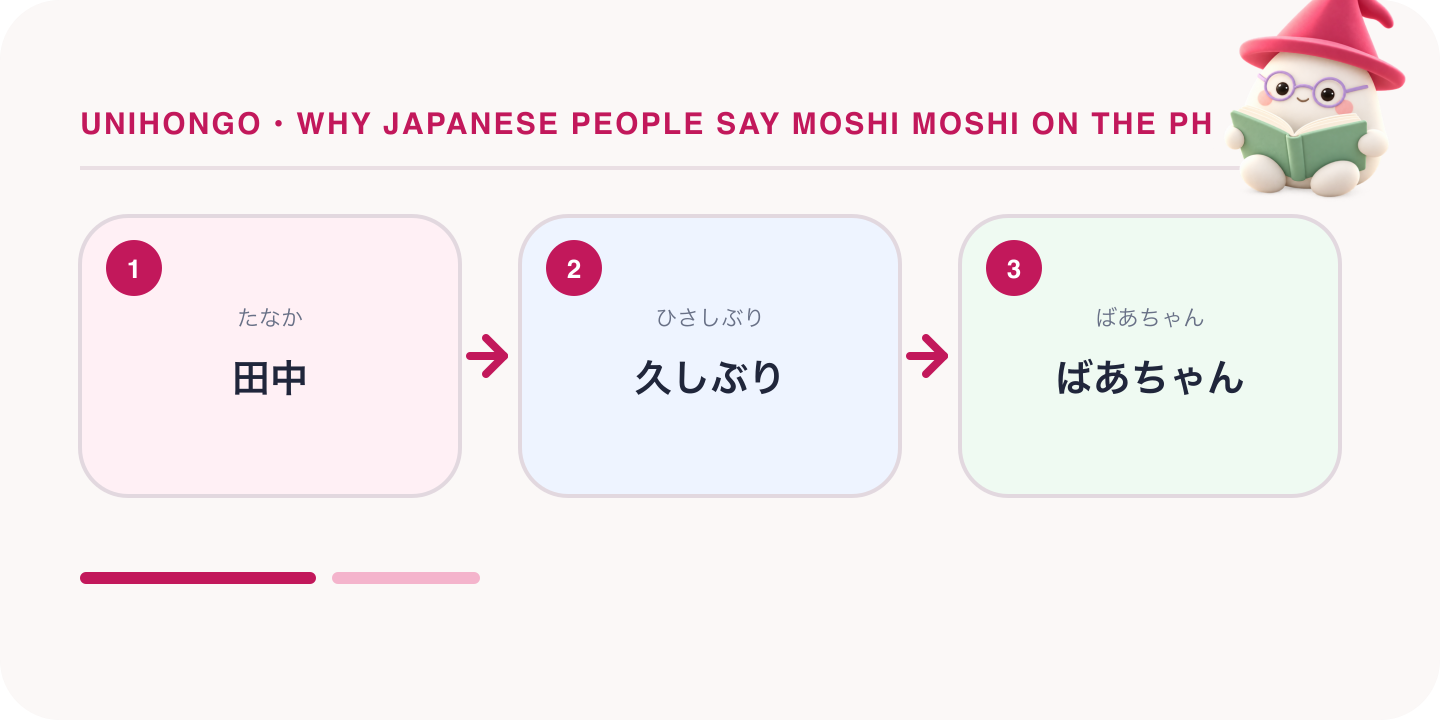
Which opening belongs to which call
| Call situation | Opening to use | Register |
|---|---|---|
| Friend or family rings you | もしもし、〇〇です。 Moshi moshi, [name] desu. | Casual |
| You ring a friend | もしもし、〇〇だけど。 Moshi moshi, [name] da kedo. | Casual |
| Unknown number rings you | はい、〇〇です。 Hai, [surname] desu. | Neutral, guarded |
| Outside call to your company | お電話ありがとうございます。 O-denwa arigatō gozaimasu. | Formal |
| Internal extension | はい、営業部です。 Hai, eigyōbu desu. | Polite |
| You ring a client | いつもお世話になっております。 Itsumo osewa ni natte orimasu. | Formal |
| You ring a stranger's office | 突然のお電話失礼いたします。 Totsuzen no o-denwa shitsurei itashimasu. | Very formal |
| Line has gone silent | もしもし?もしもし? Moshi moshi? Moshi moshi? | Any |
| Ringing back after a drop | 先ほどは失礼いたしました。 Sakihodo wa shitsurei itashimashita. | Formal |
Read the table as a set of slots rather than a set of sentences. The first slot is either moshi moshi or a greeting, the second is who you are, and the third is what you want. Formal Japanese fills the first two slots more heavily and the casual version almost skips them.
Answering a personal call
On a private phone, the answer is short. Many people say only moshi moshi, and add their surname if the caller might not have their number saved. Notice that the caller usually names themselves immediately afterwards, because Japanese phone habit puts identification early rather than making the other person guess.
| Japanese | Romaji | Meaning |
|---|---|---|
| もしもし。 | Moshi moshi. | Hello. (answering) |
| もしもし、田中です。 | Moshi moshi, Tanaka desu. | Hello, this is Tanaka. |
| あ、もしもし、久しぶり。 | A, moshi moshi, hisashiburi. | Oh, hello, it has been a while. (casual) |
| もしもし、おばあちゃん? | Moshi moshi, obāchan? | Hello, Grandma? (casual) |
| うん、聞こえるよ。 | Un, kikoeru yo. | Yes, I can hear you. (casual reply) |
| 今、大丈夫? | Ima, daijōbu? | Is now all right? (casual) |
| ごめん、今ちょっと電話できない。 | Gomen, ima chotto denwa dekinai. | Sorry, I cannot talk right now. (casual) |
| 後でこっちからかけるね。 | Ato de kotchi kara kakeru ne. | I will ring you back later. (casual) |
Answering a business call without moshi moshi
A company phone is answered with thanks, then the company name, then usually your own. Many offices ask staff to pick up within a few rings and to apologise if they were slower, which is why the o-matase itashimashita line exists. If the caller is a regular contact, the exchange of osewa ni natte orimasu happens in both directions before any business is discussed, and it is a set greeting rather than a real statement about care received.
| Japanese | Romaji | Meaning |
|---|---|---|
| お電話ありがとうございます。株式会社さくらでございます。 | O-denwa arigatō gozaimasu. Kabushiki-gaisha Sakura de gozaimasu. | Thank you for calling. This is Sakura Ltd. |
| はい、営業部の田中でございます。 | Hai, eigyōbu no Tanaka de gozaimasu. | Yes, this is Tanaka in the sales department. |
| お待たせいたしました。 | O-matase itashimashita. | Sorry to have kept you waiting. |
| いつもお世話になっております。 | Itsumo osewa ni natte orimasu. | Thank you for your continued support. (set greeting) |
| ABC商事の山田と申します。 | Ēbīshī shōji no Yamada to mōshimasu. | This is Yamada from ABC Trading. |
| 鈴木様はいらっしゃいますか。 | Suzuki-sama wa irasshaimasu ka? | Is Mr Suzuki available? |
| 少々お待ちください。 | Shōshō o-machi kudasai. | One moment, please. |
| 鈴木はただいま席を外しております。 | Suzuki wa tadaima seki o hazushite orimasu. | Suzuki is away from his desk at the moment. |
| 折り返しお電話いたしましょうか。 | Orikaeshi o-denwa itashimashō ka? | Shall we call you back? |
| ご伝言を承ります。 | Go-dengon o uketamawarimasu. | I can take a message. |
The mistake to avoid is mixing registers inside one sentence. Moshi moshi followed by de gozaimasu sounds like two different people talking. Choose the casual opener or the formal one and keep the rest of the call at that level.
Making the call: what the caller says first
When you are the one ringing, you carry more of the greeting work. Introduce yourself before asking for anything, and check that the moment is convenient. Ima o-denwa daijōbu deshō ka is one of the most useful sentences in spoken Japanese, because it gives the other person an easy way to say not now without seeming rude.
| Japanese | Romaji | Meaning |
|---|---|---|
| お世話になっております。田中と申します。 | Osewa ni natte orimasu. Tanaka to mōshimasu. | Hello, this is Tanaka speaking. |
| 今、お電話大丈夫でしょうか。 | Ima, o-denwa daijōbu deshō ka? | Is now a good time to talk? |
| 少々お時間よろしいでしょうか。 | Shōshō o-jikan yoroshii deshō ka? | Do you have a moment? |
| はい、大丈夫です。どうぞ。 | Hai, daijōbu desu. Dōzo. | Yes, that is fine. Go ahead. (their reply) |
| すみません、今は少し立て込んでおりまして。 | Sumimasen, ima wa sukoshi tatekonde orimashite. | Sorry, I am rather tied up right now. (their reply) |
| では、後ほど改めてお電話いたします。 | De wa, nochihodo aratamete o-denwa itashimasu. | Then I will call again later. |
| 何時ごろがご都合よろしいですか。 | Nan-ji goro ga go-tsugō yoroshii desu ka? | About what time would suit you? |
| 突然のお電話失礼いたします。 | Totsuzen no o-denwa shitsurei itashimasu. | Forgive the unexpected call. |
When the line is bad
Japanese reports a bad connection indirectly. O-denwa ga tōi yō desu says the phone seems far away, which quietly avoids saying that the other person is hard to hear or that their signal is poor. Follow it with a request for repetition rather than a complaint. Between friends the same idea comes out as denpa ga warui, and hanging up to redial is treated as normal problem solving rather than rudeness.
| Japanese | Romaji | Meaning |
|---|---|---|
| 恐れ入りますが、お電話が少し遠いようです。 | Osoreirimasu ga, o-denwa ga sukoshi tōi yō desu. | I am sorry, but the line seems rather faint. |
| もう一度おっしゃっていただけますか。 | Mō ichido osshatte itadakemasu ka? | Could you say that once more? |
| もう少し大きな声でお願いできますか。 | Mō sukoshi ōkina koe de o-negai dekimasu ka? | Could I ask you to speak a little louder? |
| 電波が悪いみたいです。 | Denpa ga warui mitai desu. | The signal seems bad. |
| 一度切って、かけ直します。 | Ichido kitte, kakenaoshimasu. | I will hang up and ring you back. |
| 先ほどは電話が切れてしまい、失礼いたしました。 | Sakihodo wa denwa ga kirete shimai, shitsurei itashimashita. | Sorry, the call cut out earlier. |
| ゆっくり話していただけると助かります。 | Yukkuri hanashite itadakeru to tasukarimasu. | It would help if you could speak slowly. |
Checking that the other person can hear you
This is where the second moshi moshi earns its keep. If the line goes quiet, Japanese speakers repeat the word with a rising question tone, usually twice, and wait. It is not a greeting the second time; it is a ping. If nothing comes back, people either wait a beat and try once more, or say kikoemasu ka and then hang up to redial. In a formal call, the same test is done with the polite line rather than the word itself.
| Japanese | Romaji | Meaning |
|---|---|---|
| もしもし?もしもし? | Moshi moshi? Moshi moshi? | Hello? Are you still there? |
| 聞こえますか。 | Kikoemasu ka? | Can you hear me? |
| はい、聞こえています。 | Hai, kikoete imasu. | Yes, I can hear you. |
| すみません、聞こえていますでしょうか。 | Sumimasen, kikoete imasu deshō ka? | Excuse me, can you hear me? (formal) |
| 声が途切れています。 | Koe ga togirete imasu. | Your voice keeps breaking up. |
| 今、聞こえなくなりました。 | Ima, kikoenaku narimashita. | I lost you just then. |
| こちらの声、届いていますか。 | Kochira no koe, todoite imasu ka? | Is my voice getting through? |
Calls from numbers you do not know
Many people answer an unfamiliar number with a bare hai rather than their name, and wait for the caller to identify themselves. That is a sensible habit for a learner too, because it keeps your details private until you know who is on the line. Dochira-sama deshō ka is the polite way to ask who is calling, and it is softer than the flat dare desu ka, which can sound sharp on the phone.
| Japanese | Romaji | Meaning |
|---|---|---|
| はい、もしもし。 | Hai, moshi moshi. | Hello? (guarded) |
| 失礼ですが、どちら様でしょうか。 | Shitsurei desu ga, dochira-sama deshō ka? | Sorry, may I ask who is calling? |
| どちらの会社の方でしょうか。 | Dochira no kaisha no kata deshō ka? | Which company are you calling from? |
| ご用件をお伺いできますか。 | Go-yōken o o-ukagai dekimasu ka? | May I ask what this is regarding? |
| 申し訳ありませんが、間違い電話だと思います。 | Mōshiwake arimasen ga, machigai denwa da to omoimasu. | Sorry, I think you have the wrong number. |
| 結構です。失礼します。 | Kekkō desu. Shitsurei shimasu. | No thank you. Goodbye. |
| 日本語がまだ上手ではないので、ゆっくりお願いします。 | Nihongo ga mada jōzu de wa nai node, yukkuri o-negai shimasu. | My Japanese is still not good, so please speak slowly. |
Ending the call
Japanese calls close with shitsurei shimasu, literally I am being rude, which works as a spoken sign-off in the way goodbye does in English. Sayōnara is rare on the phone and sounds oddly final. There is also a soft convention that the caller hangs up first, and that a junior person waits for a senior one; if in doubt, say your closing line and pause rather than cutting the line immediately.
| Japanese | Romaji | Meaning |
|---|---|---|
| では、失礼します。 | De wa, shitsurei shimasu. | Right, goodbye then. |
| 失礼いたします。 | Shitsurei itashimasu. | Goodbye. (formal) |
| お忙しいところありがとうございました。 | O-isogashii tokoro arigatō gozaimashita. | Thank you for your time when you are busy. |
| よろしくお願いいたします。 | Yoroshiku o-negai itashimasu. | I look forward to your help. |
| また連絡します。 | Mata renraku shimasu. | I will be in touch again. |
| じゃあ、またね。 | Jā, mata ne. | See you then. (casual) |
| おやすみなさい。 | Oyasuminasai. | Good night. |
For the body of a call, where you take a message, spell a name or repeat a number back, the dedicated phone call post walks through the whole conversation; this one stays on the greeting layer that surrounds it.
Ringing or messaging: which is expected
Among friends and younger colleagues in Japan, messaging is often the default and a sudden voice call can feel intrusive, so people frequently send a short message asking whether they may ring. At work the reverse can be true: an urgent problem, an apology or anything needing a decision today is usually phoned, and sending only a message can look like avoidance. Practice varies by company and generation, so watch what the people around you do and copy it.
| Japanese | Romaji | Meaning |
|---|---|---|
| 今から電話してもいい? | Ima kara denwa shite mo ii? | Is it all right if I call you now? (casual) |
| メールでもよろしいでしょうか。 | Mēru demo yoroshii deshō ka? | Would an email be acceptable instead? |
| お電話でご相談したいことがあります。 | O-denwa de go-sōdan shitai koto ga arimasu. | There is something I would like to discuss by phone. |
| 留守番電話にメッセージを残しました。 | Rusuban denwa ni messēji o nokoshimashita. | I left a message on your voicemail. |
| 先ほどお電話をいただいたようですが。 | Sakihodo o-denwa o itadaita yō desu ga. | I believe you called me a moment ago. |
| 出られなくてすみません。 | Derarenakute sumimasen. | Sorry I could not pick up. |
- Send denwa shite mo ii before ringing a friend outside working hours.
- Phone rather than message when you are late, cancelling, or apologising at work.
- Leave a short voicemail with your name, your company and one sentence of reason.
- Follow a decision made by phone with a written message so both sides have a record.
- Ring back promptly after a missed call from a colleague; silence reads as ignoring it.
Mistakes learners make with moshi moshi
- Using it as a general hello in shops, offices or doorways, where a greeting is expected instead.
- Opening an outside business call with it rather than the company name.
- Following it with de gozaimasu, which mixes a casual opener with formal speech.
- Saying it with heavy stress on the first syllable rather than four even light beats.
- Repeating it every few sentences as a filler, when its job is limited to opening and to testing a silent line.
- Closing a call with sayōnara instead of shitsurei shimasu.