
Keshō, meiku and suppin
Japanese has two everyday words for makeup. 化粧 (keshō) is the standard word, used on product labels and by all ages; with the polite お, okeshō, it sounds soft and a little old-fashioned. メイク (meiku) is the casual word you hear among friends, in magazines and in online tutorials. Both are used with する: keshō o suru, meiku suru.
The opposite of makeup has its own word: すっぴん (suppin), a bare face. It is casual and very common when people talk about themselves, but think twice before using it about someone else.
| Japanese | Romaji | Meaning |
|---|---|---|
| メイク、かわいい! | Meiku, kawaii! | Your makeup looks cute! (casual compliment) |
| 化粧 | keshō | makeup (standard word) |
| メイク | meiku | makeup (casual, modern) |
| 化粧品 | keshōhin | cosmetics, beauty products |
| コスメ | kosume | cosmetics (trendy word) |
| すっぴん | suppin | bare face, no makeup |
| 今日はすっぴんです。 | Kyō wa suppin desu. | I'm not wearing makeup today. |
Four items in most makeup bags
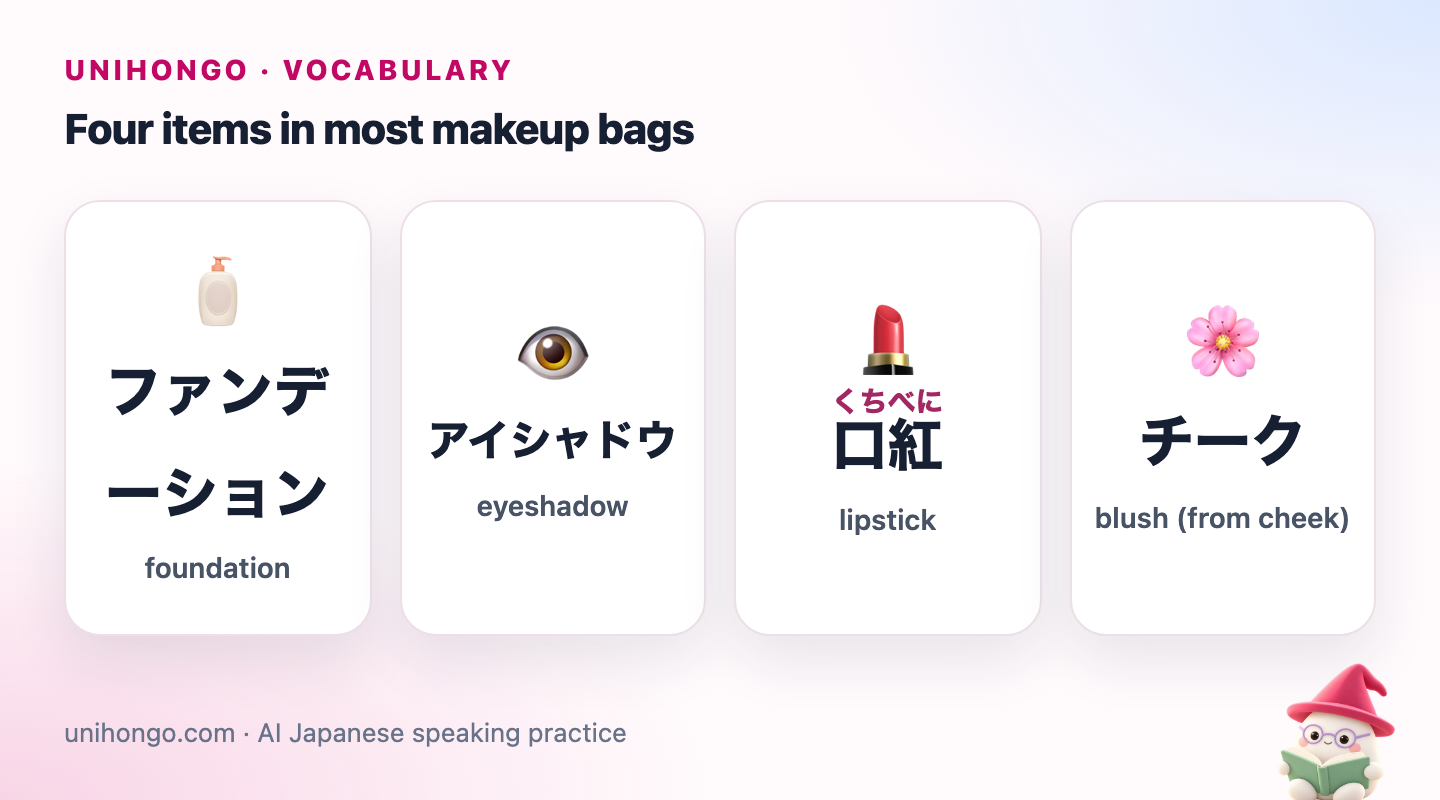
These four cover the face from base to lips. Notice that three are katakana loanwords and one, lipstick, is a native word.
| Japanese | Romaji | Meaning |
|---|---|---|
| ファンデーション | fandēshon | foundation |
| アイシャドウ | aishadō | eyeshadow |
| 口紅 | kuchibeni | lipstick |
| チーク | chīku | blush (from cheek) |
| ファンデ | fande | foundation (short, casual) |
| メイクポーチ | meiku pōchi | makeup bag |
チーク comes from the English cheek, but in Japanese it means the product, blush, not the body part. The cheek itself is 頬 (hoo) or ほっぺ (hoppe) casually. Shortened loanwords such as ファンデ are very common in casual talk and in reviews.
Base makeup and the verb nuru
Base makeup is ベースメイク (bēsu meiku). In Japan, sunscreen and a primer are often part of the base, and many products combine two or three steps. The main verb is 塗る (nuru), to spread or apply, used for anything you spread on the skin.
| Japanese | Romaji | Meaning |
|---|---|---|
| 日焼け止め | hiyakedome | sunscreen |
| 化粧下地 | keshō shitaji | makeup primer |
| コンシーラー | konshīrā | concealer |
| パウダー | paudā | powder |
| 塗る | nuru | to apply, to spread on |
| ファンデを薄く塗ります。 | Fande o usuku nurimasu. | I apply a thin layer of foundation. |
| 肌に合わない | hada ni awanai | doesn't suit my skin, irritates it |
Usuku, thinly, and atsuku, thickly, are the words for how much you apply. Many Japanese beauty magazines praise a light, natural base, ナチュラルメイク (nachuraru meiku), but styles vary a lot from person to person and trend to trend.
Sunscreen deserves a special mention. Many people in Japan wear it every day, not only at the beach, and products are often sold by how well they hold up against sweat and water: 汗に強い (ase ni tsuyoi), sweat-resistant, and ウォータープルーフ (wōtāpurūfu), waterproof. You will see both words on mascara and eyeliner too.
Eyes and eyebrows: hiku, kaku and tsukeru
Eye makeup has the widest range of verbs. A line is drawn with 引く (hiku), the verb for drawing a line. Eyebrows are drawn with 描く (kaku), to draw a picture. Mascara and false lashes are put on with つける (tsukeru), to attach. Eyeshadow is often placed with のせる (noseru), to put on top, and blended with ぼかす (bokasu).
| Japanese | Romaji | Meaning |
|---|---|---|
| アイライナー | airainā | eyeliner (the product) |
| アイラインを引く | airain o hiku | to draw eyeliner |
| マスカラをつける | masukara o tsukeru | to put on mascara |
| つけまつげ | tsukematsuge | false eyelashes |
| 眉毛を描く | mayuge o kaku | to draw in your eyebrows |
| アイシャドウをのせる | aishadō o noseru | to put on eyeshadow |
| ぼかす | bokasu | to blend, to soften edges |
| まつげ | matsuge | eyelashes |
Lips, cheeks and finishing touches
| Japanese | Romaji | Meaning |
|---|---|---|
| リップ | rippu | lip product, lipstick (casual) |
| グロス | gurosu | lip gloss |
| 口紅を塗る | kuchibeni o nuru | to put on lipstick |
| ハイライト | hairaito | highlighter |
| 化粧直し | keshōnaoshi | touching up your makeup |
| 化粧を落とす | keshō o otosu | to take off your makeup |
| クレンジング | kurenjingu | makeup remover, cleansing oil |
| ちょっと化粧直ししてくるね。 | Chotto keshōnaoshi shite kuru ne. | I'm just going to touch up my makeup. (casual) |
Rippu is the everyday word for any lip product, while kuchibeni sounds a little more classic. Keshōnaoshi is also a polite way to excuse yourself to the bathroom in some situations. Restaurants and department stores sometimes have a パウダールーム (paudā rūmu), a powder room with mirrors, next to the toilets.
At a beauty counter
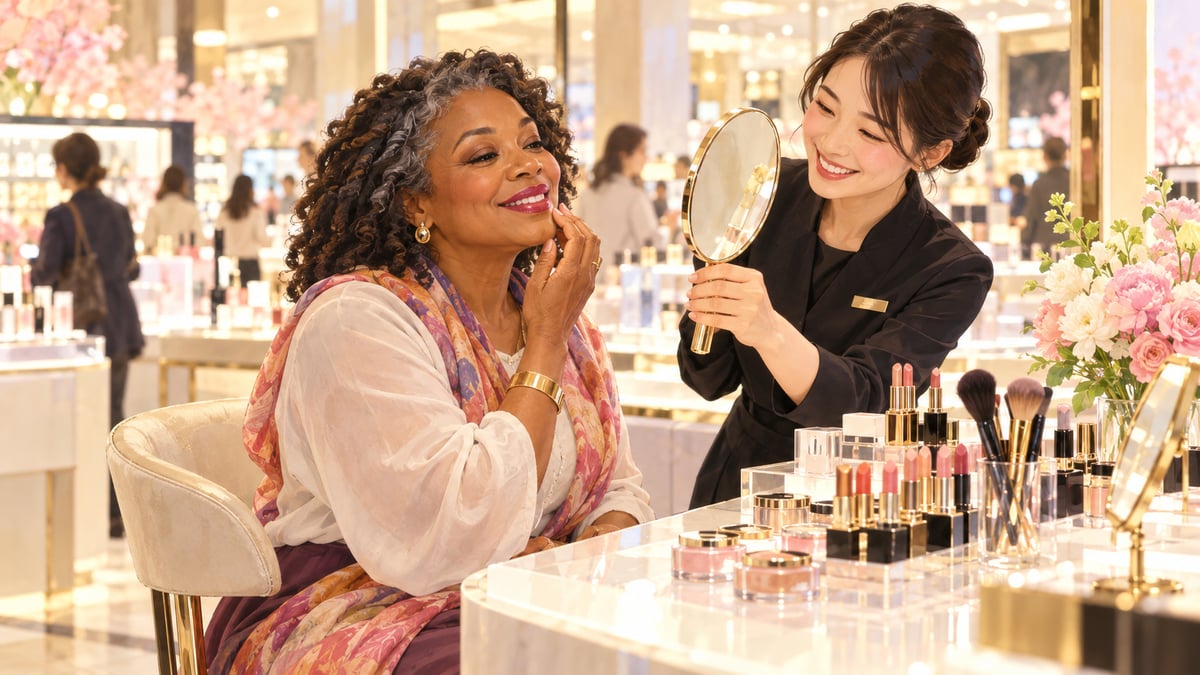
Department store cosmetics counters usually offer a タッチアップ (tatchiappu), a short try-on by staff, and colour advice. Drugstores have testers, テスター (tesutā), that you can try on the back of your hand. Colour words matter here: 色味 (iromi) is the tone of a colour, 明るめ (akarume) means a little lighter and 暗め (kurame) a little darker.
Some staff and many shoppers talk about personal colour, パーソナルカラー (pāsonaru karā), and the casual labels イエベ (iebe, yellow base, warm undertone) and ブルベ (burube, blue base, cool undertone). You do not need to use them, but they are worth recognising.
| Japanese | Romaji | Meaning |
|---|---|---|
| タッチアップできますか。 | Tatchiappu dekimasu ka. | You: Could I try it on? |
| どんな色味をお探しですか。 | Donna iromi o osagashi desu ka. | Staff: What kind of tone are you looking for? |
| 自然な感じのピンクがいいです。 | Shizen na kanji no pinku ga ii desu. | You: I'd like a natural-looking pink. |
| こちらはいかがでしょうか。 | Kochira wa ikaga deshō ka. | Staff: How about this one? |
| もう少し明るめの色はありますか。 | Mō sukoshi akarume no iro wa arimasu ka. | You: Do you have a slightly lighter shade? |
| 肌が弱いんですが、大丈夫ですか。 | Hada ga yowai n desu ga, daijōbu desu ka. | You: My skin is sensitive. Is it all right? |
| 今日は見るだけです。 | Kyō wa miru dake desu. | You: I'm just looking today. |
Kyō wa miru dake desu is the polite way to say you are not buying yet. Staff are used to it, and a smile with arigatō gozaimasu ends the conversation nicely.
Compliments among friends, and words to avoid
Complimenting a friend's makeup is common and friendly, especially when they have changed something. Name the specific thing, such as the lip colour or the eyeshadow, and the compliment sounds sincere. Be careful with words that describe amount: 化粧が濃い (keshō ga koi), heavy makeup, is almost always a criticism, and saying someone looks different without makeup can come across badly.
| Japanese | Romaji | Meaning |
|---|---|---|
| そのリップの色、似合ってるね。 | Sono rippu no iro, niatteru ne. | Friend: That lip colour really suits you. |
| ありがとう!新しく買ったんだ。 | Arigatō! Atarashiku katta n da. | You: Thanks! I just bought it. |
| どこのアイシャドウ? | Doko no aishadō? | Friend: Where's that eyeshadow from? |
| ドラッグストアで見つけたよ。 | Doraggusutoa de mitsuketa yo. | You: I found it at a drugstore. |
| 化粧が濃い | keshō ga koi | heavy makeup (usually critical; avoid) |
Practise your routine with Mocchi
- Write your morning routine in five Japanese sentences and send it with /correct. Mocchi fixes verbs like nuru, hiku and tsukeru and explains each change.
- Ask Mocchi to make cards for the products you own with /create-flashcards, choosing a photo of each one, and review them with /review-flashcards.
- Mocchi remembers the verbs you confuse and brings them back in a quiz the next time you chat.
- Ready to speak? Ask AI Sensei, for example Sakura-sensei, to play a beauty adviser at a department store counter.
Common learner mistakes
- Using tsukeru for everything. It works for mascara and lip balm, but foundation is nuru and eyeliner is hiku.
- Saying chīku for the cheek itself. In Japanese, chīku is blush; the cheek is hoo or hoppe.
- Telling a friend kyō suppin? as a joke. It can sound like a comment on how they look.
- Saying meikuappu. Meiku is the normal word; meikuappu exists but sounds formal, like a product name or a stage makeup artist.
- Forgetting the long vowels in fandēshon, paudā and aishadō. Hold each one for two beats.