

What tashika ni means
The kanji 確 means firm or certain, and 確か, tashika, describes something that is sure or reliable. Add the particle ni and it becomes an adverb: tashika ni, certainly or definitely. In writing it can simply mean certainly, as in tashika ni uketorimashita, I have certainly received it, a set phrase in business emails and receipts.
In conversation, tashika ni is above all a reaction. When someone makes a point you had not considered, or one you agree with, you say tashika ni, and it means that's true, fair point or you're right. It is short, natural and extremely common among friends, classmates and colleagues, and it often comes with a nod or a thoughtful ā.
| Japanese | Romaji | Meaning |
|---|---|---|
| 確かに。 | Tashika ni. | That's true. / Fair point. |
| 確かに、そうだね。 | Tashika ni, sō da ne. | Yeah, you're right. |
| ああ、確かに。 | Ā, tashika ni. | Ah, good point. |
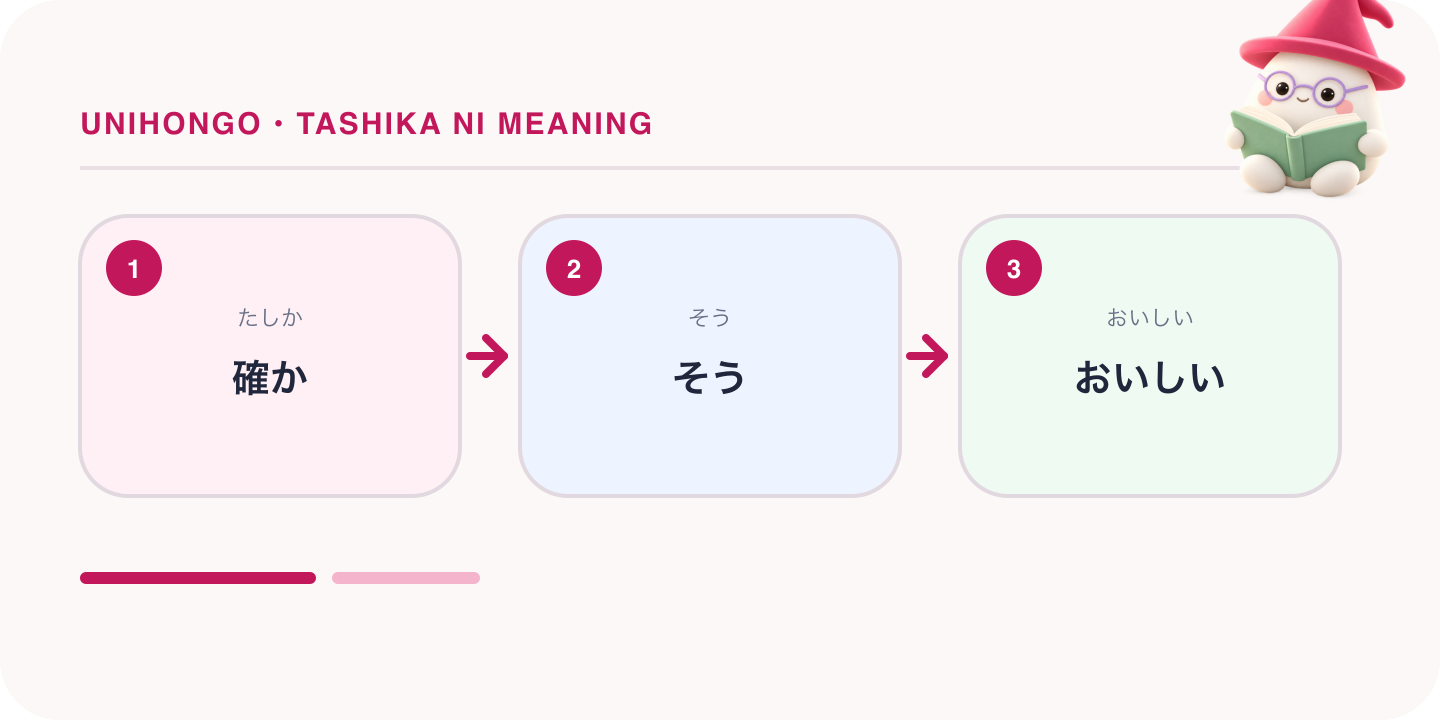
| 確かにおいしいね。 | Tashika ni oishii ne. | It really is tasty. |
| 確かに受け取りました。 | Tashika ni uketorimashita. | I have duly received it. |
| 確かにお預かりしました。 | Tashika ni o-azukari shimashita. | We have safely received it (for safekeeping). |
Tashika: if I remember correctly
Drop the ni, put tashika at the start of a sentence, and the meaning changes. Here tashika signals that you believe something is true but are relying on memory: tashika, kare wa Ōsaka shusshin da yo, if I remember right, he's from Osaka. It is roughly I think or I'm pretty sure, and it often pairs with yo ne or hazu at the end.
This use of tashika is useful for learners because it lets you share information while leaving room to be corrected. It is polite enough for work: tashika, kaigi wa sanji kara deshita yo ne? the meeting was from three o'clock, wasn't it? If you are wrong, the other person can correct you without anyone losing face.
| Japanese | Romaji | Meaning |
|---|---|---|
| 確か、彼は大阪出身だよ。 | Tashika, kare wa Ōsaka shusshin da yo. | If I remember right, he's from Osaka. |
| 確か、会議は3時からでしたよね。 | Tashika, kaigi wa sanji kara deshita yo ne. | The meeting was from three, wasn't it? |
| 確か、この辺にあったはずです。 | Tashika, kono hen ni atta hazu desu. | I'm fairly sure it was around here. |
| 確か、火曜日は休みだったと思う。 | Tashika, kayōbi wa yasumi datta to omou. | I think they're closed on Tuesdays. |
| 確か、前にも来たことがある。 | Tashika, mae ni mo kita koto ga aru. | I think I've been here before. |
The difference is easy to hear. Tashika ni reacts to something someone else said; tashika introduces something you are about to say.
Tashika ni ... ga: it's true, but
Tashika ni often begins a concession, the first half of an it's true that X, but Y sentence. Tashika ni kono resutoran wa takai kedo, aji wa saikō da, it's certainly pricey, but the food is excellent. The pattern acknowledges the other side before adding your view, which is how many polite disagreements are built in Japanese.
In meetings you will hear this constantly: tashika ni sono tōri desu ga, that is certainly true, but. The phrase agrees first and disagrees second, which softens the disagreement considerably. Kedo is casual, ga is neutral or polite, and tada, however, can start the second sentence for a gentler break.
| Japanese | Romaji | Meaning |
|---|---|---|
| 確かに高いけど、味は最高だよ。 | Tashika ni takai kedo, aji wa saikō da yo. | It's pricey, sure, but the food is amazing. |
| 確かにその通りですが、時間が足りません。 | Tashika ni sono tōri desu ga, jikan ga tarimasen. | That's certainly true, but we don't have enough time. |
| 確かに便利です。ただ、少し高いですね。 | Tashika ni benri desu. Tada, sukoshi takai desu ne. | It's certainly convenient. It is a little expensive, though. |
| 確かに難しいですが、やってみる価値はあります。 | Tashika ni muzukashii desu ga, yatte miru kachi wa arimasu. | It's certainly difficult, but it's worth trying. |
Agreeing politely with a boss or client
A bare tashika ni is perfectly natural between equals, but many Japanese speakers feel it can sound slightly evaluative when said to a superior, as if you are judging whether their point passes. Opinions on this vary, and plenty of people say it at work without problems, but the safe choice is to expand it.
Tashika ni sō desu ne, that's certainly true, adds the polite desu. O-ssharu tōri desu, it's exactly as you say, uses respectful language and suits bosses and clients. Naruhodo, I see, is another common reaction, but it has the same issue as tashika ni, so naruhodo desu ne or sō desu ne are gentler with seniors.
| Phrase | Meaning | Best with |
|---|---|---|
| 確かに tashika ni | Fair point | Friends, peers |
| 確かにそうですね tashika ni sō desu ne | That's certainly true | Colleagues, most people |
| おっしゃる通りです o-ssharu tōri desu | It's exactly as you say | Bosses, clients |
| そうですね sō desu ne | That's right, yes | Anyone |
| なるほど naruhodo | I see | Friends, peers |
| 勉強になります benkyō ni narimasu | That's very instructive | Seniors, mentors |
Benkyō ni narimasu, literally that is a learning experience for me, is a courteous way to acknowledge a superior's advice without sounding like you are grading it.
Tashika na: reliable and definite
As a na-adjective, tashika na describes something trustworthy, accurate or definite. Tashika na jōhō is reliable information; tashika na shōko is solid evidence; ude ga tashika da means someone's skills are dependable. You will meet this in news, reviews and recommendations.
The negative, tashika ja nai or tashika de wa nai, means not certain: sore wa mada tashika ja nai, that's not confirmed yet. A related word, kakujitsu, means certain or sure in a more formal way: kakujitsu ni todokimasu, it will arrive without fail.
| Japanese | Romaji | Meaning |
|---|---|---|
| 確かな情報 | tashika na jōhō | Reliable information |
| 確かな証拠 | tashika na shōko | Solid evidence |
| あの職人は腕が確かだ。 | Ano shokunin wa ude ga tashika da. | That craftsman's skill is dependable. |
| それはまだ確かじゃない。 | Sore wa mada tashika ja nai. | That isn't confirmed yet. |
| 確実に届きます。 | Kakujitsu ni todokimasu. | It will arrive without fail. |
Tashikameru and kakunin: checking and confirming
The verb tashikameru means to check, make sure or verify, usually by looking again, asking or testing. Kagi o kaketa ka tashikameru is to check whether you locked the door. Mō ichido tashikamete kudasai, please check once more, is a common request.
In business, kakunin, confirmation, is the more formal word, and kakunin shimasu, I'll check, is one of the most useful phrases at work. Go-kakunin kudasai, please confirm, appears at the end of countless emails. Tashikameru is friendlier and more physical; kakunin is procedural.
| Japanese | Romaji | Meaning |
|---|---|---|
| 鍵をかけたか確かめる。 | Kagi o kaketa ka tashikameru. | To check whether I locked the door. |
| もう一度確かめてください。 | Mō ichido tashikamete kudasai. | Please check once more. |
| 自分の目で確かめたい。 | Jibun no me de tashikametai. | I want to see it with my own eyes. |
| 確認します。 | Kakunin shimasu. | I'll check. |
| ご確認ください。 | Go-kakunin kudasai. | Please confirm. |
| 確認してからご連絡します。 | Kakunin shite kara go-renraku shimasu. | I'll check and get back to you. |
Common learner mistakes with tashika ni
- Using tashika ni to say yes to a question: it agrees with a point, it does not answer hai or iie
- Confusing tashika and tashika ni: one recalls, the other agrees
- Saying only tashika ni to a boss: add sō desu ne or use o-ssharu tōri desu
- Repeating tashika ni after every sentence: vary it with sō da ne, un and naruhodo
- Using tashikameru in formal emails: kakunin sounds more natural in business writing
If someone asks kore, anata no desu ka? is this yours? the answer is hai, sō desu, not tashika ni. Tashika ni responds to an opinion or an observation, not to a question.