
What kawaii covers
The centre of kawaii is a warm reaction to something that appeals to you and asks nothing of you. Smallness is often part of that, which is why animals and children are the textbook examples, but smallness is not required. A wide-brimmed hat, a hand-lettered menu, a rounded font and a carefully wrapped parcel are all comfortably kawaii, and none of them is small.
That is why kawaii is heard so often in shops, cafes and conversations about design. English distributes this territory across cute, sweet, lovely, charming, pretty and nice. Japanese lets one word do it, and the listener works out from context whether you mean adorable, well made, or simply pleasing.
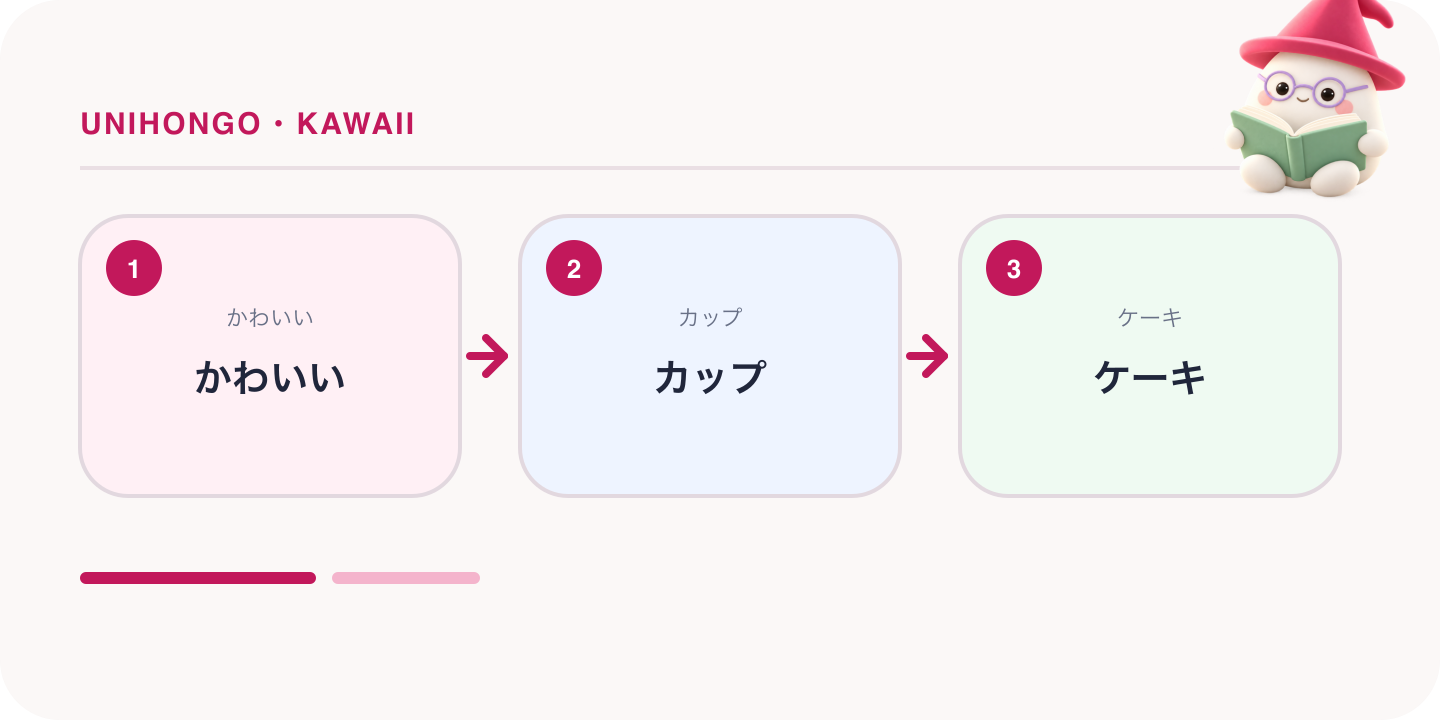
| Japanese | Romaji | Meaning |
|---|---|---|
| かわいいですね。 | Kawaii desu ne. | That is lovely. |
| この猫、かわいいです。 | Kono neko, kawaii desu. | This cat is adorable. |
| かわいいお店ですね。 | Kawaii omise desu ne. | What a charming little shop. |
| そのカップ、かわいいですね。 | Sono kappu, kawaii desu ne. | That mug is really nice. |
| 字がかわいいですね。 | Ji ga kawaii desu ne. | Your handwriting is cute. |
Why objects, food and behaviour qualify
Japanese uses kawaii freely for things that were made with care and turned out pleasing. Packaging, a plated dessert, a stationery set, a shop's interior, a phone case and a bento arrangement are all standard targets. This is descriptive, not childish: an adult professional can say kono kēki, kawaii and mean the presentation is well judged.
It also covers behaviour and manner. A small habit, a reaction, a way of speaking, an older relative's stubbornness about their routine can all be described as kawaii with real affection. Applied this way it is warm, but it is also a judgement about a person, which is where the caution in the later sections begins.
| Japanese | Romaji | Meaning |
|---|---|---|
| かわいい服ですね。 | Kawaii fuku desu ne. | That is a lovely outfit. |
| このケーキ、かわいい。 | Kono kēki, kawaii. | This cake looks beautifully done. (casual) |
| 反応がかわいいですね。 | Hannō ga kawaii desu ne. | The way you reacted is endearing. |
| 部屋がかわいくまとまっていますね。 | Heya ga kawaiku matomatte imasu ne. | The room is put together very nicely. |
| おばあちゃん、かわいいね。 | Obāchan, kawaii ne. | Grandma is adorable. (casual, affectionate) |
Kawaii, kirei, utsukushii and suteki
| Word | Type | Core sense | What it suits |
|---|---|---|---|
| かわいい kawaii | i-adjective | Endearing, appealing, charming | Animals, children, objects, food, style |
| きれい kirei | na-adjective | Clean, tidy, visually beautiful | Rooms, handwriting, scenery, a person's looks |
| 美しい utsukushii | i-adjective | Formal, serious beauty | Landscapes, art, form, written praise |
| 素敵 suteki | na-adjective | Lovely, tasteful, appealing | Clothes, homes, ideas, adults of any gender |
| かっこいい kakkoii | i-adjective | Cool, sharp, impressive | Style, bearing, performance, skill |
The grammar trap here is kirei. It ends in the sound i but is a na-adjective, so it is kirei na hito, kirei deshita and kirei ni, never kireikatta. Utsukushii is genuinely beautiful in an elevated sense; used about a person in ordinary conversation it can sound like a line from a novel, so most speakers keep it for scenery, music and art. Suteki is the quiet workhorse: it praises taste rather than appearance and is safe with almost anyone.
Choosing between them is a real decision, not a stylistic flourish. Kirei na ji desu ne praises neat, controlled handwriting; kawaii ji desu ne praises rounded, friendly handwriting. Both are compliments and they are not interchangeable.
The forms and the casual versions
Kawaii conjugates like any i-adjective. Kawaii desu, kawaikatta desu for the past, kawaikunai desu for the negative, and kawaiku as the adverb. Kawairashii is a softer, slightly more formal relative meaning charming or sweet-natured, and it is a good choice when you want the warmth of kawaii without the casualness.
Casual speech shortens and stretches it constantly. The drawn-out kawaī, the clipped exclamation, and kawaii jan, meaning that is cute, right, all belong to relaxed conversation among friends. Metcha kawaii is widespread informal speech. Recognise these, use them with friends your own age, and keep kawaii desu for anyone else.
| Japanese | Romaji | Meaning |
|---|---|---|
| かわいいです。 | Kawaii desu. | It is cute. |
| かわいかったです。 | Kawaikatta desu. | It was cute. |
| かわいくないです。 | Kawaikunai desu. | It is not cute. |
| かわいく撮れましたね。 | Kawaiku toremashita ne. | It came out looking lovely in the photo. |
| かわいらしい方ですね。 | Kawairashii kata desu ne. | She has a charming manner. (polite) |
| かわいいじゃん。 | Kawaii jan. | That is cute, isn't it. (casual) |
| かわいー。 | Kawaī. | Cuuute. (drawn out, casual) |
| めっちゃかわいい。 | Metcha kawaii. | So cute. (casual) |
| かわいすぎます。 | Kawaisugimasu. | It is almost too cute. |
Kawaisou is not cute
可哀想 kawaisō means pitiable, and it expresses sympathy for someone in a bad situation. It is not the seems form of kawaii, despite the ending, and the resemblance catches out a great many learners. Saying kawaisō desu ne after someone shows you their new bag would be baffling at best and insulting at worst.
If you want to say something looks cute, the natural options are kawaii desu ne, kawairashii desu ne, or kawaiku miemasu. Keep kawaisō for what it is: a sympathy word, used about a caged animal, a rained-out event, or a friend who has had a hard week. Even then, use it about the situation rather than at the person, since being called pitiable is rarely welcome.
| Japanese | Romaji | Meaning |
|---|---|---|
| かわいそうですね。 | Kawaisō desu ne. | That is a shame. |
| 犬がかわいそうです。 | Inu ga kawaisō desu. | I feel sorry for the dog. |
| かわいそうな話でした。 | Kawaisō na hanashi deshita. | It was a sad story. |
| かわいく見えますね。 | Kawaiku miemasu ne. | It looks lovely. |
Calling a person kawaii
Used about a person, kawaii can mean physically cute, dressed appealingly, or endearing in manner. Which one the listener hears depends on your relationship, the setting, and often on gender. Between close friends of similar age it is ordinary and welcome. From someone senior to someone junior, or from a man to a woman colleague he does not know well, the same word can sound like an assessment of her appearance rather than a compliment.
There is a second problem. Kawaii implies smallness and softness, so applied to an adult professional it can quietly diminish them, in the way that calling a colleague sweet in English might. Praising a person's child, pet, bag or shoes carries none of that risk, because the judgement lands on the thing rather than on them.
| Japanese | Romaji | Meaning |
|---|---|---|
| お子さん、かわいいですね。 | Okosan, kawaii desu ne. | Your child is adorable. |
| 猫、かわいいですね。 | Neko, kawaii desu ne. | Your cat is lovely. |
| 今日の髪型、かわいいね。 | Kyō no kamigata, kawaii ne. | Your hair looks cute today. (casual, close friend) |
| そういうところ、かわいいね。 | Sōiu tokoro, kawaii ne. | That side of you is endearing. (close friends only) |
| かわいい人ですね。 | Kawaii hito desu ne. | She is a sweet person. (can sound evaluative) |
Safe and unsafe uses at a glance
| Who or what | Kawaii? | Why |
|---|---|---|
| A stranger's dog | Safe | Praising a pet is welcome almost anywhere |
| A colleague's mug or lunchbox | Safe | The judgement lands on the object |
| A shop, a cake, a poster | Safe | Standard everyday use |
| A friend's new haircut | Usually safe | Close relationship and casual register |
| A colleague's appearance at work | Risky | Reads as commenting on how they look |
| A senior colleague | Avoid | Sounds diminishing as well as personal |
| An adult man's appearance | Avoid | Kakkoii is the expected word instead |
| Someone's mistake or clumsiness | Avoid | Sounds condescending even when meant kindly |
None of this is a fixed rule, and practice varies by workplace, generation and region. What does not vary is the cost asymmetry: praising the object is never wrong, while praising the person can be, so when you are unsure, move the compliment onto the thing.
Safer compliments about appearance
The reliable pattern is to compliment a choice rather than a body. Clothes, accessories, colours and styling are all things the person decided, so praising them reads as noticing their taste. Suteki and oshare do this work naturally, and niatte imasu, meaning it suits you, is warm without evaluating the person's looks at all.
| Japanese | Romaji | Meaning |
|---|---|---|
| そのシャツ、素敵ですね。 | Sono shatsu, suteki desu ne. | That shirt is lovely. |
| おしゃれですね。 | Oshare desu ne. | You have a stylish look. |
| その色、よく似合っていますね。 | Sono iro, yoku niatte imasu ne. | That colour really suits you. |
| センスがいいですね。 | Sensu ga ii desu ne. | You have good taste. |
| 素敵なバッグですね。どこで買われたんですか。 | Suteki na baggu desu ne. Doko de kawareta n desu ka. | That is a lovely bag. Where did you buy it? |
| お似合いですね。 | Oniai desu ne. | It suits you well. |
Complimenting work instead
In a workplace, the safest compliment is usually not about appearance at all. Japanese praise at work tends to name what the work achieved or how carefully it was done, and kirei has a whole life here that has nothing to do with beauty: kirei ni matomatte imasu means neatly organised. This is where a learner's adjective range pays off most visibly.
| Japanese | Romaji | Meaning |
|---|---|---|
| 字がきれいですね。 | Ji ga kirei desu ne. | Your handwriting is very neat. |
| 資料がきれいにまとまっていますね。 | Shiryō ga kirei ni matomatte imasu ne. | The document is neatly put together. |
| 丁寧なお仕事ですね。 | Teinei na oshigoto desu ne. | That is careful work. |
| 分かりやすい説明でした。 | Wakariyasui setsumei deshita. | That was an easy explanation to follow. |
| デザイン、素敵ですね。 | Dezain, suteki desu ne. | The design is lovely. |
How to widen the habit
Learners over-rely on kawaii for the same reason they over-rely on sugoi: it always gets a friendly response, so there is no pressure to improve. The fix is mechanical rather than motivational. Force a choice between four words every time you want to praise something, and the choice becomes automatic within a few weeks.
- Before saying kawaii, ask yourself whether kirei, suteki or kakkoii is closer.
- Add one detail after the adjective so the compliment carries information.
- Move every workplace compliment from the person to their work or their choice.
- Say kawaisō out loud daily for a week until it stops sounding like kawaii.
- Learn kawairashii as the polite option and use it with people you have just met.
- Collect one real example a day from a shop sign, a menu, or a product description.