

Ai and koi: two kinds of love
Koi, 恋, is romantic love, particularly the heart-racing, longing kind. You koi ni ochiru, fall in love, and a koi can be one-sided. It often looks towards someone you want to be with. Ai, 愛, is a broader and steadier love: the love of parents for children, of long-married couples, of people for their home town, and in abstract terms, love for humanity.
A common way to explain the difference is that koi is about wanting and ai is about giving. That is a simplification, and poets and songwriters play with both words freely, but it captures how most native speakers feel the contrast. Ren'ai, 恋愛, combines both kanji and is the general word for romance or romantic relationships.
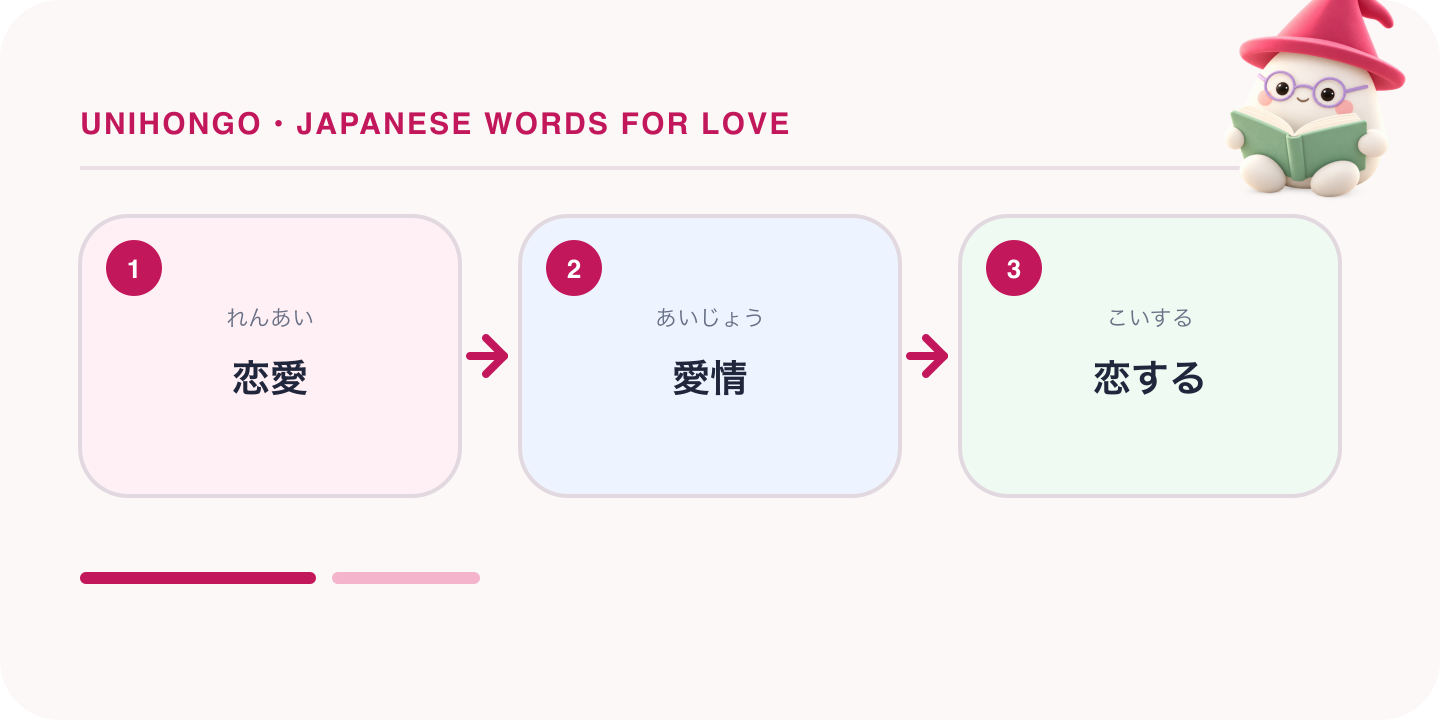
| Word | Reading | Meaning |
|---|---|---|
| 恋 | koi | Romantic love, being in love |
| 愛 | ai | Love, deep affection |
| 恋愛 | ren'ai | Romance, romantic relationships |
| 愛情 | aijō | Affection, love (as a feeling) |
| 恋する | koi suru | To be in love |
| 愛する | aisuru | To love (deeply) |
| 恋に落ちる | koi ni ochiru | To fall in love |
The kanji 愛 and 恋
Both kanji contain 心, heart. In 愛 it sits in the middle of the character, and in 恋 it sits at the bottom. A well-known Japanese play on words uses this: koi wa shitagokoro, ai wa magokoro, love as koi has its heart below, a hidden motive, while love as ai has its heart in the centre, sincerity. It is a pun, not etymology, but many learners find it a useful memory hook.
Ai appears in many everyday compounds that have nothing to do with romance. Aiken is a beloved dog, aiyō means something you use regularly and are fond of, and aichaku is attachment to a place or object. Koi compounds, by contrast, almost always stay romantic.
| Word | Reading | Meaning |
|---|---|---|
| 愛犬 | aiken | One's beloved dog |
| 愛用 | aiyō | Regular, favourite use |
| 愛着 | aichaku | Attachment, fondness |
| 愛読書 | aidokusho | Favourite book |
| 母の愛 | haha no ai | A mother's love |
| 初恋 | hatsukoi | First love |
| 恋人 | koibito | Lover, partner |
| 恋しい | koishii | Missing someone, longing for |
Suki, daisuki and aishiteru
In everyday life, feelings of love are mostly expressed with suki, liking, and daisuki, liking a lot. Suki desu said to a person in the right context is a clear romantic confession. Daisuki is warmer and more open, and it is used freely for family, friends, pets and food, as well as partners.
Aishiteru, from aisuru, is the strongest option and is famously rare in spoken Japanese. Many people say they have never said it aloud, or only on very special occasions. Using it casually can sound theatrical, so treat it as a word for songs, films and the rare serious moment.
| Japanese | Romaji | Meaning |
|---|---|---|
| 好きです。 | Suki desu. | I like you. (a confession, in context) |
| 大好きだよ。 | Daisuki da yo. | I really love you. (warm, casual) |
| 愛してる。 | Aishiteru. | I love you. (very strong, rare) |
| ラーメンが大好きです。 | Rāmen ga daisuki desu. | I love ramen. |
| 家族のことが大好きです。 | Kazoku no koto ga daisuki desu. | I love my family. |
| 会いたい。 | Aitai. | I want to see you; I miss you. |
Notice the particle ga in these sentences. Suki and daisuki are adjectives in Japanese, so the thing you like is marked with ga, not o, in standard speech.
Crushes, first sight and one-sided love
Before a relationship there is usually a stage of wanting, and Japanese has precise words for it. Hitomebore, love at first sight, is literally one-look falling-for. Horeru is to fall for someone, and ki ni naru, to be on someone's mind, is how many people describe the very first stage of a crush.
Kataomoi, one-sided love, is a staple of Japanese songs and manga. Its opposite, ryōomoi, mutual love, is the happy moment when both people turn out to feel the same way.
| Japanese | Romaji | Meaning |
|---|---|---|
| 彼女に一目惚れしました。 | Kanojo ni hitomebore shimashita. | I fell for her at first sight. |
| 最近、同じクラスの人が気になっています。 | Saikin, onaji kurasu no hito ga ki ni natte imasu. | Lately I can't stop thinking about someone in my class. |
| ずっと片思いしています。 | Zutto kataomoi shite imasu. | I've had a one-sided crush for ages. |
| 実は両思いだったんです。 | Jitsu wa ryōomoi datta n desu. | It turned out the feeling was mutual. |
| Word | Reading | Meaning |
|---|---|---|
| 一目惚れ | hitomebore | Love at first sight |
| 惚れる | horeru | To fall for someone |
| 気になる | ki ni naru | To have someone on your mind, a budding crush |
| 片思い | kataomoi | One-sided love, unrequited crush |
| 両思い | ryōomoi | Mutual love |
| 好きな人 | suki na hito | The person you like, your crush |
Kokuhaku and starting to date
Kokuhaku, confession, is the moment someone tells the other person they like them, often with a direct request to date. It is a familiar step in many Japanese relationships, especially among students and young adults, although plenty of couples get together more gradually, and habits vary from person to person.
The verb for dating is tsukiau, to go out with; tsukiatte kudasai is please go out with me. Once together, people refer to each other as kareshi and kanojo, and a date is simply dēto.
| Japanese | Romaji | Meaning |
|---|---|---|
| 好きです。付き合ってください。 | Suki desu. Tsukiatte kudasai. | I like you. Please go out with me. |
| 昨日、告白されました。 | Kinō, kokuhaku saremashita. | Someone confessed to me yesterday. |
| 二人は付き合っています。 | Futari wa tsukiatte imasu. | The two of them are dating. |
| 彼氏はいますか。 | Kareshi wa imasu ka. | Do you have a boyfriend? |
| 週末、デートに行きます。 | Shūmatsu, dēto ni ikimasu. | I'm going on a date at the weekend. |
| Word | Reading | Meaning |
|---|---|---|
| 告白 | kokuhaku | Confession of feelings |
| 付き合う | tsukiau | To date, go out with |
| 恋人 | koibito | Partner, lover |
| 彼氏 | kareshi | Boyfriend |
| 彼女 | kanojo | Girlfriend; also she |
| 遠距離恋愛 | enkyori ren'ai | Long-distance relationship |
| 恋愛結婚 | ren'ai kekkon | Love marriage |
| お見合い | omiai | Arranged introduction for marriage |
Heartbreak and missing someone
Love vocabulary has a sad side too. Shitsuren is heartbreak, literally losing love. Furareru, the passive of furu, means to be dumped or rejected, and wakareru means to break up or separate. Motokare and motokano are casual words for an ex-boyfriend and ex-girlfriend.
Koishii expresses longing for someone or something absent, and it is more poetic than sabishii, lonely. Setsunai captures the ache of a love that hurts, and you will hear it constantly in love songs.
| Japanese | Romaji | Meaning |
|---|---|---|
| 失恋しました。 | Shitsuren shimashita. | I've had my heart broken. |
| 告白したけど、振られました。 | Kokuhaku shita kedo, furaremashita. | I confessed, but I was turned down. |
| 先月、彼と別れました。 | Sengetsu, kare to wakaremashita. | I broke up with him last month. |
| あなたが恋しいです。 | Anata ga koishii desu. | I miss you. (poetic) |
| 切ないラブソングですね。 | Setsunai rabu songu desu ne. | What a heartbreaking love song. |
Common mistakes with love words
- Saying aishiteru casually. It is far stronger than English I love you; daisuki is usually what you want.
- Using koi for family love. Koi is romantic; for parents, children and friends, use ai, aijō or daisuki.
- Marking the loved one with o after suki. Standard Japanese says anata ga suki, not anata o suki, although you may hear o in some speech and songs.
- Calling your partner koibito in conversation. It is correct but sounds formal; kareshi, kanojo or pātonā are more natural.
- Forgetting that kanojo also means she. Kanojo wa sensei desu can mean she is a teacher or my girlfriend is a teacher, depending on context.
- Translating I miss you as sabishii. Sabishii means I'm lonely; aitai, I want to see you, is the natural phrase.
Review the words with Unihongo's learning games
Love vocabulary is easy to remember as a story: ki ni naru, hitomebore, kataomoi, kokuhaku, tsukiau, and then either ryōomoi or shitsuren. Put the words in that order in your notes and review them as a sequence rather than a list.
Unihongo's free learning games are a quick way to drill the kanji and meanings in short rounds, especially the compounds built on 愛 and 恋 such as 恋愛, 初恋, 愛情 and 愛着. Play a round, then say one sentence aloud about a film, book or song you know that uses the word. Connecting a word to a story you already care about helps it stay.
- Round one: ai, koi, ren'ai and the kanji 愛 and 恋 with their compounds.
- Round two: the crush and dating words, from hitomebore to tsukiau.
- Round three: heartbreak and longing, from shitsuren to koishii and setsunai.