
The 鉄 family of words
The kanji 鉄 means iron, and in tetsudō (鉄道), railway, it means the iron road. Fans have turned it into a suffix: put tetsu after a verb or noun and you have a type of train fan. The words are informal but widely used in Japanese media and by fans themselves, and saying them correctly is an easy way to show another fan that you belong.
| Japanese | Romaji | Meaning |
|---|---|---|
| 電車が大好きです。 | Densha ga daisuki desu. | I love trains. |
| 鉄道ファン | tetsudō fan | railway fan |
| 鉄ちゃん | tetchan | train buff (casual, friendly) |
| 鉄オタ | tetsuota | train geek (often self-mocking) |
Densha (電車) strictly means an electric train, and kisha (汽車) is an old word for a steam train. In daily speech, densha is used for almost any train. Ressha (列車) is the more technical word for a train service, and you hear it in announcements and timetables.
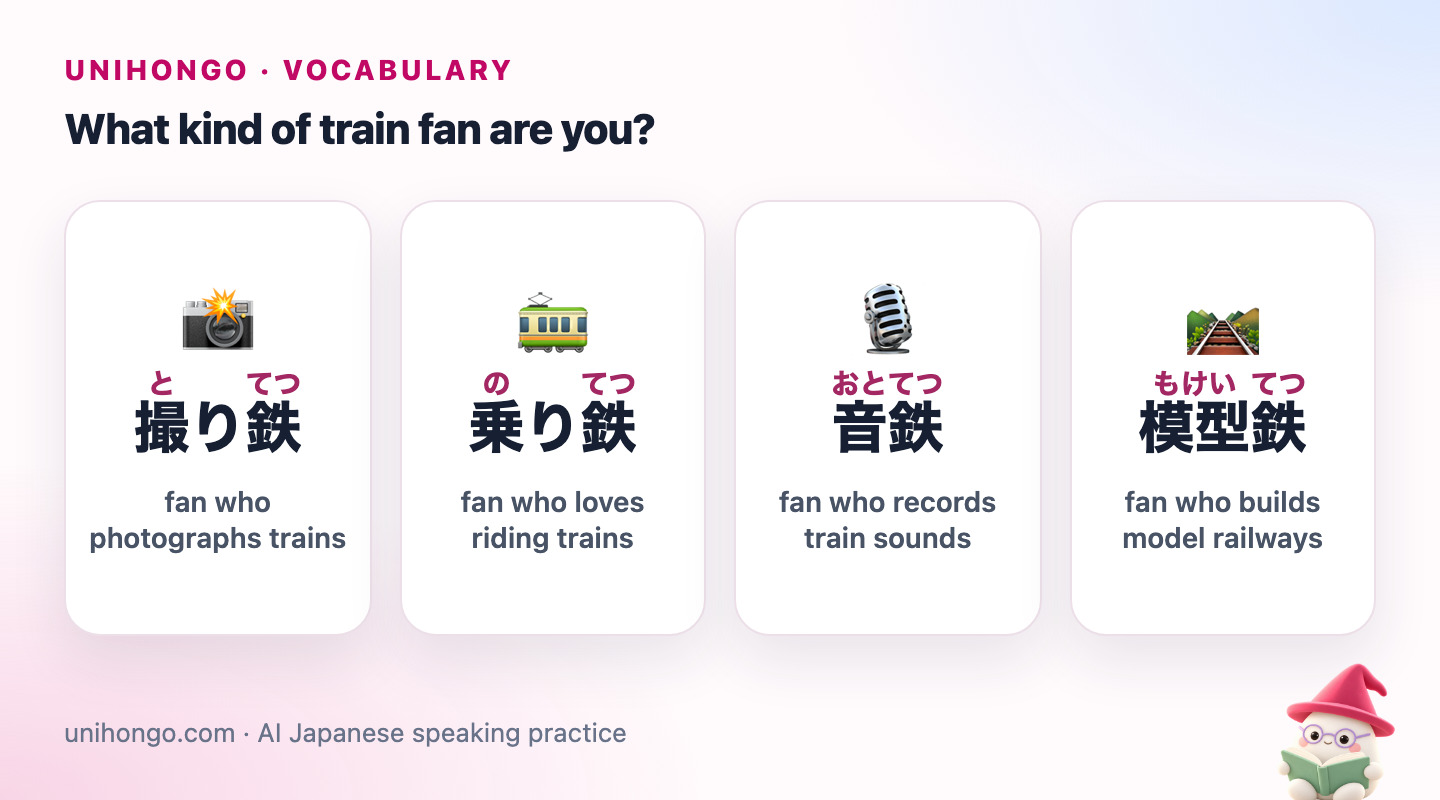
What kind of train fan are you?
These are the four most common fan types. The names are built from a verb or noun plus tetsu: toru (to photograph), noru (to ride), oto (sound) and mokei (model). Many other types exist, such as fans of station buildings or of timetables, but these four are the ones every Japanese train fan will recognise.
| Japanese | Romaji | Meaning |
|---|---|---|
| 撮り鉄 | toritetsu | fan who photographs trains |
| 乗り鉄 | noritetsu | fan who loves riding trains |
| 音鉄 | ototetsu | fan who records train sounds |
| 模型鉄 | mokeitetsu | fan who builds model railways |
| 私は乗り鉄です。 | Watashi wa noritetsu desu. | I'm a train-riding fan. |
| 全線完乗が目標です。 | Zensen kanjō ga mokuhyō desu. | My goal is to ride every line. |
Cars, formations and the front window
Train fans talk precisely about rolling stock, sharyō (車両). A train is made of cars counted with ryō, the full set is a hensei, and each model or class of train has a keishiki (形式), type designation, usually a number. The front car is the sentōsha (先頭車), and the driver's cab is the untenseki (運転席) or untendai (運転台).
One much-loved word is kaburitsuki (かぶりつき), originally the front row of a theatre, now used for standing at the front window of a train to watch the track ahead. Children and adults do it, and in many trains you can, as long as you do not block the driver's view or other passengers.
| Japanese | Romaji | Meaning |
|---|---|---|
| この電車は十両編成です。 | Kono densha wa jūryō hensei desu. | This train has ten cars. |
| 先頭車 | sentōsha | front car |
| 運転席の後ろ | untenseki no ushiro | right behind the driver's cab |
| 前面展望が最高! | Zenmen tenbō ga saikō! | The view out the front is the best! |
| かぶりつきで見たい。 | Kaburitsuki de mitai. | I want to watch from the front window. |
| 新型車両 | shingata sharyō | new-model train |
| パンタグラフ | pantagurafu | pantograph |
| モーター音 | mōtā on | motor sound |
Zenmen tenbō (前面展望), the forward view, is also the name for videos filmed from the cab or the front window, a whole genre among fans. Mōtā on, the sound of the motors as a train speeds up, is what ototetsu love to record, and some fans can recognise a train type with their eyes closed.
Special trains, retirements and last runs
Some of the biggest events for fans are special services and goodbyes. A rinji ressha (臨時列車) is an extra or special train that runs on certain days. When an old type of train is taken out of service, it is intai (引退), retirement, and its final service is the rasuto ran (ラストラン), last run. Lines that close are haisen (廃線), and the platforms on those days can be packed.
| Japanese | Romaji | Meaning |
|---|---|---|
| 臨時列車 | rinji ressha | special extra train |
| 寝台列車 | shindai ressha | sleeper train |
| 蒸気機関車 | jōki kikansha | steam locomotive |
| 引退が決まった。 | Intai ga kimatta. | Its retirement has been announced. |
| ラストランを見に行く。 | Rasuto ran o mi ni iku. | I'm going to see its last run. |
| 廃線になる | haisen ni naru | for a line to close |
| ありがとう、お疲れさま! | Arigatō, otsukaresama! | Thank you, well done! (said to a retiring train) |
Fans really do say otsukaresama to trains. At last runs, crowds often thank the train and the crew, and you will see people waving and recording. Plan for crowds and follow any restrictions the station announces.
Local lines and station lunch boxes
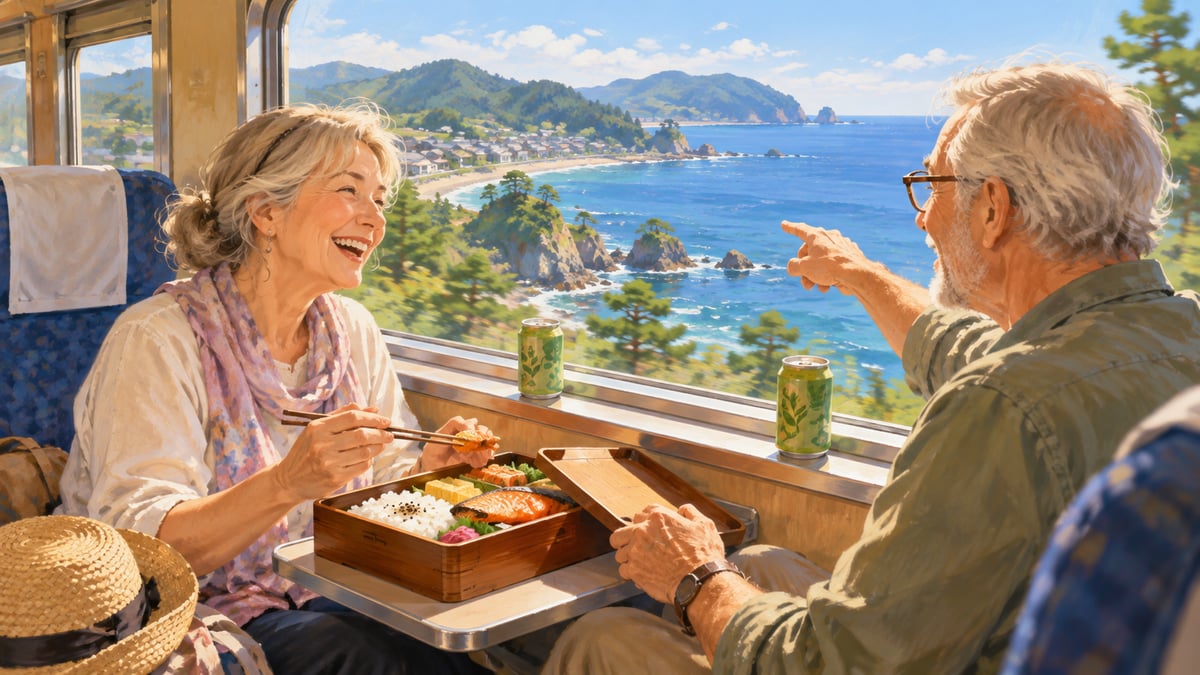
Many noritetsu love slow travel on rōkaru sen (ローカル線), local rural lines, where trains might run once an hour along a coast or through mountains. The slow all-stations train is the donkō (鈍行) or kakueki teisha (各駅停車). Part of the fun is food: ekiben (駅弁), lunch boxes sold at stations and often based on regional dishes, and eki sutanpu (駅スタンプ), rubber stamps that many stations offer for free so visitors can collect them in a notebook.
| Japanese | Romaji | Meaning |
|---|---|---|
| ローカル線でのんびり旅 | rōkaru sen de nonbiri tabi | a relaxed trip on a local line |
| 鈍行で行こう。 | Donkō de ikō. | Let's take the slow train. |
| 駅弁はどこで買えますか。 | Ekiben wa doko de kaemasu ka. | Where can I buy a station lunch box? |
| 駅スタンプはありますか。 | Eki sutanpu wa arimasu ka. | Do you have a station stamp? |
| 次の電車は何時ですか。 | Tsugi no densha wa nanji desu ka. | What time is the next train? |
| 窓側の席がいいです。 | Madogawa no seki ga ii desu. | I'd like a window seat. |
On quiet rural lines, the train may be a single car with a ticket machine near the driver, and you pay as you get off. Watch what local passengers do, take a numbered ticket when you board if there is one, and ask the driver if you are unsure: kono kippu de daijōbu desu ka, is this ticket all right? Station stamps are usually kept near the ticket gate or the station office, and many fans carry a small notebook just for them. Press firmly, once, and put the stamp back where you found it.
Mini dialogue: two fans at the end of the platform
Fans at the end of a platform are usually happy to chat, and polite Japanese is the safe start with a stranger. Here you meet an older photographer waiting for a special train.
| Japanese | Romaji | Meaning |
|---|---|---|
| すみません、何か来るんですか。 | Sumimasen, nanika kuru n desu ka. | You: Excuse me, is something special coming? |
| ええ、十時に臨時列車が通るんですよ。 | Ē, jūji ni rinji ressha ga tōru n desu yo. | Fan: Yes, a special train passes at ten. |
| 隣で撮ってもいいですか。 | Tonari de totte mo ii desu ka. | You: May I take photos next to you? |
| どうぞ。黄色い線の内側でね。 | Dōzo. Kiiroi sen no uchigawa de ne. | Fan: Go ahead. Just stay behind the yellow line. |
| もちろんです。鉄道がお好きなんですね。 | Mochiron desu. Tetsudō ga osuki nan desu ne. | You: Of course. You must love railways. |
| 子供のころからの撮り鉄です。 | Kodomo no koro kara no toritetsu desu. | Fan: I've been photographing trains since I was a kid. |
Manners and common learner mistakes
In recent years, Japanese media have reported on a small number of photographers who shouted at passengers, trespassed on tracks or damaged private property to get a shot. Most fans are courteous, and many are frustrated by this image. Following the rules is the best way to be welcome.
- Never step past the yellow line or onto tracks, fields or private land. Tachiiri kinshi (立入禁止) means no entry.
- Do not use flash at a train; it can dazzle the driver.
- Do not block passengers or put up a tripod on a crowded platform. Many stations ask people not to use them.
- Do not photograph passengers or staff close up without asking.
- Saying ressha in casual chat about your commute. It is correct but technical; densha sounds more natural.
- Counting cars with dai. Dai is for vehicles in general, but train cars are counted with ryō.
Build a train-fan vocabulary track with Mocchi
Type to Mocchi: Make a short train-fan word list for me with toritetsu, hensei, rasuto ran and ekiben, then quiz me tomorrow. Mocchi explains each word, keeps a note of the counters you still mix up, such as ryō and gōsha, and can add a few minutes of train vocabulary to your personal plan if you ask with /adjust-plan.
Want to hear the words fast, the way a station speaks? Turn your list into flashcards and play Kotoba Tank with your own deck: you hear a word and hit the right one, which trains the quick listening you need on a busy platform.