
Zurui meaning: unfair, sly, and 'no fair!'
Zurui is an i-adjective that describes a person or an action that gets an advantage in a way that is not quite fair. A player who peeks at cards is zurui. A coworker who takes credit for your idea is zurui. A friend who gets the day off while you work is, in a joking way, also zurui.
The key is that the word judges fairness, not legality. Zurui behaviour is usually small, the kind of thing that annoys people rather than breaks laws. These four lines show the range.
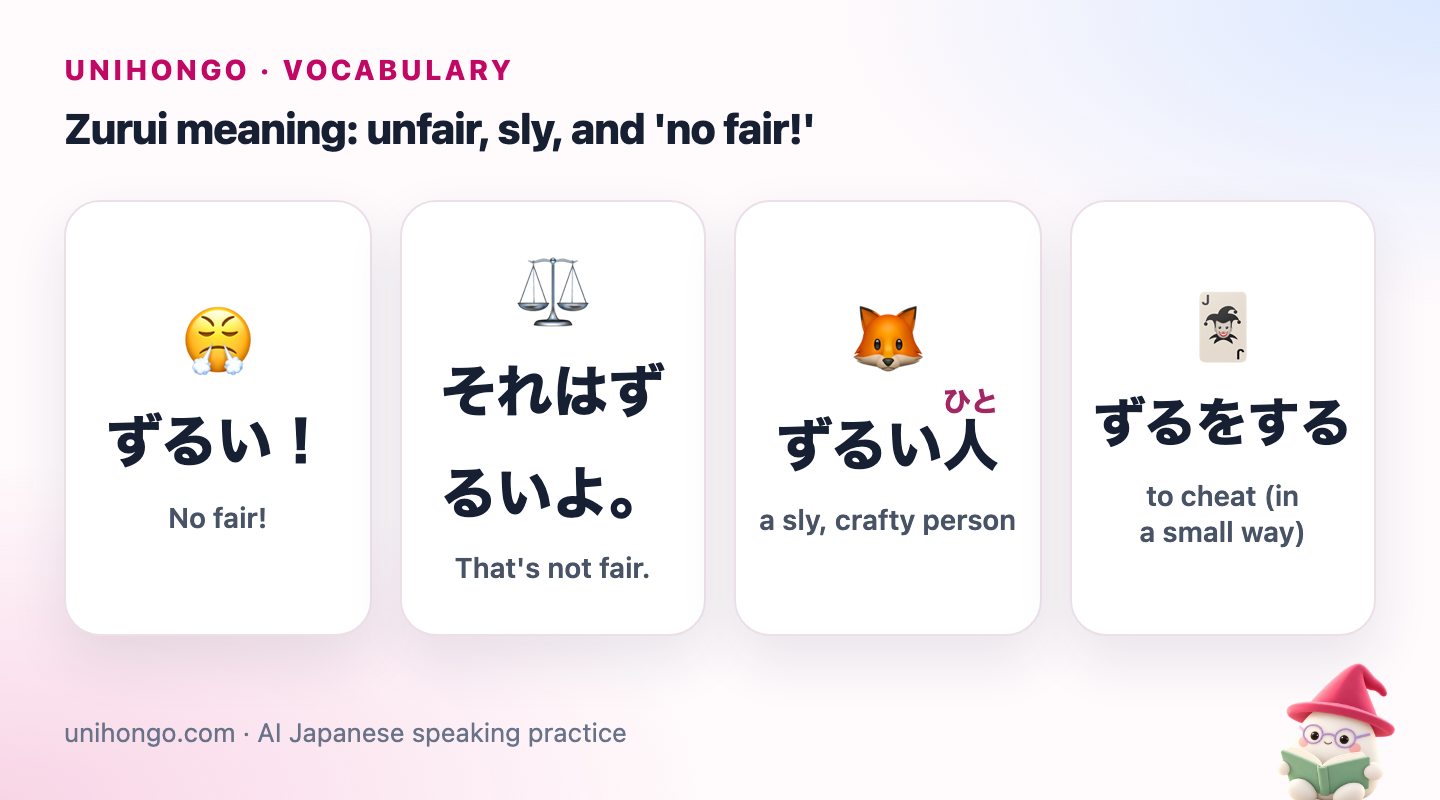
| Japanese | Romaji | Meaning |
|---|---|---|
| ずるい! | Zurui! | No fair! |
| それはずるいよ。 | Sore wa zurui yo. | That's not fair. |
| ずるい人 | zurui hito | a sly, crafty person |
| ずるをする | zuru o suru | to cheat (in a small way) |
Zurui is casual by nature. You will hear it constantly among friends, siblings, classmates and couples, and rarely in formal speech.
The playful zurui: envy among friends
The most common zurui in daily life is not an accusation at all. When a friend tells you some good news that you wish were yours, zurui! is a fun, exaggerated protest. It means something like lucky you, I'm jealous, and it is often paired with ii na (how nice) and a request to share.
Because it shows that you care about the news, a playful zurui can actually be warm. The tone is high and bright, often with a laugh or a pout. Saying it flatly changes the meaning, so keep the energy up.
| Japanese | Romaji | Meaning |
|---|---|---|
| いいな、ずるい! | Ii na, zurui! | Lucky you, no fair! |
| えー、ずるい!私も行きたい! | Ē, zurui! Watashi mo ikitai! | Aw, no fair! I want to go too! |
| 一人だけずるいよ。 | Hitori dake zurui yo. | Not fair, just you getting it. |
| ずるい、一口ちょうだい。 | Zurui, hitokuchi chōdai. | No fair, give me a bite. |
Zurui as a compliment: 'unfairly good'
Zurui has a softer, almost flattering use. When someone is so charming, talented or good-looking that it feels like cheating, people call it zurui. This is common in romance, fan talk about celebrities, and teasing between friends. The person is not doing anything wrong; they are simply too good.
| Japanese | Romaji | Meaning |
|---|---|---|
| その笑顔はずるい。 | Sono egao wa zurui. | That smile is unfair. |
| かわいすぎてずるい。 | Kawaisugite zurui. | It's so cute it's not fair. |
| 料理もできるの?ずるい! | Ryōri mo dekiru no? Zurui! | You can cook too? No fair! |
In a love story, a character who says zurui yo to the person they like may also mean you are toying with my feelings: saying sweet things without making your feelings clear. Context decides which.
When zurui is a real accusation
Said seriously, zurui is a complaint that someone is not playing fair: cutting in line, using a loophole, letting others do the work, changing their move after seeing yours. In a game of rock, paper, scissors, throwing late is atodashi, and atodashi wa zurui is a standard protest.
Calling a person a zurui hito, or saying anata wa zurui with a straight face, criticises their character. That is strong, so save it for real situations and expect the other person to react.
| Japanese | Romaji | Meaning |
|---|---|---|
| 後出しはずるい! | Atodashi wa zurui! | Throwing late is cheating! |
| 順番を抜かすのはずるいですよ。 | Junban o nukasu no wa zurui desu yo. | Cutting in line isn't fair. |
| 自分だけ楽をするなんてずるい。 | Jibun dake raku o suru nante zurui. | It's not fair that only you take it easy. |
| あの人はずるいところがある。 | Ano hito wa zurui tokoro ga aru. | That person has a sly streak. |
| Word | Strength | What it suggests |
|---|---|---|
| zurui (ずるい) | Mild to medium | Unfair, sly, taking an advantage |
| sekoi (せこい) | Mild, casual | Petty, stingy, small-minded tricks |
| hikyō (卑怯) | Strong | Cowardly, dirty, dishonourable |
| inchiki (インチキ) | Strong, casual | Fraud, a rigged game, fake |
Hikyō is a word you hear in dramas and anime fights: attacking from behind is hikyō. It is much heavier than zurui, so do not use it for small everyday unfairness.
Zuru, zuru-yasumi and other set phrases
The noun zuru (ずる) means a small act of cheating, and it appears in a few everyday phrases. Zuru-yasumi (ずる休み) means skipping school or work while pretending to be sick, a bit like playing hooky. Children say zuru shita! when a friend peeks during hide-and-seek. Adults use the same phrase jokingly about eating before everyone has sat down.
| Japanese | Romaji | Meaning |
|---|---|---|
| 今、ずるしたでしょう。 | Ima, zuru shita deshō. | You just cheated, didn't you? |
| ずるしてないよ! | Zuru shite nai yo! | I didn't cheat! |
| 昨日、学校をずる休みした。 | Kinō, gakkō o zuru-yasumi shita. | Yesterday I skipped school. |
| 先に食べるのはずるいよ。 | Saki ni taberu no wa zurui yo. | Eating first isn't fair. |
Politeness and common mistakes
Zurui belongs to casual speech. In a meeting, telling a colleague that their proposal is zurui would sound childish and personal. When fairness really matters at work, describe the situation instead and use fukōhei (不公平), unfair, which sounds objective rather than emotional.
| Japanese | Romaji | Meaning |
|---|---|---|
| それは少し不公平だと思います。 | Sore wa sukoshi fukōhei da to omoimasu. | I think that's a little unfair. |
| 順番に決めませんか。 | Junban ni kimemasen ka. | Shall we decide by taking turns? |
- Saying it flatly when you mean to tease. Without a smile and bright tone, ii na, zurui can sound genuinely resentful.
- Using it to a superior. Even a playful zurui to your manager about their holiday can feel too familiar. Ii desu ne, how nice, is safer.
- Confusing it with kitanai. Kitanai means dirty, and kitanai te, a dirty trick, is stronger than zurui.
- Thinking it always means cheating. Most of the time, between friends, it means you are a little jealous and happy for them at the same time.
How to reply when someone calls you zurui
When a friend shouts zurui! at your good news, they are usually inviting you to play along. The natural replies are modest: you were just lucky, it was a coincidence, or you will share. Downplaying your luck is a common way to keep the moment friendly, and offering to treat your friend turns their envy into a laugh.
If someone calls you zurui seriously, for example because they think you skipped a queue, do not answer with a joke. Apologise if they are right, or explain calmly if they are not: I was holding this place for my friend, or I was told to come to this counter.
| Japanese | Romaji | Meaning |
|---|---|---|
| ずるくないよ!運が良かっただけ。 | Zurukunai yo! Un ga yokatta dake. | It's not unfair! I just got lucky. |
| たまたまだよ。 | Tamatama da yo. | It was just by chance. |
| 今度おごるから、許して。 | Kondo ogoru kara, yurushite. | I'll treat you next time, forgive me. |
| すみません、気づきませんでした。 | Sumimasen, kizukimasen deshita. | Sorry, I didn't realise. |
| 友達の場所を取っていたんです。 | Tomodachi no basho o totte ita n desu. | I was saving a place for my friend. |
Mini dialogue: your friend got the concert tickets
Your friend tried for tickets to a band you both love, and you missed out. Now they show you the confirmation. A natural reaction mixes playful protest, curiosity and a hopeful question.

| Japanese | Romaji | Meaning |
|---|---|---|
| 見て、チケット取れた! | Mite, chiketto toreta! | Friend: Look, I got tickets! |
| えー、ずるい!どうやって? | Ē, zurui! Dō yatte? | You: No fair! How? |
| 抽選で当たったの。 | Chūsen de atatta no. | Friend: I won the lottery for them. |
| いいな。私は全部外れたよ。 | Ii na. Watashi wa zenbu hazureta yo. | You: Lucky you. I lost every draw. |
| 実は、二枚あるんだけど… | Jitsu wa, nimai aru n da kedo... | Friend: Actually, I've got two... |
| 本当?一緒に行っていい? | Hontō? Issho ni itte ii? | You: Really? Can I come with you? |