
The four-digit wall
English speakers read numbers in groups of three because our unit words change every three digits: thousand, million, billion. Japanese changes unit words every four digits: 万 man at ten thousand, 億 oku at a hundred million, 兆 chō at a trillion. The commas printed on Japanese price tags follow the Western three-digit convention, which is exactly why the tags mislead you. The comma in 12,000 is in the wrong place for the way you have to say it.
The fix is to stop reading left to right and instead find the man boundary first. Count four digits from the right and draw a mental line: 12,000 becomes 1 and 2000, so ichiman nisen. 150,000 becomes 15 and 0000, so jūgoman. 3,500,000 becomes 350 and 0000, so sanbyakugojūman. Once that line is drawn, the rest is ordinary counting up to 9,999 on each side of it.
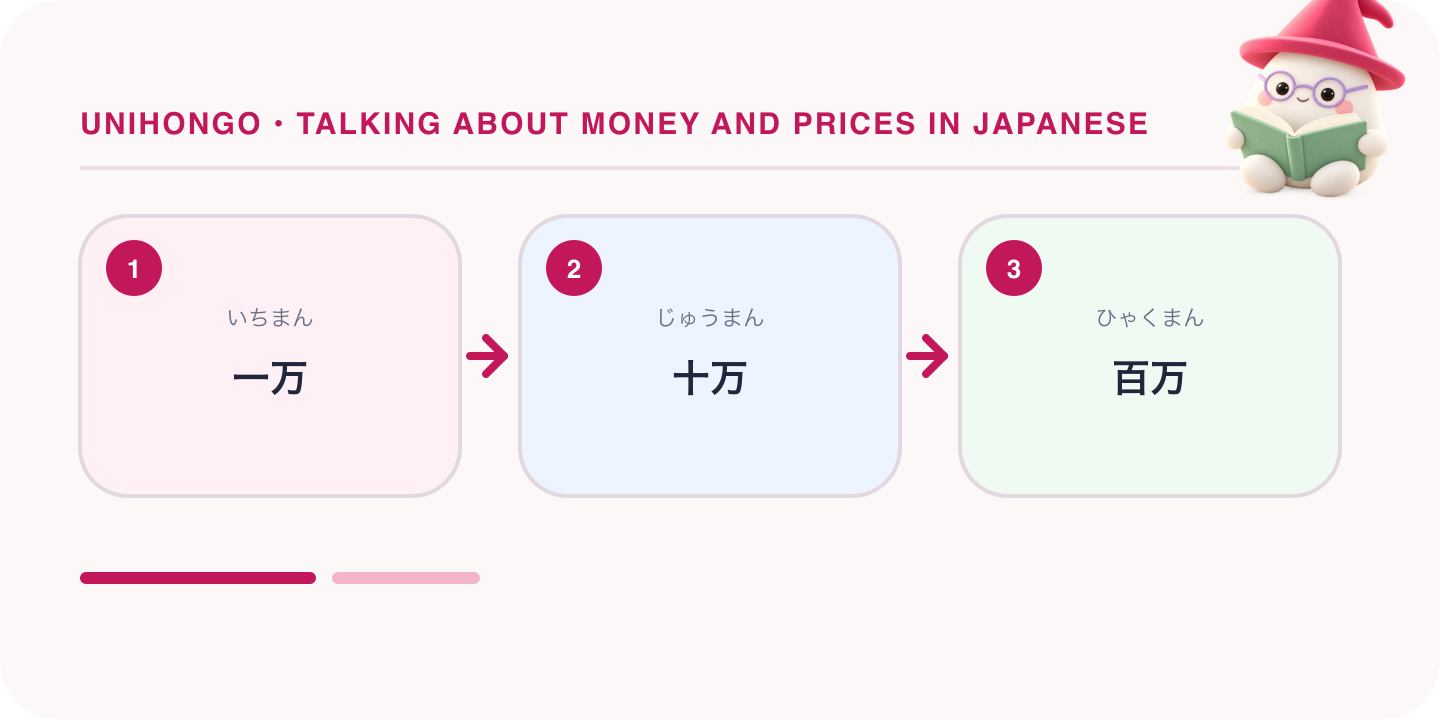
Number scales at a glance
| Scale | Value | Reading | Example price |
|---|---|---|---|
| 十 | 10 | Jū | 十円 jū-en, a ten yen coin |
| 百 | 100 | Hyaku | 百円 hyaku-en, a coffee at a convenience store |
| 千 | 1,000 | Sen | 千円 sen-en, the smallest note |
| 一万 | 10,000 | Ichiman | 一万円 ichiman-en, the largest common note |
| 十万 | 100,000 | Jūman | 十万円 jūman-en, a month of rent in many places |
| 百万 | 1,000,000 | Hyakuman | 百万円 hyakuman-en, a used car |
| 一千万 | 10,000,000 | Issenman | 一千万円 issenman-en, a deposit on a home |
| 一億 | 100,000,000 | Ichioku | 一億円 ichioku-en, a lottery headline |
| 一兆 | 1,000,000,000,000 | Itchō | 一兆円 itchō-en, a national budget line |
Two rules save most mistakes. First, 万 always needs a number in front of it, so ten thousand is ichiman and never bare man, unlike 千 and 百 which can stand alone as sen and hyaku. Second, everything between man and oku is just a number from 1 to 9999 followed by man, which means you never need a new word for hundred thousand or million.
Reading prices aloud without stumbling
Inside each four-digit block, three hundreds and two thousands change their sound. Three hundred is sanbyaku, six hundred is roppyaku, eight hundred is happyaku. Three thousand is sanzen and eight thousand is hassen. These five are the whole list, and they appear in prices constantly, so they are worth drilling on their own. In the counter itself, four yen is yo-en and seven yen is nana-en, though prices ending in those digits are rare.
String the blocks together with no linking word: 3,980 is sanzen kyūhyaku hachijū, and adding en gives sanzen kyūhyaku hachijū-en. Say it as three chunks rather than one long word, because that is how staff say it too, and chunking is what lets you catch it when it comes back at you at speed.
| Japanese | Romaji | Meaning |
|---|---|---|
| 三百円です。 | Sanbyaku-en desu. | It is 300 yen. |
| 六百円です。 | Roppyaku-en desu. | It is 600 yen. |
| 八百円です。 | Happyaku-en desu. | It is 800 yen. |
| 三千円です。 | Sanzen-en desu. | It is 3,000 yen. |
| 八千円です。 | Hassen-en desu. | It is 8,000 yen. |
| 千二百八十円です。 | Sen nihyaku hachijū-en desu. | It is 1,280 yen. |
| 三千九百八十円です。 | Sanzen kyūhyaku hachijū-en desu. | It is 3,980 yen. |
| 一万二千円です。 | Ichiman nisen-en desu. | It is 12,000 yen. |
| 十五万円です。 | Jūgoman-en desu. | It is 150,000 yen. |
Asking how much and catching the answer
Ikura desu ka is the core question and it takes wa for the thing you are asking about. For a total, put zenbu de in front of it. In a restaurant you rarely ask for a number at all: you ask for the bill with okaikei o onegai shimasu, and the number arrives on paper. When a total comes back too fast, the repair phrases matter more than the number itself, so learn them as a pair with the question.
Staff usually wrap the figure in a set frame: sen gohyaku-en ni narimasu or okaikei wa sen gohyaku-en de gozaimasu. Because the frame never changes, you can train your ear to ignore it and listen only for the digits in the middle. That single habit turns a wall of polite Japanese into a two-second listening task.
| Japanese | Romaji | Meaning |
|---|---|---|
| これはいくらですか? | Kore wa ikura desu ka? | How much is this? |
| 全部でいくらですか? | Zenbu de ikura desu ka? | How much is it altogether? |
| お会計をお願いします。 | Okaikei o onegai shimasu. | The bill, please. |
| 千五百円になります。 | Sen gohyaku-en ni narimasu. | That comes to 1,500 yen. (staff) |
| ちょうど二千円です。 | Chōdo nisen-en desu. | That is exactly 2,000 yen. (staff) |
| すみません、もう一度お願いします。 | Sumimasen, mō ichido onegai shimasu. | Sorry, could you say that again? |
| ゆっくり言っていただけますか? | Yukkuri itte itadakemasu ka? | Could you say it slowly? |
| 少し高いですね。 | Sukoshi takai desu ne. | That is a little expensive. |
| もっと安いのはありますか? | Motto yasui no wa arimasu ka? | Do you have a cheaper one? |
Cash, card, or code
| Japanese | Romaji | When you use it |
|---|---|---|
| 現金でお願いします。 | Genkin de onegai shimasu. | Paying with cash |
| カードでお願いします。 | Kādo de onegai shimasu. | Paying by card |
| カードは使えますか? | Kādo wa tsukaemasu ka? | Checking that cards are accepted |
| 一括でお願いします。 | Ikkatsu de onegai shimasu. | One single payment, not instalments |
| 分割でお願いします。 | Bunkatsu de onegai shimasu. | Paying in instalments |
| コード決済でお願いします。 | Kōdo kessai de onegai shimasu. | Paying with a QR or barcode app |
| 電子マネーで払えますか? | Denshi manē de haraemasu ka? | Asking about tap-to-pay e-money |
| ここにタッチしてください。 | Koko ni tatchi shite kudasai. | Staff: tap your card or phone here |
| 暗証番号を入力してください。 | Anshō bangō o nyūryoku shite kudasai. | Staff: enter your PIN |
| サインをお願いします。 | Sain o onegai shimasu. | Staff: please sign |
| 袋はご利用ですか? | Fukuro wa goriyō desu ka? | Staff: would you like a bag |
| ポイントカードはお持ちですか? | Pointo kādo wa omochi desu ka? | Staff: do you have a point card |
| レシートは要りません。 | Reshīto wa irimasen. | Declining the receipt |
| 両替できますか? | Ryōgae dekimasu ka? | Asking to break a large note |
Cash is still normal in Japan, especially in small restaurants, at shrines and festivals, and in older shops, so carrying notes matters even where cards are common. Acceptance varies by shop and changes over time, so the one-line check kādo wa tsukaemasu ka before you order is worth more than any assumption.
A full checkout exchange
| Japanese | Romaji | Meaning |
|---|---|---|
| いらっしゃいませ。 | Irasshaimase. | Welcome. (staff) |
| お会計は千八百円でございます。 | Okaikei wa sen happyaku-en de gozaimasu. | Your total is 1,800 yen. (staff) |
| カードでお願いします。 | Kādo de onegai shimasu. | By card, please. |
| お支払い回数はいかがなさいますか? | Oshiharai kaisū wa ikaga nasaimasu ka? | How many payments would you like? (staff) |
| 一括でお願いします。 | Ikkatsu de onegai shimasu. | One payment, please. |
| 二千円お預かりします。 | Nisen-en oazukari shimasu. | Taking 2,000 yen from you. (staff) |
| 二百円のお返しです。 | Nihyaku-en no okaeshi desu. | Here is your 200 yen change. (staff) |
| ちょうどお預かりします。 | Chōdo oazukari shimasu. | That is the exact amount, thank you. (staff) |
| ありがとうございました。 | Arigatō gozaimashita. | Thank you very much. (staff) |
Every line above except the number is fixed. Oazukari shimasu means the staff member is holding your money while the till calculates, and okaeshi is the change coming back. Hearing those two words tells you where you are in the exchange even if you missed the figure entirely.
The tray, the change, and the receipt
In most shops there is a small tray on the counter. Notes and coins usually go on the tray rather than into the staff member's hand, and change is often handed back directly, sometimes with the receipt underneath the coins. This is common practice rather than a rule, and plenty of small stalls simply take cash by hand, so follow what the person in front of you did.
| Japanese | Romaji | Meaning |
|---|---|---|
| お金はトレーに置いてください。 | Okane wa torē ni oite kudasai. | Please put the money on the tray. (staff) |
| 小銭がありません。 | Kozeni ga arimasen. | I do not have any small change. |
| 細かいのがないんですが。 | Komakai no ga nain desu ga. | I am afraid I have nothing smaller. |
| 一万円札でもいいですか? | Ichiman-en satsu demo ii desu ka? | Is a 10,000 yen note all right? |
| お釣りをお願いします。 | Otsuri o onegai shimasu. | My change, please. |
| レシートをお願いします。 | Reshīto o onegai shimasu. | The receipt, please. |
| 領収書をいただけますか? | Ryōshūsho o itadakemasu ka? | Could I have a formal receipt? |
Tax included and tax excluded
Japanese price tags distinguish 税込 zeikomi, tax included, from 税抜 zeinuki or 本体価格 hontai kakaku, the price before consumption tax. Many tags print both, often with the tax-included figure in smaller type, which is how a shelf price and a till total end up different. Consumption tax rates and the categories they apply to change over time and can differ for food and for eating in versus taking away, so read the tag and ask rather than assuming a rate.
| Japanese | Romaji | Meaning |
|---|---|---|
| これは税込みですか? | Kore wa zeikomi desu ka? | Is this price tax included? |
| 税抜きの値段です。 | Zeinuki no nedan desu. | That is the price before tax. (staff) |
| 税込で千百円です。 | Zeikomi de sen hyaku-en desu. | It is 1,100 yen including tax. (staff) |
| 消費税は別にかかります。 | Shōhizei wa betsu ni kakarimasu. | Consumption tax is charged separately. (staff) |
| 店内でお召し上がりですか? | Tennai de omeshiagari desu ka? | Are you eating in? (staff) |
| 免税できますか? | Menzei dekimasu ka? | Is tax-free shopping available? |
Splitting the bill and paying separately
Betsubetsu asks the till to ring up each person's items separately, and it is normal in cafes and casual restaurants, though busy places and some izakaya will decline and hand you one bill. Warikan is the social act of dividing a single total between friends afterwards, usually into round numbers. If someone senior invites you, expect them to pay, and thank them properly rather than insisting.
| Japanese | Romaji | Meaning |
|---|---|---|
| 別々でお願いします。 | Betsubetsu de onegai shimasu. | Separate bills, please. |
| 一緒でお願いします。 | Issho de onegai shimasu. | All together, please. |
| 申し訳ありません、お会計は一緒になります。 | Mōshiwake arimasen, okaikei wa issho ni narimasu. | I am sorry, the bill has to be one. (staff) |
| 割り勘にしましょう。 | Warikan ni shimashō. | Let us split it evenly. |
| 一人三千円です。 | Hitori sanzen-en desu. | It is 3,000 yen each. |
| 今日は私が払います。 | Kyō wa watashi ga haraimasu. | I will pay today. |
| ごちそうさまでした。 | Gochisōsama deshita. | Thank you for the meal. |
| 立て替えておきます。 | Tatekaete okimasu. | I will cover it for now. |
| あとで返します。 | Ato de kaeshimasu. | I will pay you back later. |
Sales, discounts, and bargains
Discounts are usually expressed with 割 wari, which is a tenth, so niwaribiki is twenty percent off and sanwaribiki is thirty percent off. Percentages and the word ofu also appear on signs. Hangaku means half price, and okaidoku marks something as good value. Haggling is not normal in ordinary shops, so treat yasuku narimasen ka as a question you would only use at a flea market or a very informal stall.
| Japanese | Romaji | Meaning |
|---|---|---|
| 今セール中です。 | Ima sēru-chū desu. | There is a sale on at the moment. (staff) |
| 二割引です。 | Niwaribiki desu. | It is twenty percent off. (staff) |
| 半額になっています。 | Hangaku ni natte imasu. | It is half price. (staff) |
| こちらはお買い得ですよ。 | Kochira wa okaidoku desu yo. | This one is good value. (staff) |
| 少し安くなりませんか? | Sukoshi yasuku narimasen ka? | Could you make it a bit cheaper? |
| 送料は無料です。 | Sōryō wa muryō desu. | Delivery is free. |
| 返品できますか? | Henpin dekimasu ka? | Can I return this? |
| 返金してもらえますか? | Henkin shite moraemasu ka? | Could I have a refund? |
Rent, salary, and sending money
Money talk between friends stays general in Japanese. People discuss yachin, rent, and seikatsuhi, living costs, fairly openly, but asking a colleague their exact kyūryō is intrusive. Say a range with kurai, or answer with futsū desu, it is about average. For sending money, furikomi is a bank transfer and sōkin is remittance in general; a dedicated post covers bank counters in detail, so this is only the vocabulary you need in conversation.
| Japanese | Romaji | Meaning |
|---|---|---|
| 予算は一万円くらいです。 | Yosan wa ichiman-en kurai desu. | My budget is around 10,000 yen. |
| 家賃はいくらですか? | Yachin wa ikura desu ka? | How much is the rent? |
| 家賃は七万円くらいです。 | Yachin wa nanaman-en kurai desu. | The rent is about 70,000 yen. |
| 時給で働いています。 | Jikyū de hataraite imasu. | I am paid by the hour. |
| 給料日は二十五日です。 | Kyūryōbi wa nijūgo-nichi desu. | Payday is the twenty-fifth. |
| 毎月少し貯金しています。 | Maitsuki sukoshi chokin shite imasu. | I save a little every month. |
| 最近節約しています。 | Saikin setsuyaku shite imasu. | I have been cutting back lately. |
| 振り込みでお願いします。 | Furikomi de onegai shimasu. | By bank transfer, please. |
| 家族に送金しています。 | Kazoku ni sōkin shite imasu. | I send money to my family. |
| 手数料はいくらですか? | Tesūryō wa ikura desu ka? | How much is the fee? |
| 口座番号を教えてください。 | Kōza bangō o oshiete kudasai. | Please tell me the account number. |
Nanaman-en in that third row is a good example of the four-digit habit paying off: seventy thousand is seven man, not seventy of anything. Once that mapping is automatic, rent, salaries, and flight prices all stop being a mental arithmetic problem in the middle of a conversation.