
What kanpai says
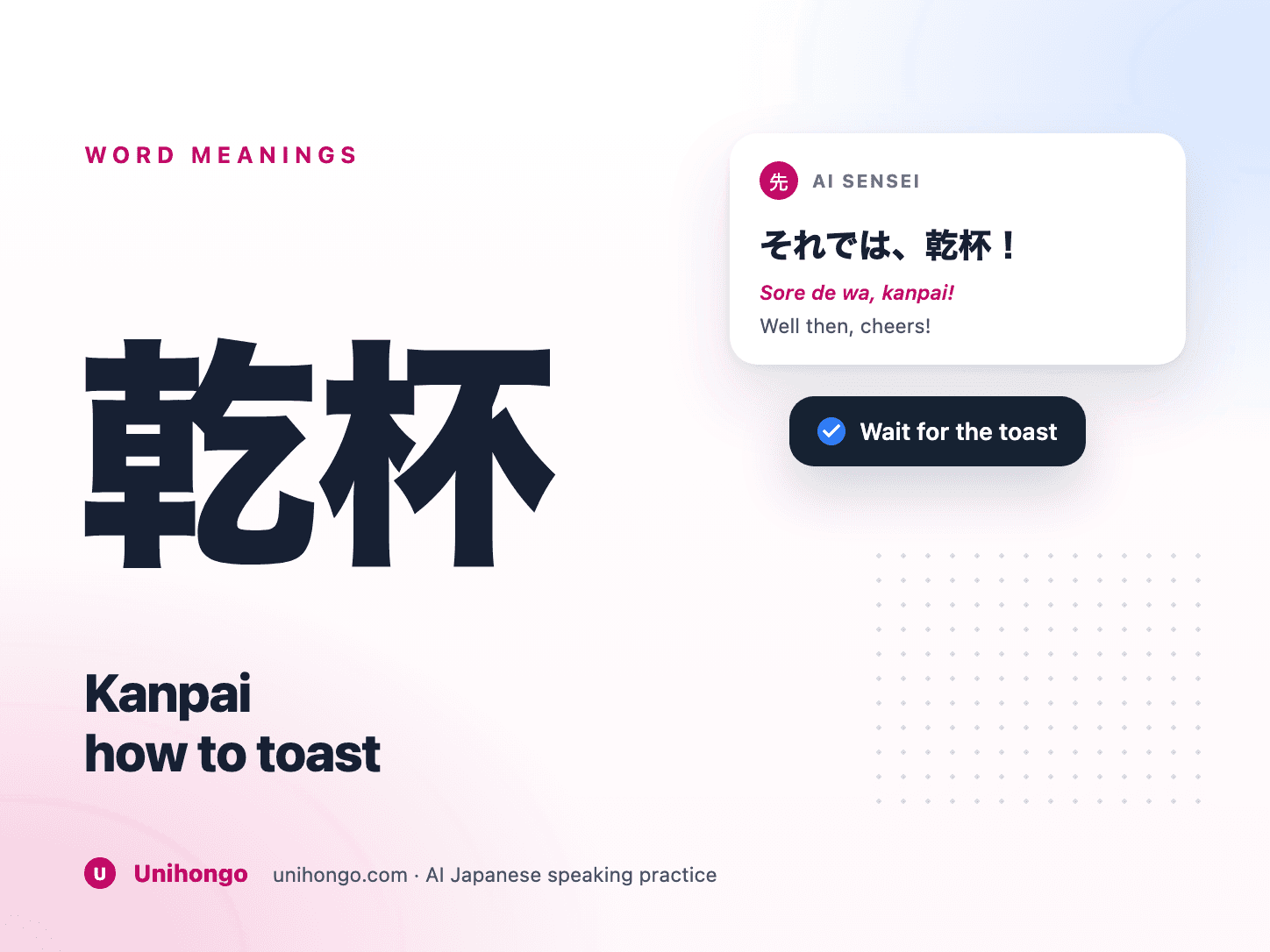
Kanpai is written with the characters for dry and cup, so the literal meaning is drain your cup. In practice it is simply cheers, and the literal meaning survives only as a joke when someone actually empties their glass.
It is said together, loudly and brightly, with glasses raised. The word is the signal that the gathering has officially begun.
| Japanese | Romaji | Meaning |
|---|---|---|
| 乾杯! | Kanpai! | Cheers! |
| それでは、乾杯! | Sore de wa, kanpai! | Well then, cheers! |
| 乾杯しましょう。 | Kanpai shimashō. | Let's make a toast |
Wait for the toast
At a group meal, the first drinks arrive and everyone waits, even if the glasses sit there for a minute. Drinking before the toast is one of the few table mistakes people genuinely notice.
In a work or formal setting someone is chosen to lead the toast, often after a short speech. In a casual group, whoever is most organised simply says it.
| Japanese | Romaji | Meaning |
|---|---|---|
| とりあえずビールで。 | Toriaezu bīru de. | Beer for now, to start |
| 皆さん、グラスをお持ちください。 | Minasan, gurasu o o-mochi kudasai. | Everyone, please take your glass |
| 乾杯の音頭を取らせていただきます。 | Kanpai no ondo o torasete itadakimasu. | Allow me to lead the toast |
| 飲み物、そろいましたか。 | Nomimono, soroimashita ka. | Does everyone have a drink? |
Kanpai and otsukaresama
After work, the toast usually starts with otsukaresama, thanks for your hard work, and ends with kanpai. Among close colleagues the whole toast may be just otsukare followed by clinking glasses.
For celebrations, the formula is the occasion plus o shukushite, in celebration of, followed by kanpai.
| Japanese | Romaji | Meaning |
|---|---|---|
| お疲れ様です。乾杯! | Otsukaresama desu. Kanpai! | Thanks for your hard work. Cheers! |
| お疲れー! | Otsukare! | Good work, everyone!: casual |
| プロジェクトの成功を祝して、乾杯! | Purojekuto no seikō o shukushite, kanpai! | To the success of the project, cheers! |
| お二人の幸せを祈って、乾杯! | O-futari no shiawase o inotte, kanpai! | To the happiness of the couple, cheers! |
Glasses and pouring, briefly
Two small habits go with the toast. When clinking with someone senior, hold your glass slightly lower than theirs. At tables with shared bottles, people pour for each other rather than for themselves.
Neither is enforced strictly in casual settings, and the full etiquette of work drinking parties is its own topic. For kanpai itself, raising your glass and joining in is what counts.
- Raise your glass when the leader says kanpai.
- Clink with the people near you, not across the table.
- Hold your glass a little lower than a senior's.
- Clapping briefly after the toast is common.
Toasting without alcohol
Not drinking is completely acceptable in Japan, whether for health, religion, driving or preference. Order oolong tea or a soft drink with the first round, and raise it with everyone else.
A short reason is enough, and you do not need to apologise at length.
| Japanese | Romaji | Meaning |
|---|---|---|
| お酒が飲めないので、ウーロン茶で。 | O-sake ga nomenai node, ūroncha de. | I can't drink alcohol, so oolong tea for me |
| 車なので、ノンアルコールで。 | Kuruma na node, non-arukōru de. | I'm driving, so something non-alcoholic |
| ソフトドリンクで乾杯させてください。 | Sofuto dorinku de kanpai sasete kudasai. | Let me join the toast with a soft drink |
| 今日はお茶にしておきます。 | Kyō wa o-cha ni shite okimasu. | I'll stick with tea today |
Kenpai: the memorial toast
At a meal after a funeral or at a memorial service, the toast changes. Instead of kanpai, the leader says kenpai, written with characters meaning to offer a cup, and it is dedicated to the person who has died.
Everything about it is quiet. Glasses are raised gently, not clinked, the word is said in a low voice, and there is no clapping afterwards. Saying kanpai loudly at such a gathering would be a painful mistake.
| Japanese | Romaji | Meaning |
|---|---|---|
| 献杯 | kenpai | A memorial toast |
| 故人を偲んで、献杯。 | Kojin o shinonde, kenpai. | In memory of the deceased, a toast |
| 献杯の音頭を取らせていただきます。 | Kenpai no ondo o torasete itadakimasu. | Allow me to lead the memorial toast |