
What zettai means in one minute
Zettai is an adverb that turns a statement up to full strength: absolutely, definitely, for sure, no matter what. It fits promises, strong opinions, confident predictions, enthusiastic recommendations, firm bans and flat refusals. It is everyday Japanese, heard far more in conversation than in formal writing.
Its power comes with a cost. Because it is so strong, it can sound childish or pushy if you use it all the time, and blunt in polite situations.
You will hear it everywhere in anime and dramas, from vows before a big match to arguments between siblings, and in song lyrics about love that will never end. In real life, it is just as common in small moments: insisting a café is good, refusing to eat nattō, promising to send photos after a trip.
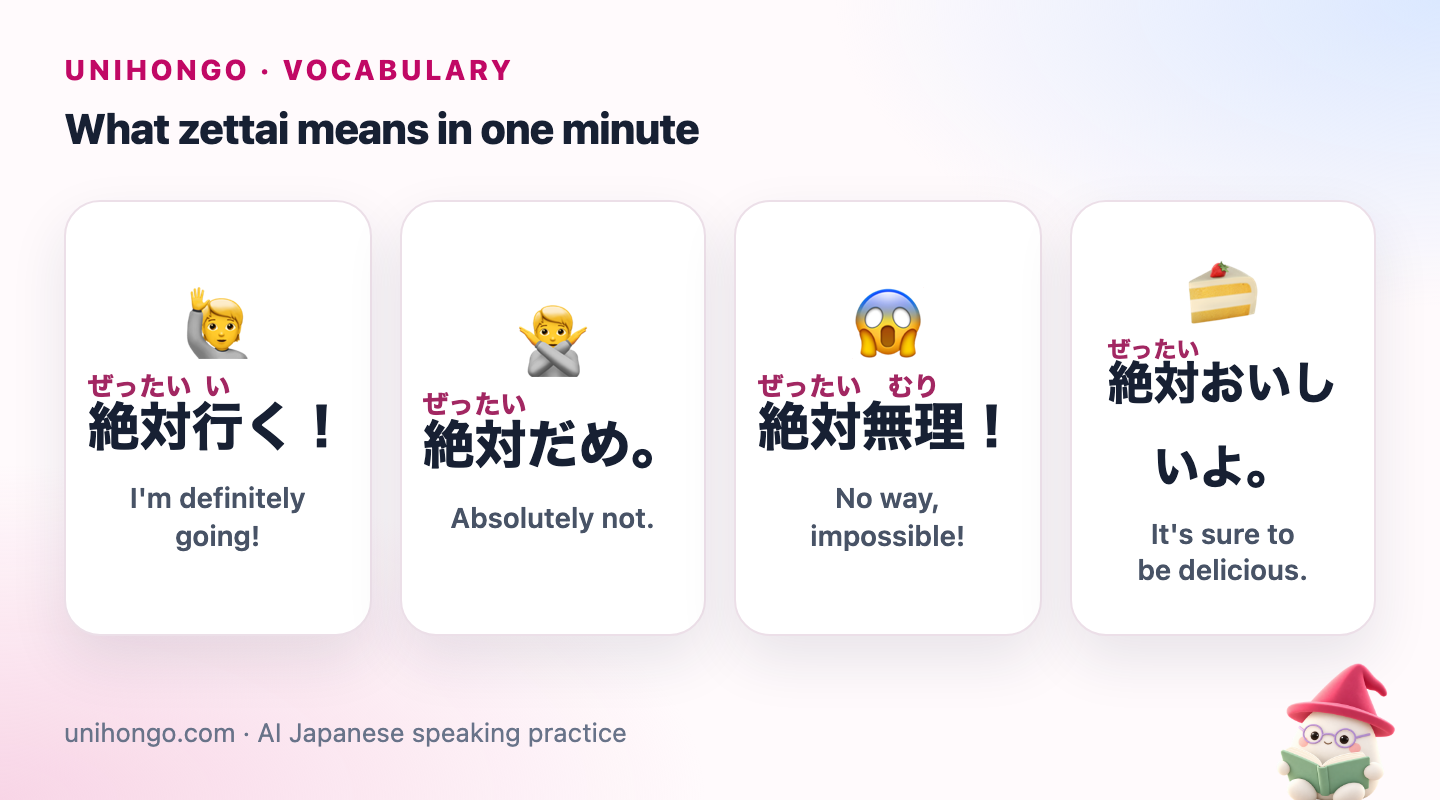
| Japanese | Romaji | Meaning |
|---|---|---|
| 絶対行く! | Zettai iku! | I'm definitely going! |
| 絶対だめ。 | Zettai dame. | Absolutely not. |
| 絶対無理! | Zettai muri! | No way, impossible! |
| 絶対おいしいよ。 | Zettai oishii yo. | It's sure to be delicious. |
The kanji and the grammar
Zettai is written 絶対. The first kanji means to cut off or to be beyond, and the second means opposite or against. Together they describe something beyond any comparison or opposition: the absolute. As a noun, zettai means the absolute, and zettaiteki (絶対的) means absolute, as in absolute power.
As an adverb, the full form is zettai ni. Conversation usually drops the ni: zettai iku and zettai ni iku mean the same thing. Zettai ni is a little more careful and is the form you will see in rules and instructions.
| Japanese | Romaji | Meaning |
|---|---|---|
| 絶対 | zettai | absolutely; the absolute |
| 絶対に | zettai ni | absolutely (full adverb form) |
| 絶対的な自信 | zettaiteki na jishin | absolute confidence |
| 絶対に触らないでください。 | Zettai ni sawaranaide kudasai. | Please do not touch under any circumstances. |
Every real use of zettai, with examples
Here is zettai in its everyday jobs. Notice that it often goes with yo, ne or a sentence ending that adds emotion.
| Japanese | Romaji | Meaning |
|---|---|---|
| 絶対連絡するね。 | Zettai renraku suru ne. | I'll definitely get in touch. (promise) |
| あれ、絶対田中さんだ。 | Are, zettai Tanaka-san da. | That's definitely Tanaka. (certainty) |
| この映画、絶対見たほうがいいよ。 | Kono eiga, zettai mita hō ga ii yo. | You absolutely have to see this film. |
| 明日は絶対晴れるよ。 | Ashita wa zettai hareru yo. | It's definitely going to be sunny tomorrow. |
| それは絶対いや。 | Sore wa zettai iya. | No way am I doing that. |
| 絶対来てね! | Zettai kite ne! | You've got to come, okay? |
Zettai also works for confident guesses about other people and the future, as in ashita wa zettai hareru yo. Here it shows feeling more than knowledge: the speaker cannot know the weather, but wants to sound sure. If you want to sound reasonable rather than excited, kitto or tabun fits better, as the comparison below shows.
Zettai with negatives: never
When zettai comes before a negative verb, it means never or absolutely not. This is the zettai of vows and warnings: zettai makenai (I will never lose) is a classic anime line, and zettai wasurenai (I'll never forget) shows up in farewells and songs.
In rules and instructions the full form zettai ni is common, for example zettai ni osanaide kudasai (never push this button). It is clear and firm, which is why you see it in safety notices and hear it from teachers on school trips. In an apology, mō zettai… shimasen promises that a mistake will not happen again, and it sounds sincere as long as you keep the promise.
| Japanese | Romaji | Meaning |
|---|---|---|
| 絶対忘れない。 | Zettai wasurenai. | I'll never forget. |
| 絶対負けない! | Zettai makenai! | I will never lose! |
| もう絶対遅刻しません。 | Mō zettai chikoku shimasen. | I will never be late again. |
| 誰にも絶対言わないで。 | Dare ni mo zettai iwanaide. | Don't you dare tell anyone. |
Zettai vs kanarazu vs kitto
English often uses definitely for all three of these, but Japanese separates them. Zettai is emotional and absolute. Kanarazu (必ず) means without fail: it fits rules, habits and polite promises about your own actions. Kitto (きっと) is a confident guess or hope about something you cannot control.
| Japanese | Romaji | Meaning |
|---|---|---|
| 必ず連絡します。 | Kanarazu renraku shimasu. | I will be sure to contact you. (polite) |
| 毎朝必ずコーヒーを飲みます。 | Maiasa kanarazu kōhī o nomimasu. | I always have coffee every morning. |
| きっと大丈夫ですよ。 | Kitto daijōbu desu yo. | I'm sure it'll be fine. |
| 彼はたぶん来ないと思う。 | Kare wa tabun konai to omou. | I think he probably won't come. |
| Word | Core idea | Typical use | With negatives? |
|---|---|---|---|
| zettai (絶対) | Absolutely, no matter what | Promises, strong feelings, bans | Yes: never |
| kanarazu (必ず) | Without fail, every time | Rules, routines, polite promises | Rarely |
| kitto (きっと) | Surely, I bet | Hopes and confident guesses | Yes: surely not |
| tabun (たぶん) | Probably | Ordinary guesses | Yes: probably not |
For never in polite speech, use zettai ni with a negative, or kesshite (決して), never, which is formal: kesshite wasuremasen, I shall never forget.
Overuse, politeness and learner mistakes
Zettai is fun to say, so learners sprinkle it everywhere. Japanese speakers do use it a lot among friends, but too much makes you sound like an excited teenager, and in polite speech it can sound pushy or stubborn. When you disagree with a colleague, zettai chigaimasu (that's absolutely wrong) is a slammed door. Sore wa chotto chigau kamo shiremasen, that might not be quite right, keeps the conversation open.
| Japanese | Romaji | Meaning |
|---|---|---|
| それはちょっと難しいです。 | Sore wa chotto muzukashii desu. | That's a little difficult. (polite refusal) |
| 必ず伺います。 | Kanarazu ukagaimasu. | I will be sure to come. (humble) |
- Mistake 1: using kitto for your own promise. Kitto ikimasu sounds like a hopeful guess. Use kanarazu ikimasu or zettai iku.
- Mistake 2: kanarazu with a negative to mean never. Use zettai ni or kesshite. Kanarazushimo with a negative means not necessarily, a different idea.
- Mistake 3: zettai in every sentence. Save it for things you really mean.
- Mistake 4: zettai muri to a host or boss. It sounds like a flat refusal. Say chotto muzukashii desu, that's a bit difficult.
Zettai as a reply, and other strong words
Zettai works on its own as a one-word question or answer. Zettai? with rising intonation asks for sure? or promise?, and zettai! answers definitely! It is the spoken version of a pinky promise between friends.
When you want strength without the emotion of zettai, other words help. Mochiron means of course, and it is fine in polite speech too. Machigai naku, without a doubt, sounds confident and measured. Kanzen ni, completely, describes degree rather than certainty: kanzen ni wasureteta, I completely forgot.
| Japanese | Romaji | Meaning |
|---|---|---|
| 絶対? | Zettai? | For sure? Promise? |
| 絶対! | Zettai! | Definitely! |
| もちろんです。 | Mochiron desu. | Of course. (polite) |
| 間違いなくおいしいです。 | Machigai naku oishii desu. | It's delicious, no doubt about it. |
| 完全に忘れてた。 | Kanzen ni wasureteta. | I completely forgot. |
Mini dialogue: concert tickets
Two friends have just found out their favourite band is touring. Notice zettai for the promise, kitto for the guess, and zettai muri for the refusal.

| Japanese | Romaji | Meaning |
|---|---|---|
| ライブのチケット、取れた! | Raibu no chiketto, toreta! | Nao: I got the concert tickets! |
| 本当?絶対行く! | Hontō? Zettai iku! | Alex: Really? I'm definitely going! |
| 最前列は無理だったけど。 | Saizenretsu wa muri datta kedo. | Nao: We couldn't get the front row, though. |
| 大丈夫、きっと楽しいよ。 | Daijōbu, kitto tanoshii yo. | Alex: That's fine, I'm sure it'll be fun. |
| 朝五時に並ぶ? | Asa goji ni narabu? | Nao: Shall we queue from five in the morning? |
| それは絶対無理! | Sore wa zettai muri! | Alex: No way, that's impossible! |