
Three vocabularies for one evening
The Japanese you need for music is not one set but three. Taste vocabulary is what you use in conversation, and it is mostly nouns plus a small number of verbs. Logistics vocabulary is what you read: ticket pages, entry signs, and a handful of announcements, written in a compressed style with heavy compound nouns. Show-floor vocabulary is short and mostly heard rather than said.
Learners often study only the first group, then find that the evening itself runs on the second. A ticket page will not teach you kaijō and kaien gently; it prints them side by side and expects you to know which is which. Fifteen minutes with the reference table below removes almost all of that friction.
Genres and saying what you listen to
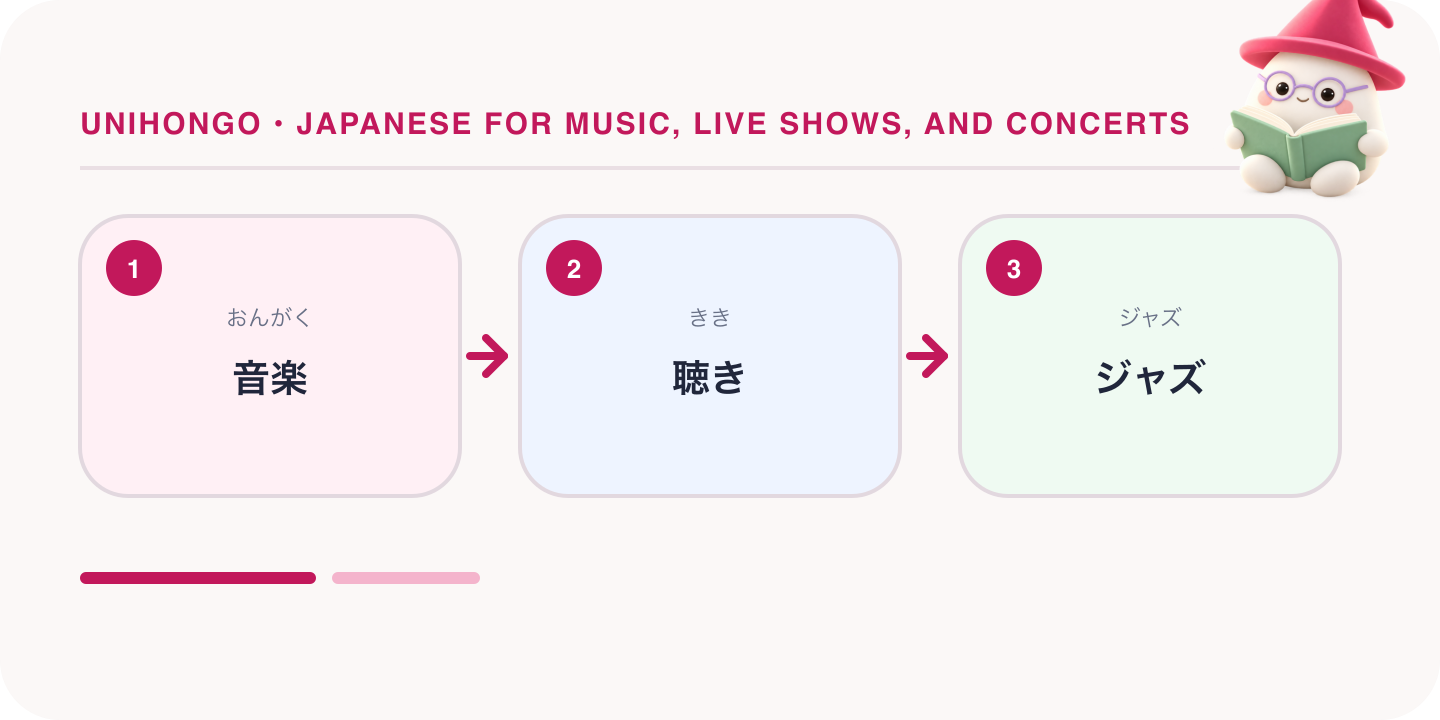
Genre words in Japanese are mostly loanwords, which makes them easy to recognise but easy to mispronounce, since each syllable gets its own beat. Two useful native terms are hōgaku for Japanese music and yōgaku for Western music, and enka for the older sentimental ballad style. To listen attentively, kiku is written 聴く; the ordinary 聞く is fine in most writing and identical in speech.
| Japanese | Romaji | Meaning |
|---|---|---|
| どんな音楽を聴きますか? | Donna ongaku o kikimasu ka? | What kind of music do you listen to? |
| ジャズをよく聴きます。 | Jazu o yoku kikimasu. | I often listen to jazz. |
| クラシックが好きです。 | Kurashikku ga suki desu. | I like classical music. |
| ロックとポップスを聴きます。 | Rokku to poppusu o kikimasu. | I listen to rock and pop. |
| 最近は演歌も聴いています。 | Saikin wa enka mo kiite imasu. | Lately I have been listening to enka as well. |
| 邦楽より洋楽のほうが多いです。 | Hōgaku yori yōgaku no hō ga ōi desu. | I listen to Western music more than Japanese music. |
| 通勤中に聴くことが多いです。 | Tsūkin-chū ni kiku koto ga ōi desu. | I usually listen on my commute. |
| どの曲が一番好きですか? | Dono kyoku ga ichiban suki desu ka? | Which track do you like best? |
Instruments and the verb that goes with each
Japanese chooses the verb by how the instrument is played. Strings and keyboards take hiku, so piano o hikimasu and gitā o hikimasu. Wind instruments take fuku, so furūto o fukimasu and shakuhachi o fukimasu. Drums and other struck instruments take tataku, so taiko o tatakimasu. Singing is utau, and the general verb ensō suru covers performing on any instrument in a slightly formal register.
The particle is o in every case, and the instrument keeps its own article-free noun form. When you talk about learning rather than playing, use narau for taking lessons and renshū suru for practising, as in piano o naratte imasu.
| Japanese | Romaji | Meaning |
|---|---|---|
| 楽器は何かできますか? | Gakki wa nanika dekimasu ka? | Do you play any instrument? |
| ギターを弾きます。 | Gitā o hikimasu. | I play the guitar. |
| ピアノを習っています。 | Piano o naratte imasu. | I am taking piano lessons. |
| フルートを吹きます。 | Furūto o fukimasu. | I play the flute. |
| 太鼓を叩いたことがあります。 | Taiko o tataita koto ga arimasu. | I have played taiko drums before. |
| 三味線の生演奏を聴きました。 | Shamisen no nama ensō o kikimashita. | I heard a live shamisen performance. |
| 歌うのは苦手です。 | Utau no wa nigate desu. | I am not good at singing. |
| 毎日三十分練習しています。 | Mainichi sanjuppun renshū shite imasu. | I practise for thirty minutes every day. |
Ticket and venue vocabulary at a glance
| Japanese | Reading | Meaning |
|---|---|---|
| 公演 | kōen | Performance or show |
| 会場 | kaijō | Venue |
| 開場 | kaijō | Doors open |
| 開演 | kaien | Show starts |
| 終演 | shūen | Show ends |
| 休憩 | kyūkei | Interval |
| 先行予約 | senkō yoyaku | Advance booking window |
| 抽選 | chūsen | Lottery draw |
| 申し込み | mōshikomi | Application |
| 当選 | tōsen | Selected in the draw |
| 落選 | rakusen | Not selected |
| 一般発売 | ippan hatsubai | General sale |
| 完売 | kanbai | Sold out |
| 前売り券 | maeuriken | Advance ticket |
| 当日券 | tōjitsuken | Same-day ticket |
| 電子チケット | denshi chiketto | E-ticket |
| 半券 | hanken | Ticket stub |
| 整理番号 | seiri bangō | Entry number |
| 指定席 | shiteiseki | Reserved seat |
| 自由席 | jiyūseki | Unreserved seat |
| 立ち見 | tachimi | Standing area |
| 座席表 | zasekihyō | Seating chart |
| 入場 | nyūjō | Entry |
| 本人確認 | honnin kakunin | Identity check |
| 身分証明書 | mibun shōmeisho | Photo identification |
| 転売禁止 | tenbai kinshi | Resale prohibited |
| 撮影禁止 | satsuei kinshi | No photography |
| 物販 | buppan | Merchandise sales |
| 最後尾 | saikōbi | End of the queue |
| クローク | kurōku | Cloakroom |
| ロッカー | rokkā | Coin locker |
| アンコール | ankōru | Encore |
| 拍手 | hakushu | Applause |
| 手拍子 | tebyōshi | Clapping in time |
| 声援 | seien | Cheering |
| 払い戻し | haraimodoshi | Refund |
| 中止 | chūshi | Cancellation |
| 延期 | enki | Postponement |
The pair to memorise first is 開場 and 会場. Both are read kaijō, but the first is a time on your ticket and the second is a place. A line such as kaijō wa rokuji, kaien wa shichiji means doors at six, start at seven, and misreading it costs you an hour on the pavement or a missed opening.
Watch the long vowels as well. Kōen with a long o is a performance, while kōen written 公園 is a park and kōen 講演 is a lecture. Shūen ends the show. Saying these with a short vowel is the single most common way a learner gets a blank look at a box office.
Applying when tickets go by lottery
For popular shows, tickets are commonly distributed by a draw rather than by speed. You register during a senkō yoyaku window, choose a date and a ticket type, and wait for the result. Being fast does not help; being inside the window does. Results arrive as tōsen if you were selected and rakusen if you were not, and payment is usually taken only after a successful draw.
This varies a great deal between shows and sellers, and rules change, so read each application page rather than assuming. What stays constant is the vocabulary: mōshikomi for the application, chūsen for the draw, hikkae for collection, and shiharai kigen for the payment deadline. Missing the deadline usually forfeits the ticket.
| Japanese | Romaji | Meaning |
|---|---|---|
| 先行予約はいつまでですか? | Senkō yoyaku wa itsu made desu ka? | When does the advance booking window close? |
| 抽選に申し込みました。 | Chūsen ni mōshikomimashita. | I applied for the lottery. |
| 当選しました。 | Tōsen shimashita. | I was selected. |
| 残念ながら落選でした。 | Zannen nagara rakusen deshita. | Unfortunately I was not selected. |
| 支払い期限はいつですか? | Shiharai kigen wa itsu desu ka? | When is the payment deadline? |
| 一般発売はいつ始まりますか? | Ippan hatsubai wa itsu hajimarimasu ka? | When does the general sale start? |
| もう完売だそうです。 | Mō kanbai da sō desu. | I hear it is already sold out. |
| 次の公演を待ちます。 | Tsugi no kōen o machimasu. | I will wait for the next show. |
Buying and collecting on the day
At a box office the exchange is short and predictable. You state what you want, hear a price, hand over payment, and receive the ticket with a fixed set of staff lines. Tōjitsuken means a same-day ticket, and asking whether any remain is the one question worth having ready before you arrive.
| Japanese | Romaji | Meaning |
|---|---|---|
| 当日券はまだありますか? | Tōjitsuken wa mada arimasu ka? | Are there still same-day tickets? |
| 大人一枚お願いします。 | Otona ichimai onegaishimasu. | One adult ticket, please. |
| 二枚、指定席でお願いします。 | Nimai, shiteiseki de onegaishimasu. | Two reserved seats, please. |
| 申し訳ありません、完売しております。 | Mōshiwake arimasen, kanbai shite orimasu. | Staff: I am sorry, we are sold out. |
| 身分証明書を拝見できますか? | Mibun shōmeisho o haiken dekimasu ka? | Staff: May I see your photo identification? |
| こちらが半券になります。 | Kochira ga hanken ni narimasu. | Staff: This is your stub. |
| 開場は何時ですか? | Kaijō wa nanji desu ka? | What time do the doors open? |
| 整理番号順にご入場ください。 | Seiri bangō-jun ni go-nyūjō kudasai. | Staff: Please enter in entry-number order. |
| 荷物はロッカーに預けられますか? | Nimotsu wa rokkā ni azukeraremasu ka? | Can I leave my bag in a locker? |
Standing or seated
Tickets usually say whether you are seated or standing, and the difference changes your whole evening. Shiteiseki gives you a numbered seat printed as row and number, so you can arrive close to kaien. Jiyūseki is unreserved seating, first come first served within a section. Sutandingu or tachimi means a standing floor with no seats, and that is where seiri bangō decides your entry order.
At standing shows, staff usually call entry numbers in blocks rather than one by one, so listen for a range such as ichiban kara hyakuban made. Once inside, people generally hold the space they took rather than pushing forward between pieces, and the area near the front fills first.
| Japanese | Romaji | Meaning |
|---|---|---|
| この席はどこですか? | Kono seki wa doko desu ka? | Where is this seat? |
| 自由席なので早めに行きます。 | Jiyūseki na node hayame ni ikimasu. | It is unreserved, so I will go early. |
| 立ち見でも大丈夫です。 | Tachimi demo daijōbu desu. | Standing is fine with me. |
| 整理番号は何番ですか? | Seiri bangō wa nanban desu ka? | What is your entry number? |
| 一番から百番までの方、お入りください。 | Ichiban kara hyakuban made no kata, ohairi kudasai. | Staff: Numbers one to one hundred, please come in. |
| すみません、通ってもいいですか? | Sumimasen, tōtte mo ii desu ka? | Excuse me, may I get past? |
| 前の方は詰めてください。 | Mae no kata wa tsumete kudasai. | Staff: Those at the front, please move up. |
The merchandise queue
Merchandise is sold at the buppan counter, often before doors open and again after the show. Queues are orderly and the end of the line is marked by a staff member or a sign reading saikōbi, which literally means the very back. Asking which line you are in is normal and expected, because there are often several.
| Japanese | Romaji | Meaning |
|---|---|---|
| 物販の列はどこですか? | Buppan no retsu wa doko desu ka? | Where is the merchandise queue? |
| 最後尾はこちらですか? | Saikōbi wa kochira desu ka? | Is the end of the line here? |
| こちらが最後尾です。 | Kochira ga saikōbi desu. | Staff: This is the end of the line. |
| Tシャツのサイズはありますか? | Tī-shatsu no saizu wa arimasu ka? | Do you have this in other sizes? |
| Mサイズを一枚お願いします。 | Emu-saizu o ichimai onegaishimasu. | One in medium, please. |
| 現金だけですか? | Genkin dake desu ka? | Is it cash only? |
| こちらは売り切れです。 | Kochira wa urikire desu. | Staff: This one is sold out. |
| 袋をいただけますか? | Fukuro o itadakemasu ka? | Could I have a bag? |
Inside the show: calls, applause, and the encore
What the audience does varies enormously by genre and venue. At a classical or acoustic performance, people usually listen in silence and applaud at the end of a piece. At a rock or pop show, cheering, tebyōshi, and calling out between songs are normal. The safest approach at an unfamiliar show is to follow the people around you for the first few minutes.
The encore is called by chanting ankōru, often with clapping in time. It is the audience's request rather than a guaranteed part of the programme. Shūen means the show has ended, and announcements after it usually cover which exit to use and reminders about queueing outside.
| Japanese | Romaji | Meaning |
|---|---|---|
| アンコール! | Ankōru! | Encore. (audience call) |
| すごくよかったですね。 | Sugoku yokatta desu ne. | That was really good, was it not. |
| 撮影は禁止されています。 | Satsuei wa kinshi sarete imasu. | Staff: Photography is prohibited. |
| 携帯電話の電源をお切りください。 | Keitai denwa no dengen o okiri kudasai. | Staff: Please switch off your mobile phones. |
| まもなく開演します。 | Mamonaku kaien shimasu. | Staff: The performance will begin shortly. |
| 十分間の休憩がございます。 | Juppun-kan no kyūkei ga gozaimasu. | Staff: There will be a ten-minute interval. |
| 本日の公演は終演しました。 | Honjitsu no kōen wa shūen shimashita. | Staff: Today's performance has ended. |
| お気をつけてお帰りください。 | Oki o tsukete okaeri kudasai. | Staff: Please take care on your way home. |
Etiquette that varies, and what usually holds
Etiquette at Japanese live shows is best described as what is commonly done rather than as a rulebook, and it differs by genre, city, venue, and generation. Some venues ban photography entirely and others allow it at set moments; some shows expect a still, quiet audience and others expect noise. Announcements before the show usually tell you which kind of evening it is.
- Arrive by the kaijō time, not the kaien time, if you have unreserved or standing entry.
- Check the venue notice for satsuei kinshi before taking any photograph.
- Keep bags small or use a rokkā or the kurōku; floor space at standing shows is tight.
- Wait for the applause of the people around you at a classical performance rather than clapping between movements.
- Leave in the order staff direct after shūen; venues near stations usually manage the exit in blocks.
- If you want to sing rather than listen, that is what a karaoke room is for, and it has its own vocabulary.
Talking about music afterwards
The conversation after a show, or with a new acquaintance, follows a simple shape: what did you hear, how was it, and why do you like it. The last part is where learners stall, because suki desu on its own ends the exchange. Add a reason with kara or node, or describe the sound with an adjective, and the conversation continues.
| Japanese | Romaji | Meaning |
|---|---|---|
| 昨日ライブに行きました。 | Kinō raibu ni ikimashita. | I went to a live show yesterday. |
| どうでしたか? | Dō deshita ka? | How was it? |
| とてもよかったです。 | Totemo yokatta desu. | It was really good. |
| 生で聴くと全然違いますね。 | Nama de kiku to zenzen chigaimasu ne. | Hearing it live is completely different, is it not. |
| 音がきれいでした。 | Oto ga kirei deshita. | The sound was beautiful. |
| 歌詞が好きだから、よく聴きます。 | Kashi ga suki dakara, yoku kikimasu. | I listen to it often because I like the lyrics. |
| 静かな曲のほうが好きです。 | Shizuka na kyoku no hō ga suki desu. | I prefer quieter tracks. |
| 元気が出る音楽をよく聴きます。 | Genki ga deru ongaku o yoku kikimasu. | I often listen to music that lifts my mood. |
| おすすめの曲はありますか? | Osusume no kyoku wa arimasu ka? | Do you have a track you would recommend? |
| 今度一緒に行きませんか? | Kondo issho ni ikimasen ka? | Shall we go together next time? |
| ぜひ行きたいです。 | Zehi ikitai desu. | I would love to go. |
Notice the two reason patterns. Kashi ga suki dakara is plain form plus kara and sounds relaxed; kashi ga suki na node is a little softer and fits a first meeting. Either is better than a bare suki desu, which leaves your listener with nothing to answer.
Keep one prepared answer for donna ongaku o kikimasu ka. It is asked constantly in small talk, and having a genre, a habit, and a reason ready turns a two-second reply into a real conversation.