
Pocket Monsters: the name behind the name
In Japan the series is called Poketto Monsutā, "Pocket Monsters", and everybody shortens it to Pokemon. This is a standard move in Japanese. Long loanwords are cut down to a piece from each half, often giving a neat word of four beats. Pasokon is a personal computer and rimokon is a remote control.
Say it the Japanese way and you will hear four even beats: po, ke, mo, n. There is no stress on any of them, and the e sounds like the e in "pet".
| Japanese | Romaji | Meaning |
|---|---|---|
| ポケットモンスター | Poketto Monsutā | Pocket Monsters |
| ポケモン | Pokemon | Pokémon (the short form) |
| パソコン | pasokon | personal computer |
| リモコン | rimokon | remote control |
Pikachu and the first three partners
The four most famous names show the main recipe: take a word that describes the creature and attach a word that says what animal it is.
Pikachū is sparkle plus squeak. Fushigidane is fushigi (不思議), "strange", plus tane (種), "seed", and it is commonly explained as a pun on fushigi da ne, "strange, isn't it?". Hitokage is hi (火), "fire", plus tokage, "lizard". Zenigame is a real word: zenigame (銭亀) is what Japanese people call baby pond turtles, whose round shells look like old coins, zeni.
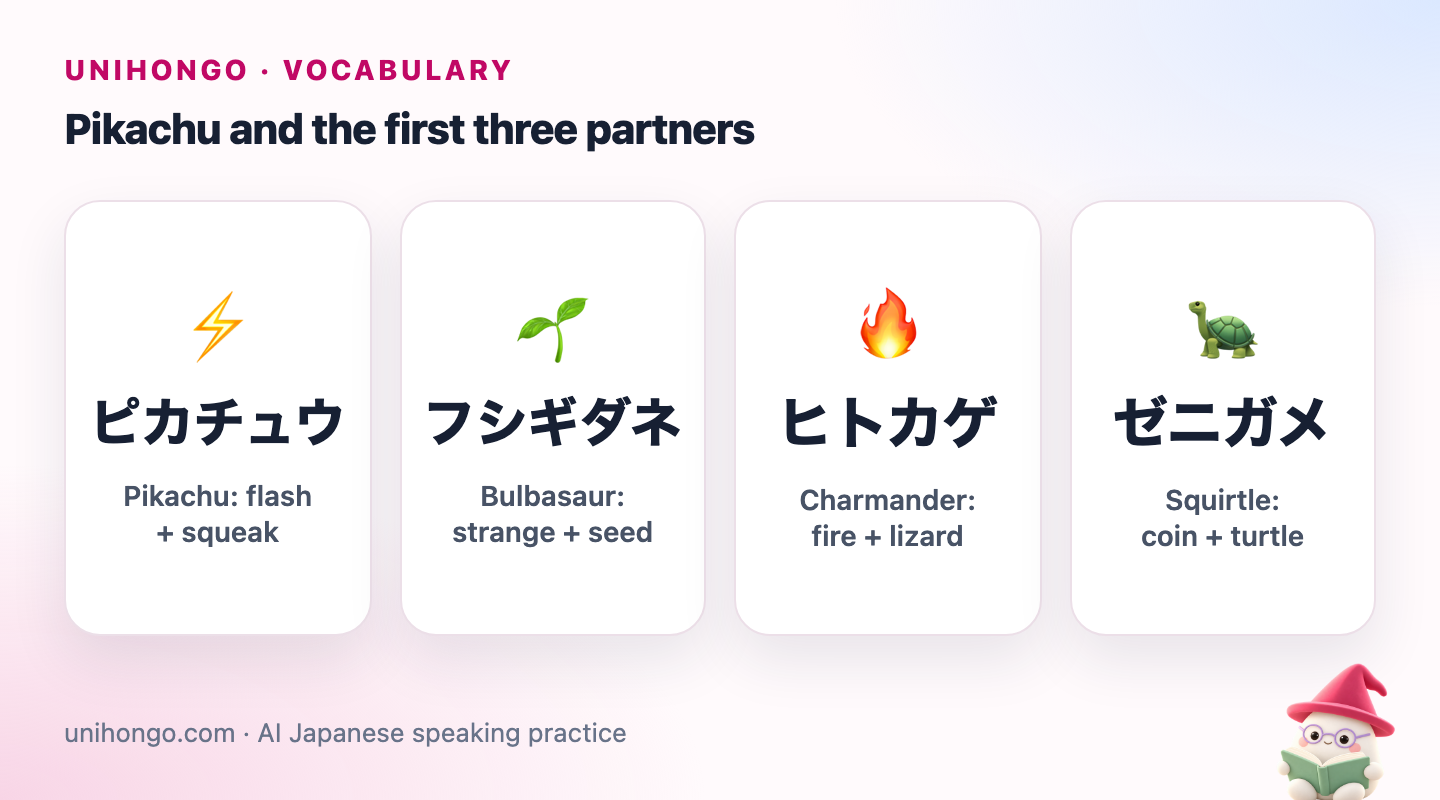
| Japanese | Romaji | Meaning |
|---|---|---|
| ピカチュウ | Pikachū | Pikachu: flash + squeak |
| フシギダネ | Fushigidane | Bulbasaur: strange + seed |
| ヒトカゲ | Hitokage | Charmander: fire + lizard |
| ゼニガメ | Zenigame | Squirtle: coin + turtle |
| 不思議 | fushigi | strange, mysterious |
| 種 | tane | seed |
| 火 | hi | fire |
| トカゲ | tokage | lizard |
More names that are not the English ones
Knowing these saves confusion when you talk with Japanese fans, who will not recognise most English names.
| Japanese | Romaji | Meaning |
|---|---|---|
| コダック | Kodakku | Psyduck |
| カビゴン | Kabigon | Snorlax |
| イーブイ | Ībui | Eevee |
| ニャース | Nyāsu | Meowth |
| プリン | Purin | Jigglypuff |
| カモネギ | Kamonegi | Farfetch'd |
| ロコン | Rokon | Vulpix |
| ポッポ | Poppo | Pidgey |
| ナゾノクサ | Nazonokusa | Oddish |
| リザードン | Rizādon | Charizard |
Some of these are clear to any Japanese speaker. Nyāsu comes from nyā, the sound a cat makes. Nazonokusa is simply nazo no kusa, "mystery grass". Poppo comes from the way small children talk about pigeons, as in the nursery song Hato Poppo. Purin is the word for a wobbly custard pudding. Kamonegi joins kamo, "duck", and negi, "leek", after a proverb about a duck that arrives carrying its own leek, meaning a stroke of luck that walks right up to you.
Others are usually explained as follows. Ībui is the Japanese reading of the letters E and V, as in "evolution". Rokon is roku, "six", for its six tails, plus kon, the cry of a fox. Kodakku is ko, "small", plus duck. Kabigon is said to come from the nickname of someone on the development team, and kabi also happens to be the word for mould. Treat these as the common explanations, not as official statements.
The sound words hiding in the names
Japanese has thousands of onomatopoeic words, and people use them in ordinary adult conversation, not only in comics. Pokémon names are an easy first collection, because each sound is attached to a creature you can picture.
| Japanese | Romaji | Meaning |
|---|---|---|
| ピカピカ | pikapika | sparkling, shiny |
| チューチュー | chūchū | squeak squeak (a mouse) |
| にゃあ | nyā | meow |
| コンコン | konkon | a fox's cry; knock knock |
| にょろにょろ | nyoronyoro | wriggling, slithering |
| 靴がピカピカです。 | Kutsu ga pikapika desu. | My shoes are sparkling clean. |
| 猫がにゃあと鳴く。 | Neko ga nyā to naku. | The cat goes meow. |
Pikapika is the most useful of these in daily life. It describes polished floors, new cars and clean windows. A child starting school in April is called pikapika no ichinensei, a "shiny new first grader".
Word-building tricks you can reuse
Look again at Fushigidane. The word for seed is tane, but in the name it is dane. When two Japanese words join, the first consonant of the second word often becomes voiced: t turns to d, k to g, h to b. The same change turns hana, "flower", into bana in Fushigibana, the Japanese name of Venusaur.
This is not a game rule. It is ordinary Japanese, and you already know examples. Tegami, "letter", is te, "hand", plus kami, "paper". Hanabi, "fireworks", is hana, "flower", plus hi, "fire". Once you expect the change, long words become easier to split into parts you know.
The second trick is the pun. Japanese has few sounds and many words that sound alike, so one name can carry two meanings at once. Jokes of this kind are everywhere in Japanese adverts and shop names, and Pokémon is good training for spotting them.
| Japanese | Romaji | Meaning |
|---|---|---|
| 手紙 | tegami | letter (hand + paper) |
| 花火 | hanabi | fireworks (flower + fire) |
Lines from the anime, and what to say in real life
The long-time hero of the anime is called Satoshi in Japan and Ash in English. His two most famous lines are short and worth knowing. Getto da ze uses the rough, boyish ending ze, which you should leave to him. Kimi ni kimeta is more useful: ni kimeru means "to decide on", and you can use that pattern every time you choose something.
| Japanese | Romaji | Meaning |
|---|---|---|
| 君に決めた! | Kimi ni kimeta! | I choose you! |
| ゲットだぜ! | Getto da ze! | Got it! (rough, boyish) |
| これに決めました。 | Kore ni kimemashita. | I've decided on this one. |
| 一番好きなポケモンは何ですか。 | Ichiban suki na Pokemon wa nan desu ka. | What's your favourite Pokémon? |
| 私はピカチュウが好きです。 | Watashi wa Pikachū ga suki desu. | I like Pikachu. |
| 子どものころ、よく遊びました。 | Kodomo no koro, yoku asobimashita. | I played it a lot as a child. |
The polite kore ni kimemashita works in a shop, at a restaurant or when choosing a seat. Asking about a favourite Pokémon is an easy way to start a conversation, because the series is known to people of almost every age in Japan.
Saying the names the Japanese way
English speakers tend to stress one syllable of each name. Japanese gives every beat the same length. Pikachū has four beats, pi-ka-chu-u, with the last vowel held. Kodakku has a small tsu, which is a one-beat pause before the k: ko-da-(pause)-ku. Ībui begins with a long i that lasts two beats.
Getting these lengths right is not a detail. Long vowels and small tsu change meaning in Japanese, and names are a pleasant way to train your ear and mouth for them.