
Dō shiyō meaning: one grammar point, four feelings
Shiyō is the volitional form of suru, to do. The volitional expresses intention or a suggestion: ikō means let's go, tabeyō means let's eat, and shiyō means let's do or I shall do. Put dō, how, in front, and you get how shall I do it? In other words: what do I do?
Change the ending, the tone or the politeness, and the same core gives you four different feelings.
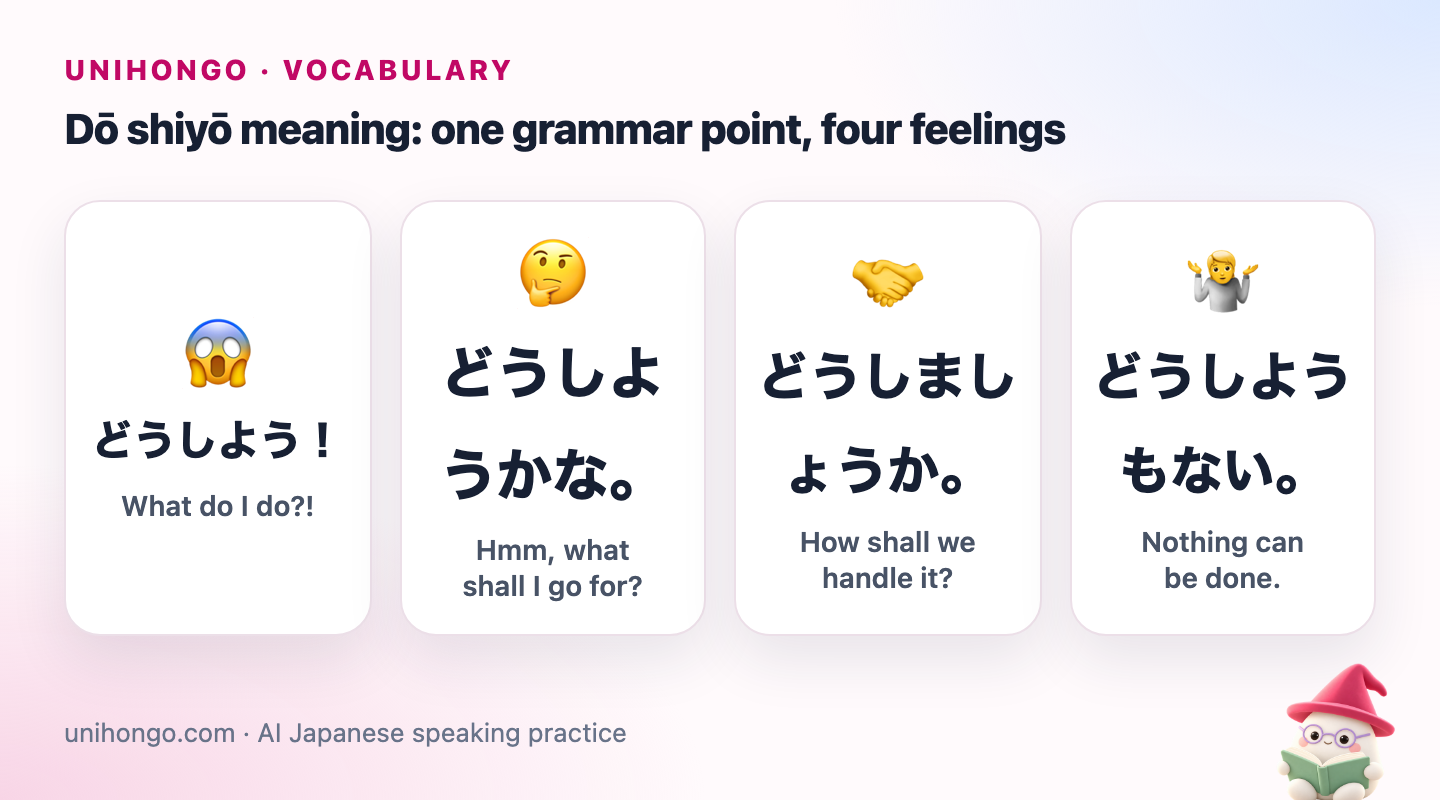
| Japanese | Romaji | Meaning |
|---|---|---|
| どうしよう! | Dō shiyō! | What do I do?! |
| どうしようかな。 | Dō shiyō ka na. | Hmm, what shall I go for? |
| どうしましょうか。 | Dō shimashō ka. | How shall we handle it? |
| どうしようもない。 | Dō shiyō mo nai. | Nothing can be done. |
The polite volitional of suru is shimashō, so dō shimashō ka is simply the masu version of dō shiyō ka. Adding ka turns it into a real question to someone else.
Panic: dō shiyō as self-talk
The panicked dō shiyō is usually said to yourself, or to anyone nearby, the moment a problem hits. It is often doubled for effect and followed by the problem itself. You do not need an answer; you are thinking aloud, and that is exactly why it sounds so natural.
After the first shock, Japanese speakers often move to a calmer volitional: ochitsukō, let's calm down, or sagashite miyō, let's try looking. Learning these next steps makes the moment sound real rather than dramatic.
| Japanese | Romaji | Meaning |
|---|---|---|
| どうしよう、財布がない! | Dō shiyō, saifu ga nai! | Oh no, my wallet's gone! |
| どうしよう、寝坊した! | Dō shiyō, nebō shita! | Oh no, I overslept! |
| どうしよう、どうしよう… | Dō shiyō, dō shiyō... | What do I do, what do I do... |
| とりあえず落ち着こう。 | Toriaezu ochitsukō. | First, let's calm down. |
| もう一回探してみよう。 | Mō ikkai sagashite miyō. | Let's try looking once more. |
Indecision: dō shiyō ka na at the menu
Add ka na, I wonder, and the panic disappears. Dō shiyō ka na is the gentle thinking-aloud you hear in front of a menu, a clothes rack or a weekend with no plans. It invites the other person to help without demanding it.
For choosing between items, nani ni shiyō ka na (what shall I go for?) and dotchi ni shiyō ka na (which one shall I pick?) are even more common. The particle ni here marks the choice, as in kore ni suru, I'll go with this.
| Japanese | Romaji | Meaning |
|---|---|---|
| 何にしようかな。 | Nani ni shiyō ka na. | What shall I have? |
| どっちにしようかな。 | Dotchi ni shiyō ka na. | Which one shall I pick? |
| 週末、どうしようかな。 | Shūmatsu, dō shiyō ka na. | What shall I do this weekend? |
| よし、これにしよう。 | Yoshi, kore ni shiyō. | Right, I'll go with this. |
Polite consultation: dō shimashō ka
Dō shimashō ka is not panic at all. It is the polite, cooperative way to ask how something should be handled. Shop staff use it to ask about wrapping or delivery, colleagues use it when a plan changes, and hosts use it to ask what a guest would like. It frames the decision as something you will settle together.
To ask a superior or a client for instructions, an even more careful form is dō sureba yoroshii deshō ka, how should I proceed?
| Japanese | Romaji | Meaning |
|---|---|---|
| お包みはどうしましょうか。 | Otsutsumi wa dō shimashō ka. | Staff: How would you like it wrapped? |
| 会議の時間、どうしましょうか。 | Kaigi no jikan, dō shimashō ka. | What shall we do about the meeting time? |
| どうすればよろしいでしょうか。 | Dō sureba yoroshii deshō ka. | How should I proceed? (very polite) |
| どうしたらいいと思う? | Dō shitara ii to omou? | What do you think I should do? |
The last line is the casual way to ask a friend for advice. Dō shiyō voices your worry; dō shitara ii asks for an answer.
Dō shiyō mo nai: when nothing can be done
Add mo nai and the phrase means there is no way to do anything about it. It describes situations beyond your control, such as a cancelled train, bad weather or a decision already made. It is close to shō ga nai and shikata ga nai, it can't be helped, but it feels more helpless.
Said about a person, dō shiyō mo nai hito or dō shiyō mo nai yatsu means someone hopeless: lazy, unreliable or impossible. That is harsh when meant seriously, though old friends sometimes say it with affection.
| Japanese | Romaji | Meaning |
|---|---|---|
| 台風だから、どうしようもないね。 | Taifū da kara, dō shiyō mo nai ne. | It's a typhoon, so nothing can be done. |
| 今さらどうしようもない。 | Imasara dō shiyō mo nai. | It's too late to do anything now. |
| まあ、しょうがないね。 | Mā, shō ga nai ne. | Well, it can't be helped. |
| Phrase | Register | Feeling |
|---|---|---|
| dō shiyō | Casual, self-talk | Worry or panic: what do I do? |
| dō shiyō ka na | Casual | Relaxed indecision |
| dō shitara ii? | Casual | Asking someone for advice |
| dō shimashō ka | Polite | Consulting together on what to do |
| dō shiyō mo nai | Casual to neutral | Nothing can be done; hopeless |
| shō ga nai | Casual | It can't be helped; accepting it |
Common mistakes with dō shiyō
- Asking a friend for advice with dō shiyō alone. They may just sympathise. If you want an answer, say dō shitara ii to omou?
- Saying dō shiyō to a customer or a boss. It sounds like you are panicking in front of them. Use dō shimashō ka or dō sureba yoroshii deshō ka.
- Pronouncing it with a short o. The ending is a long yō, two beats: shi-yō, not shi-yo.
- Using dō shiyō mo nai hito as a light joke with people you do not know well. It is a real criticism of character.
- Mixing up dō shiyō with dō shita no? The second means what's wrong? or what happened?, which is what a friend asks after hearing your dō shiyō.
Answering a friend's dō shiyō
When someone near you says dō shiyō, the natural first reaction is a question: dō shita no?, what happened? Then come calming words and an offer to help. Japanese friends often echo the problem back before suggesting anything, which shows they are listening and gives the other person a moment to breathe.
With a colleague or someone older, use the polite versions: dō shimashita ka? and daijōbu desu ka? Offering concrete help, such as issho ni sagashimashō ka, shall we look together?, is warmer than general reassurance.
| Japanese | Romaji | Meaning |
|---|---|---|
| どうしたの?大丈夫? | Dō shita no? Daijōbu? | What happened? Are you okay? |
| 落ち着いて。一緒に考えよう。 | Ochitsuite. Issho ni kangaeyō. | Calm down. Let's think it through together. |
| 一緒に探そうか。 | Issho ni sagasō ka. | Shall we look for it together? |
| どうしましたか。何かお手伝いしましょうか。 | Dō shimashita ka. Nanika otetsudai shimashō ka. | What's wrong? Can I help with anything? (polite) |
Issho ni kangaeyō, let's think it through together, is a lovely phrase to know. It turns a lonely dō shiyō into a shared problem.
Mini dialogue: your train pass is gone
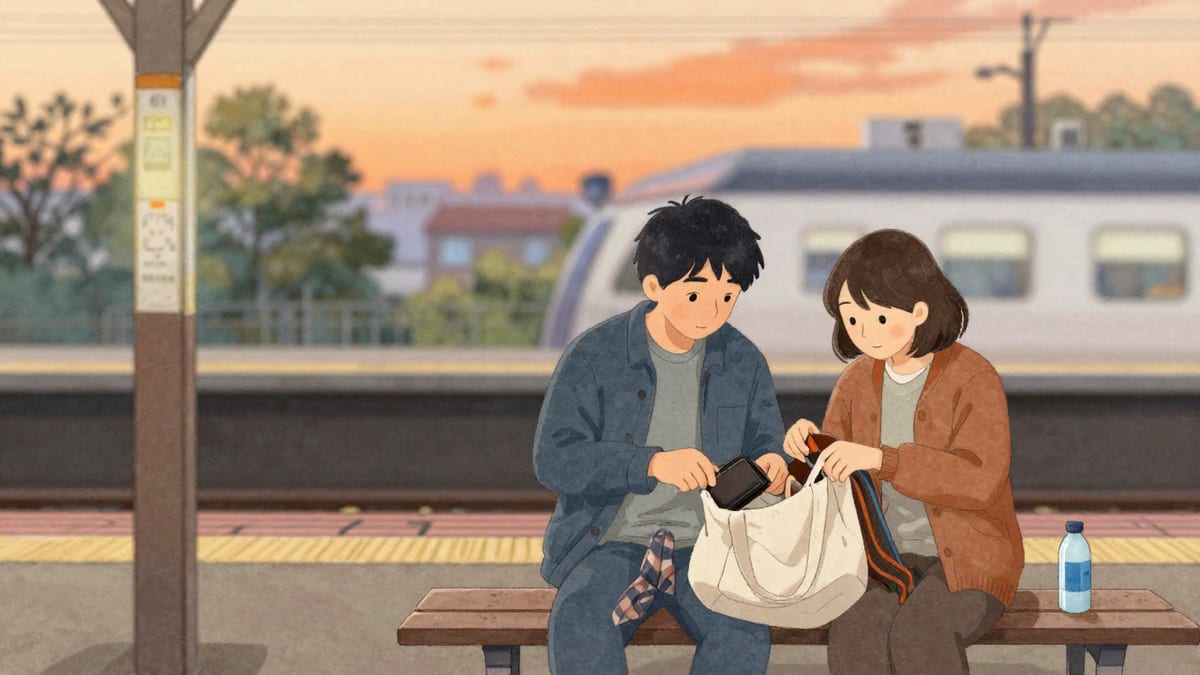
You reach the ticket gate after a day out and your commuter pass is not in its usual pocket. Your friend hears your dō shiyō and helps you think it through: when you last had it, where it could be, and who to ask.
| Japanese | Romaji | Meaning |
|---|---|---|
| どうしよう、定期がない! | Dō shiyō, teiki ga nai! | You: Oh no, my pass is gone! |
| え、どうしたの? | E, dō shita no? | Friend: What happened? |
| さっきまであったのに… | Sakki made atta noni... | You: I had it just now... |
| 最後に使ったのはいつ? | Saigo ni tsukatta no wa itsu? | Friend: When did you last use it? |
| カフェに入る前かな。 | Kafe ni hairu mae ka na. | You: Before we went into the café, I think. |
| じゃあ、カフェに戻ってみよう。 | Jā, kafe ni modotte miyō. | Friend: Then let's go back and check. |
| 駅員さんにも聞いてみようか。 | Ekiin-san ni mo kiite miyō ka. | Friend: Shall we ask the station staff too? |