

Breaking down komorebi
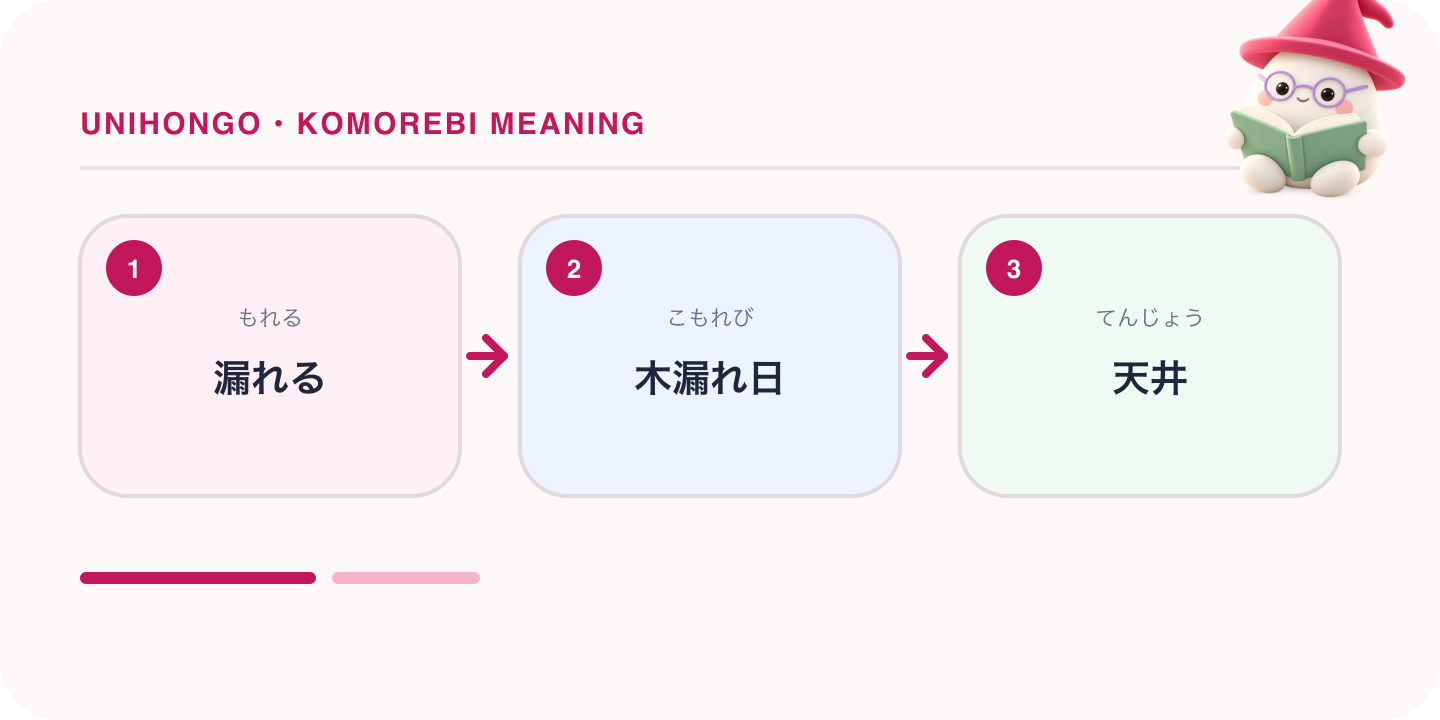
Komorebi is written 木漏れ日. The first kanji, ki, is tree, but in compounds it often becomes ko, as in kokage, the shade of a tree, and konoha, tree leaves. The middle part, more, comes from moreru, to leak or escape through a gap. The last part, hi, means sun or sunlight, and becomes bi when it joins the word.
So komorebi is literally tree-leak-sun: sunlight leaking through the trees. The image is not of bright open sun, but of light getting through gaps, which is why the word feels soft and shifting.
| Part | Reading | Meaning |
|---|---|---|
| 木 | ki / ko | Tree |
| 漏れる | moreru | To leak, to escape through a gap |
| 日 | hi / bi | Sun, sunlight, day |
| 木漏れ日 | komorebi | Sunlight filtering through leaves |
The verb inside: moreru
Moreru is a very practical verb that learners often meet first in komorebi. It describes anything escaping through a gap or leaking out: water from a pipe, light from under a door, voices through a wall, or information that was supposed to stay secret.
Learning komorebi together with moreru gives you both a beautiful word and a useful one. The transitive form, morasu, means to let something leak, as in letting slip a secret or a sigh.
| Japanese | Romaji | Meaning |
|---|---|---|
| 天井から水が漏れています。 | Tenjō kara mizu ga morete imasu. | Water is leaking from the ceiling. |
| ドアの隙間から光が漏れている。 | Doa no sukima kara hikari ga morete iru. | Light is coming through the gap under the door. |
| 隣の部屋から声が漏れてくる。 | Tonari no heya kara koe ga morete kuru. | I can hear voices from the next room. |
| 情報が漏れた。 | Jōhō ga moreta. | The information leaked. |
| ため息を漏らす | tameiki o morasu | To let out a sigh |
The first phrase is exactly what you would say to a landlord about a leak, so moreru earns its place well beyond poetry.
How Japanese speakers use komorebi
In real Japanese, komorebi usually appears in descriptions of parks, forest paths, shrine approaches, temple gardens and hiking trails, particularly in spring and early summer when leaves are fresh. People talk about walking through it, relaxing in it and how pleasant it feels.
It is common in song lyrics, poems, novels and travel writing, and it is a popular name for cafés, guesthouses and products. The film Perfect Days by Wim Wenders, set in Tokyo, drew international attention to the word by featuring the idea of komorebi, but for Japanese speakers it was already familiar.
| Japanese | Romaji | Meaning |
|---|---|---|
| 木漏れ日がきれいですね。 | Komorebi ga kirei desu ne. | The sunlight through the leaves is lovely, isn't it? |
| 木漏れ日の中を散歩した。 | Komorebi no naka o sanpo shita. | I went for a walk in the dappled sunlight. |
| 木漏れ日が差し込む公園 | komorebi ga sashikomu kōen | A park where sunlight filters through the trees |
| 木漏れ日の下で本を読むのが好きです。 | Komorebi no shita de hon o yomu no ga suki desu. | I like reading under the trees in the dappled light. |
| 木漏れ日が揺れている。 | Komorebi ga yurete iru. | The patches of sunlight are flickering. |
Words for light and shade
Japanese has a rich set of everyday words for light, many built the same way as komorebi. Hidamari, a sunny spot, is the patch of sunlight where a cat curls up on a cold day. Kokage is the shade under a tree, where you rest in summer.
| Japanese | Romaji | Meaning |
|---|---|---|
| 日だまり | hidamari | A sunny, sheltered spot |
| 木陰 | kokage | The shade of a tree |
| 日差し | hizashi | Sunlight, the sun's rays |
| 月明かり | tsukiakari | Moonlight |
| 薄明かり | usuakari | Dim light, twilight glow |
| 陽炎 | kagerō | Heat haze, shimmering air |
| 猫が日だまりで寝ている。 | Neko ga hidamari de nete iru. | The cat is sleeping in a sunny spot. |
| 木陰で休みましょう。 | Kokage de yasumimashō. | Let's rest in the shade of the trees. |
Sky, sunset and time-of-day words
Yūyake, the sunset glow, is one of the first nature words many Japanese children learn, partly through the well-known song Yūyake Koyake. Asayake is its morning partner. These words describe the colour of the sky, not the moment the sun goes down, which is hinoiri.
Tasogare, dusk, is more literary, and it is the source of the expression tasogare-doki, the twilight hour, when it gets hard to make out faces.
| Word | Reading | Meaning |
|---|---|---|
| 夕焼け | yūyake | Red or orange evening sky |
| 朝焼け | asayake | Red morning sky |
| 日の入り | hinoiri | Sunset, the moment the sun sets |
| 日の出 | hinode | Sunrise |
| 夕暮れ | yūgure | Evening, dusk |
| 黄昏 | tasogare | Twilight, dusk (literary) |
| 星空 | hoshizora | Starry sky |
A natural line on an evening walk is yūyake ga kirei, the sunset sky is beautiful, often followed by ashita wa hareru ka na, I wonder if it will be sunny tomorrow, since a red evening sky is traditionally seen as a sign of good weather.
Wind and seasonal weather words
Japanese names many seasonal winds and kinds of weather, and several are in everyday use because weather forecasts and news report them. Kogarashi is the cold, strong wind of late autumn and early winter that strips leaves from the trees; it literally means tree-withering. In some regions, the first one of the season is announced as kogarashi ichigō, cold wind number one.
Koharubiyori is a mild, sunny day in late autumn or early winter, not a spring day, despite containing haru, spring. Learners and even some native speakers get this wrong, so it is a nice word to use correctly.
| Japanese | Romaji | Meaning |
|---|---|---|
| 木枯らし | kogarashi | Cold wind that strips the trees in late autumn |
| 木枯らし一号が吹きました。 | Kogarashi ichigō ga fukimashita. | The first cold wind of winter has blown. |
| 小春日和 | koharubiyori | Mild, sunny day in late autumn |
| 五月晴れ | satsukibare | Clear, fine weather in May |
| 梅雨 | tsuyu | Early summer rainy season |
| 新緑 | shinryoku | Fresh green leaves of early summer |
| 紅葉 | kōyō / momiji | Autumn leaves |
Using nature words in small talk
Talking about the weather and seasons is one of the most natural ways to start a conversation in Japanese, and it appears in letters and emails too. Using a precise word like komorebi or koharubiyori instead of just ii tenki, nice weather, shows you are noticing the season the way Japanese speakers do.
The pattern is simple: name the thing, then add a feeling. Adding ne invites the other person to agree, which keeps the conversation going.
| Japanese | Romaji | Meaning |
|---|---|---|
| 今日は小春日和ですね。 | Kyō wa koharubiyori desu ne. | It's a lovely mild day today, isn't it? |
| 木漏れ日が気持ちいいですね。 | Komorebi ga kimochi ii desu ne. | The sunlight through the trees feels lovely. |
| 夕焼けがすごくきれいでした。 | Yūyake ga sugoku kirei deshita. | The sunset sky was really beautiful. |
| もうすぐ紅葉の季節ですね。 | Mōsugu kōyō no kisetsu desu ne. | It's nearly the season for autumn leaves. |
| 木枯らしが吹いて、寒くなりましたね。 | Kogarashi ga fuite, samuku narimashita ne. | The winter wind has started and it's got cold, hasn't it? |
Lines like these are perfect openers with neighbours, colleagues or a host family, and they are much easier to say than they look once you have practised them out loud a few times.