
Onii-chan and onee-chan in one minute
The kanji 兄 means older brother and 姉 means older sister. On their own they are read ani and ane, plain words you use about your own siblings. Add the polite prefix o- and the reading shifts to onii and onee: お兄 and お姉. Then comes the ending. With -san you get onii-san and onee-san, polite and neutral. With -chan, the affectionate ending used for children and people you are close to, you get onii-chan and onee-chan.
So onii-chan is not a different word from ani. It is the same older brother, seen through the eyes of a younger sibling who loves him, or at least lives with him.
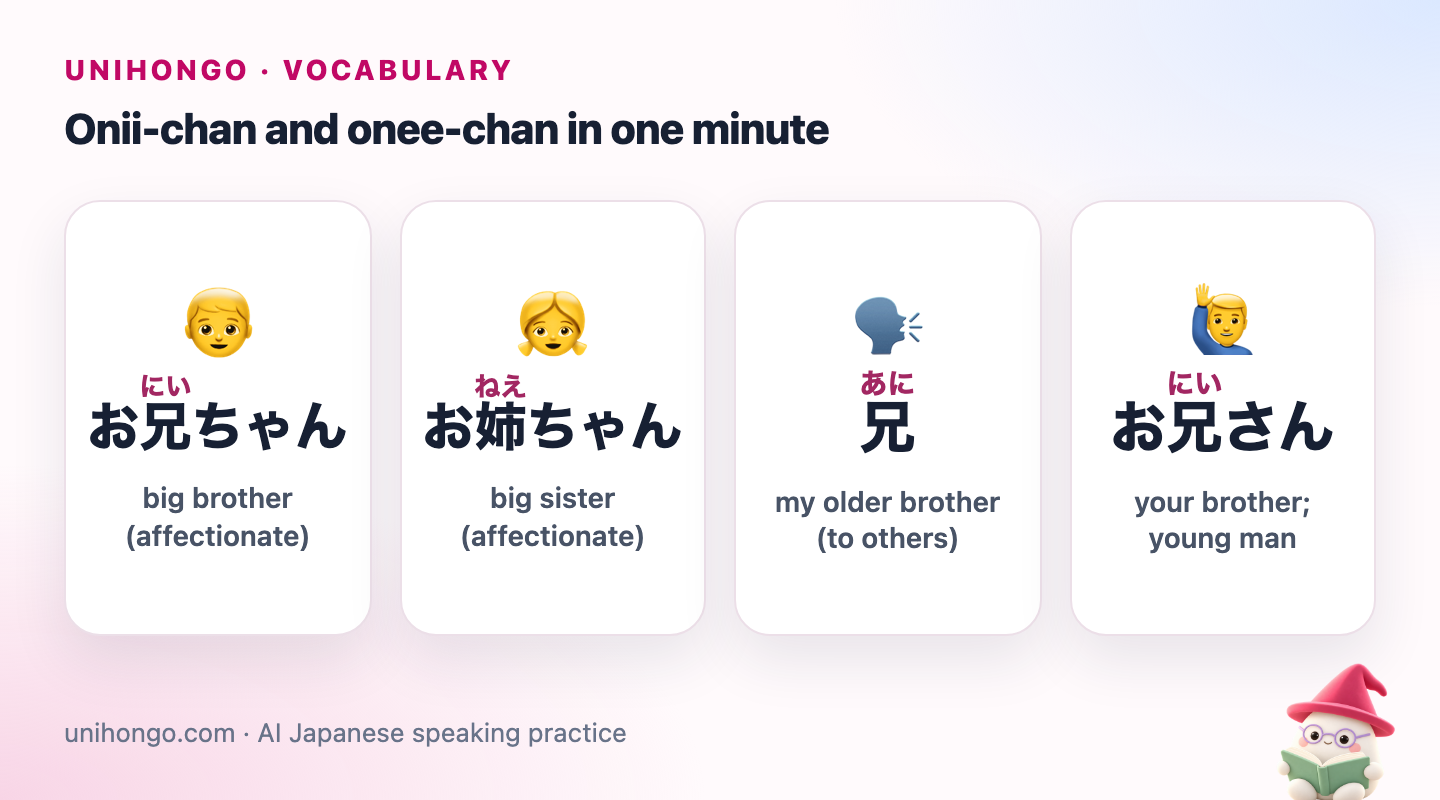
| Japanese | Romaji | Meaning |
|---|---|---|
| お兄ちゃん | onīchan | big brother (affectionate) |
| お姉ちゃん | onēchan | big sister (affectionate) |
| 兄 | ani | my older brother (to others) |
| お兄さん | onīsan | your brother; young man |
| 姉 | ane | my older sister (to others) |
| お姉さん | onēsan | your sister; young woman |
Inside the family: role names, not first names
In many Japanese families, older relatives are called by their role. A child says okāsan or mama to their mother, never her first name, and the same logic applies to siblings: the younger children call the eldest onii-chan or onee-chan, often for their whole lives. Some families use onii-san and onee-san at home instead, which sounds a little more refined. Others use the short forms nii-chan and nee-chan.
Younger siblings, by contrast, are called by their names. There is no everyday word for calling a younger brother; you call him Kenta or Ken-chan. This one-way pattern surprises many learners, but it reflects the way Japanese marks age and position in a group.
Parents join in too. A mother with two children may call the older one onii-chan, as if speaking from the younger child's point of view. The famous line onii-chan nan dakara, which means because you are the big brother, is how many Japanese adults remember being asked to share their toys.
| Japanese | Romaji | Meaning |
|---|---|---|
| お兄ちゃん、待って! | Onīchan, matte! | Wait for me, big brother! |
| お姉ちゃん、これ貸して。 | Onēchan, kore kashite. | Sis, lend me this. (casual) |
| お兄ちゃんなんだから、我慢しなさい。 | Onīchan nan dakara, gaman shinasai. | Parent: You're the big brother, so be patient. |
| お姉ちゃんが宿題を手伝ってくれた。 | Onēchan ga shukudai o tetsudatte kureta. | My big sister helped me with my homework. (casual) |
| 健太、ご飯だよ。 | Kenta, gohan da yo. | Older sibling: Kenta, dinner's ready. (younger one called by name) |
Talking about your own siblings: ani and ane
When you mention your siblings to someone outside the family, such as a teacher, a colleague or a new acquaintance, Japanese expects you to lower your own family and raise the other person's. So your own older brother becomes ani (兄) and your older sister ane (姉), with no honorific. Their siblings, on the other hand, are onii-san and onee-san.
With close friends, many people relax this rule and say uchi no onii-chan or just onii-chan, especially younger speakers. That is fine in casual talk. In a job interview, a class presentation or a polite first meeting, switch to ani and ane.
| Japanese | Romaji | Meaning |
|---|---|---|
| 兄が二人います。 | Ani ga futari imasu. | I have two older brothers. (polite context) |
| 姉は大阪に住んでいます。 | Ane wa Ōsaka ni sunde imasu. | My older sister lives in Osaka. |
| お兄さんはお元気ですか。 | Onīsan wa ogenki desu ka. | How is your brother doing? |
| ご兄弟はいますか。 | Gokyōdai wa imasu ka. | Do you have any brothers or sisters? |
| Person | Calling them | Talking about yours | Talking about someone else's |
|---|---|---|---|
| Older brother | onii-chan / onii-san | ani | onii-san |
| Older sister | onee-chan / onee-san | ane | onee-san |
| Younger brother | his name | otōto | otōto-san |
| Younger sister | her name | imōto | imōto-san |
| Siblings in general | not used to call | kyōdai | go-kyōdai |
Onii-san and onee-san for strangers
Outside the family, onii-san and onee-san work as friendly ways to address a young man or a young woman whose name you do not know. You will hear them most from market stall holders, street food sellers and staff in lively shops who want to catch your attention: onii-san, these are cheap today!
There is a social reason the words stretch so far. Calling a woman obasan (auntie) or a man ojisan (uncle) can sting, because they suggest middle age. Sellers therefore tend to choose onee-san and onii-san generously, as a kind of compliment. Children are also taught to call young adults onii-san and onee-san, so a child at a park may call you that.
As a customer, you can call staff with onii-san or onee-san in casual places, and some people do, but many find it a little old-fashioned or familiar. Sumimasen is the safe choice everywhere. Avoid the rough forms nii-chan and nee-chan for strangers: from a man to a woman they can sound like a pickup line.
| Japanese | Romaji | Meaning |
|---|---|---|
| お兄さん、今日は安いよ! | Onīsan, kyō wa yasui yo! | Seller: Hey there, it's cheap today! |
| お姉さん、これ落としましたよ。 | Onēsan, kore otoshimashita yo. | Excuse me, miss, you dropped this. |
| すみません、お水をください。 | Sumimasen, omizu o kudasai. | Excuse me, some water, please. (safe with staff) |
| お兄さん、ボール取って! | Onīsan, bōru totte! | Child: Mister, get the ball for us! |
Anime forms: onii-sama, aniki, nii-nii and more
Anime and manga push the sibling words much further than daily life does, and each form tells you something about the character. Real speakers do use most of them, but less often and in narrower situations.
| Japanese | Romaji | Meaning |
|---|---|---|
| お兄様、お帰りなさいませ。 | Onīsama, okaerinasaimase. | Welcome home, dear brother. (very polite, fiction-style) |
| 兄貴、ありがとう。 | Aniki, arigatō. | Thanks, bro. (rough, masculine) |
| にいにい、遊ぼう! | Nīnī, asobō! | Small child: Big bro, let's play! |
| ねえねえ、聞いて。 | Nē nē, kiite. | Hey, hey, listen. (not about sisters) |
- Onii-sama and onee-sama (お兄様, お姉様): very polite or elegant. In fiction they mark a rich, refined family, or a younger girl's admiration for an older one. In real life onii-sama mostly appears in formal speech about someone else's brother, for example at a wedding.
- Nii-san and nee-san (兄さん, 姉さん): a slightly grown-up, plain way to call your own siblings, common among adults and in older dramas.
- Aniki and aneki (兄貴, 姉貴): rough, manly forms. Some men call their real older brother aniki. It is also used for a respected senior in sports teams or gangs, which is how many anime use it.
- Nii-nii and nee-nee (にいにい, ねえねえ): toddler-style forms used by small children. They are also especially associated with Okinawa, where many people use them for older siblings and young adults.
Careful with that last line. Nē nē (ねえねえ) is also the everyday way to get a friend's attention, built from the particle ne. In most conversations it means hey, listen, not big sister. Context makes it obvious.
How to reply when someone calls you onii-san or onee-san
If a seller or a child calls you onii-san or onee-san, you do not need to correct them or feel flattered. Treat it like hey there or excuse me and answer naturally. If your younger sibling or a friend's child calls you onii-chan, a soft nāni (what is it?) is the classic warm reply.
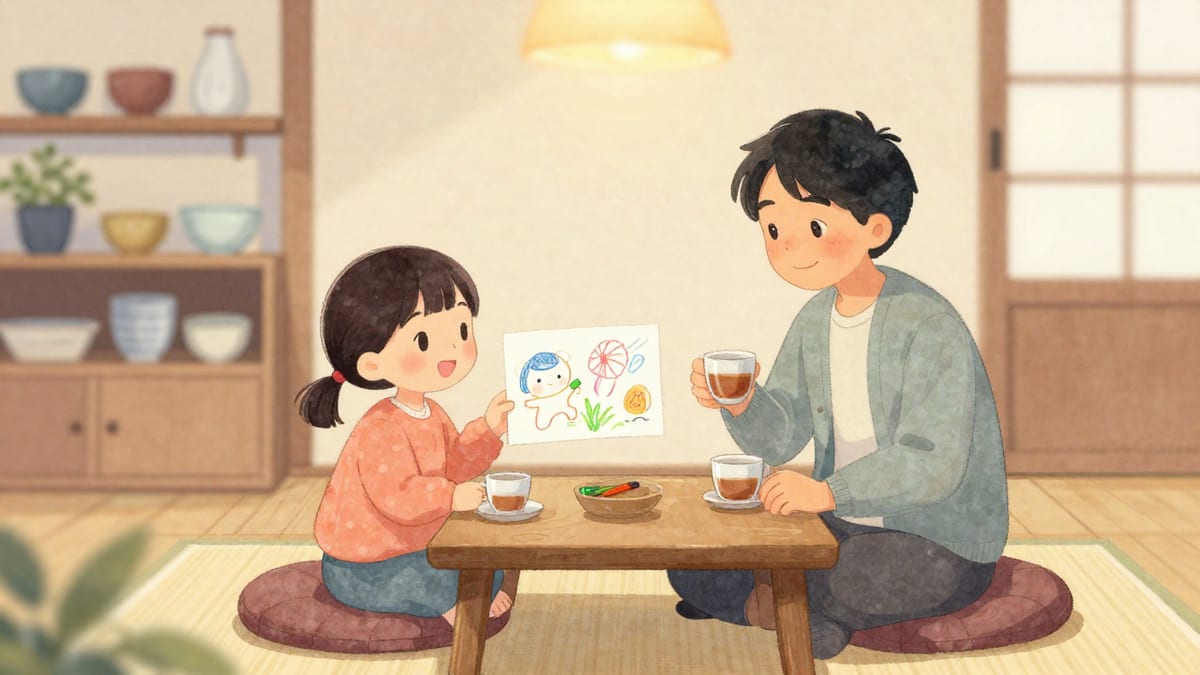
In the scene below, a learner visits a Japanese friend's home, where the friend's little sister has a question for her older brother. Notice who uses which word.
| Japanese | Romaji | Meaning |
|---|---|---|
| お兄ちゃん、見て見て! | Onīchan, mite mite! | Little sister: Big brother, look, look! |
| なあに?上手だね。 | Nāni? Jōzu da ne. | Brother: What is it? That's really good. |
| 妹さん、かわいいですね。 | Imōtosan, kawaii desu ne. | Guest: Your little sister is so sweet. |
| 兄弟はいるの? | Kyōdai wa iru no? | Friend: Do you have any brothers or sisters? (casual) |
| 姉が一人います。 | Ane ga hitori imasu. | Guest: I have one older sister. |
| お姉さんも日本語を話す? | Onēsan mo Nihongo o hanasu? | Friend: Does your sister speak Japanese too? |
Common mistakes and related words
| Japanese | Romaji | Meaning |
|---|---|---|
| 兄弟 | kyōdai | siblings; brothers |
| 姉妹 | shimai | sisters |
| 弟 | otōto | my younger brother |
| 妹 | imōto | my younger sister |
| 一人っ子です。 | Hitorikko desu. | I'm an only child. |
| 末っ子です。 | Suekko desu. | I'm the youngest child. |
- Saying watashi no onii-san in a polite setting. Use ani and ane for your own siblings.
- Calling a younger sibling otōto or imōto to their face. Use their name.
- Using onii-chan for your boyfriend or an older male friend. Outside fiction this sounds odd, or like role-play. Senpai or his name is normal.
- Shortening the vowel: onichan and onechan are not words. Keep the long ii and ee.
- Calling a stranger nee-chan. It is rough and can come across as harassment.