
Two laughs, two cries
Start with four words that cover the extremes: a loud laugh and a quiet one, a loud cry and silent tears. They are written in katakana here, as they usually are in manga and on screens; hiragana is just as common in messages.
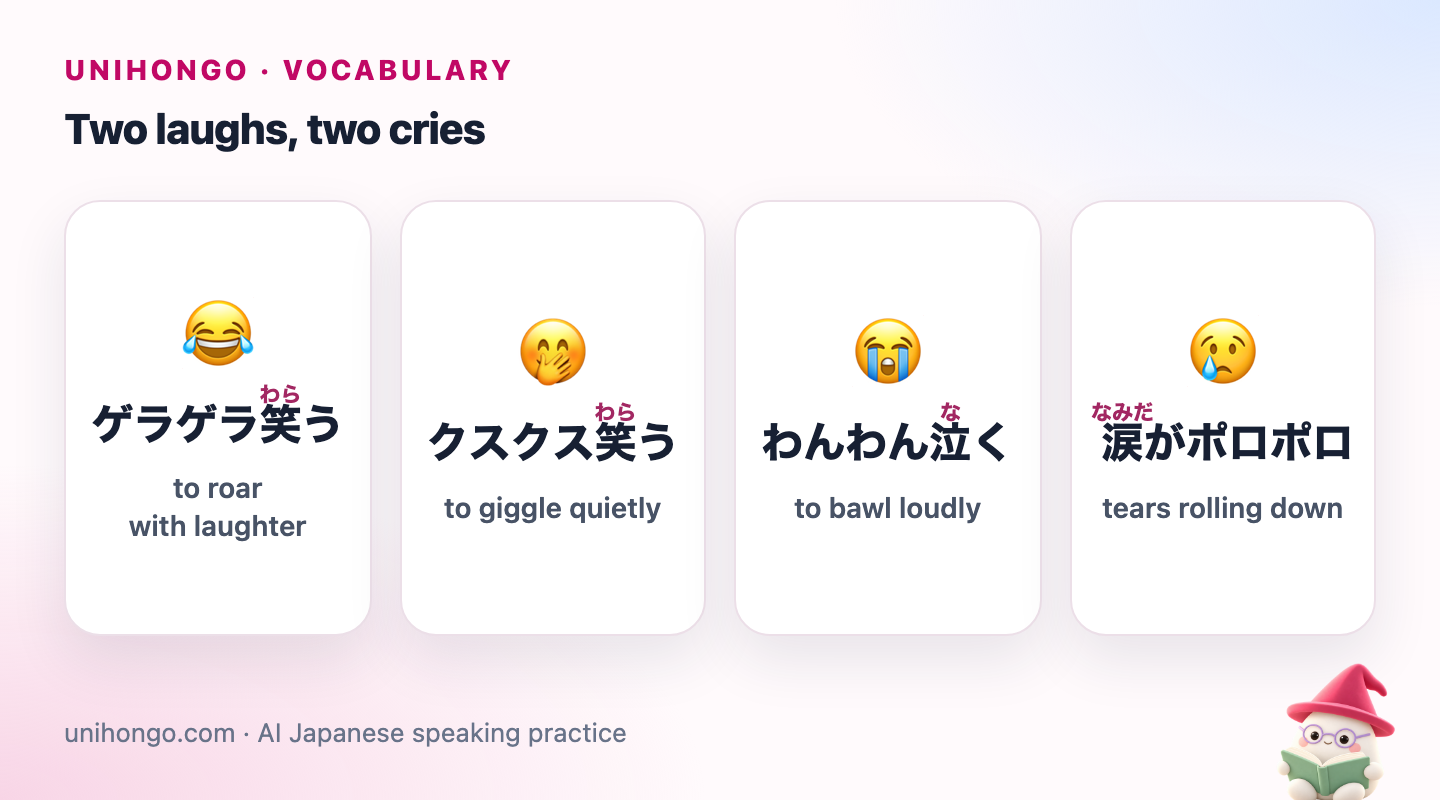
| Japanese | Romaji | Meaning |
|---|---|---|
| ゲラゲラ笑う | geragera warau | to roar with laughter |
| クスクス笑う | kusukusu warau | to giggle quietly |
| わんわん泣く | wanwan naku | to bawl loudly |
| 涙がポロポロ | namida ga poroporo | tears rolling down |
Kinds of laughing
Each laughing word suggests a sound, a face and a feeling. Choose by asking: was it loud or quiet, open or hidden, kind or not?
| Japanese | Romaji | Meaning |
|---|---|---|
| みんなでゲラゲラ笑った。 | Minna de geragera waratta. | We all roared with laughter. |
| 子供たちがケラケラ笑ってる。 | Kodomotachi ga kerakera waratteru. | The kids are laughing away. |
| 後ろの人がクスクス笑ってた。 | Ushiro no hito ga kusukusu waratteta. | The people behind us were giggling. |
| お腹がよじれるほど笑った。 | Onaka ga yojireru hodo waratta. | I laughed so hard my sides hurt. |
| Word | What it sounds and looks like | Feeling |
|---|---|---|
| geragera | Loud, helpless laughter, head thrown back | Uncontrolled fun |
| kerakera | Light, bright, high laughter | Carefree, often children or young people |
| kusukusu | Muffled giggle, hand over mouth | Trying not to be heard |
| gahaha | Big, booming laugh | Hearty; a cartoon boss or uncle |
| fufu | Soft, closed-mouth chuckle | Gentle, amused |
Kusukusu often has a social edge: people giggling quietly may be laughing at someone. Kerakera is innocent and bright. Gahaha is mostly a manga sound and is rarely used to describe real people unless you are joking.
Smiles without sound: nikoniko and niyaniya
Two of the most common words in this family describe faces, not sounds, and they are used with suru rather than warau. Nikoniko suru is to beam, to smile happily, often for a while: a baby, a kind shop owner, a friend who just got good news. It is purely positive.
Niyaniya suru looks similar in English, to grin, but the feeling is very different. It is the grin of someone enjoying a secret, laughing at you, or thinking something they should not. A friend who saw your text from a crush might niyaniya at you. A stranger who niyaniya at you on the train is unsettling. Never use niyaniya when you mean a warm smile.
| Japanese | Romaji | Meaning |
|---|---|---|
| 赤ちゃんがニコニコしてる。 | Akachan ga nikoniko shiteru. | The baby is all smiles. |
| 何ニヤニヤしてるの? | Nani niyaniya shiteru no? | What are you grinning about? |
| 彼女はニコッと笑った。 | Kanojo wa nikotto waratta. | She gave a quick smile. |
Kinds of crying
Crying words split into how the person cries and what the tears do. Shikushiku, wanwan and oioi describe the crying; poroporo and boroboro describe the tears.
| Japanese | Romaji | Meaning |
|---|---|---|
| 妹がしくしく泣いていた。 | Imōto ga shikushiku naite ita. | My little sister was crying quietly. |
| 子供がわんわん泣いてる。 | Kodomo ga wanwan naiteru. | A child is bawling. |
| いつまでもめそめそしないで。 | Itsu made mo mesomeso shinaide. | Stop moping around. |
| 涙がボロボロ出てきた。 | Namida ga boroboro dete kita. | The tears just poured out. |
| Word | What it describes | Typical use |
|---|---|---|
| shikushiku | Quiet sniffling sobs | Crying alone, trying to hide it |
| wanwan / ēn ēn | Loud wailing | Small children, or adults who let go completely |
| oioi | Loud, open wailing | Older, dramatic; often in stories |
| mesomeso | Weepy, whimpering self-pity | Often a criticism: stop whining |
| poroporo | Tears falling drop by drop | Moving moments |
| boroboro | Tears pouring, big and heavy | Overwhelmed by emotion |
Wanwan is also how Japanese dogs bark, so wanwan naku about a person only works because naku follows. Mesomeso is the one to be careful with: it implies that the crying is excessive, so saying it to a friend who is genuinely upset can feel harsh.
Moved, teary and crying your eyes out
Some of the most useful words describe the moment before or after tears. Uruuru suru is when your eyes fill and shine. Jīn to kuru describes the warm ache of being moved, and needs no tears at all. Gōkyū, written with kanji, literally means wailing loudly, but in casual speech people use it as I cried my eyes out, especially about films and dramas.
| Japanese | Romaji | Meaning |
|---|---|---|
| 目がうるうるしてきた。 | Me ga uruuru shite kita. | My eyes started to well up. |
| 最後の手紙、ジーンときた。 | Saigo no tegami, jīn to kita. | The last letter really got to me. |
| 映画館で号泣した。 | Eigakan de gōkyū shita. | I cried my eyes out at the cinema. |
| 泣ける映画だね。 | Nakeru eiga da ne. | It's a real tearjerker, isn't it? |
The grammar: to, suru, or straight in
Sound words behave like adverbs. With warau and naku you can put them straight before the verb, or add to: geragera warau and geragera to warau mean the same, and the version without to is more common in speech. Words that describe a state, such as nikoniko, niyaniya, mesomeso and uruuru, more often take suru and become verbs.
| Japanese | Romaji | Meaning |
|---|---|---|
| もう、ゲラゲラ。 | Mō, geragera. | Oh, we were in stitches. |
| 最後はポロポロ。 | Saigo wa poroporo. | By the end, I was in tears. |
| Pattern | Example | Meaning |
|---|---|---|
| Sound word + warau / naku | kusukusu warau | to giggle |
| Sound word + to + verb | shikushiku to naku | to sob quietly |
| Sound word + suru | niyaniya suru | to smirk |
| Namida ga + sound word + deru | namida ga poroporo deru | tears roll down |
In storytelling, the sound word usually carries the stress and the emotion, so say it with energy: GERAgera waratta, not a flat geragera. Japanese listeners often repeat the sound word back to you, geragera?, as a way of showing they are following.
You can also use the sound words without a verb at all in casual speech, especially in reply to a question: dō datta? mō, geragera. How was it? Oh, we were in stitches. This clipped style is very natural with friends and sounds lively.
Scenario: retelling a film to a friend
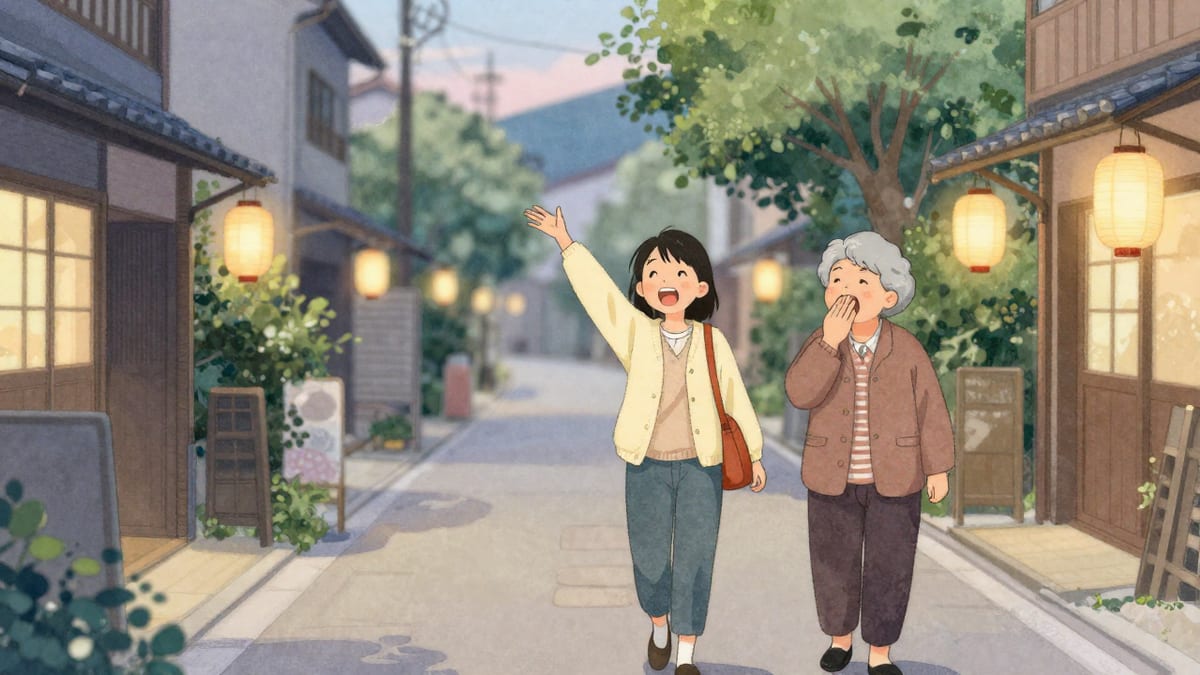
You saw a comedy-drama last night and your friend Aoi asks how it was. Good storytelling in Japanese often uses sound words to replay the audience's reactions as well as the plot.
| Japanese | Romaji | Meaning |
|---|---|---|
| 昨日の映画、どうだった? | Kinō no eiga, dō datta? | Aoi: How was the film yesterday? |
| 最初はみんなゲラゲラ笑ってたよ。 | Saisho wa minna geragera waratteta yo. | You: At first everyone was roaring with laughter. |
| でも最後は涙がポロポロ出てきて。 | Demo saigo wa namida ga poroporo dete kite. | You: But at the end my tears just kept falling. |
| 隣の人も号泣してた。 | Tonari no hito mo gōkyū shiteta. | You: The person next to me was sobbing too. |
| へえ、泣ける映画なんだ。 | Hē, nakeru eiga na n da. | Aoi: Oh, so it's a tearjerker. |
| うん、ジーンときた。 | Un, jīn to kita. | You: Yeah, it really got to me. |
Common mistakes
- Using niyaniya for a friendly smile: it suggests something sly. Say nikoniko.
- Using geragera in a polite story about your boss laughing: it can sound like he lost control. Try ōgoe de warau, to laugh loudly.
- Saying mesomeso to comfort someone: it criticises them. Say daijōbu? instead.
- Forgetting that shikushiku is also a dull pain: onaka ga shikushiku itai is a stomach ache, not a sad tummy.
- Adding warau after nikoniko: nikoniko suru is the natural verb.