

Mountains and land
Around three quarters of Japan is mountainous, and yama is one of the first kanji most learners see. On its own it is read yama; in named mountains it is usually -san, as in Fuji-san, and sometimes -zan or -yama, as in Asama-yama. Hills, valleys and volcanoes each have their own everyday word.
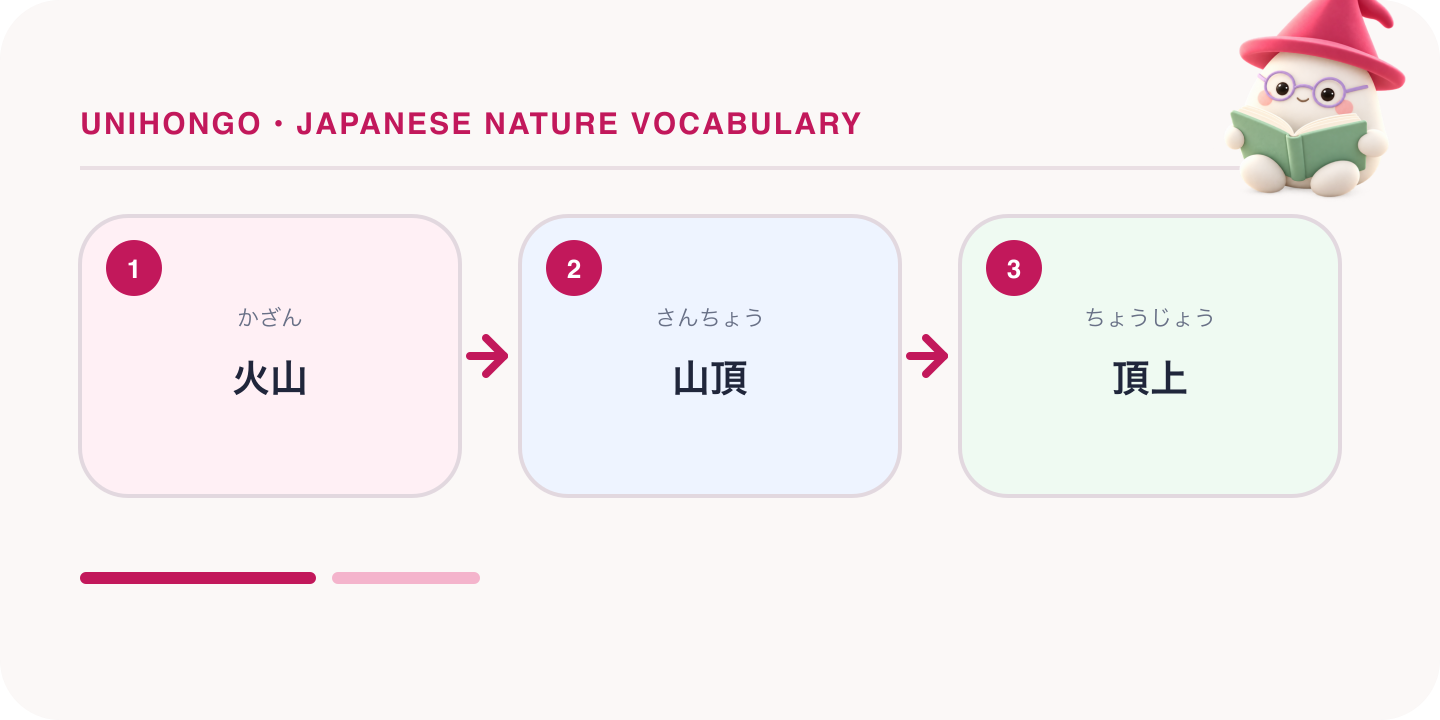
Climbing is tozan, and a casual hike is haikingu. At the top you reach the chōjō, the summit, and many popular peaks have a hut, yamagoya, where hikers rest or stay the night.
| Word | Reading | Meaning |
|---|---|---|
| 山 | yama | Mountain |
| 丘 | oka | Hill |
| 谷 | tani | Valley |
| 火山 | kazan | Volcano |
| 山頂 | sanchō | Summit (formal) |
| 頂上 | chōjō | Top, summit |
| 坂 | saka | Slope, hill on a road |
| 岩 | iwa | Rock, boulder |
| 石 | ishi | Stone |
| 土 | tsuchi | Soil, earth |
| 洞窟 | dōkutsu | Cave |
Rivers, lakes and the sea
Water words are just as common. Kawa is a river, written 川 for most rivers and 河 in a few large ones. In names it often becomes -gawa through rendaku, so the Kamo river in Kyoto is Kamogawa. A lake is mizuumi, or -ko in names such as Biwako and Kawaguchiko.
The sea is umi, and the shore is kaigan. Islands are shima, which becomes -jima in many names, such as Miyajima and Ishigakijima. Waterfalls, taki, and hot springs, onsen, are major travel draws and appear on signs throughout the countryside.
| Word | Reading | Meaning |
|---|---|---|
| 川 | kawa | River |
| 湖 | mizuumi | Lake |
| 池 | ike | Pond |
| 滝 | taki | Waterfall |
| 海 | umi | Sea, ocean |
| 海岸 | kaigan | Coast, shore |
| 浜 / 砂浜 | hama / sunahama | Beach / sandy beach |
| 波 | nami | Wave |
| 島 | shima | Island |
| 湾 | wan | Bay |
| 温泉 | onsen | Hot spring |
| 水 | mizu | Water |
Sky, weather and light
The sky is sora, and it takes colour and weather adjectives easily: aoi sora, blue sky, kumotta sora, cloudy sky. Stars are hoshi, the moon is tsuki, and the sun is taiyō, often called o-hi-sama by children and in gentle speech.
For detailed weather words, the weather vocabulary guide covers forecasts and seasons, but a handful of sky words belong in any description of a landscape.
| Japanese | Romaji | Meaning |
|---|---|---|
| 空 | sora | Sky |
| 雲 | kumo | Cloud |
| 太陽 | taiyō | Sun |
| 月 | tsuki | Moon |
| 星 | hoshi | Star |
| 虹 | niji | Rainbow |
| 夕日 | yūhi | Setting sun |
| 朝日 | asahi | Morning sun |
| 星空がとてもきれいでした。 | Hoshizora ga totemo kirei deshita. | The starry sky was really beautiful. |
| 雲一つない青空でした。 | Kumo hitotsu nai aozora deshita. | It was a blue sky without a single cloud. |
Trees, flowers and plants
Ki is a tree and also wood; mori and hayashi are both woods or forest. Mori usually suggests a deeper, denser forest, often around a shrine, and hayashi a smaller wood or grove, as in takebayashi, bamboo grove. Shinrin is the formal word, found in shinrin-yoku, forest bathing.
Flowers are hana, grass is kusa, and leaves are ha or happa. Japan's best-known plants have their own words that carry cultural weight: sakura for cherry blossom, ume for plum blossom, matsu for pine and take for bamboo.
| Word | Reading | Meaning |
|---|---|---|
| 木 | ki | Tree, wood |
| 森 | mori | Forest, woods |
| 林 | hayashi | Wood, grove |
| 森林 | shinrin | Forest (formal) |
| 花 | hana | Flower |
| 草 | kusa | Grass |
| 葉 / 葉っぱ | ha / happa | Leaf |
| 桜 | sakura | Cherry blossom, cherry tree |
| 梅 | ume | Japanese plum, plum blossom |
| 松 | matsu | Pine |
| 竹 | take | Bamboo |
| 苔 | koke | Moss |
Landscape and scenery words
To talk about a view as a whole, use keshiki, scenery, or the slightly more formal fūkei. A panoramic view from a height is nagame or tenbō, and viewpoints are signposted as tenbōdai. Travel brochures love zekkei, a breathtaking view.
Inaka is the countryside, often with a nostalgic feel, and tanbo or ta is a rice paddy, one of the most typical rural landscapes. Satoyama describes the managed, lived-in landscape of villages, fields and wooded hills that surrounds much of rural Japan.
| Japanese | Romaji | Meaning |
|---|---|---|
| 自然 | shizen | Nature |
| 景色 | keshiki | Scenery, view |
| 風景 | fūkei | Landscape, scenery |
| 絶景 | zekkei | Breathtaking view |
| 展望台 | tenbōdai | Observation point |
| 田舎 | inaka | Countryside |
| 田んぼ | tanbo | Rice paddy |
| 里山 | satoyama | Village landscape of fields and wooded hills |
| 景色がすばらしいですね。 | Keshiki ga subarashii desu ne. | The view is wonderful, isn't it? |
Seasonal nature words
Japanese conversation often marks the season through nature. In spring people go to hanami under the cherry blossoms and talk about the sakura zensen, the cherry blossom front moving north. Early summer brings shinryoku, fresh green leaves, and the rainy season, tsuyu. In summer, the sound of semi, cicadas, and hotaru, fireflies, is part of the season.
Autumn is the season of kōyō, coloured leaves, and momijigari, going out to see them. Winter brings yuki, snow, and yukigeshiki, a snowy landscape. These words appear in greetings, letters and seasonal menus, not only in nature talk.
| Word | Reading | Meaning |
|---|---|---|
| 花見 | hanami | Cherry blossom viewing (spring) |
| 桜前線 | sakura zensen | Cherry blossom front (spring) |
| 新緑 | shinryoku | Fresh green leaves (early summer) |
| 梅雨 | tsuyu | Rainy season (early summer) |
| 蛍 | hotaru | Firefly (early summer) |
| 蝉 | semi | Cicada (summer) |
| 紅葉 | kōyō / momiji | Autumn leaves (autumn) |
| 紅葉狩り | momijigari | Autumn leaf viewing (autumn) |
| 雪景色 | yukigeshiki | Snowy landscape (winter) |
Describing a trip: phrases and collocations
Most nature descriptions use a small set of adjectives: kirei, beautiful, sunda, clear, used for water and air, ōkii and takai for mountains, hiroi for wide views, and shizuka for calm places. Nature nouns also have fixed verb partners: yama ni noboru, climb a mountain, kawa de oyogu, swim in a river, and umi ni iku, go to the sea.
Build your story in time order with the te-form and finish with a feeling. Keshiki ga kirei deshita is fine, but adding a detail such as the colour or the sound makes it sound natural and memorable.
| Japanese | Romaji | Meaning |
|---|---|---|
| 週末、山に登りました。 | Shūmatsu, yama ni noborimashita. | I climbed a mountain at the weekend. |
| 頂上から海が見えました。 | Chōjō kara umi ga miemashita. | We could see the sea from the top. |
| 川の水がとても澄んでいました。 | Kawa no mizu ga totemo sunde imashita. | The river water was really clear. |
| 森の中は静かで涼しかったです。 | Mori no naka wa shizuka de suzushikatta desu. | It was quiet and cool in the forest. |
| 空気がおいしかったです。 | Kūki ga oishikatta desu. | The air was so fresh. |
| 紅葉がちょうど見頃でした。 | Kōyō ga chōdo migoro deshita. | The autumn leaves were at their best. |
| 自然が豊かな所ですね。 | Shizen ga yutaka na tokoro desu ne. | It's a place rich in nature, isn't it? |
| 夕日が海に沈むのを見ました。 | Yūhi ga umi ni shizumu no o mimashita. | We watched the sun set over the sea. |
Kūki ga oishii, literally the air is delicious, is a very common way to praise fresh countryside air, and it sounds entirely natural in Japanese.
Common mistakes
- Calling Mount Fuji Fuji-yama: it is Fuji-san in Japanese; Fujiyama is mainly a foreign usage.
- Using kirei for clear water: kirei works, but sunda or tōmei na is more precise for clarity.
- Mixing mori and hayashi freely: mori suggests a larger, deeper forest; hayashi a smaller wood.
- Using hana for plants in general: hana is a flower; plants as a whole are shokubutsu.
- Using yama ni iku to mean climb: that is only go to the mountains; climb is yama ni noboru.
- Forgetting rendaku in names: Sumidagawa, Miyajima and Takebayashi all voice the second part.
How to review nature words
The best reinforcement is the map. Look at a train route or a hiking area and decode every place name you can: yama, kawa, shima, ta, mori and saka turn up constantly, and spotting them makes the kanji feel useful rather than abstract. Family names work too, since Yamada, Kawaguchi, Morita and Hayashi are all built from nature words.
Unihongo's free learning games are a quick way to drill the core words and their kanji in short rounds. Pair each game session with one spoken description of a real or imagined landscape, so the words move from recognition into speech.
- Group 1: yama, kawa, umi, sora, mori
- Group 2: oka, tani, mizuumi, taki, shima
- Group 3: ki, hana, kusa, happa, take
- Group 4: keshiki, zekkei, inaka, tanbo, shizen
- Group 5: hanami, shinryoku, kōyō, yukigeshiki