
Plamo, mokei and what is in the box
Every kit comes in a box with plastic frames full of parts, an instruction sheet called the setsumeisho (説明書) or kumitate setsumeisho, and usually a sheet of stickers or decals. Builders talk about kits by genre: robotto (robots), sensha (tanks), kansen (warships), hikōki (aircraft), kuruma (cars) and shiro (castles), as well as characters from anime and games. Each genre has its own fans and its own shelf in a hobby shop.
A popular joke among builders is tsumipura (積みプラ), stacked plamo: kits bought and piled up, waiting to be built. Almost every builder has a tower of them, and admitting yours is a good icebreaker.
| Japanese | Romaji | Meaning |
|---|---|---|
| プラモ作ろう! | Puramo tsukurō! | Let's build a model kit! |
| 説明書をよく読む | setsumeisho o yoku yomu | to read the instructions carefully |
| 積みプラが増えてきた。 | Tsumipura ga fuete kita. | My stack of unbuilt kits keeps growing. |
| 戦車のプラモが好きです。 | Sensha no puramo ga suki desu. | I like tank kits. |
From runner to finished model
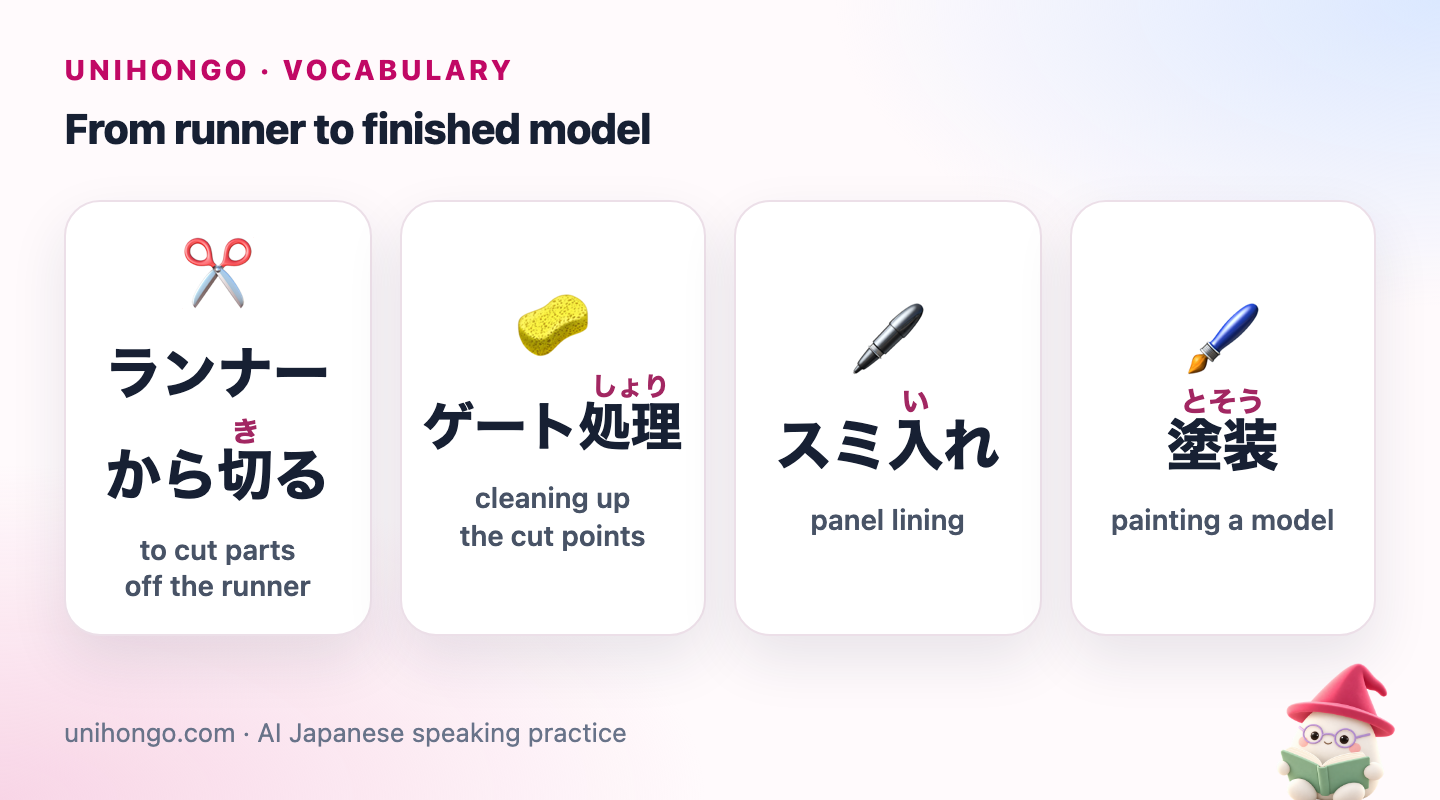
Almost every build follows the same four stages, and Japanese build videos name them constantly. You cut each part off the runner, clean the gate marks so the cut does not show, add panel lines with dark paint, and paint the whole model or just the details. Learn these four and you can follow the structure of most build guides.
Kiru (切る) is the plain verb to cut. Shori (処理) means processing or treatment, and gēto shori is the whole job of trimming and sanding the gate until it is smooth. Tosō (塗装) is the technical word for painting a model, used in shop sections and guides; in conversation people also say nuru, to paint.
| Japanese | Romaji | Meaning |
|---|---|---|
| ランナーから切る | rannā kara kiru | to cut parts off the runner |
| ゲート処理 | gēto shori | cleaning up the cut points |
| スミ入れ | sumiire | panel lining |
| 塗装 | tosō | painting a model |
| 今日はゲート処理だけで終わった。 | Kyō wa gēto shori dake de owatta. | Today I only managed the gate cleanup. |
Tools on the workbench
Model tools are mostly katakana, but a few native words are essential. Nippā (ニッパー), from the English nippers, is the small side cutter used to snip parts off. A single-blade nipper, kataba nippā, cuts more cleanly and is popular with careful builders. Yasuri (やすり) is a file, kami yasuri (紙やすり) is sandpaper, and pinsetto (ピンセット), from the Dutch word, is tweezers.
| Japanese | Romaji | Meaning |
|---|---|---|
| ニッパー | nippā | side cutters |
| デザインナイフ | dezain naifu | hobby knife |
| 紙やすり | kami yasuri | sandpaper |
| ピンセット | pinsetto | tweezers |
| 接着剤 | setchakuzai | glue |
| 流し込み接着剤 | nagashikomi setchakuzai | thin cement that flows into joints |
| マスキングテープ | masukingu tēpu | masking tape |
| カッティングマット | kattingu matto | cutting mat |
| 筆 | fude | paintbrush |
Assembling and fixing parts
Many modern kits are snap-fit, which Japanese calls setchakuzai fuyō (接着剤不要), no glue needed, and parts push together. Older and scale kits are glued. The verbs here are simple and very common in instructions: hameru (はめる) is to fit or press a part into place, toritsukeru (取り付ける) is to attach, and kumitateru (組み立てる) is to assemble. When a part breaks or comes loose, the words get just as practical.
| Japanese | Romaji | Meaning |
|---|---|---|
| パーツをはめる | pātsu o hameru | to press a part into place |
| 組み立てる | kumitateru | to assemble |
| 接着剤不要 | setchakuzai fuyō | no glue needed |
| パーツが折れちゃった。 | Pātsu ga orechatta. | A part snapped. (casual) |
| 小さいパーツをなくした。 | Chiisai pātsu o nakushita. | I lost a tiny part. |
| 合わせ目を消す | awaseme o kesu | to hide the seam lines |
| 左右を間違えた。 | Sayū o machigaeta. | I mixed up the left and right parts. |
Awaseme (合わせ目) are the seam lines where two halves of a part meet, and awaseme keshi, removing them with glue and sanding, is a classic step for builders who want a cleaner look. Sayū, left and right, is a common mistake on robot arms and legs, and the instruction sheet usually marks parts with numbers and letters to help.
Painting and finishing
Painting has the richest vocabulary. Fudenuri (筆塗り) is brush painting, and eaburashi (エアブラシ) is airbrushing; many beginners start with kan supurē (缶スプレー), spray cans. Before painting, many builders spray a primer called sāfeisā, from surfacer, usually shortened to safu (サフ). Decals are dekāru (デカール). The final clear coat is the toppu kōto (トップコート), and you choose the shine: tsuyakeshi (つや消し) is matt, hantsuya (半つや) is semi-gloss and kōtaku (光沢) is gloss.
Weathering, uezaringu, makes a tank or ship look used with dirt, rust and chipped paint, and it is a whole skill of its own that builders love to discuss.
| Japanese | Romaji | Meaning |
|---|---|---|
| 筆塗りで仕上げました。 | Fudenuri de shiagemashita. | I finished it with a brush. |
| サフを吹く | safu o fuku | to spray on primer |
| デカールを貼る | dekāru o haru | to apply decals |
| つや消しのトップコート | tsuyakeshi no toppu kōto | a matt topcoat |
| 色ムラが出ちゃった。 | Iromura ga dechatta. | The paint came out patchy. |
| 汚し塗装が上手ですね。 | Yogoshi tosō ga jōzu desu ne. | Your weathering is really good. |
Model shop and build-talk dialogues
Hobby shop staff in Japan are usually builders themselves and happy to help, and some shops have a corner where finished models by customers are displayed. Model clubs and exhibitions, called tenjikai (展示会), are where builders show their work and talk technique. The first dialogue is at the counter; the second is at a small exhibition.
| Japanese | Romaji | Meaning |
|---|---|---|
| 初心者におすすめのニッパーはありますか。 | Shoshinsha ni osusume no nippā wa arimasu ka. | You: Do you have side cutters you'd recommend for beginners? |
| こちらが切れ味がよくて人気ですよ。 | Kochira ga kireaji ga yokute ninki desu yo. | Staff: This one cuts cleanly and is popular. |
| クリアパーツには何の接着剤がいいですか。 | Kuria pātsu ni wa nan no setchakuzai ga ii desu ka. | You: Which glue is good for clear parts? |
| これ、全部筆塗りですか。 | Kore, zenbu fudenuri desu ka. | You: Is this all brush-painted? |
| そうなんです。三か月かかりました。 | Sō nan desu. Sankagetsu kakarimashita. | Builder: That's right. It took three months. |
| 汚し方がリアルですね。 | Yogoshikata ga riaru desu ne. | You: The weathering looks so real. |
| ありがとうございます。まだまだですけどね。 | Arigatō gozaimasu. Mada mada desu kedo ne. | Builder: Thank you. I've still got a lot to learn. |
Safety and common learner mistakes
Paints, thinners and glues have strong fumes. Japanese labels and guides repeat the word kanki (換気), ventilation, and kaki genkin (火気厳禁), keep away from fire. Open a window, use a mask if a guide recommends one, keep blades in a safe place and keep small parts away from young children and pets.
- Saying penki for model paint. Penki is house paint; model paint is toryō (塗料) or simply the paint type, such as akuriru toryō.
- Using sasu or kakeru for spraying. Builders say fuku: supurē o fuku, safu o fuku.
- Calling the runner a furēmu. It may be understood, but rannā is the word on every guide and video.
- Mixing up nuru and haru. Nuru is to paint or spread; haru is to stick on, for decals, stickers and tape.
- Treating sugumi as lazy. Building straight from the box is a respected way to enjoy a kit.
A model-builder's study session with Mocchi
Try asking Mocchi: Quiz me on model kit words, and include the difference between nuru, haru and fuku. Mocchi explains each answer, notices which verbs you keep swapping, and brings them back in a later /review, picking up where you left off. Paste the Japanese line from your kit's instruction sheet with /explain, and Mocchi breaks it down word by word, naming each particle.
Then turn the tool words into a flashcard deck with a photo of each tool from your own workbench, and run it through Vocabulary Dash between painting sessions while the paint dries.