

What genki actually means: body, energy and mood together
English has no single word that does what genki does. Healthy is about the body, energetic is about activity, and cheerful is about mood, but genki bundles all three. A person who is genki is not ill, has energy to spare and is in good spirits. Lose any one of the three and Japanese speakers start to say genki ga nai, they seem low, even if the other two are fine.
The kanji help. Gen, 元, means origin or source, and ki, 気, is the energy or spirit that appears in words like tenki, weather, kibun, mood, and byōki, illness, literally sick ki. Genki is therefore something like your original, healthy energy, the natural state you return to after illness or tiredness. That is why genki ni naru, to become genki, is the standard way to say to recover.
Genki works as a na adjective and as a noun. Before a noun it takes na: genki na hito, a lively person. After a subject it takes desu: haha wa genki desu, my mother is well. As a noun it takes particles: genki ga aru, genki ga nai, genki o dasu.
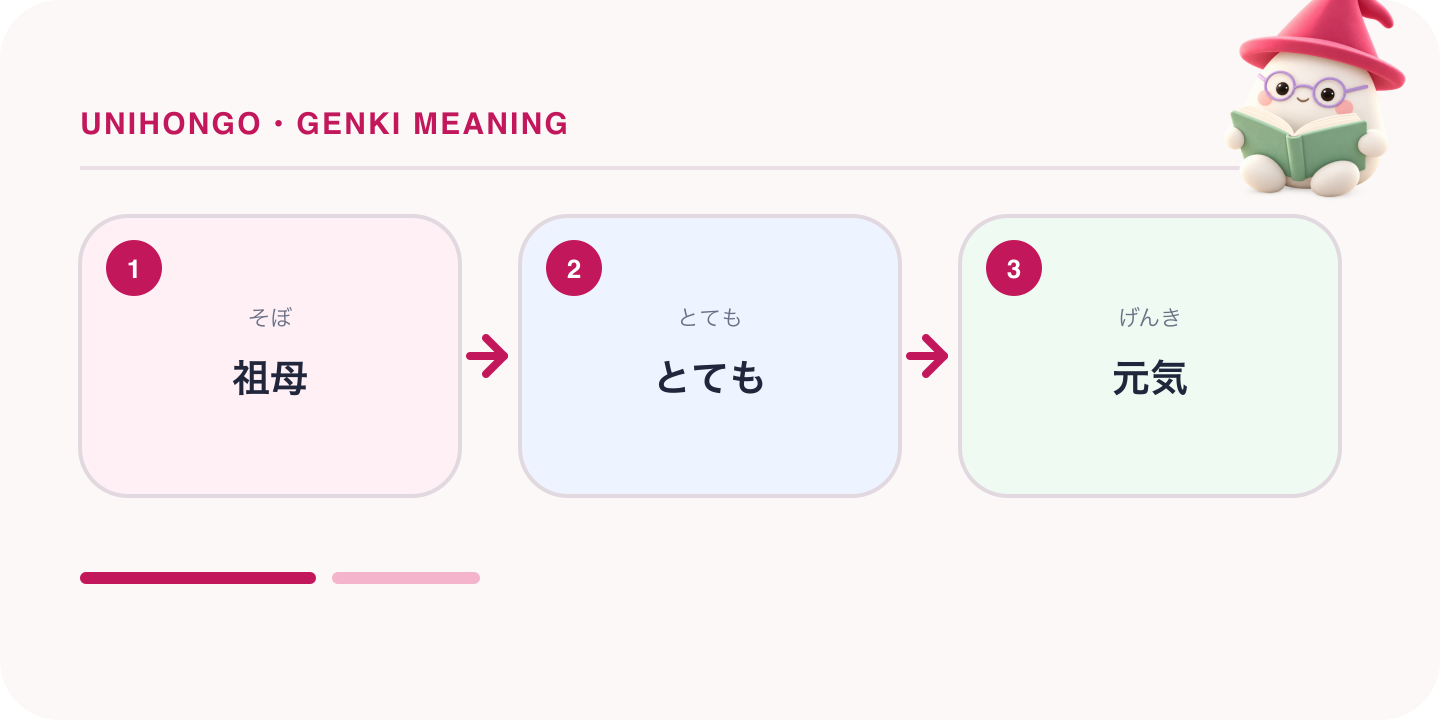
| Japanese | Romaji | Meaning |
|---|---|---|
| 祖母は九十歳ですが、とても元気です。 | Sobo wa kyūjussai desu ga, totemo genki desu. | My grandmother is ninety, but she is very well. |
| 元気な子ですね。 | Genki na ko desu ne. | What a lively child. |
| 犬が元気になった。 | Inu ga genki ni natta. | The dog has recovered. |
| 最近、元気がないね。 | Saikin, genki ga nai ne. | You seem low lately. |
| 元気があれば何でもできる。 | Genki ga areba nan demo dekiru. | If you have energy, you can do anything. |
| 元気いっぱいですね。 | Genki ippai desu ne. | You're full of energy. |
Genki na: describing people, places and things
With na before a noun, genki describes someone or something lively. Genki na kodomo is a lively child, genki na koe is a bright, energetic voice, and genki na aisatsu is a cheerful greeting, the kind shop staff are trained to give. A genki na machi is a town with energy and life, and genki na kaisha is a company that is doing well, so the word stretches from people to organisations and the economy.
In Japanese descriptions of people, genki sits next to akarui, bright and cheerful, and yasashii, kind, as one of the standard positive traits. Teachers write itsumo genki de akarui, always energetic and cheerful, on primary school reports. It is an unreservedly positive word, with no sense of being too loud or hyperactive unless someone adds sugiru, too much.
| Japanese | Romaji | Meaning |
|---|---|---|
| 元気な挨拶をしましょう。 | Genki na aisatsu o shimashō. | Let's greet people brightly. |
| 元気な声で返事をしてください。 | Genki na koe de henji o shite kudasai. | Please answer in a clear, lively voice. |
| 彼女は明るくて元気な人です。 | Kanojo wa akarukute genki na hito desu. | She is a cheerful, energetic person. |
| 元気な赤ちゃんが生まれました。 | Genki na akachan ga umaremashita. | A healthy baby was born. |
| 元気すぎて疲れる。 | Genki sugite tsukareru. | So energetic it's tiring. |
Genki ga nai and genki ni naru: the ups and downs
The noun patterns are where genki earns its keep. Genki ga nai, to have no genki, is the everyday way to say someone looks down, flat, tired or not themselves. It is gentle and non-specific, which makes it the perfect opening for a caring conversation: genki nai ne, dō shita no, you seem low, what's up. Nobody has to admit to being ill or sad; the word covers whatever it is.
Genki ga deru means energy comes out, to feel one's spirits rise, and its negative genki ga denai, I can't get going, is a standard complaint on Monday mornings and after a cold. Genki ni naru, to become genki, means to recover from illness or to cheer up, and genki ni natta, I'm better now, is what you say when someone asks after a cold. Genki o dasu, to bring out your genki, is the effort to cheer up, and it gives us the encouragement genki dashite.
| Japanese | Romaji | Meaning |
|---|---|---|
| 元気ないね。どうしたの? | Genki nai ne. Dō shita no? | You seem down. What's the matter? |
| 月曜日は元気が出ない。 | Getsuyōbi wa genki ga denai. | I can't get going on Mondays. |
| 風邪はもう治って、元気になりました。 | Kaze wa mō naotte, genki ni narimashita. | My cold is gone and I'm better now. |
| この曲を聞くと元気が出る。 | Kono kyoku o kiku to genki ga deru. | This song lifts my spirits. |
| 子どもたちから元気をもらった。 | Kodomo-tachi kara genki o moratta. | The children gave me energy. |
| 早く元気になってね。 | Hayaku genki ni natte ne. | Get well soon. |
Genki dashite: cheering someone up
Genki dashite is the te form of genki o dasu used as a soft request: bring out your energy, cheer up. It is the sentence Japanese speakers reach for when a friend has failed an exam, been dumped, lost a match or is simply exhausted. The tone is warm rather than bossy, and adding ne makes it gentler still: genki dashite ne. With people you speak politely to, say genki dashite kudasai, or the more encouraging genki o dashite kudasai ne.
Timing matters. Genki dashite is for when the bad news has landed and the person is ready to be lifted. Said too early, while they are still upset, it can feel like being told to snap out of it. In that case, taihen datta ne, that was hard, comes first, and genki dashite follows once the person has been heard. Related encouragements are ganbatte, for effort ahead, and muri shinaide, for someone worn out.
| Japanese | Romaji | Meaning |
|---|---|---|
| 元気出して。 | Genki dashite. | Cheer up. |
| 元気出してね。私がついてるから。 | Genki dashite ne. Watashi ga tsuiteru kara. | Chin up. I'm here for you. |
| 元気を出してください。 | Genki o dashite kudasai. | Please keep your spirits up. (polite) |
| 大変だったね。元気出して。 | Taihen datta ne. Genki dashite. | That was rough. Cheer up. |
| 無理しないで、ゆっくり休んで。 | Muri shinaide, yukkuri yasunde. | Don't push yourself, get some rest. |
O-genki de: the farewell for a long absence
O-genki de is a goodbye with the sense of stay well, look after yourself. It comes from dōzo o-genki de ite kudasai, please stay well, shortened to its heart. Because it implies a gap before you meet again, it belongs to real partings: the end of a holiday, a colleague leaving the company, a host family waving you off at the station, or the last line of a letter or email to someone far away.
Between people who see each other every day, o-genki de sounds oddly final, as if you were emigrating. Use ja mata or mata ashita with friends, otsukaresama deshita with colleagues, and shitsurei shimasu when leaving a formal room. O-genki sō desu ne, you look well, is a kind thing to say when meeting someone after a long time.
| Japanese | Romaji | Meaning |
|---|---|---|
| それでは、お元気で。 | Sore de wa, o-genki de. | Well then, take care. |
| どうぞお元気でお過ごしください。 | Dōzo o-genki de o-sugoshi kudasai. | Please stay well. (letters, formal) |
| お元気そうですね。 | O-genki sō desu ne. | You look well. |
| ご家族の皆さんもお元気ですか。 | Go-kazoku no minasan mo o-genki desu ka. | Is your family well too? |
| また会いましょう。お元気で。 | Mata aimashō. O-genki de. | Let's meet again. Take care. |
The greeting genki desu ka, and why it is not asked daily
Every textbook opens with o-genki desu ka and the answer hai, genki desu, so learners expect to hear it constantly. They rarely do. The reason is that in Japanese it remains a real question about health and energy rather than a ritual. Asking it suggests there has been enough time for something to change, which is why it is natural after a long gap, in a letter, or when someone has been ill, and strange between colleagues who saw each other yesterday.
Daily greetings do different work: ohayō gozaimasu in the morning, a comment on the heat or the rain, or otsukaresama at the end of the day. When people do ask after a gap, the casual versions are genki? or genki datta?, and the answers run from the plain genki desu to the modest boku-boku desu, so-so, and mā mā desu, not bad. A separate guide on this blog covers the full how are you exchange, including the many ways to answer; here the point is simply that genki is the content of the question, not an empty formula.
| Japanese | Romaji | Meaning |
|---|---|---|
| 久しぶり!元気だった? | Hisashiburi! Genki datta? | Long time no see! Have you been well? |
| おかげさまで元気です。 | Okagesama de genki desu. | I'm well, thank you. |
| まあまあです。 | Mā mā desu. | Not bad. |
Genki in self-description, at work and about children
Genki appears in a few fixed contexts that are worth knowing. In self-introductions and interviews, genki de akarui, energetic and cheerful, is a common self-description, especially for customer-facing or teaching jobs, though adults usually pair it with something more concrete. In job adverts, genki na kata boshū means we want energetic applicants.
About children, genki is almost the default praise. Genki ni sodatte imasu, growing up healthy, is how parents answer questions about a baby, and genki ni gakkō ni itte imasu, going to school happily, describes a settled child. Grandparents are described as genki when they are active and well for their age. The table gathers the set expressions.
| Expression | Reading | Meaning and where you hear it |
|---|---|---|
| 元気です | genki desu | I'm well; answer to a greeting or a doctor |
| 元気な | genki na | lively, energetic; before a noun |
| 元気がない | genki ga nai | to seem down or flat |
| 元気が出る | genki ga deru | to feel one's spirits rise |
| 元気になる | genki ni naru | to recover; to cheer up |
| 元気を出す | genki o dasu | to summon energy; to cheer up |
| 元気出して | genki dashite | cheer up (encouragement) |
| お元気で | o-genki de | take care (farewell before a long gap) |
| お元気ですか | o-genki desu ka | how are you (after a gap) |
| 元気いっぱい | genki ippai | full of energy; children, teams |
| 元気に育つ | genki ni sodatsu | to grow up healthy; children, plants |
| 元気をもらう | genki o morau | to be energised by someone |
Genki also describes plants and pets: hana ga genki, the flowers are perky; neko ga genki ni natta, the cat is better.
Common mistakes with genki
Learners make four recurring mistakes. The first is using genki desu ka as a daily greeting to people they see all the time, which sounds as if you suspect they were ill. The second is treating genki as an i adjective and producing genkii or genkikatta; it is a na adjective, so the past is genki deshita or genki datta. The third is saying o-genki de to someone you will see tomorrow, which sounds like an emigration. The fourth is answering a doctor's genki desu ka with mā mā desu out of modesty, when the doctor needs a real answer.
- Do not greet daily colleagues with genki desu ka; use ohayō gozaimasu or a weather comment
- Past tense is genki datta or genki deshita, never genkikatta
- O-genki de only when you will not meet for a while
- Genki ga nai is gentle; do not translate it as depressed
- Genki dashite comes after listening, not instead of it
- Genki sugiru is the only common negative shade, too energetic
If you remember one thing, remember that genki is a real state rather than a formula. Ask about it when you genuinely want to know, describe it when it changes, and wish it on people when you part.