
The rules in one minute
One player says a word. The next player must say a word that begins with the kana that ended it. Sakana (さかな), fish, ends in na, so the next word might be natsu (なつ), summer, and then tsukue (つくえ), desk. The chain goes on until someone is stuck or breaks a rule.
- Start with the last kana, not the last letter. Neko ends in こ, so the next word starts with ko, not with o.
- Nouns only. Most groups also leave out the names of people and places.
- No repeats. A word that has already been said is out.
- A word ending in ん loses the game at once.
Many games start from the word shiritori itself, so the first player needs a word beginning with ri. That is why ringo (りんご), apple, opens so many chains.
A sample chain to read aloud
This is close to the chain most Japanese children learn first. Read it aloud and listen for the handover: the last sound of each word becomes the first sound of the next. Hiragana and katakana count as the same kana, so ringo can hand over to gorira.
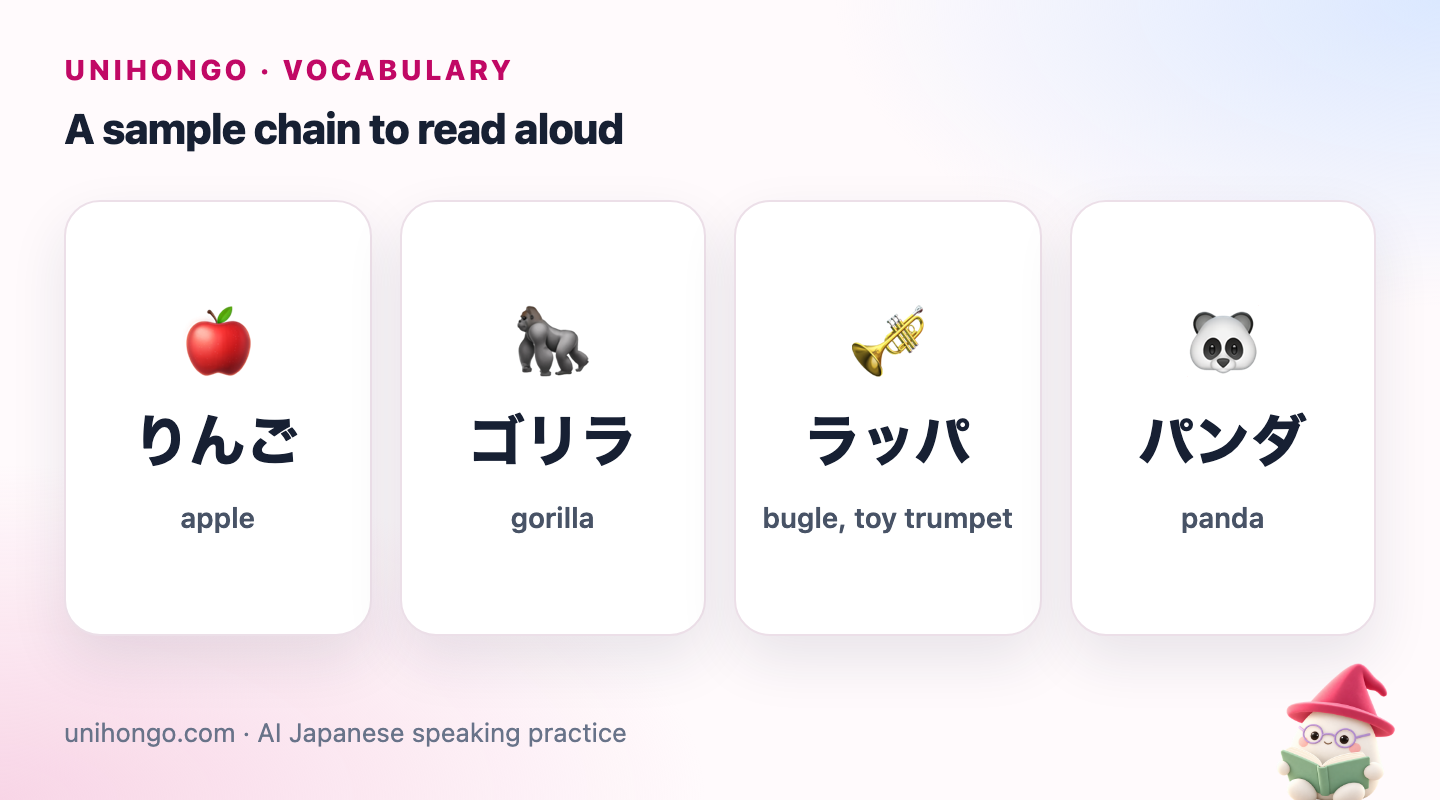
| Japanese | Romaji | Meaning |
|---|---|---|
| りんご | ringo | apple |
| ゴリラ | gorira | gorilla |
| ラッパ | rappa | bugle, toy trumpet |
| パンダ | panda | panda |
| だるま | daruma | daruma doll |
| まくら | makura | pillow |
| ライオン | raion | lion (ends in n: you lose) |
The chain ends at raion. The player who says it loses, however good the word was.
Why n ends the game
In standard Japanese, everyday words do not begin with ん. A few foreign place names are written that way in katakana, such as the capital of Chad, but nobody can build a game on those, so the rule is simple: end on n and you are out.
This makes n-final words a trap worth knowing, and there are many of them. Good players learn to feel that final n coming before they open their mouths.
| Japanese | Romaji | Meaning |
|---|---|---|
| みかん | mikan | mandarin orange |
| かばん | kaban | bag |
| きりん | kirin | giraffe |
| にんじん | ninjin | carrot |
Long vowels, small kana and voiced sounds: house rules
Three situations have no single official answer, so players agree before starting.
Long vowel marks. Kōhī (コーヒー), coffee, ends in a long mark. Some groups ignore the mark and continue from hi (ひ); others continue from the vowel you actually hear, i (い). Both are common.
Small kana. Jitensha (自転車), bicycle, ends in しゃ. The most common ruling treats the small ゃ as a full や, so the next word starts with ya. A stricter ruling demands a word starting with sha.
Voiced marks. After ringo, the strict rule requires a word starting with go (ご). Looser games let you drop or add the marks, so ko (こ) is accepted too, and ha, ba and pa may be swapped. Games with small children are usually loose; adults who want a challenge play strict.
| Japanese | Romaji | Meaning |
|---|---|---|
| コーヒー | kōhī | coffee: continue with hi or i |
| 自転車 | jitensha | bicycle: continue with ya or sha |
| りんご | ringo | apple: continue with go, or ko if loose |
Phrases for playing in Japanese
Run the whole game in Japanese, including the talk around it. The lines below are polite enough for a language exchange; with close friends, shorten them, as in the first row.
| Japanese | Romaji | Meaning |
|---|---|---|
| しりとりしよう。 | Shiritori shiyō. | Let's play shiritori. (casual) |
| しりとりをしませんか。 | Shiritori o shimasen ka. | Would you like to play shiritori? |
| 「り」から始めます。 | Ri kara hajimemasu. | I'll start from ri. |
| 次は「ご」ですね。 | Tsugi wa go desu ne. | Next is go, right? |
| 「ん」がついたら負けです。 | N ga tsuitara make desu. | If it ends in n, you lose. |
| それはもう言いました。 | Sore wa mō iimashita. | That one has been said. |
| ちょっと待ってください。 | Chotto matte kudasai. | Please wait a moment. |
| 思いつきません。 | Omoitsukimasen. | I can't think of one. |
| 私の負けです。 | Watashi no make desu. | I lose. |
Why shiritori is real practice
First, it forces you to think in kana. A learner who thinks in the alphabet believes gakkō, school, ends in o. In kana it is がっこう, so the next word starts with u. Sensei is せんせい and tokei, clock, is とけい: both hand over i. Every round quietly corrects your spelling.
Second, it trains retrieval. Knowing a word when you see it is easy; producing a noun that begins with nu within five seconds is hard, and that is the skill conversation needs. Third, it maps your vocabulary. After a few games you will know which kana rows are empty for you, and you can go and fill them.
Variations that change the difficulty
- Theme shiritori: only food, only animals, or only things you can see in the room.
- Three-kana shiritori: every word must be exactly three kana long.
- Picture shiritori, e-shiritori (絵しりとり): draw each word instead of saying it, and let the others guess.
- The ru attack: keep handing your opponent words that end in ru, because few nouns start with it. Learn rusu (留守), being away from home, rūru (ルール), rule, and rubī (ルビー), ruby, as a defence.
- Learner mode: allow a kana chart, ten seconds of thinking time, and one hint per player.
Playing with a partner or the AI Sensei
With a Japanese-speaking friend, propose the game with shiritori o shimasen ka and settle the house rules first; that negotiation is good speaking practice in itself. Ask your partner to explain any word you do not know before the chain moves on, and repeat it aloud once.
With no partner, play against a timer: two minutes, one chain, no repeats, and write down the word that stopped you. In Unihongo you can ask the AI Sensei to play a friend and run a spoken game, which adds the pressure of a real listener and gives you words you would never have chosen yourself.