
Majime in one minute
Majime is written 真面目. 真 means true or genuine, and 面目 means face or appearance, so the image is a true, straight face. The kanji spelling is a special reading: you cannot work out まじめ from the individual characters, so it is worth learning as a whole. In casual writing it is often written in hiragana, まじめ.
Grammatically, majime is a na-adjective. Majime na hito is a serious person, majime da is she is serious, and majime ni is the adverb, seriously or properly.
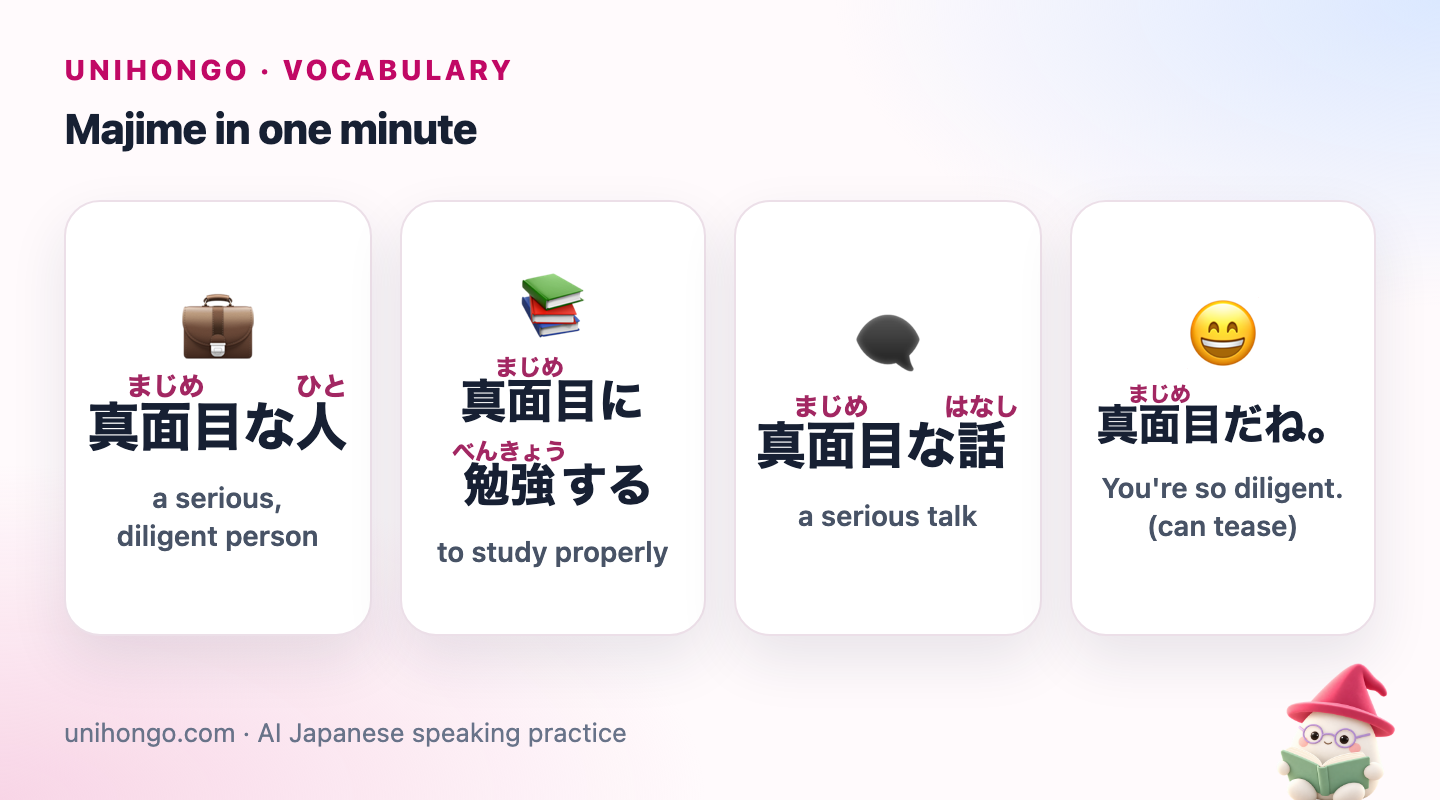
| Japanese | Romaji | Meaning |
|---|---|---|
| 真面目な人 | majime na hito | a serious, diligent person |
| 真面目に勉強する | majime ni benkyō suru | to study properly |
| 真面目な話 | majime na hanashi | a serious talk |
| 真面目だね。 | Majime da ne. | You're so diligent. (can tease) |
Majime as praise
In most settings, majime is a compliment, and a meaningful one. It suggests that someone is reliable, honest and does what they promise. Teachers use it about students who hand in homework on time, managers about staff who never cut corners, and parents when describing what they hope for in a child's partner.
It is also a common answer when Japanese people describe their own personality in a job interview: majime na seikaku desu, I'm a conscientious person. Unlike many self-praise words, this one is acceptable to say about yourself in that context, because it is about effort rather than talent.
| Japanese | Romaji | Meaning |
|---|---|---|
| 彼女はとても真面目です。 | Kanojo wa totemo majime desu. | She is very conscientious. |
| 真面目に働いています。 | Majime ni hataraite imasu. | He works diligently. |
| 私は真面目な性格です。 | Watashi wa majime na seikaku desu. | I'm a conscientious person. (interview style) |
| 真面目なところが好きです。 | Majime na tokoro ga suki desu. | I like how earnest you are. |
Majime is also a common description in dating profiles and when friends introduce someone: majime de yasashii hito, an earnest, kind person, is a classic pairing. It promises reliability rather than excitement, and most people hear it as a good sign.
Majime ni: do it properly
As an adverb, majime ni means seriously, properly, without fooling around. It appears in instructions from teachers and parents, in self-resolutions, and in the very common majime ni kiite, listen to me seriously, when someone wants to stop joking and say something important.
Majime na hanashi, a serious talk, works the same way. Majime na hanashi, ... at the start of a sentence signals a change of tone: joking aside.
| Japanese | Romaji | Meaning |
|---|---|---|
| 真面目にやって! | Majime ni yatte! | Do it properly! (casual, firm) |
| ちょっと真面目に聞いて。 | Chotto majime ni kiite. | Listen to me seriously for a moment. |
| 真面目な話、転職を考えてるんだ。 | Majime na hanashi, tenshoku o kangaeteru n da. | Joking aside, I'm thinking of changing jobs. |
| 来年は真面目に日本語を勉強します。 | Rainen wa majime ni Nihongo o benkyō shimasu. | Next year I'll study Japanese seriously. |
The teasing majime da ne, and too-serious words
Among friends, especially younger people, majime can carry a light tease. If you refuse a second drink because you have an early meeting, or you are the only one who read the course book, a friend might laugh and say majime da ne or majime sugi. It means you're such a goody two-shoes, but kindly. The best response is to laugh along.
Stronger versions exist. Kimajime (生真面目) means very earnest, sometimes stiffly so. Kuso-majime (くそ真面目) is a rough, casual word for someone serious to the point of being no fun; keep it for friends, and do not say it about anyone you do not know well.
| Japanese | Romaji | Meaning |
|---|---|---|
| 真面目すぎるよ。 | Majime sugiru yo. | You're way too serious. (casual tease) |
| 真面目か! | Majime ka! | Why so serious?! (comic retort) |
| 生真面目な性格です。 | Kimajime na seikaku desu. | He has a very earnest, rather stiff character. |
| くそ真面目だな。 | Kuso-majime da na. | You're so painfully serious. (rough, friends only) |
Majime ka! is a stock comic retort, a tsukkomi, used when someone gives an overly serious answer to a joke. It is playful, and you will hear it on variety shows.
Fumajime, maji and related words
Majime overlaps with several English-friendly words, which is why learners mix it up. The key is what each word focuses on: majime is about taking things properly and following through; seijitsu is about honesty toward people; kinben is about hard work and sounds formal; nesshin is about enthusiasm; honki is about meaning what you say in a particular moment. A person can be nesshin about a hobby without being majime in general, and a majime person can still be quite relaxed.
The opposite, fumajime (不真面目), means not serious or not diligent, and is a fairly strong criticism. The slang maji (マジ, まじ), meaning seriously or for real, is commonly said to be a shortened form of majime; the meanings line up well. Maji is very casual and used with friends: maji de? means seriously? Unihongo has a separate guide to maji and gachi if you want more.
| Japanese | Romaji | Meaning |
|---|---|---|
| 誠実な人と結婚したい。 | Seijitsu na hito to kekkon shitai. | I want to marry a sincere person. |
| 熱心に練習しています。 | Nesshin ni renshū shite imasu. | She practises enthusiastically. |
| 本気で言ってるの? | Honki de itteru no? | Do you really mean that? (casual) |
| マジで? | Maji de? | Seriously? (slang, friends only) |
| 不真面目な態度はよくないよ。 | Fumajime na taido wa yoku nai yo. | A careless attitude isn't good. |
| Word | Meaning | Difference from majime |
|---|---|---|
| Seijitsu (誠実) | Sincere, honest, faithful | Focus on honesty toward people |
| Kinben (勤勉) | Industrious, hard-working | Formal; focus on hard work |
| Nesshin (熱心) | Enthusiastic, keen | Focus on passion, not rule-following |
| Honki (本気) | Serious intent, for real | About meaning it, not about character |
| Katai (堅い) | Stiff, rigid, formal | Often a criticism of being too proper |
| Fumajime (不真面目) | Not serious, careless | The opposite |
A short dialogue: the friend who studies on Friday night
Two friends meet at a café. One has brought her kanji workbook; the other wants to go to karaoke. Listen to how majime moves from tease to praise.

| Japanese | Romaji | Meaning |
|---|---|---|
| え、金曜の夜に勉強?真面目だね。 | E, kin'yō no yoru ni benkyō? Majime da ne. | Friend: What, studying on a Friday night? You're so diligent. |
| 来月、試験なんだ。 | Raigetsu, shiken nan da. | Learner: I've got an exam next month. |
| マジで?じゃあ、カラオケはまた今度だね。 | Maji de? Jā, karaoke wa mata kondo da ne. | Friend: Seriously? Then karaoke will have to wait. |
| ごめん。合格したら行こう! | Gomen. Gōkaku shitara ikō! | Learner: Sorry. Let's go once I pass! |
| 真面目なところ、尊敬するよ。 | Majime na tokoro, sonkei suru yo. | Friend: I respect how dedicated you are. |
Common mistakes
| Japanese | Romaji | Meaning |
|---|---|---|
| 深刻な問題です。 | Shinkoku na mondai desu. | It's a serious problem. |
| 本当ですか。 | Hontō desu ka. | Really? (polite) |
- Saying majime ni hito. The adjective form before a noun is majime na: majime na hito.
- Translating every serious as majime. A serious face is majime na kao, but a serious accident is ōkina jiko, and seriously ill is jūbyō.
- Using majime for serious problems. A serious illness or situation is shinkoku (深刻), not majime.
- Using maji with a teacher or boss. Say hontō desu ka instead.
- Hearing every majime da ne as an insult. Usually it is affectionate; laugh along.