
Baking words in one minute
Okashi (お菓子) means sweets or snacks, and okashi zukuri is making them at home: cookies, sponge cakes, tarts and puddings. Pan zukuri is bread making. Tezukuri (手作り), handmade, is the word people use when they give someone something they baked themselves, and it carries warmth: tezukuri no kukkī means more than homemade cookies in English.
| Japanese | Romaji | Meaning |
|---|---|---|
| クッキー焼いたよ! | Kukkī yaita yo! | I baked cookies! (casual) |
| お菓子作りが趣味です。 | Okashi zukuri ga shumi desu. | My hobby is baking sweets. |
| 週末はパン作りをしています。 | Shūmatsu wa pan zukuri o shite imasu. | I make bread at the weekend. |
| 手作りのケーキ | tezukuri no kēki | a homemade cake |
The four verbs of every recipe
Most baking recipes in Japanese are built from a small set of verbs. These four carry the most weight: you mix the ingredients, whisk eggs or cream until airy, knead bread dough, and bake. Recipes write them in the polite form or as plain dictionary forms in a list, such as mazeru or mazemasu.
Awadateru (泡立てる) is literally to make bubbles. You use it for whisking egg whites, whipping cream and beating eggs and sugar until pale. Koneru (こねる) is kneading, for bread and also for clay.
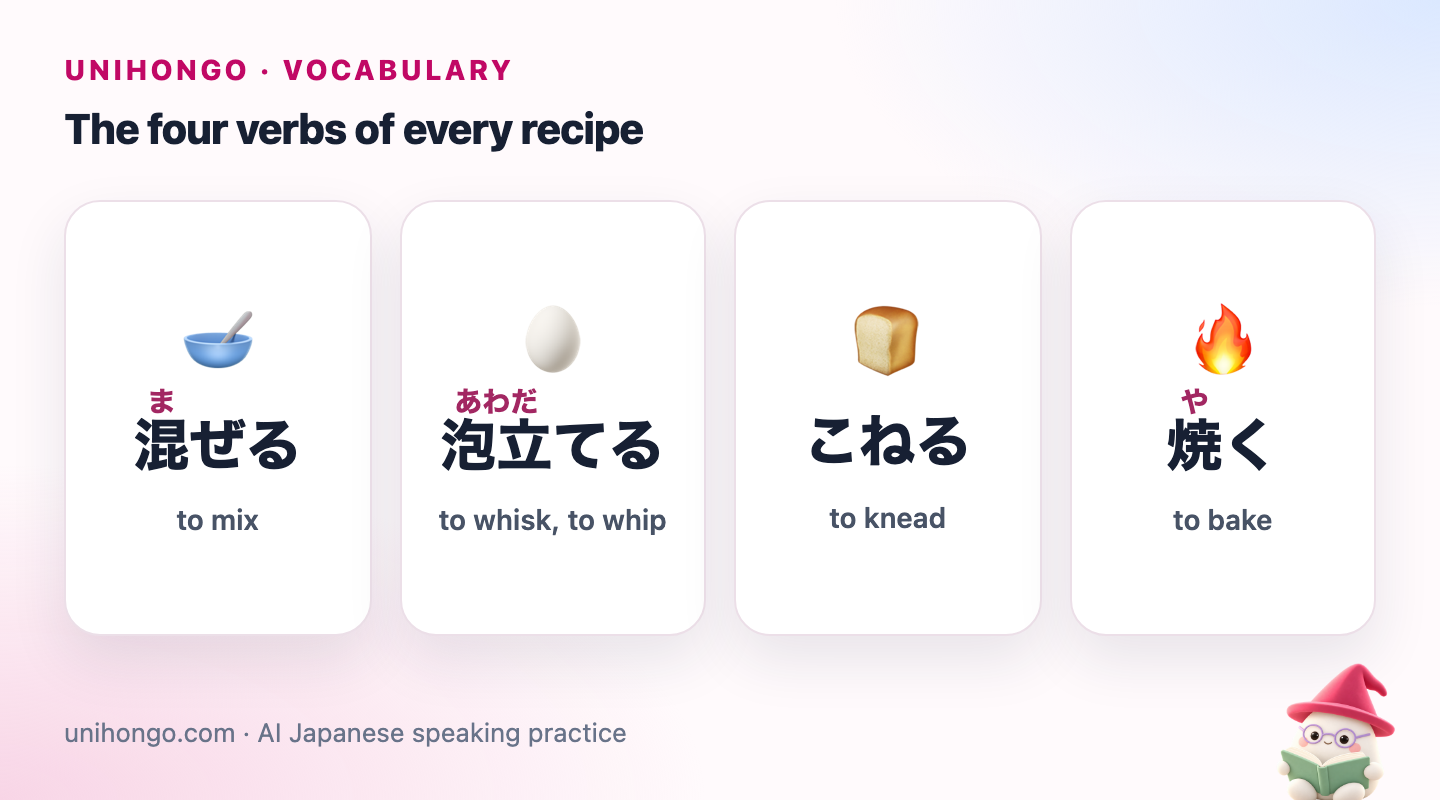
| Japanese | Romaji | Meaning |
|---|---|---|
| 混ぜる | mazeru | to mix |
| 泡立てる | awadateru | to whisk, to whip |
| こねる | koneru | to knead |
| 焼く | yaku | to bake |
| さっくり混ぜる | sakkuri mazeru | to fold in lightly |
| 角が立つまで泡立てる | tsuno ga tatsu made awadateru | to whisk until peaks form |
Other verbs you will meet in nearly every recipe: kiru (切る) is to cut, and kizamu (刻む) is to chop finely, as with nuts or chocolate; tokasu (溶かす) is to melt; tokihogusu (溶きほぐす) is to beat eggs lightly until the yolk and white are mixed; and nuru (塗る) is to brush or spread, as in brushing beaten egg on top of bread before baking. Hiyasu (冷やす) is to chill, used for cookie dough and cheesecake.
Ingredients on the shelf
Baking ingredients are a mix of native words and loanwords. Butter, cream and baking powder are katakana; flour, sugar, eggs and milk are native words with kanji. Japanese supermarkets have a baking corner, often called the seika zairyō (製菓材料) section, confectionery supplies, with small bags of nuts, chocolate and gelatine.
| Japanese | Romaji | Meaning |
|---|---|---|
| 薄力粉 | hakurikiko | cake flour |
| 強力粉 | kyōrikiko | bread flour |
| 砂糖 | satō | sugar |
| 卵 | tamago | eggs |
| 牛乳 | gyūnyū | milk |
| 無塩バター | muen batā | unsalted butter |
| 生クリーム | nama kurīmu | fresh cream |
| ベーキングパウダー | bēkingu paudā | baking powder |
| ドライイースト | dorai īsuto | dry yeast |
| 塩ひとつまみ | shio hitotsumami | a pinch of salt |
Butter in Japan is often sold salted by default, so baking recipes specify muen batā, unsalted butter. Nama kurīmu means fresh dairy cream; whipped toppings made from vegetable fat are sold beside it and are labelled differently, so check the package if a recipe calls for real cream.
Tools and measuring
Japanese recipes weigh ingredients in grams, guramu, and measure small amounts with ōsaji (15 ml) and kosaji (5 ml). A kitchen scale, kitchin sukēru, is the most useful tool you can buy. Baking tins are kata (型), literally moulds or shapes, and the flat oven tray is the tenpan (天板).
| Japanese | Romaji | Meaning |
|---|---|---|
| 大さじ一 | ōsaji ichi | one tablespoon |
| 小さじ二分の一 | kosaji nibun no ichi | half a teaspoon |
| キッチンスケール | kitchin sukēru | kitchen scale |
| ボウル | bōru | mixing bowl |
| 泡立て器 | awadateki | whisk |
| ゴムべら | gomubera | rubber spatula |
| 型 | kata | baking tin, mould |
| 天板 | tenpan | oven tray |
| クッキングシート | kukkingu shīto | baking paper |
| 粉をふるう | kona o furuu | to sift the flour |
The oven, rising and cooling
Many home kitchens in Japan use an ōbun renji (オーブンレンジ), a combination microwave and oven, rather than a large separate oven. Recipes give the temperature in degrees Celsius and the time in minutes. Bread dough goes through hakkō (発酵), fermentation or rising, often twice: ichiji hakkō, the first rise, and niji hakkō, the second rise after shaping.
After baking, recipes often say aranetsu o toru (粗熱を取る), to let the heat come off, which means letting the bake cool until it is warm rather than hot, before you remove it from the tin or cover it.
| Japanese | Romaji | Meaning |
|---|---|---|
| オーブンを百八十度に予熱する | ōbun o hyakuhachijū do ni yonetsu suru | to preheat the oven to 180 degrees |
| 二十分焼く | nijuppun yaku | to bake for twenty minutes |
| 生地を寝かせる | kiji o nekaseru | to let the dough rest |
| 一次発酵 | ichiji hakkō | the first rise |
| 二倍に膨らむまで | nibai ni fukuramu made | until doubled in size |
| 竹串を刺して確認する | takegushi o sashite kakunin suru | to check with a bamboo skewer |
| 粗熱を取る | aranetsu o toru | to let it cool slightly |
| 焼き上がり! | Yakiagari! | It's done! |
When the bake goes wrong
Every baker fails sometimes, and talking about it is half the fun. Most problems are described with a verb plus te shimatta, which adds regret: kogete shimatta, it got burnt. The words below cover the classic disasters.
| Japanese | Romaji | Meaning |
|---|---|---|
| 焦げちゃった。 | Kogechatta. | It got burnt. (casual) |
| 膨らまなかった。 | Fukuramanakatta. | It didn't rise. |
| しぼんでしまいました。 | Shibonde shimaimashita. | It collapsed. |
| 中が生焼けだった。 | Naka ga namayake datta. | The inside was underbaked. |
| パサパサになった。 | Pasapasa ni natta. | It came out dry. |
| 次は温度を下げてみる。 | Tsugi wa ondo o sagete miru. | Next time I'll try a lower temperature. |
Japanese uses many sound-symbolic words for texture, and bakers love them. Fuwafuwa (ふわふわ) is fluffy, like a good sponge; sakusaku (サクサク) is crisp and light, like a cookie or pastry; mochimochi (もちもち) is chewy and springy, like some breads; and pasapasa (パサパサ) is dry, which is the one you do not want.
Mini dialogues: shopping and sharing
The first dialogue is in a supermarket, asking where the baking ingredients are. The second is the moment many home bakers enjoy most: bringing something to share at work. Note the modest phrase people use when offering homemade food.

| Japanese | Romaji | Meaning |
|---|---|---|
| すみません、強力粉はどこですか。 | Sumimasen, kyōrikiko wa doko desu ka. | You: Excuse me, where is the bread flour? |
| 製菓材料のコーナーにありますよ。 | Seika zairyō no kōnā ni arimasu yo. | Staff: It's in the baking supplies corner. |
| 無塩バターもありますか。 | Muen batā mo arimasu ka. | You: Do you have unsalted butter too? |
| クッキーを焼いてきました。よかったらどうぞ。 | Kukkī o yaite kimashita. Yokattara dōzo. | You: I baked some cookies. Please have some if you like. |
| え、手作り?すごい! | E, tezukuri? Sugoi! | Coworker: Wait, homemade? Amazing! |
| サクサクでおいしい! | Sakusaku de oishii! | Coworker: So crisp and delicious! |
| お口に合ってよかったです。 | Okuchi ni atte yokatta desu. | You: I'm glad you like them. |
Okuchi ni au, to suit someone's mouth, is the polite way to say someone likes the taste of food you made. Okuchi ni au ka wakarimasen ga, I do not know if it will suit your taste, is the modest line to say before offering, and okuchi ni atte yokatta desu is the reply when they enjoy it.
Turn your recipe into a flashcard deck
Ask Mocchi: /create-flashcards for hakurikiko, kyōrikiko, awadateru, koneru, yonetsu and aranetsu o toru. For each card you pick a photo, ideally of your own flour bag or mixing bowl, and Mocchi reviews the deck with you with spaced repetition, bringing the words you keep forgetting back sooner. Later, ask /quiz on baking verbs and Mocchi will remember which ones you missed last time.
For a game break while the dough rises, play Sentence Builder: putting a recipe line like batā to satō o yoku mazemasu into the right order is surprisingly good practice for reading real recipes.