
I promise in Japanese: the four key phrases
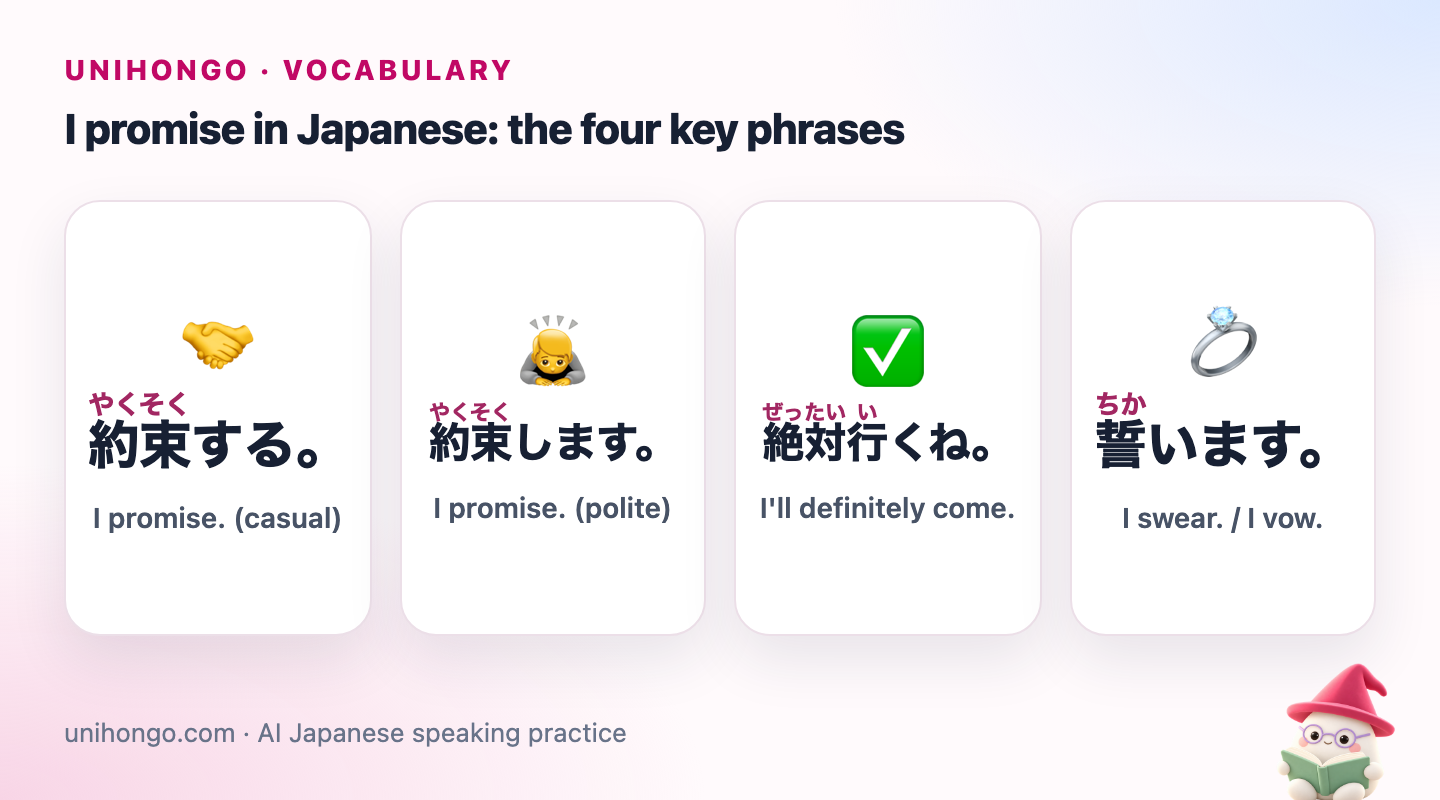
These four lines cover a casual promise, a polite one, the everyday promise without the word promise, and a solemn vow.
| Japanese | Romaji | Meaning |
|---|---|---|
| 約束する。 | Yakusoku suru. | I promise. (casual) |
| 約束します。 | Yakusoku shimasu. | I promise. (polite) |
| 絶対行くね。 | Zettai iku ne. | I'll definitely come. |
| 誓います。 | Chikaimasu. | I swear. / I vow. |
Yakusoku: a promise, and also your plans
Yakusoku (約束) is both a noun, a promise, and with suru a verb, to promise. Yakusoku da yo, it's a promise, and yakusoku ne, promise, okay?, are what friends say to seal a casual agreement. Yakusoku o mamoru means to keep a promise.
The meaning learners miss is plans with someone. Kyō wa tomodachi to yakusoku ga arimasu means I have plans with a friend today, not that you made a vow. Saki ni yakusoku ga atte, I already have plans, is a very common polite way to decline an invitation.
To say what you promised, put the content before to or koto o: mainichi renraku suru to yakusoku shita, I promised to get in touch every day. The person you promised takes to: kodomo to yakusoku shita, I made a promise to my child. In casual speech the content often comes first and yakusoku comes last, almost as a tag: ashita hachi-ji ne, yakusoku, eight o'clock tomorrow, promise.
| Japanese | Romaji | Meaning |
|---|---|---|
| 約束だよ。 | Yakusoku da yo. | It's a promise. (casual) |
| 約束ね。 | Yakusoku ne. | Promise, okay? |
| 約束を守ります。 | Yakusoku o mamorimasu. | I'll keep my promise. |
| 今日は友だちと約束があります。 | Kyō wa tomodachi to yakusoku ga arimasu. | I have plans with a friend today. |
| 先に約束があって、すみません。 | Saki ni yakusoku ga atte, sumimasen. | Sorry, I already have plans. |
Zettai and kanarazu: promising without the word
In everyday Japanese, people promise far more often with zettai, definitely, absolutely, than with yakusoku. Zettai iku ne, I'll definitely come; zettai iwanai kara, I won't tell, I swear. Zettai is casual to neutral and very common among friends.
Kanarazu (必ず), without fail, is the more formal partner and the word to use at work: kanarazu kaeshimasu, I'll be sure to return it. Both work with a negative to promise not to do something: zettai ni okurenai, I definitely won't be late.
| Japanese | Romaji | Meaning |
|---|---|---|
| 絶対言わないから。 | Zettai iwanai kara. | I won't tell, I swear. (casual) |
| 絶対に遅れない。 | Zettai ni okurenai. | I definitely won't be late. |
| 必ず返します。 | Kanarazu kaeshimasu. | I'll be sure to return it. |
| 明日、必ず連絡します。 | Ashita, kanarazu renraku shimasu. | I'll definitely get in touch tomorrow. |
Be careful with zettai in polite situations. Zettai daijōbu desu, it's absolutely fine, can sound overconfident to a customer or a boss, and if things go wrong, it is remembered as a broken promise. At work, kanarazu with a specific action, or dekiru kagiri, as far as possible, is safer.
Chikau: vows and solemn promises
Chikau (誓う) means to vow or to swear. It is the word you hear at weddings, where the couple answer chikaimasu, I do, I vow, and in serious apologies: mō nido to shinai to chikaimasu, I swear I will never do it again. It is heavy, so it sounds dramatic in casual promises.
Kami ni chikatte, I swear to God, exists but is not common in daily speech. Kokoro ni chikau, to vow in your heart, describes a private resolution.
| Japanese | Romaji | Meaning |
|---|---|---|
| もう二度としないと誓います。 | Mō nido to shinai to chikaimasu. | I swear I'll never do it again. |
| 健やかなる時も、病める時も…誓いますか。 | Sukoyaka naru toki mo, yameru toki mo... chikaimasu ka. | In health and in sickness... do you vow? (wedding) |
| はい、誓います。 | Hai, chikaimasu. | Yes, I do. |
Yubikiri: the pinky promise
Yubikiri (指切り), literally finger cutting, is the Japanese pinky promise. Two people hook their little fingers, shake them in rhythm and chant a short rhyme. The most common version goes yubikiri genman, uso tsuitara hari senbon nomasu, yubi kitta: pinky promise, if you lie you'll swallow a thousand needles, fingers cut. The exact wording varies a little, and the origin of the custom is debated.
The words sound fierce, but the custom is playful, mostly among children, parents and children, and sometimes couples joking around. Yubikiri shiyō, let's pinky promise, is all you need to start.
| Japanese | Romaji | Meaning |
|---|---|---|
| 指切りしよう。 | Yubikiri shiyō. | Let's pinky promise. |
| 指切りげんまん、嘘ついたら針千本飲ます。 | Yubikiri genman, uso tsuitara hari senbon nomasu. | Pinky promise: lie, and you'll swallow a thousand needles. |
| 指切った! | Yubi kitta! | Sealed! (end of the rhyme) |
Keeping and breaking promises
To break a promise is yakusoku o yaburu. The common complaint is yakusoku shita ja nai, you promised!, and the apology is yakusoku o yabutte gomen, sorry I broke my promise, or politely, o-yakusoku o mamorezu, mōshiwake arimasen. Yakusoku wa yakusoku, a promise is a promise, is used to hold someone to their word.
To check that someone remembers, yakusoku, oboeteru? is friendly. Keeping a promise is often praised with yakusoku o mamotte kurete arigatō, thanks for keeping your promise.
| Japanese | Romaji | Meaning |
|---|---|---|
| 約束したじゃない! | Yakusoku shita ja nai! | You promised! |
| 約束を破ってごめん。 | Yakusoku o yabutte gomen. | Sorry I broke my promise. |
| 約束は約束だよ。 | Yakusoku wa yakusoku da yo. | A promise is a promise. |
| 約束、覚えてる? | Yakusoku, oboeteru? | Do you remember your promise? |
| 約束を守ってくれてありがとう。 | Yakusoku o mamotte kurete arigatō. | Thanks for keeping your promise. |
Business commitments: careful promises
Japanese companies are generally careful about promising. Instead of yakusoku shimasu, a commitment at work usually names the action, the deadline and kanarazu: kin'yōbi made ni kanarazu o-okuri itashimasu, I will be sure to send it by Friday. O-yakusoku shimasu is used too, for example in advertising or a firm personal pledge, but it sounds weighty.
When you cannot commit, the polite phrase is kakuyaku wa dekikanemasu ga, I am unable to give a firm commitment, but, followed by what you can do. You may also hear zensho shimasu, I will deal with it appropriately, which is often understood as a polite way of not promising anything.
| Japanese | Romaji | Meaning |
|---|---|---|
| 金曜日までに必ずお送りいたします。 | Kin'yōbi made ni kanarazu o-okuri itashimasu. | I will be sure to send it by Friday. |
| 確約はできかねますが、できる限り対応いたします。 | Kakuyaku wa dekikanemasu ga, dekiru kagiri taiō itashimasu. | I can't commit firmly, but I'll do everything I can. |
| 善処します。 | Zensho shimasu. | I'll handle it as best I can. (often non-committal) |
Mini dialogue and common mistakes
| Japanese | Romaji | Meaning |
|---|---|---|
| 誰にも言わないでね。 | Dare ni mo iwanaide ne. | Friend: Don't tell anyone, okay? |
| うん、絶対言わない。約束する。 | Un, zettai iwanai. Yakusoku suru. | You: Okay, I won't tell. I promise. |
| 本当?指切りね。 | Hontō? Yubikiri ne. | Friend: Really? Pinky promise, then. |
| いいよ、指切りげんまん! | Ii yo, yubikiri genman! | You: Sure, pinky promise! |
- Confusing yakusoku with yoyaku: book a table is yoyaku, plans with a friend is yakusoku.
- Using chikaimasu for small promises: it sounds like a wedding vow.
- Saying I promise to mean believe me: for I promise it's true, say hontō da yo or hontō desu.
- Overusing yakusoku shimasu at work: name the action and deadline with kanarazu instead.
- Missing that saki ni yakusoku ga aru is a polite refusal, not a promise.