
Nikoniko: a smile that stays on the face
Nikoniko is formed by doubling niko, a root that also appears in nikkori and nikotto. Doubled mimetic words often describe something continuous or repeated, and that is the key to nikoniko: it is a smile that stays, not one that flashes and disappears. Think of a grandmother at a family gathering, a baby in a pushchair or a café owner who smiles at every customer all day.
It describes a happy, open face with no hidden meaning. It is not usually a laugh with sound; for that, Japanese has words such as geragera or kusukusu. Nikoniko is quieter, a visible glow of good mood.
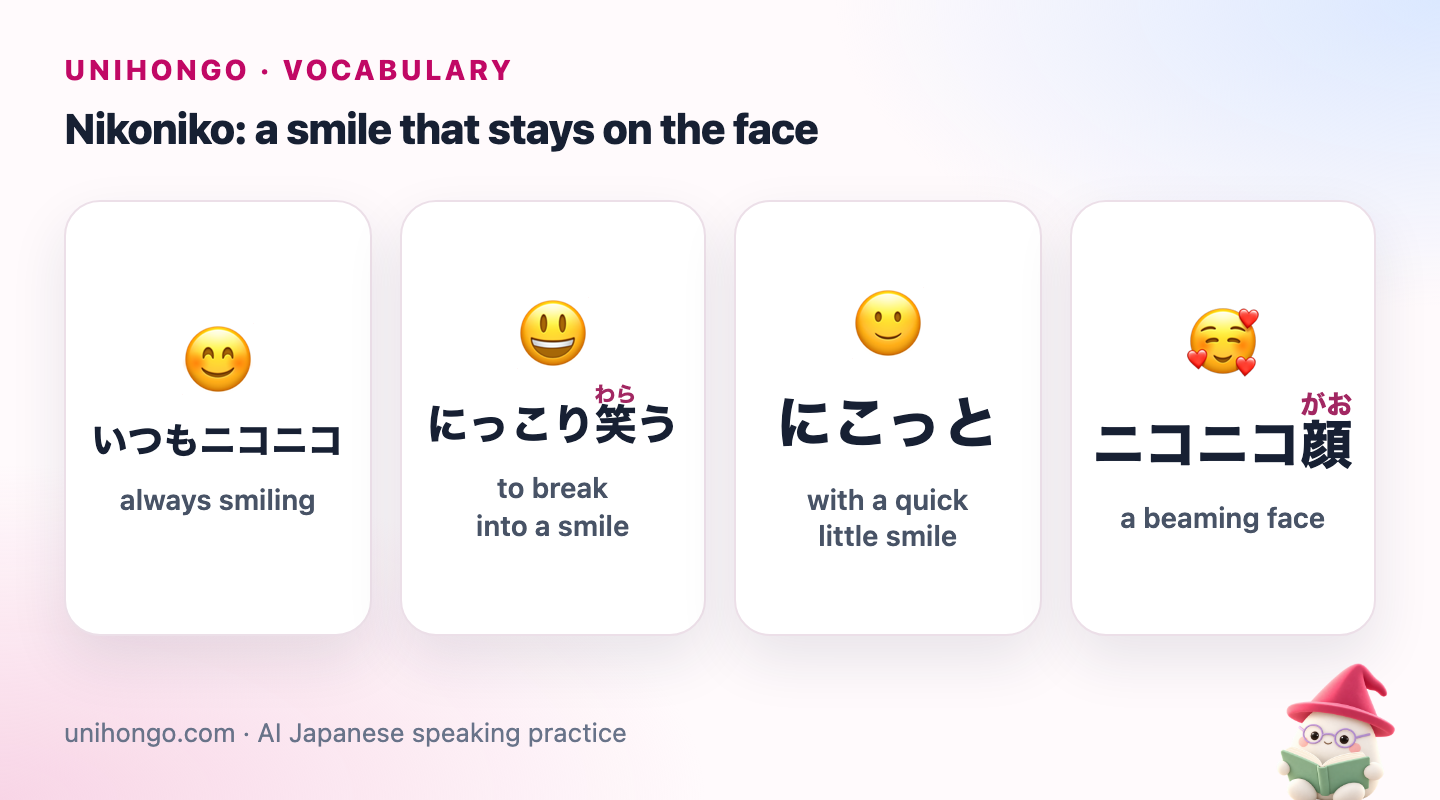
| Japanese | Romaji | Meaning |
|---|---|---|
| いつもニコニコ | itsumo nikoniko | always smiling |
| にっこり笑う | nikkori warau | to break into a smile |
| にこっと | nikotto | with a quick little smile |
| ニコニコ顔 | nikoniko gao | a beaming face |
The grammar: nikoniko suru, shite iru and to
Like most mimetic words, nikoniko becomes a verb with suru. Because it describes a lasting state, the te iru form is by far the most common: nikoniko shite iru, someone is smiling, or someone is a smiling sort of person when paired with itsumo. In casual speech this shortens to nikoniko shiteru.
Nikoniko can also sit before another verb as an adverb, with or without to: nikoniko (to) warau, to smile happily, nikoniko (to) mimamoru, to watch over with a smile. To describe a noun, use the te iru form: nikoniko shite iru hito, a smiling person. A simpler compound, nikoniko egao, a beaming smile, is also widely used in writing.
| Japanese | Romaji | Meaning |
|---|---|---|
| 赤ちゃんがずっとニコニコしている。 | Akachan ga zutto nikoniko shite iru. | The baby has been smiling the whole time. |
| 店長はいつもニコニコしています。 | Tenchō wa itsumo nikoniko shite imasu. | The manager is always smiling. (polite) |
| おばあちゃんがニコニコと見守っていた。 | Obāchan ga nikoniko to mimamotte ita. | Grandma watched over us with a smile. |
| ニコニコしている人が好きです。 | Nikoniko shite iru hito ga suki desu. | I like people who smile a lot. |
Who nikoniko describes, and when
Nikoniko is naturally used for babies and small children, for grandparents, for kind shopkeepers and for anyone whose good mood shows on their face. It is also a common word in descriptions of what someone is like: in a school report, a teacher might write that a child is itsumo nikoniko shite ite, akarui, always smiling and cheerful.
It also describes a moment of happiness that will not go away. When you get good news, your face may stay nikoniko all afternoon, and a friend might tease you about it. Here the word suggests that the smile is a bit uncontrollable, which is part of its charm.
| Japanese | Romaji | Meaning |
|---|---|---|
| プレゼントをもらって、娘はニコニコだった。 | Purezento o moratte, musume wa nikoniko datta. | My daughter was all smiles after getting a present. |
| ニコニコしてるね。何かいいことあった? | Nikoniko shiteru ne. Nanika ii koto atta? | You're all smiles. Did something good happen? |
| うれしくて、ついニコニコしちゃう。 | Ureshikute, tsui nikoniko shichau. | I'm so happy I can't help smiling. |
When someone says nikoniko shiteru ne to you, they are inviting you to share the reason. A natural reply is to confirm and explain: wakaru? jitsu wa ne..., can you tell? Actually... If you would rather not say, a light un, chotto ne, yeah, a little something, keeps it friendly.
In service jobs, a steady, welcoming smile is often expected, and people praise staff who are itsumo nikoniko shite iru. In customer reviews you may see a shop described as staff ga nikoniko shite ite kanji ga ii, the staff are smiley and pleasant. It is one of the most common compliments for a friendly local business.
The smile family: nikkori, nikotto, ninmari and hohoemu
Japanese splits smiling into more pieces than English. Nikkori (にっこり) is one clear, warm smile, often at a particular moment, such as a clerk smiling as she hands you change. Nikotto (にこっと) is quicker and lighter, a small smile that appears and goes. Ninmari (にんまり) is a satisfied, self-pleased grin, as when your plan worked. Hohoemu (微笑む) is the verb to smile gently, more literary and calm, and egao (笑顔) is the everyday noun for a smiling face.
| Japanese | Romaji | Meaning |
|---|---|---|
| 店員さんがにっこり笑ってくれた。 | Ten'in san ga nikkori waratte kureta. | The shop assistant gave me a lovely smile. |
| 目が合うと、にこっとした。 | Me ga au to, nikotto shita. | When our eyes met, she gave a quick smile. |
| 計画どおりで、思わずにんまりした。 | Keikaku dōri de, omowazu ninmari shita. | It went to plan, and I couldn't help a satisfied grin. |
| 素敵な笑顔ですね。 | Suteki na egao desu ne. | What a lovely smile. (polite compliment) |
| Word | Kind of smile | Typical moment |
|---|---|---|
| nikoniko | Warm, lasting, open | A baby, a kind host, a good mood |
| nikkori | One clear, warm smile | Smiling as you greet someone |
| nikotto | A quick, light smile | A brief smile across the room |
| ninmari | Satisfied, a little smug | When a plan works out |
| hohoemu | A gentle smile (verb) | Writing, songs, calm faces |
Smiles to keep apart: niyaniya and herahera
Two words look similar but carry criticism. Niyaniya (にやにや) is a grin with something behind it: the smile of someone who knows a secret, who is teasing, or, at worst, who is leering. Between friends, nani niyaniya shiteru no, what are you grinning about, is light teasing. Said about a stranger, it can sound creepy.
Herahera (へらへら) is a flippant, empty smile, often when someone should be serious. A boss who says herahera suru na means stop grinning and take this seriously. Never use either word when you mean to compliment someone's smile.
| Japanese | Romaji | Meaning |
|---|---|---|
| 何ニヤニヤしてるの? | Nani niyaniya shiteru no? | What are you grinning about? (teasing a friend) |
| へらへらしないで、ちゃんと聞いて。 | Herahera shinaide, chanto kiite. | Stop grinning and listen properly. |
| 苦笑いするしかなかった。 | Nigawarai suru shika nakatta. | All I could do was give a wry smile. |
Nikoniko in writing and set phrases
Mimetic words are often written in either script, and nikoniko is a good example. Hiragana にこにこ can feel soft, gentle and childlike, and it is common in picture books and messages to children. Katakana ニコニコ looks more vivid and is common in shop names, comics and casual posts. Writers choose by feel, so do not look for a strict rule.
There is also an old, playful set phrase, nikoniko genkin barai, smiling cash payment, meaning paying in cash on the spot, cheerfully. It sounds old-fashioned and humorous today, and you are more likely to hear it as a joke from an older person than in a real shop. Some neighbourhood shops and services also use nikoniko in their names to suggest friendliness, and you will see smiling-face icons described as nikoniko māku, a smiley mark, on reward stickers that teachers give to young children.
| Japanese | Romaji | Meaning |
|---|---|---|
| にこにこ笑顔でごあいさつ | nikoniko egao de goaisatsu | greeting people with a big smile (to children) |
| ニコニコ現金払いでお願いします。 | Nikoniko genkin barai de onegai shimasu. | Cash on the spot, with a smile, please. (old-fashioned joke) |
Mini dialogue: a colleague notices your smile
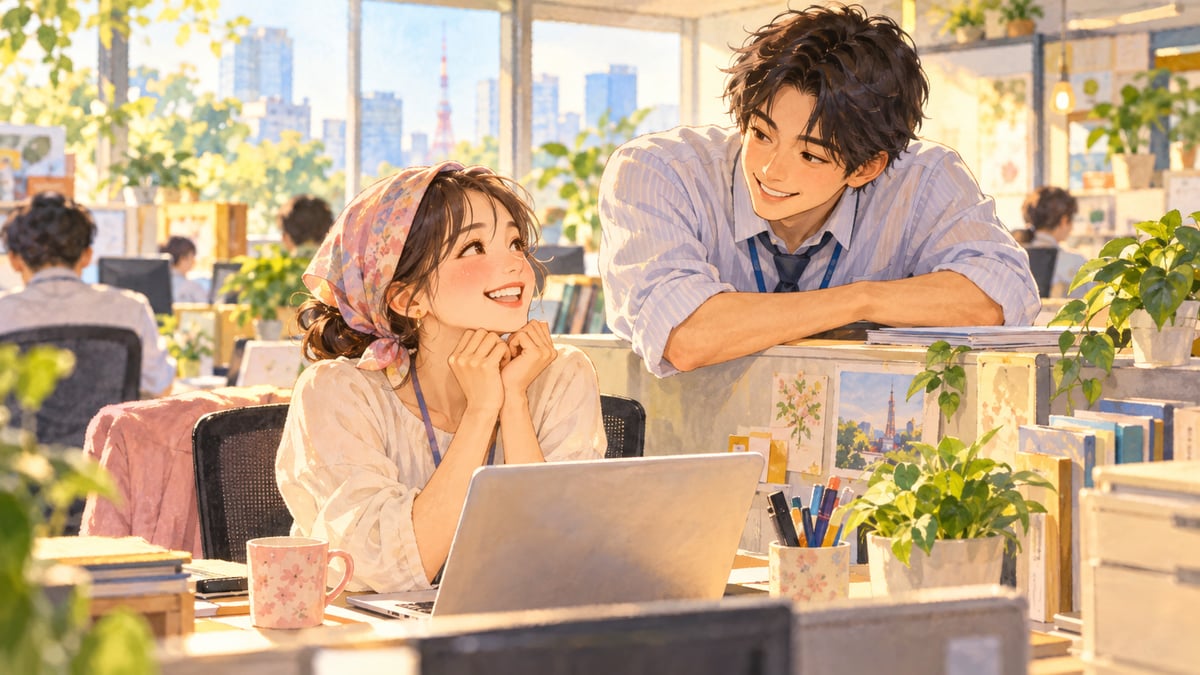
Aisha has just heard that her parents will visit Japan next month. Back at her desk, she cannot stop smiling, and her coworker Kenta notices. Listen to how nikoniko works as a gentle tease.
| Japanese | Romaji | Meaning |
|---|---|---|
| アイシャさん、朝からニコニコしてるね。 | Aisha san, asa kara nikoniko shiteru ne. | Kenta: Aisha, you've been smiling all morning. |
| わかる?実は来月、両親が日本に来るんです。 | Wakaru? Jitsu wa raigetsu, ryōshin ga Nihon ni kurun desu. | Aisha: Can you tell? Actually, my parents are coming to Japan next month. |
| それはうれしいね!どこに連れて行くの? | Sore wa ureshii ne! Doko ni tsurete iku no? | Kenta: That's great! Where will you take them? |
| 京都に行きたいです。もう楽しみで。 | Kyōto ni ikitai desu. Mō tanoshimi de. | Aisha: I want to go to Kyoto. I just can't wait. |
| だから、ずっとニコニコなんだ。 | Dakara, zutto nikoniko nan da. | Kenta: So that's why you can't stop smiling. |
Sort the smiles with Mocchi
- Ask Mocchi: give me eight short scenes and let me choose nikoniko, nikkori, niyaniya or herahera for each. Mocchi explains why each answer fits and notes the pair you confuse so it can return in a later quiz.
- Paste a sentence such as 何ニヤニヤしてるの? into /explain to see each part broken down, including the casual no at the end.
- Add the five smile words to your flashcards with a photo for each face, then play Kotoba Tank with your own deck: hearing the word and hitting the right picture is a quick way to fix the differences.
Common learner mistakes
- Using nikoniko for a laugh with sound. For laughing out loud, use warau or a word such as geragera.
- Using niyaniya as a compliment. It suggests a smirk; say suteki na egao desu ne for a lovely smile.
- Using the plain form for a lasting state. Kare wa nikoniko suru sounds incomplete; say kare wa itsumo nikoniko shite iru.
- Describing an adult stranger's smile at length. Commenting on a stranger's face can feel intrusive; it is more natural with people you know.
- Assuming nikoniko is only for children. Adults use it about each other all the time, especially for kind, cheerful people.