
One word gives, the other receives
The two words sit in the same social slot but point in opposite directions. Dōzo sends something away from you: a plate, a seat, a turn at the doorway, permission to start. Dōmo comes back the other way and acknowledges what somebody has just done for you. Once you hear them as give and receive, choosing between them stops being guesswork. A shop assistant places your change on the tray and says dōzo, you pick it up and say dōmo, and the small transaction closes.
Neither word means much by itself. Dōzo softens whatever offer or request follows it, and dōmo strengthens whatever feeling the situation already carries. That emptiness is the source of their range. Dōmo can stand in for thank you, for a light hello, for a small apology and for goodbye, and the listener works out which from context. It also means that dōmo on its own communicates very little on the record, which matters when you need your politeness to be unmistakable.
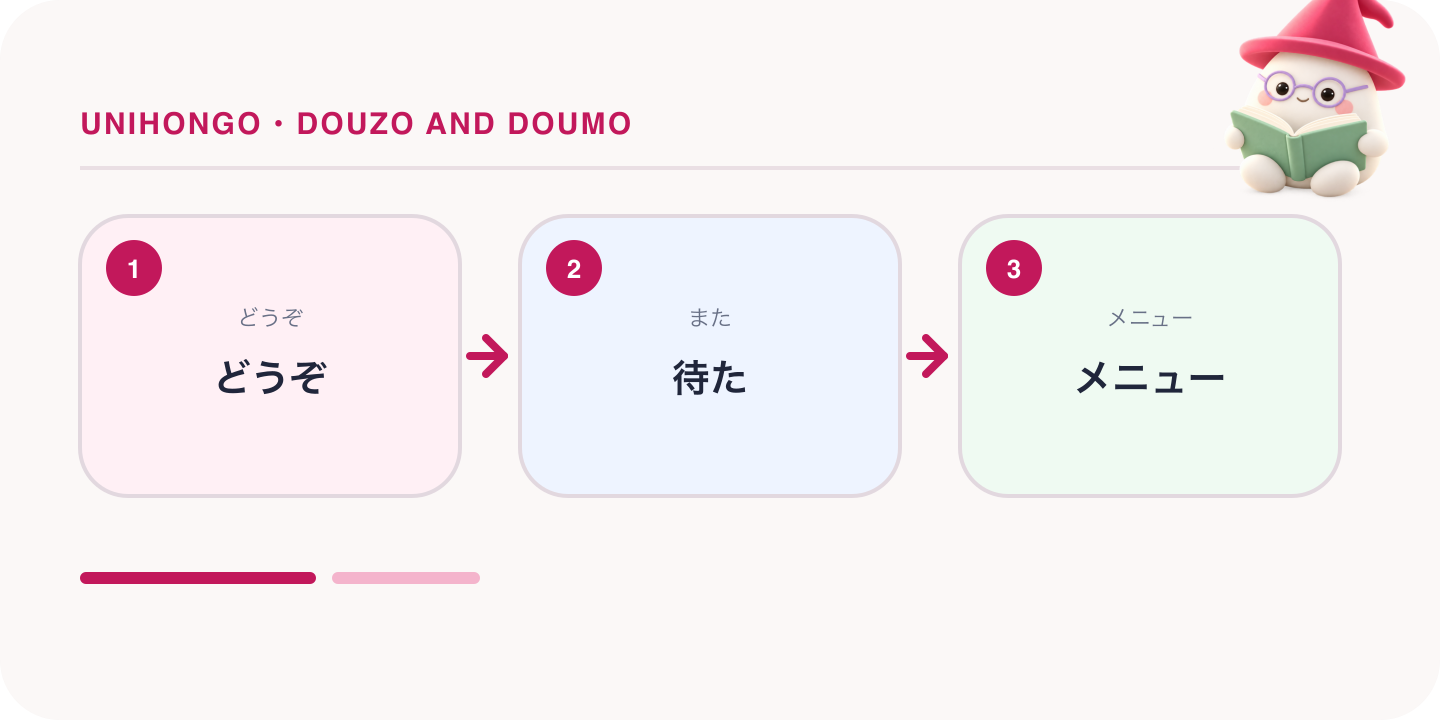
Which word fits which moment
| Situation | Word | A fuller line you can say |
|---|---|---|
| Handing someone an item | Dōzo | はい、どうぞ。 Hai, dōzo. |
| Receiving that item | Dōmo | どうもありがとうございます。 Dōmo arigatō gozaimasu. |
| Holding a door open | Dōzo | どうぞ、お先に。 Dōzo, osaki ni. |
| Walking through the held door | Dōmo | どうも、すみません。 Dōmo, sumimasen. |
| Inviting someone inside | Dōzo | どうぞお入りください。 Dōzo ohairi kudasai. |
| Offering a seat | Dōzo | どうぞお掛けください。 Dōzo okake kudasai. |
| Passing a colleague in a corridor | Dōmo | どうも、お疲れさまです。 Dōmo, otsukaresama desu. |
| Greeting a shopkeeper you know | Dōmo | どうも、こんにちは。 Dōmo, konnichiwa. |
| Thanking a colleague for help | Dōmo | どうもすみません、助かりました。 Dōmo sumimasen, tasukarimashita. |
| Meeting someone for the first time | Dōzo | どうぞよろしくお願いします。 Dōzo yoroshiku onegai shimasu. |
| Leaving a casual gathering | Dōmo | じゃあ、どうも。 Jā, dōmo. |
The pattern in the right-hand column is worth noticing on its own. Dōzo almost always leads into something else, because the offer needs a verb. Dōmo almost always leans on something else, because it needs a feeling to intensify. Learn the fuller lines and the bare words become easy shortcuts rather than risky guesses.
Dōzo when you hand something over
This is the use you will produce most often, and it is the easiest to get right. When an object leaves your hands and enters someone else's, dōzo is the word that accompanies the movement. It works for a cup of tea, a pen, a document, a menu, a returned card. In a shop or an office you will often hear it preceded by an apology for the wait or followed by a polite verb telling the person what to do with the thing.
| Japanese | Romaji | Meaning |
|---|---|---|
| はい、どうぞ。 | Hai, dōzo. | Here you are. |
| お待たせしました。どうぞ。 | Omatase shimashita. Dōzo. | Sorry to keep you waiting. Here you are. |
| こちらのメニューをどうぞ。 | Kochira no menyū o dōzo. | Here is the menu for you. |
| どうぞ、お使いください。 | Dōzo, otsukai kudasai. | Please go ahead and use it. |
| どうぞ、召し上がってください。 | Dōzo, meshiagatte kudasai. | Please help yourself to some. |
| どうぞご覧ください。 | Dōzo goran kudasai. | Please take a look. |
Dōzo when you grant, invite or let someone past
Nothing physical has to change hands for dōzo to work. It also gives away a turn, a space or a permission, which is why it appears at doorways, at lift buttons, at a free seat and at the moment someone asks whether they may begin. In this use the natural reply is not another dōzo but a word of thanks, so the exchange closes quickly and neither person has to invent a sentence.
| Japanese | Romaji | Meaning |
|---|---|---|
| どうぞお入りください。 | Dōzo ohairi kudasai. | Please come in. |
| どうぞお掛けください。 | Dōzo okake kudasai. | Please have a seat. |
| どうぞこちらへ。 | Dōzo kochira e. | This way, please. |
| お先にどうぞ。 | Osaki ni dōzo. | Please go ahead of me. |
| どうぞご自由にお取りください。 | Dōzo gojiyū ni otori kudasai. | Please take one, help yourself. |
| どうぞご遠慮なく。 | Dōzo goenryo naku. | Please do not hold back. |
| すみません、ここ、空いていますか。 | Sumimasen, koko, aite imasu ka. | Excuse me, is this seat free? |
| ええ、どうぞ。 | Ē, dōzo. | Yes, go ahead. |
Osaki ni dōzo and dōzo osaki ni both circulate, and neither will sound wrong. The mistake learners make here is answering someone else's dōzo with dōzo, as though returning a serve. If two people genuinely defer to each other, the second one usually adds a small protest such as ie ie or a thank you before finally moving.
Dōzo yoroshiku and the other fixed pairings
A handful of set phrases have dōzo welded into them, and in these the word no longer means please take it. It simply adds warmth and a little formality, the way sincerely does at the end of an English letter. Dōzo yoroshiku onegai shimasu is the big one, used when a relationship begins, when you hand over a task, or when you close a request. Dropping the dōzo leaves a perfectly good yoroshiku onegai shimasu, so treat it as an upgrade rather than a requirement.
The parting phrases work the same way. Dōzo odaiji ni to somebody unwell and dōzo ogenki de to somebody leaving are both softened by that opening word, and both sound noticeably kinder than the bare version. Dōzo okamainaku is the phrase to have ready when a host starts preparing something for you and you would rather they did not go to the trouble.
| Japanese | Romaji | Meaning |
|---|---|---|
| どうぞよろしくお願いします。 | Dōzo yoroshiku onegai shimasu. | I look forward to working with you. |
| こちらこそ、どうぞよろしくお願いいたします。 | Kochira koso, dōzo yoroshiku onegai itashimasu. | The pleasure is mine, I look forward to it as well. |
| どうぞお大事に。 | Dōzo odaiji ni. | Please take care of yourself. |
| どうぞお元気で。 | Dōzo ogenki de. | Please stay well. |
| どうぞお構いなく。 | Dōzo okamainaku. | Please do not go to any trouble. |
| どうぞ楽にしてください。 | Dōzo raku ni shite kudasai. | Please make yourself comfortable. |
The four jobs of dōmo
Dōmo is the more slippery of the two because the same syllables do four different jobs. It thanks, it greets, it apologises and it says goodbye, and only the situation tells the listener which. A colleague who says dōmo while taking a coffee from you is thanking you. The same colleague saying dōmo while walking past your desk is greeting you. Someone saying dōmo as they squeeze past your chair is apologising for the intrusion.
That flexibility is a gift once you can hear it, because it means you always have something to say. It is also why dōmo is best learned attached to its longer partners. Dōmo arigatō gozaimasu is unambiguous thanks, dōmo sumimasen is unambiguous apology or thanks for trouble taken, and dōmo osewa ni narimashita closes a period of being looked after.
| Japanese | Romaji | Meaning |
|---|---|---|
| どうも。 | Dōmo. | Thanks. / Hi. / Sorry. (the moment decides which) |
| どうもありがとうございます。 | Dōmo arigatō gozaimasu. | Thank you very much. |
| どうもありがとうございました。 | Dōmo arigatō gozaimashita. | Thank you very much for what you did. |
| どうもすみません。 | Dōmo sumimasen. | I am very sorry. / Thanks for going to the trouble. |
| どうも、お疲れさまです。 | Dōmo, otsukaresama desu. | Hello there, thanks for your work. |
| どうもご親切に。 | Dōmo goshinsetsu ni. | That is very kind of you. |
| どうもお世話になりました。 | Dōmo osewa ni narimashita. | Thank you for everything you have done for me. |
| じゃあ、どうも。 | Jā, dōmo. | Right, see you then. |
Why dōmo alone can sound curt
Bare dōmo is casual. Among friends, familiar colleagues and shop staff you see every week it is warm and efficient. Aimed upward at a manager, a client, a teacher or an older stranger who has just done you a real favour, it can land as clipped, as though you could not be bothered to finish the sentence. The problem is not rudeness in the word itself, it is that a short reply signals a small debt, and if the favour was not small the mismatch shows.
The fix is not complicated: finish the phrase. Arigatō gozaimasu alone is safe almost everywhere, and adding a reason makes it warmer still. If someone made a special trip, wazawaza is the word that names the effort. If you are receiving something from a client or a senior, osoreirimasu carries a note of being humbled by it. None of these cost more than a second to say.
| Japanese | Romaji | Meaning |
|---|---|---|
| あ、どうも。 | A, dōmo. | Oh, thanks. (casual, in passing) |
| ありがとうございます。 | Arigatō gozaimasu. | Thank you. (safe in almost any setting) |
| ご丁寧にありがとうございます。 | Goteinei ni arigatō gozaimasu. | Thank you for being so thorough. |
| わざわざありがとうございました。 | Wazawaza arigatō gozaimashita. | Thank you for going out of your way. |
| 恐れ入ります。 | Osoreirimasu. | I am much obliged. |
| どうもすみません、助かりました。 | Dōmo sumimasen, tasukarimashita. | Sorry for the trouble, that really helped me. |
The rule of thumb is simple. If you would happily use the plain form of a verb with this person, bare dōmo is fine. If you would automatically switch to desu and masu with them, spend the extra syllables. The dedicated guide to polite and casual Japanese covers the wider register decision that sits behind this one.
The exchange where one says dōzo and the other says dōmo
Because the words point in opposite directions, they slot together into a complete two-line exchange. This is the most useful thing to drill, since it gives you both halves of a real interaction rather than an isolated word. Practise them as pairs, saying the first line as the giver and the second as the receiver, so that whichever role you find yourself in the reply is already loaded.
| Japanese | Romaji | Meaning |
|---|---|---|
| どうぞ、お先に。 | Dōzo, osaki ni. | Please, after you. (the person holding the door) |
| どうも、すみません。 | Dōmo, sumimasen. | Thanks, sorry about that. (the person going through) |
| コーヒーです。どうぞ。 | Kōhī desu. Dōzo. | Here is your coffee. (the person serving) |
| どうも。いただきます。 | Dōmo. Itadakimasu. | Thanks. I will have it. (the person receiving) |
| こちらが資料です。どうぞ。 | Kochira ga shiryō desu. Dōzo. | Here are the documents. (the person presenting) |
| ありがとうございます。拝見します。 | Arigatō gozaimasu. Haiken shimasu. | Thank you, I will look at them. (the person taking them) |
| 傘、お使いください。どうぞ。 | Kasa, otsukai kudasai. Dōzo. | Please use this umbrella. (the person lending) |
| どうもご親切に。お借りします。 | Dōmo goshinsetsu ni. Okarishimasu. | That is very kind. I will borrow it. (the person accepting) |
Notice that the receiving line is rarely just dōmo when something substantial has passed. It picks up a second element: an apology, an itadakimasu, a statement of what you will do with the thing. That second element is what makes the reply sound like a person rather than a reflex.
Mistakes learners make with these two
- Answering dōzo with dōzo, which leaves both people standing in the doorway.
- Using bare dōmo with a client or a manager after a genuine favour, when arigatō gozaimasu costs almost nothing.
- Treating dōmo as a full greeting with someone you have never met, where konnichiwa and a proper introduction are expected.
- Saying dōzo when you mean after you at a doorway but forgetting the osaki ni, so the invitation is vague.
- Dropping dōzo from dōzo yoroshiku onegai shimasu in a first-meeting situation where the fuller version sounds better.
- Adding kudasai to a bare dōzo as dōzo kudasai, which is not a phrase; the polite verb goes in between, as in dōzo ohairi kudasai.
A week of practice you can actually do
- Day one: say hai, dōzo aloud every time you hand anything to anyone, in any language.
- Day two: add the receiving half, answering yourself with dōmo, arigatō gozaimasu.
- Day three: drill the doorway pair, dōzo osaki ni and dōmo sumimasen, until neither needs thought.
- Day four: practise three fuller dōzo lines with a polite verb, such as ohairi kudasai, okake kudasai and goran kudasai.
- Day five: swap every bare dōmo you would say to a superior for a finished thank you.
- Day six: run a cafe or office roleplay and count how many times each word appears in the reply you hear.
- Day seven: record yourself doing both halves of five exchanges and listen for the timing of the word against the gesture.