
Four words for your first time in the water
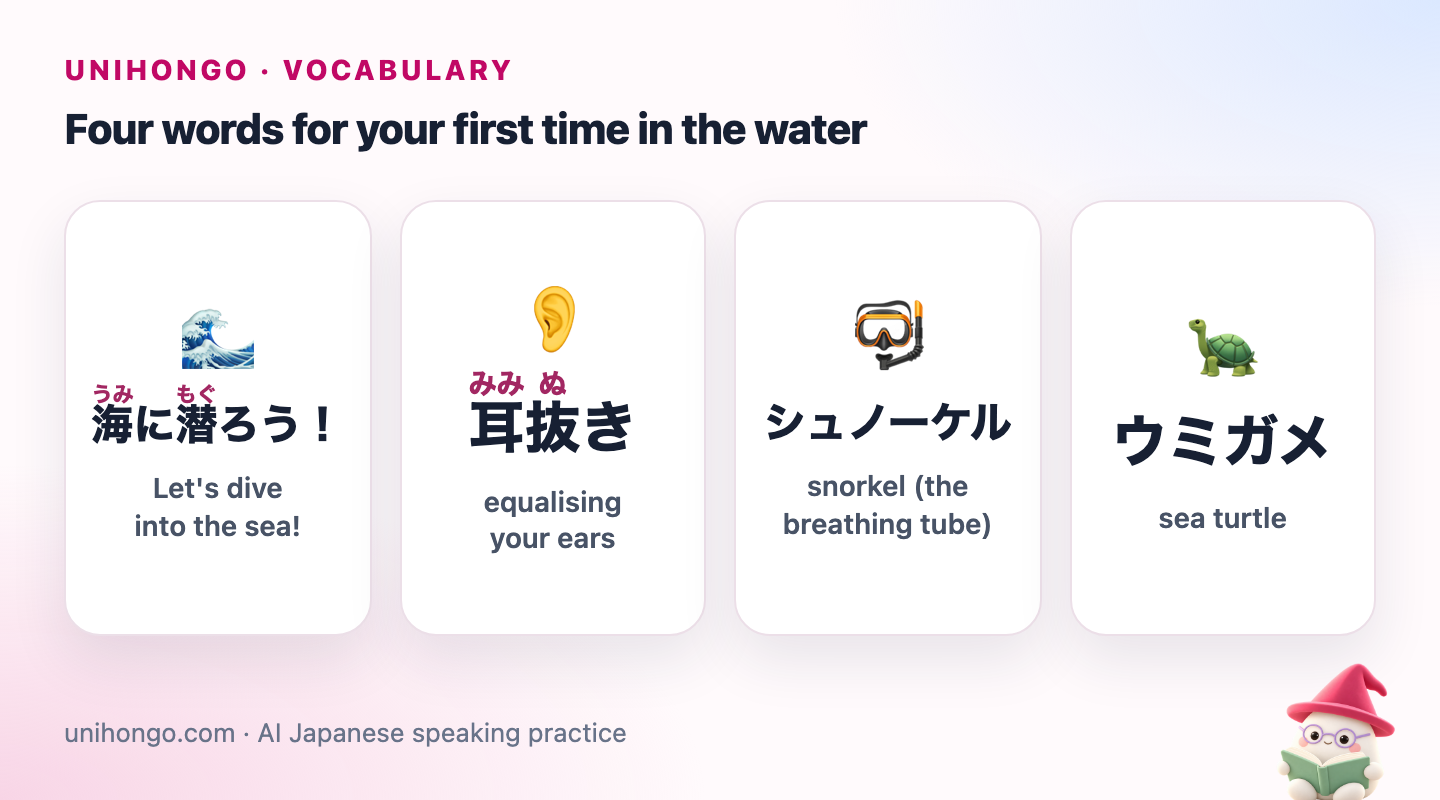
Moguru, to dive down or go underwater, is the native verb behind both scuba diving and skin diving, and umi ni mogurō, let's dive into the sea, is the happy invitation of any island holiday. Mimi nuki is the first skill an instructor checks. The shunōkeru, snorkel, is the tube you breathe through at the surface, and the umigame, sea turtle, is the animal everyone hopes to see.
| Japanese | Romaji | Meaning |
|---|---|---|
| 海に潜ろう! | Umi ni mogurō! | Let's dive into the sea! |
| 耳抜き | mimi nuki | equalising your ears |
| シュノーケル | shunōkeru | snorkel (the breathing tube) |
| ウミガメ | umigame | sea turtle |
| 潜る | moguru | to dive down, go underwater |
| 浮く | uku | to float |
Kinds of tours and certification
Dive shops sell a few standard kinds of tour, and the names are mostly Japanese-made English. A taiken daibingu is a try dive for beginners. A fan daibingu, fun dive, is a guided dive for people who already have a certification, which Japanese divers usually call raisensu, licence, or the card. Courses to get certified are raisensu shutoku kōsu.
Dives start either from the beach, bīchi daibingu, or from a boat, bōto daibingu. Snorkeling tours, shunōkeru tsuā, often give everyone a life jacket and stay near the surface.
| Japanese | Romaji | Meaning |
|---|---|---|
| 体験ダイビング | taiken daibingu | try dive (no certification needed) |
| ファンダイビング | fan daibingu | guided dive for certified divers |
| ライセンスを持っています。 | Raisensu o motte imasu. | I have a diving certification. |
| ライセンスは持っていません。 | Raisensu wa motte imasen. | I don't have a certification. |
| ボートダイビング | bōto daibingu | boat dive |
| ライフジャケット | raifu jaketto | life jacket |
| 前回潜ったのは二年前です。 | Zenkai mogutta no wa ninen mae desu. | My last dive was two years ago. |
Shops often ask when you last dived, because a long break may mean they recommend a refresher. Be honest: it is about your safety, not a test. If you have a logbook or a certification card, bring it along.
Gear for diving and snorkeling
Gear names are katakana. Note that the mask is masuku, the same word as a face mask for colds, and that gōguru, goggles, are for swimming pools, not for diving. Fins are fin, and the weight belt is ueito.
For snorkeling you only need the mask, the snorkel and fins, plus a life jacket on most tours. The common beginner problem is water in the snorkel. Guides will tell you to blow hard to clear it, shunōkeru no mizu o fukidashite, and to keep your face down and relax rather than lifting your head. Breathing calmly through your mouth takes a few minutes to feel natural, so start in shallow water near the guide.
| Japanese | Romaji | Meaning |
|---|---|---|
| マスク | masuku | diving mask |
| フィン | fin | fins |
| ウェットスーツ | wettosūtsu | wetsuit |
| タンク | tanku | air tank |
| レギュレーター | regyurētā | regulator |
| ウエイト | ueito | weights |
| マスクが曇ります。 | Masuku ga kumorimasu. | My mask keeps fogging up. |
| フィンが少しきついです。 | Fin ga sukoshi kitsui desu. | The fins are a bit tight. |
Kumoru, to cloud over, is the verb for a fogged mask, and the same verb as a cloudy sky. Kitsui means tight for clothes and gear; the opposite is yurui, loose.
The health check and the briefing
Before any dive you will fill in a health form and hear a briefing, burīfingu. Staff ask about medical conditions, jibyō, how you feel today, taichō, and whether you get seasick, funayoi. A cold matters, because a blocked nose makes equalising difficult and can hurt your ears. Answer simply and honestly; the staff decide what is safe.
If you are flying after the trip, say so when you book. Instructors will advise how long to wait between your last dive and your flight.
| Japanese | Romaji | Meaning |
|---|---|---|
| 持病はありますか。 | Jibyō wa arimasu ka. | Staff: Do you have any medical conditions? |
| 特にありません。 | Toku ni arimasen. | Nothing in particular. |
| 少し風邪気味です。 | Sukoshi kazegimi desu. | I have a slight cold. |
| 船酔いしやすいです。 | Funayoi shiyasui desu. | I get seasick easily. |
| 酔い止めはありますか。 | Yoidome wa arimasu ka. | Do you have seasickness pills? |
| 明後日、飛行機に乗ります。 | Asatte, hikōki ni norimasu. | I'm flying the day after tomorrow. |
Instructions underwater and at the surface
Underwater, communication is by hand signals, which are taught in the briefing. The spoken instructions come before you go down and at the surface, and they are short. Learn the verbs for breathing and moving, and the polite request form ~ te kudasai, which instructors use for almost everything.
| Japanese | Romaji | Meaning |
|---|---|---|
| ゆっくり息を吐いてください。 | Yukkuri iki o haite kudasai. | Please breathe out slowly. |
| 耳抜きをしてください。 | Mimi nuki o shite kudasai. | Please equalise your ears. |
| 耳抜きができません。 | Mimi nuki ga dekimasen. | I can't equalise. |
| ロープにつかまってください。 | Rōpu ni tsukamatte kudasai. | Please hold on to the rope. |
| サンゴに触らないでください。 | Sango ni sawaranai de kudasai. | Please don't touch the coral. |
| ゆっくり浮上します。 | Yukkuri fujō shimasu. | We'll go up slowly. |
Fujō, rising to the surface, is a more technical word than uku, to float. Instructors also use entorī for getting into the water and ekijitto for getting out, both Japanese diving terms from English.
Conditions and sea life
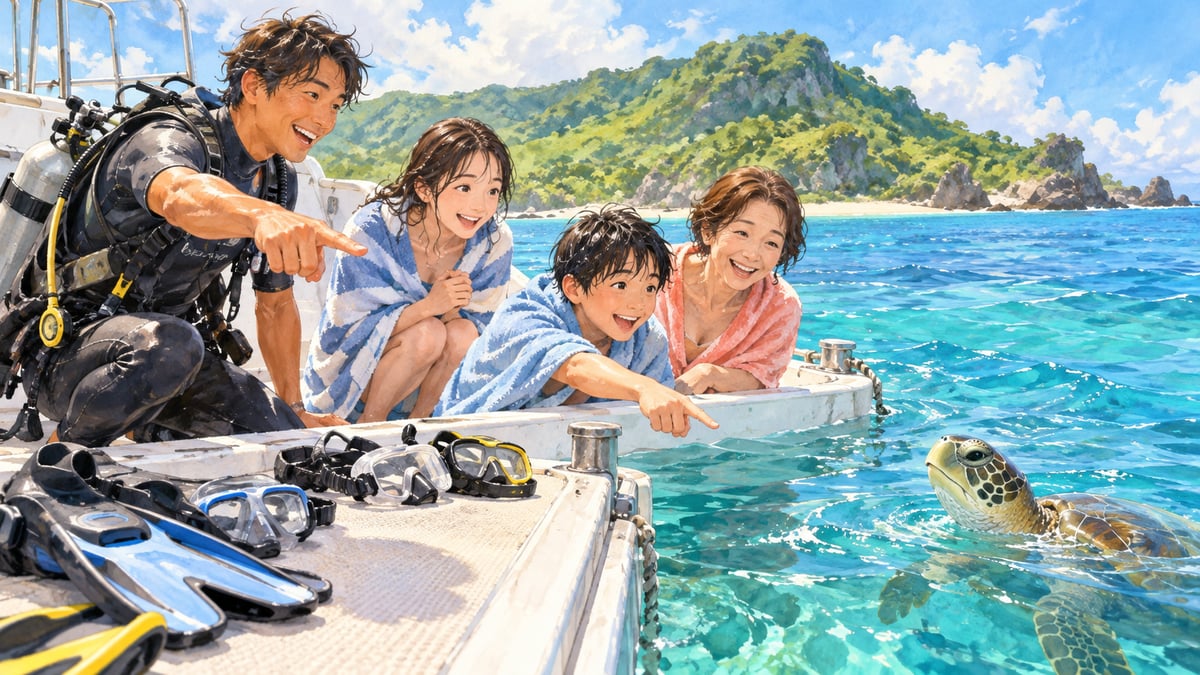
After the dive, the talk is about how clear the water was and what you saw. Tōmeido, visibility, is given in metres. Suishin is depth and suion is water temperature. Many sea creatures have native names usually written in katakana, so you will see umigame and kumanomi in katakana on the shop's photo boards.
| Japanese | Romaji | Meaning |
|---|---|---|
| 透明度がすごかった! | Tōmeido ga sugokatta! | The visibility was amazing! |
| 水深十二メートルまで潜りました。 | Suishin jūni mētoru made mogurimashita. | We went down to twelve metres. |
| 今日は流れが強いです。 | Kyō wa nagare ga tsuyoi desu. | The current is strong today. |
| サンゴ | sango | coral |
| 熱帯魚 | nettaigyo | tropical fish |
| クマノミ | kumanomi | clownfish |
| ウミガメを見ました! | Umigame o mimashita! | I saw a sea turtle! |
Kurage, jellyfish, and uni, sea urchins, are two creatures to watch for when entering from the beach. Staff may warn you: uni ni ki o tsukete kudasai, watch out for sea urchins.
Mini dialogue: booking at the dive shop
| Japanese | Romaji | Meaning |
|---|---|---|
| 明日の体験ダイビング、まだ空いていますか。 | Ashita no taiken daibingu, mada aite imasu ka. | You: Are there still places on tomorrow's try dive? |
| はい、午前の部なら大丈夫です。泳げますか。 | Hai, gozen no bu nara daijōbu desu. Oyogemasu ka. | Staff: Yes, the morning session is fine. Can you swim? |
| はい、少しなら泳げます。 | Hai, sukoshi nara oyogemasu. | You: Yes, I can swim a little. |
| 身長と足のサイズを教えてください。 | Shinchō to ashi no saizu o oshiete kudasai. | Staff: Please tell me your height and foot size. |
| 百六十センチで、二十四センチです。 | Hyaku rokujū senchi de, nijūyon senchi desu. | You: I'm 160 centimetres, and my feet are size 24. |
Gozen no bu, the morning session, uses bu for a part or session. You will also hear gogo no bu for the afternoon. Shops ask your height and foot size to prepare the wetsuit and fins.
Before the trip: a study routine for the sea
- Ask Mocchi: /quiz the dive health check phrases. It remembers which answers you hesitate on, such as kazegimi or funayoi, and returns to them in later reviews.
- Then ask Mocchi to /create-flashcards for the sea creatures and conditions in this post. You pick a photo for each card, and the reviews bring back the ones you miss sooner.
- Use the pronunciation coach for long vowels: shunōkeru, tōmeido and fujō all depend on holding the vowel, and the coach scores your rhythm and gives a tip.
Common learner mistakes
- Saying gōguru for a dive mask. Divers say masuku.
- Keeping quiet about a cold or a flight. Tell the staff; it changes what is safe.
- Using oyogu for going underwater. Oyogu is to swim; moguru is to dive down.
- Touching coral or creatures to get a photo. Look, do not touch.
- Pronouncing shunōkeru with a short o. Hold the long vowel.