
Jitsu wa in four everyday lines
These four lines cover the main jobs of jitsu wa. On its own it is a pause that makes the listener lean in. It introduces news, it opens a request for a favour, and it reveals a surprising fact about yourself. In each case, the information after jitsu wa is something the listener does not know yet.
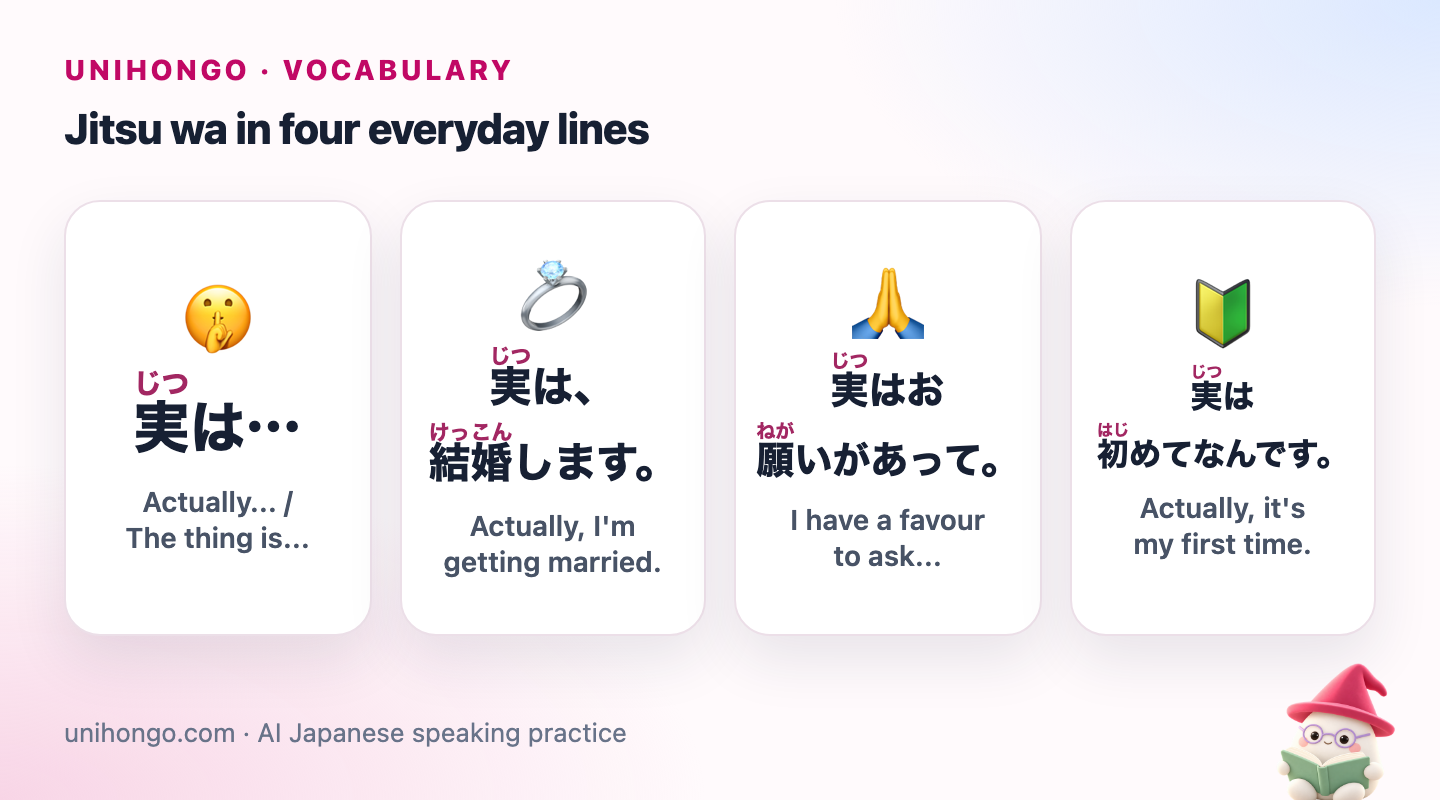
| Japanese | Romaji | Meaning |
|---|---|---|
| 実は… | Jitsu wa... | Actually... / The thing is... |
| 実は、結婚します。 | Jitsu wa, kekkon shimasu. | Actually, I'm getting married. |
| 実はお願いがあって。 | Jitsu wa onegai ga atte. | I have a favour to ask... |
| 実は初めてなんです。 | Jitsu wa hajimete nan desu. | Actually, it's my first time. |
The kanji 実 and how jitsu wa works
実 means fruit, reality or truth. Read jitsu, it appears in words such as jijitsu (事実), fact, genjitsu (現実), reality, and jissai (実際), in practice. Read mi, it is fruit or seeds: ki no mi, nuts and berries. In jitsu wa, the topic particle wa turns 'the truth' into the topic: 'as for the truth...'. That is why it feels like a door opening onto something real and new.
Jitsu wa usually comes at the very start of a sentence, often followed by a short pause, a comma in writing. It can also come after a topic: kono kēki, jitsu wa watashi ga tsukutta n desu, this cake, actually, I made it myself.
You will also meet jitsu wa in writing, especially in articles and trivia: jitsu wa shiranai, ... no himitsu, 'the secret of ... you actually didn't know'. There it introduces a surprising fact rather than personal news, but the job is the same: it promises the reader something new.
| Japanese | Romaji | Meaning |
|---|---|---|
| それは事実です。 | Sore wa jijitsu desu. | That is a fact. |
| 現実は厳しい。 | Genjitsu wa kibishii. | Reality is harsh. |
| このケーキ、実は私が作ったんです。 | Kono kēki, jitsu wa watashi ga tsukutta n desu. | This cake, actually, I made it myself. |
Jitsu wa + n desu: the natural pairing
Jitsu wa very often pairs with ~n desu (casual ~n da), the explanatory form. The n desu ending says 'here is the situation, the background you need'. Together they sound natural and engaged: jitsu wa, raigetsu kikoku suru n desu, actually, I'm going back home next month. Without n desu, jitsu wa, raigetsu kikoku shimasu is correct but sounds more like a formal announcement.
In casual speech the pairing is even stronger: jitsu wa sa, kanojo ga dekita n da, 'so, actually, I've got a girlfriend'. The little sa after jitsu wa is a casual filler that adds a beat of suspense.
| Japanese | Romaji | Meaning |
|---|---|---|
| 実は、来月帰国するんです。 | Jitsu wa, raigetsu kikoku suru n desu. | Actually, I'm going home next month. |
| 実はさ、彼女ができたんだ。 | Jitsu wa sa, kanojo ga dekita n da. | So, actually, I've got a girlfriend. |
| 実は、日本語を勉強しているんです。 | Jitsu wa, Nihongo o benkyō shite iru n desu. | Actually, I'm studying Japanese. |
| 実は、この町の出身なんです。 | Jitsu wa, kono machi no shusshin nan desu. | Actually, I'm from this town. |
Asking a favour: jitsu wa onegai ga atte
Japanese requests often start with the background before the request itself, and jitsu wa is the classic way in. Jitsu wa, onegai ga atte..., 'actually, I have a favour to ask', warns the listener that a request is coming and gives them a moment to prepare. Then you explain the situation, and only then the request.
The trailing te form, atte or arimashite, leaves the sentence open, which sounds softer than a finished statement. In polite speech, jitsu wa, onegai ga aru no desu ga is very common. Ending with ga or kedo, 'but...', invites the listener to say dō shita no? or nan deshō?, and the conversation continues naturally.
| Japanese | Romaji | Meaning |
|---|---|---|
| 実は、ちょっとお願いがあって… | Jitsu wa, chotto onegai ga atte... | The thing is, I have a small favour to ask... |
| 実は、ご相談があるのですが。 | Jitsu wa, go-sōdan ga aru no desu ga. | Actually, there's something I'd like to discuss. (polite) |
| どうしたの? | Dō shita no? | Friend: What's up? |
| 来週、引っ越しを手伝ってもらえない? | Raishū, hikkoshi o tetsudatte moraenai? | Could you help me move next week? |
Jitsu wa, hontō wa, jissai and jitsu o iu to
Several words translate as 'actually' or 'the truth is', but they do different jobs. The table shows the core difference.
| Japanese | Romaji | Meaning |
|---|---|---|
| 本当は行きたくなかった。 | Hontō wa ikitakunakatta. | The truth is, I didn't want to go. |
| 実際、かなり難しいです。 | Jissai, kanari muzukashii desu. | In practice, it's quite difficult. |
| 実を言うと、まだ決めていません。 | Jitsu o iu to, mada kimete imasen. | To tell the truth, I haven't decided yet. |
| 正直、ちょっと高いと思う。 | Shōjiki, chotto takai to omou. | Honestly, I think it's a bit pricey. |
| Word | Core job | Example |
|---|---|---|
| jitsu wa | Reveals new information | Jitsu wa, kekkon shimasu |
| hontō wa | Reality versus appearance or plan | Hontō wa ikitakunakatta |
| jissai | In practice, in reality | Jissai, muzukashii desu |
| jitsu o iu to | To tell the truth (more formal, weightier) | Jitsu o iu to, mada kimete imasen |
| shōjiki | Honestly, frankly | Shōjiki, chotto takai |
A quick test: if you could add 'you didn't know this, but', use jitsu wa. If you could add 'despite what it looked like', use hontō wa. If you mean 'in real life, as opposed to in theory', use jissai. Shōjiki adds frankness and is often a softener before mild criticism, so use it with care.
Reacting to someone's jitsu wa
When a friend says jitsu wa and pauses, they want you to lean in. A short encouraging reaction keeps them going: nani nani? (what, what?) among friends, or e, nan desu ka? politely. After the news, react to the content: congratulations for good news, sympathy for bad news, and surprise for a hidden fact.
If the news is serious, such as an illness or a job loss, slow down and switch to sympathy: sō datta n da, I see, that's how it was, and hanashite kurete arigatō, thank you for telling me. Jitsu wa does not tell you whether the news is good or bad, so wait for it before reacting with a big smile.

| Japanese | Romaji | Meaning |
|---|---|---|
| なになに? | Nani nani? | What, what? (eager, casual) |
| え、そうなんですか! | E, sō nan desu ka! | Oh, really? (polite surprise) |
| 全然知らなかった! | Zenzen shiranakatta! | I had no idea! |
| おめでとう!いつ決まったの? | Omedetō! Itsu kimatta no? | Congratulations! When did you decide? |
Jitsu wa at work: calling about a train delay
Jitsu wa does real work in polite phone calls. When you call your office because your train has stopped, the usual order is an apology, then jitsu wa with the background, then what you will do. It sounds organised and sincere. The humble ~te orimashite softens the explanation further.
| Japanese | Romaji | Meaning |
|---|---|---|
| おはようございます。リーです。 | Ohayō gozaimasu. Rī desu. | You: Good morning, it's Lee. |
| 申し訳ありません。実は、電車が止まっておりまして。 | Mōshiwake arimasen. Jitsu wa, densha ga tomatte orimashite. | You: I'm very sorry. The thing is, my train has stopped. |
| そうですか。大丈夫ですか。 | Sō desu ka. Daijōbu desu ka. | Manager: I see. Are you all right? |
| はい。三十分ほど遅れそうです。 | Hai. Sanjuppun hodo okuresō desu. | You: Yes. I think I'll be about thirty minutes late. |
| わかりました。気をつけて来てください。 | Wakarimashita. Ki o tsukete kite kudasai. | Manager: Understood. Come in safely. |
Notice the order: apology first, then jitsu wa with the reason, then a concrete estimate. Japanese managers usually want the estimate as early as possible, so have a rough time ready before you call. If you do not know yet, say mada wakarimasen ga, wakari shidai go-renraku shimasu, I don't know yet, but I'll let you know as soon as I do.
Common learner mistakes with jitsu wa
- Using it to correct someone. 'Actually, the meeting is at three' is not jitsu wa; say kaigi wa sanji desu yo, or a, sanji deshita.
- Starting every sentence with it. Jitsu wa promises something new; if nothing surprising follows, the listener feels let down.
- Forgetting n desu. Jitsu wa, kikoku shimasu is correct but stiff; jitsu wa, kikoku suru n desu sounds natural.
- Saying the request before the background. In Japanese, explain the situation after jitsu wa, then ask.
- Confusing jitsu wa and hontō wa. Use hontō wa when the truth contrasts with what people think or what you said.
Rehearse your jitsu wa moments
Write two openers in Mocchi, a piece of news and a favour, and send them with /correct. Mocchi checks the n desu ending and the order of background and request, explains each fix, and keeps a note so a later /quiz returns to the parts you got wrong.
Then say them aloud. In AI Sensei, Haru-sensei can play your manager for the train delay call or a close friend for the big news, and the session report after the conversation lists your corrections and the phrases you used well.