

What sō ka literally means
Sō means like that or so, and ka is the question particle, so sō ka is literally is it so? or is that how it is? In practice, though, it almost never asks for an answer. It is a reaction word that tells the other person the information has landed. English equivalents include I see, oh, right, got it, ah and hm.
Sō ka belongs to the category of aizuchi, the small responses Japanese listeners give throughout a conversation to show they are following. Japanese conversation relies on these more heavily than English does, and a listener who stays silent can seem distracted or even unhappy.
Sō ka on its own is casual; you would say it to a friend, a family member or yourself. The polite form is sō desu ka. Both are used constantly, so learning to say them naturally is one of the fastest ways to sound more fluent.
| Japanese | Romaji | Meaning |
|---|---|---|
| そうか。 | Sō ka. | I see. / Oh, right. |
| そうですか。 | Sō desu ka. | I see. (polite) |
| ああ、そうか。 | Ā, sō ka. | Ah, I get it now. |
| そうか、わかった。 | Sō ka, wakatta. | Right, got it. |
Falling versus rising intonation
The meaning of sō ka and sō desu ka depends heavily on pitch. With a falling tone at the end, it means I see: you are acknowledging something. This is by far the most common pattern. A teacher explaining a rule, a clerk telling you the shop closes at eight, a friend saying they are busy this weekend: all of these get a falling sō desu ka.
With a rising tone, it becomes a real reaction of surprise or doubt: really? is that so? This is useful when the news is unexpected, but it can sound sceptical, as if you are questioning the speaker, so use it when surprise is appropriate.
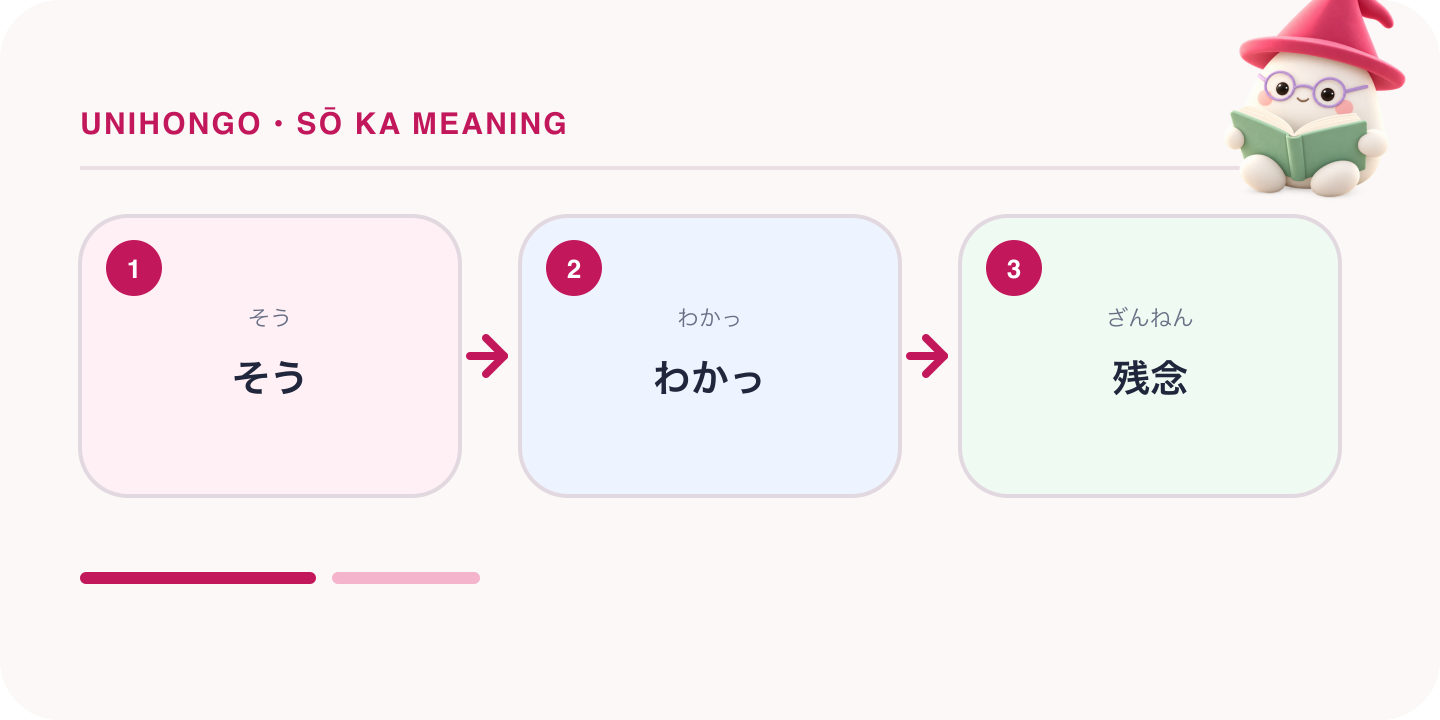
A third pattern, flat and short, can sound uninterested or even disappointed. Said with a small sigh, sō ka can mean oh, that's a shame. Recording yourself and comparing with native speakers in dramas or podcasts is the best way to hear the difference.
| Intonation | What it signals | Example situation |
|---|---|---|
| Falling: sō desu ka. | I see, understood | A clerk says the museum is closed on Mondays |
| Rising: sō desu ka? | Really? Is that so? | A colleague says they are moving to Brazil |
| Long, falling: sō desu kaa | Ah, I see now (realisation) | Someone explains why the train was late |
| Soft, low: sō ka | Oh, that's a shame | A friend says they cannot come to your party |
| Flat, clipped: sō. | Uninterested (avoid) | Replying without looking up from your phone |
Sō desu ka: the polite I see
Sō desu ka is the standard polite reaction with colleagues, teachers, shop staff, neighbours and anyone you do not know well. It is neutral and safe, and it shows you are listening respectfully. In business, it is common in meetings and on the phone.
Adding a word in front changes the feeling. Ā, sō desu ka shows realisation; hē, sō desu ka shows interest in something new; sō desu ka, zannen desu ne adds sympathy for bad news. Following up with a short question keeps the conversation going: sō desu ka. Itsu kara desu ka?, I see, since when?
In very formal service speech, such as a hotel front desk or a department store, you will hear sayō de gozaimasu ka. In most offices, a polite sō desu ka or shōchi shimashita, understood, is enough.
| Japanese | Romaji | Meaning |
|---|---|---|
| ああ、そうですか。 | Ā, sō desu ka. | Ah, I see. |
| へえ、そうですか。 | Hē, sō desu ka. | Oh, is that right? (interested) |
| そうですか。残念ですね。 | Sō desu ka. Zannen desu ne. | I see. That's a shame. |
| そうですか。いつからですか。 | Sō desu ka. Itsu kara desu ka. | I see. Since when? |
| さようでございますか。 | Sayō de gozaimasu ka. | Is that so? (very formal) |
Sokka and sokka sokka: casual I see
Between friends, sō ka often contracts to sokka. It is quick and relaxed: sokka, wakatta, right, got it. Doubling it to sokka sokka sounds warm and understanding, like ah, right, right, and is often used when someone explains a problem or their feelings.
Sokka can also be a moment of self-realisation, said to yourself: sokka! kagi, kuruma no naka da, oh! the keys are in the car. In that sense it is like English oh! or of course!
Other casual relatives include sō, just a short oh, right, and sōsō, yes, yes, exactly, which agrees rather than receives new information.
| Japanese | Romaji | Meaning |
|---|---|---|
| そっか、わかった。 | Sokka, wakatta. | Right, got it. |
| そっかそっか。 | Sokka sokka. | Ah, right, right. (sympathetic) |
| そっか!鍵、車の中だ。 | Sokka! Kagi, kuruma no naka da. | Oh! The keys are in the car. |
| そっか、残念。 | Sokka, zannen. | Oh, that's a shame. |
| そうそう。 | Sōsō. | Yes, exactly. |
Sō nan da: oh, really? I didn't know that
Sō nan da, and its softer form sō nan da ne, is the friendly way to react to new information. It carries a note of interest or mild surprise: oh, really? I didn't know that. It is extremely common in casual conversation among friends and is often a little more engaged-sounding than sō ka.
The polite versions are sō nan desu ka, oh, is that so?, and sō nan desu ne, I see, that's how it is. These are useful at work when a colleague tells you something personal or unexpected, because they sound warmer than a plain sō desu ka.
Sō nan da can also sound a little disappointed or unsure, depending on tone. A slow, flat sō nan da... after hearing that plans have changed signals that you are not thrilled.
| Japanese | Romaji | Meaning |
|---|---|---|
| そうなんだ! | Sō nan da! | Oh, really! |
| そうなんだ、知らなかった。 | Sō nan da, shiranakatta. | Oh, I didn't know that. |
| そうなんですか。 | Sō nan desu ka. | Oh, is that so? (polite) |
| そうなんですね。 | Sō nan desu ne. | I see, that's how it is. (polite, warm) |
| へえ、そうなんだ。 | Hē, sō nan da. | Huh, interesting. |
Sō ka versus naruhodo and sō desu ne
Sō ka has two close relatives that learners often confuse with it. Naruhodo means I see in the sense of that makes sense: it is about understanding an explanation or reasoning. Sō ka is broader and receives any information, including simple facts and personal news. Using naruhodo too often with a superior can sound as if you are evaluating their explanation, so many people prefer sō desu ka or ossharu tōri desu, it is just as you say, in formal settings.
Sō desu ne is different again. It agrees with something already shared, or with an opinion: kyō wa samui desu ne, it's cold today, isn't it, gets sō desu ne, yes, it is. It is also a common filler while thinking, like let me see. If you answer new information with sō desu ne, it can sound as if you already knew.
| Response | Core use | Example |
|---|---|---|
| そうか sō ka / そうですか sō desu ka | Receiving new information | The shop closes at 8. Sō desu ka. |
| なるほど naruhodo | That makes sense, understanding reasoning | It's cheaper because it's older. Naruhodo. |
| そうですね sō desu ne | Agreeing, or thinking aloud | It's hot today. Sō desu ne. |
| そうなんだ sō nan da | Friendly interest in news | I'm learning the guitar. Sō nan da! |
| へえ hē | Interest, mild surprise | Hē, sugoi ne. Wow, that's great. |
Sō ka na and sō kana: doubt and self-reflection
Add na to sō ka and it turns into sō ka na, I wonder, or is that really so? It expresses gentle doubt or disagreement without confrontation. If a friend says the exam will be easy, sō ka na means hmm, I'm not so sure. In polite speech, sō deshō ka, I wonder if that's so, does the same job.
Sō ka na is also a modest response to compliments. When someone says your Japanese is good, sō ka na, arigatō, you think so? thanks, is natural. Sō kamoshirenai, that might be so, is a softer way to half-agree.
| Japanese | Romaji | Meaning |
|---|---|---|
| そうかな。 | Sō ka na. | Hmm, I wonder. I'm not so sure. |
| そうかな、ありがとう。 | Sō ka na, arigatō. | You think so? Thanks. |
| そうでしょうか。 | Sō deshō ka. | I wonder if that's so. (polite) |
| そうかもしれない。 | Sō kamoshirenai. | That might be true. |
Sō ka in stories, anime and self-talk
In dramas and anime, sō ka is a key line for realisation. A detective who suddenly understands the case says sō ka!, of course! A character hearing sad news says a quiet sō ka..., and the pause carries the emotion. This makes sō ka a good word to listen for when watching Japanese media, because the tone tells you exactly how the speaker feels.
People also say sō ka to themselves when they remember or work something out. Sō ka, kyō wa getsuyōbi da, oh right, it's Monday today. Male characters often use sō ka in a slightly rough or thoughtful way, while sō nan da and sokka are more common in everyday casual speech across genders.
| Japanese | Romaji | Meaning |
|---|---|---|
| そうか!わかったぞ。 | Sō ka! Wakatta zo. | Of course! I've got it. |
| そうか…。 | Sō ka... | I see... (quiet, sad) |
| そうか、今日は月曜日だ。 | Sō ka, kyō wa getsuyōbi da. | Oh right, today's Monday. |
Common learner mistakes with sō ka
- Using rising intonation by default, which makes every reply sound sceptical.
- Saying sō desu ne to new information, as if you already knew it.
- Repeating the same flat sō desu ka; vary it with naruhodo, hē and sō nan desu ne.
- Using sokka or sō nan da with a boss or customer instead of sō desu ka.
- Stopping at sō desu ka without a follow-up question, which can end the conversation.
- Using naruhodo repeatedly with superiors, which can sound as if you are judging them.