
What anata means in one minute
Anata is the standard word for you. It is in every textbook, it is grammatical, and you will see it everywhere in writing. In face-to-face conversation, though, it is used far less than you in English. Japanese usually drops the subject when it is obvious, and when it needs to name the listener, it uses their name or their role.
So anata wa? (and you?) is correct, but Japanese speakers will more often say the person's name: Tanaka-san wa? Or, to a teacher, sensei wa?
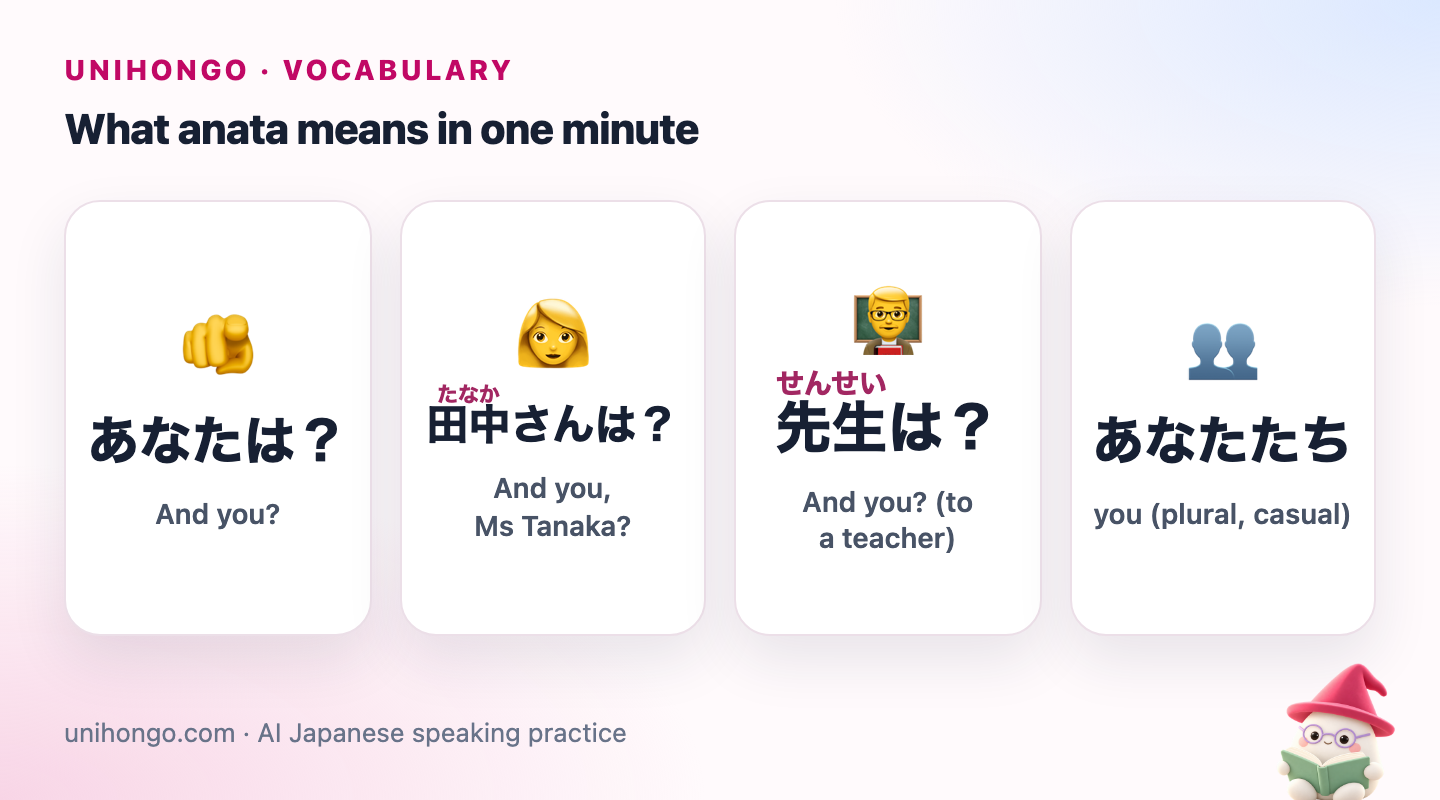
| Japanese | Romaji | Meaning |
|---|---|---|
| あなたは? | Anata wa? | And you? |
| 田中さんは? | Tanaka-san wa? | And you, Ms Tanaka? |
| 先生は? | Sensei wa? | And you? (to a teacher) |
| あなたたち | anatatachi | you (plural, casual) |
How anata is written, and where it comes from
Anata is almost always written in hiragana, あなた. Kanji spellings exist, 貴方 and, for a woman, 貴女, but they look formal or literary and are mostly seen in songs, novels and letters. The word is generally explained as originally pointing to a place over there, a direction away from the speaker, and later coming to mean the person you are talking to. Like many polite words, it has become less respectful over time.
Japanese has other words for you as well, such as kimi (君), omae (お前) and anta (あんた). They are more casual or rougher, and each says something about the relationship, so learners should use them with care.
| Word | Feel | Who uses it |
|---|---|---|
| anata (あなた) | Standard, but distant face to face | Writing, ads, some spouses |
| kimi (君) | Casual; from someone higher or close | Songs, older to younger, couples |
| anta (あんた) | Rough, familiar or irritated | Family, arguments, some dialects |
| omae (お前) | Very casual and rough | Close male friends, angry speech |
Why Japanese leaves you out
Japanese grammar lets you drop any element that is clear from context, and the listener is almost always clear. When you ask a question face to face, it is obvious who you mean, so there is no need to say you. Adding anata where it is not needed puts a spotlight on the other person, which can feel pointed, like jabbing a finger.
There is also a social reason. Japanese often addresses people by their role in the relationship: a teacher is sensei, a manager is buchō or kachō, a customer is o-kyaku-sama, and an older sister may be onēchan. Anata ignores all of this, so it can sound like you are not acknowledging who the person is to you.
| Japanese | Romaji | Meaning |
|---|---|---|
| お名前は? | Onamae wa? | What's your name? |
| どちらから来ましたか。 | Dochira kara kimashita ka. | Where are you from? |
| コーヒー、飲みますか。 | Kōhī, nomimasu ka. | Would you like some coffee? |
| 週末は何をしましたか。 | Shūmatsu wa nani o shimashita ka. | What did you do at the weekend? |
What to say instead of anata
The rule is simple: use the person's name with san, their title, or nothing. Here are the patterns that cover nearly every situation.
| Japanese | Romaji | Meaning |
|---|---|---|
| 佐藤さんはどう思いますか。 | Satō-san wa dō omoimasu ka. | What do you think, Mr Sato? |
| 先生、質問してもいいですか。 | Sensei, shitsumon shite mo ii desu ka. | May I ask you a question? (to a teacher) |
| 部長はいかがですか。 | Buchō wa ikaga desu ka. | How about you? (to a department head) |
| お客様のお名前をお願いします。 | Okyakusama no onamae o onegai shimasu. | May I have your name? (staff to customer) |
| みなさん、おはようございます。 | Minasan, ohayō gozaimasu. | Good morning, everyone. |
| ケンくんも来る? | Ken-kun mo kuru? | Are you coming too, Ken? (casual) |
Notice that Japanese uses the person's name even when speaking directly to them, which sounds natural in Japanese, even though Are you coming too, Ken? with the name repeated might sound unusual in English.
Where anata is perfectly natural
Anata comes into its own when there is no specific person to name: instructions, quizzes, surveys, advertising, slogans, song lyrics and translated texts. There, it means you, the reader, and sounds friendly and direct. It is also used when you really need to contrast you with someone else, or when talking to a stranger whose name you do not know, though even then sumimasen is the usual way to get their attention.
| Japanese | Romaji | Meaning |
|---|---|---|
| あなたにぴったりの一着。 | Anata ni pittari no itchaku. | The outfit that's just right for you. (ad) |
| あなたの声を聞かせてください。 | Anata no koe o kikasete kudasai. | Tell us what you think. (survey) |
| あなたの夢は何ですか。 | Anata no yume wa nan desu ka. | What is your dream? (textbook, essay prompt) |
| 私じゃなくて、あなたが決めて。 | Watashi ja nakute, anata ga kimete. | Not me, you decide. (contrast) |
Anata between spouses, anata-tachi, and learner mistakes
In older films and dramas, a wife often calls her husband anata, much like dear. Some couples still do, and it can sound affectionate, but many couples today use first names, nicknames, or papa and mama once they have children. Customs vary from family to family, so do not assume anata between partners sounds romantic to everyone; to some people it sounds old-fashioned.
Tone changes everything. In an argument, anata ne… can sound sharp, like now listen here, you…, and anta is rougher still.
For groups, anata-tachi (あなたたち) is the everyday plural and anata-gata (あなた方) is more polite, but minasan is what you will say most often.
| Japanese | Romaji | Meaning |
|---|---|---|
| あなた、ご飯できたよ。 | Anata, gohan dekita yo. | Dear, dinner's ready. (spouse, traditional) |
| あなたたちも来る? | Anatatachi mo kuru? | Are you all coming too? |
| あなた方のおかげです。 | Anatagata no okage desu. | It's thanks to all of you. (polite) |
- Mistake 1: calling a teacher or boss anata. Use sensei or their title; anata sounds like you are talking down.
- Mistake 2: starting every question with anata wa. Drop it, or use the person's name.
- Mistake 3: assuming anata is the polite you. It is standard in writing, but face to face, names are more polite.
- Mistake 4: using kimi or omae because you heard them in anime. They are casual or rough and depend on the relationship.
Asking what to call someone
Since names do the work of anata, it helps to know how to ask for one, and how to ask what someone would like to be called. Shitsurei desu ga, onamae wa? is the polite way to ask a name. Nan to oyobi sureba ii desu ka asks what you should call someone, which is useful with new colleagues or host families. Among people your age, shita no namae de yonde mo ii? asks if you can use their first name, and the reply might be a relaxed Ken de ii yo, just Ken is fine.
| Japanese | Romaji | Meaning |
|---|---|---|
| 失礼ですが、お名前は? | Shitsurei desu ga, onamae wa? | Excuse me, may I ask your name? |
| 何とお呼びすればいいですか。 | Nan to oyobi sureba ii desu ka. | What should I call you? (polite) |
| 下の名前で呼んでもいい? | Shita no namae de yonde mo ii? | Can I call you by your first name? |
| ケンでいいよ。 | Ken de ii yo. | Just call me Ken. |
Mini dialogue: meeting someone at a party, with no anata
Two guests meet at a friend's garden party. Notice that neither of them says anata once: names and dropped subjects do all the work.
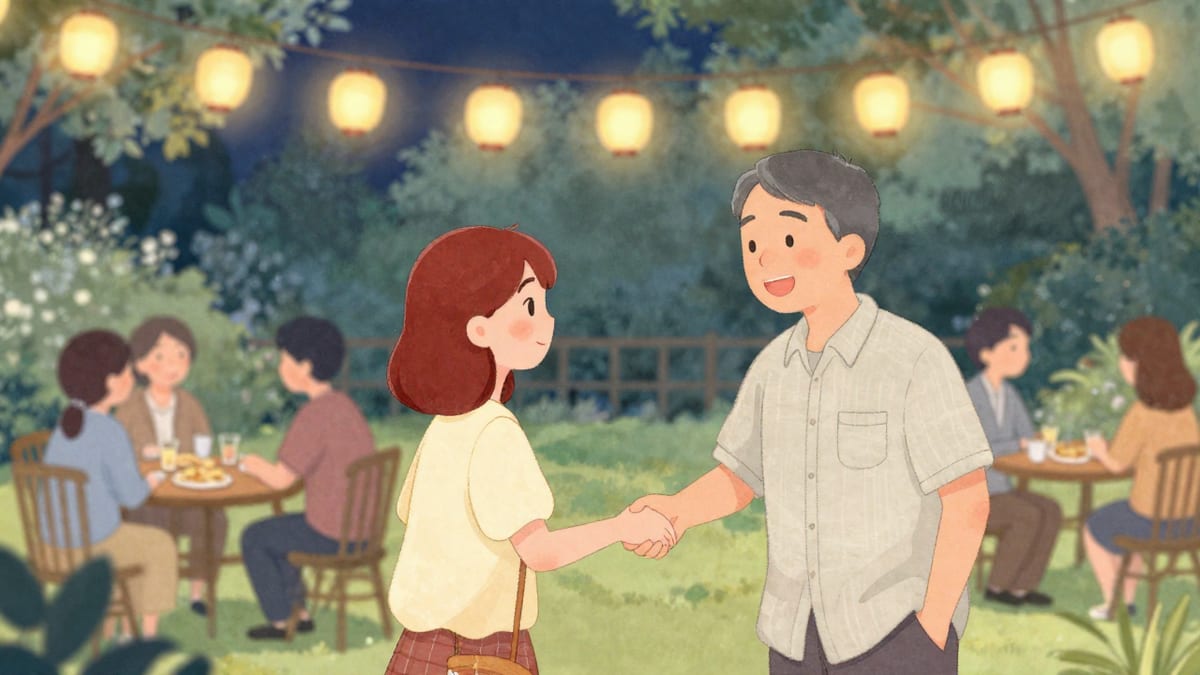
| Japanese | Romaji | Meaning |
|---|---|---|
| はじめまして。サラです。 | Hajimemashite. Sara desu. | Sara: Nice to meet you. I'm Sara. |
| 山本です。どちらから来ましたか。 | Yamamoto desu. Dochira kara kimashita ka. | Mr Yamamoto: I'm Yamamoto. Where are you from? |
| カナダです。山本さんは東京の方ですか。 | Kanada desu. Yamamoto-san wa Tōkyō no kata desu ka. | Sara: Canada. Are you from Tokyo, Mr Yamamoto? |
| いえ、大阪です。サラさんは日本は長いんですか。 | Ie, Ōsaka desu. Sara-san wa Nihon wa nagai n desu ka. | Mr Yamamoto: No, Osaka. Have you been in Japan long, Sara? |
| まだ半年です。 | Mada hantoshi desu. | Sara: Only six months. |
| 日本語、お上手ですね。 | Nihongo, ojōzu desu ne. | Mr Yamamoto: Your Japanese is very good. |