
Parent and child in a bowl: oyakodon and tanindon
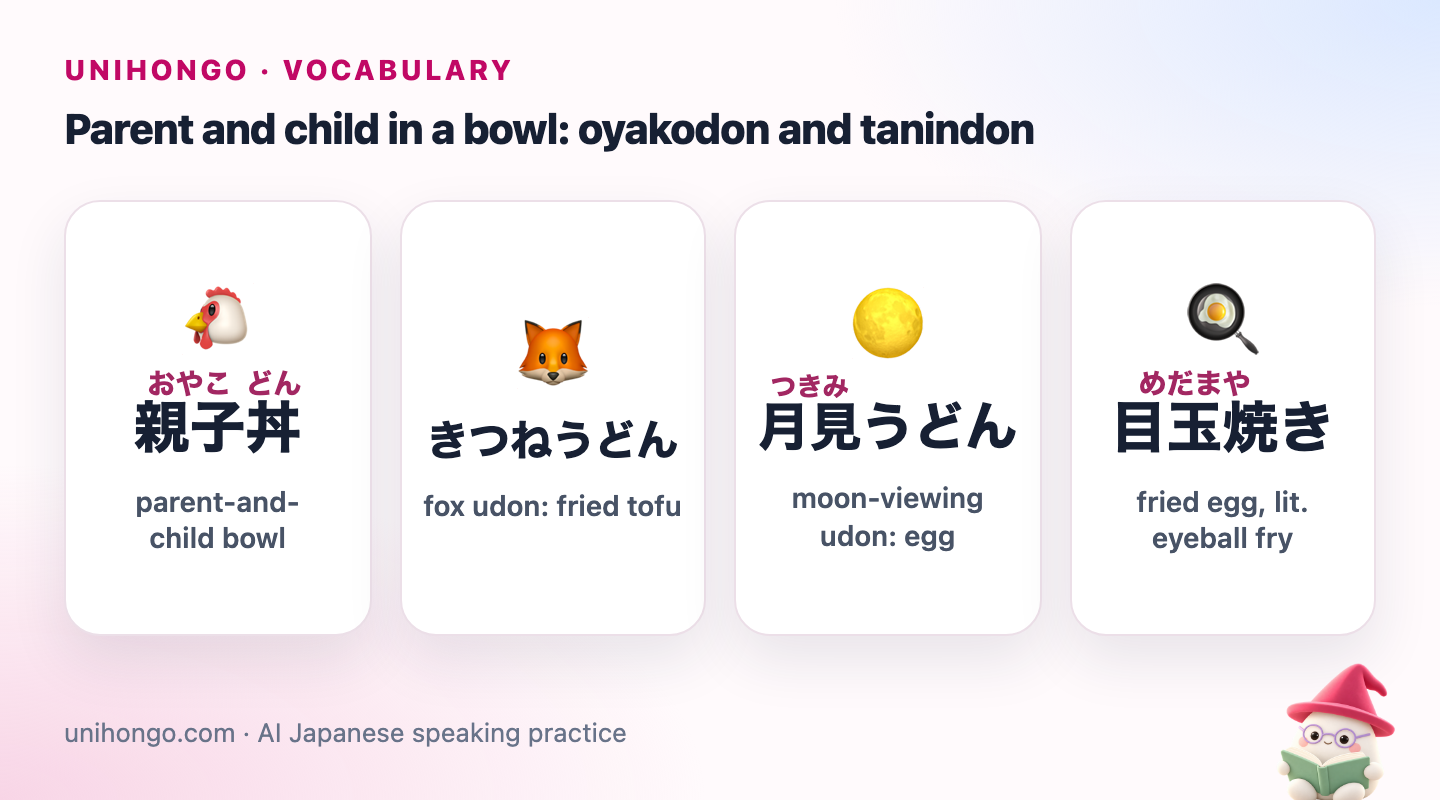
Oyakodon is chicken simmered with onion in a sweet soy broth, bound with soft egg and served over rice. Oyako (親子) is parent and child, and the kanji 丼 is read don, short for donburi. The joke is that the chicken and the egg are family.
Change the meat and the family breaks up. Pork or beef cooked with egg in the same style is tanindon (他人丼): tanin means a stranger, someone who is no relation. The name is most at home in the Kansai region, and other areas may use different names for the same idea.
| Japanese | Romaji | Meaning |
|---|---|---|
| 親子丼 | oyakodon | parent-and-child bowl |
| きつねうどん | kitsune udon | fox udon: fried tofu |
| 月見うどん | tsukimi udon | moon-viewing udon: egg |
| 目玉焼き | medamayaki | fried egg, lit. eyeball fry |
| 他人丼 | tanindon | strangers bowl: pork or beef with egg |
Fox and tanuki: animals that are not in the bowl
Kitsune (きつね) is a fox. On a noodle menu it means a topping of aburaage, thin fried tofu simmered until sweet, because foxes in folklore are said to love it. Foxes are also the messengers of Inari shrines, which is why sushi rice packed in a pouch of the same tofu is called inarizushi.
Tanuki (たぬき), the raccoon dog, is less simple. In and around Tokyo, tanuki soba or udon is topped with tenkasu, crunchy bits of tempura batter. In Osaka, tanuki usually means soba with fried tofu, the dish Tokyo calls kitsune soba. Kyoto has its own version again. Why the tanuki was chosen is not known for certain; one common story derives it from tane-nuki, without the filling.
| Japanese | Romaji | Meaning |
|---|---|---|
| たぬきそば | tanuki soba | soba with tempura bits, in Tokyo |
| 油揚げ | aburaage | thin fried tofu |
| 天かす | tenkasu | crunchy bits of tempura batter |
| いなり寿司 | inarizushi | sushi rice in a fried tofu pouch |
Moon, eyeball, fish: names that paint a picture
Tsukimi (月見) is moon viewing, an autumn custom. On a menu it means an egg dropped into the bowl: the yolk is the full moon and the white is the cloud around it. Fast-food chains sell tsukimi burgers with an egg every autumn. Medamayaki (目玉焼き) uses the same yolk for a blunter picture. Medama is an eyeball and yaki is grilled or fried: a fried egg, sunny side up, looking at you.
Taiyaki (たい焼き) is a cake baked in the shape of a tai, a sea bream, a fish served at celebrations. The filling is sweet bean paste, not fish. Takoyaki (たこ焼き), however, really contains tako, octopus. Melon bread, meronpan, is named for its looks: a sweet bun with a scored crust, traditionally with no melon inside.
| Japanese | Romaji | Meaning |
|---|---|---|
| たい焼き | taiyaki | fish-shaped cake with bean paste |
| たこ焼き | takoyaki | octopus dumpling balls |
| メロンパン | meronpan | melon-shaped sweet bun |
| 月見バーガー | tsukimi bāgā | moon-viewing burger with egg |
Sushi rolls with stories: tekkamaki and kappamaki
Tekkamaki (鉄火巻き) is a thin roll of raw tuna. Tekka means red-hot iron. The usual explanation is that the red tuna in the middle looks like glowing metal. Another story says the roll was a favourite in gambling dens, which were called tekkaba, because players could eat it with one hand. Neither is proven, and Japanese people enjoy both.
Kappamaki (かっぱ巻き) is a cucumber roll. The kappa is a river creature of folklore that is said to love cucumbers. Outside the sushi counter the vegetable is simply kyūri; only the roll gets the kappa's name.
| Japanese | Romaji | Meaning |
|---|---|---|
| 鉄火巻き | tekkamaki | tuna roll |
| かっぱ巻き | kappamaki | cucumber roll |
| まぐろ | maguro | tuna |
| きゅうり | kyūri | cucumber |
Names that simply describe: yaki and okonomi
The word yaki (焼き) means cooked over direct heat: grilled, pan-fried or griddled. Add what is being cooked and you have a dish. Okonomiyaki goes one step further. Konomi is a preference, okonomi is your preference said politely, so the name means cooked the way you like it, and you choose the fillings.
| Japanese | Romaji | Meaning |
|---|---|---|
| お好み焼き | okonomiyaki | savoury pancake, as you like it |
| 焼き鳥 | yakitori | grilled bird: chicken skewers |
| 焼き肉 | yakiniku | grilled meat |
| 焼きそば | yakisoba | fried noodles |
| 卵焼き | tamagoyaki | rolled omelette |
Okonomi is useful beyond food. Okonomi de dōzo on a table of sauces means add as much as you like.
Shabu-shabu and other names made of sound
Shabu-shabu (しゃぶしゃぶ) is a hot pot of paper-thin meat, and the name is the sound of swishing a slice through the broth. Japanese has a huge stock of sound words, and food packaging uses them constantly to describe texture. Learn three and you can read half the labels in a bakery.
| Japanese | Romaji | Meaning |
|---|---|---|
| しゃぶしゃぶ | shabushabu | hot pot named for a swishing sound |
| ふわふわ | fuwafuwa | soft and fluffy |
| さくさく | sakusaku | light and crispy |
| もちもち | mochimochi | soft and chewy |
How to ask what a dish really is
A name tells you the joke, not the ingredient list. If you have an allergy or do not eat certain foods, ask directly. Staff are used to the question, and polite desu and masu forms are right for a restaurant.
| Japanese | Romaji | Meaning |
|---|---|---|
| これは何ですか。 | Kore wa nan desu ka. | What is this? |
| 何が入っていますか。 | Nani ga haitte imasu ka. | What is in it? |
| 肉は入っていますか。 | Niku wa haitte imasu ka. | Does it contain meat? |
| 卵は生ですか。 | Tamago wa nama desu ka. | Is the egg raw? |
| どうして親子丼というんですか。 | Dōshite oyakodon to iu n desu ka. | Why is it called oyakodon? |
| 親子丼を一つお願いします。 | Oyakodon o hitotsu onegai shimasu. | One oyakodon, please. |
Haitte imasu comes from hairu, to be inside. The pattern is the ingredient, then wa haitte imasu ka. Asking why a dish has its name, with dōshite, is also a friendly way to get a cook or a waiter talking.