

The core meaning of nakama
Nakama is written 仲間, combining naka, relationship or terms, as in naka ga ii, to get on well, and ma, space or interval. The word refers to people who are inside the same circle: they share a group, an activity, a job, a hobby or a goal. Saying kare wa watashi no nakama desu means he is one of us, part of my group.
The feeling is about belonging and solidarity rather than private closeness. Your futsal team, a band, fellow volunteers and people you studied abroad with can all be nakama. You might not tell them your secrets, but you are on the same side.
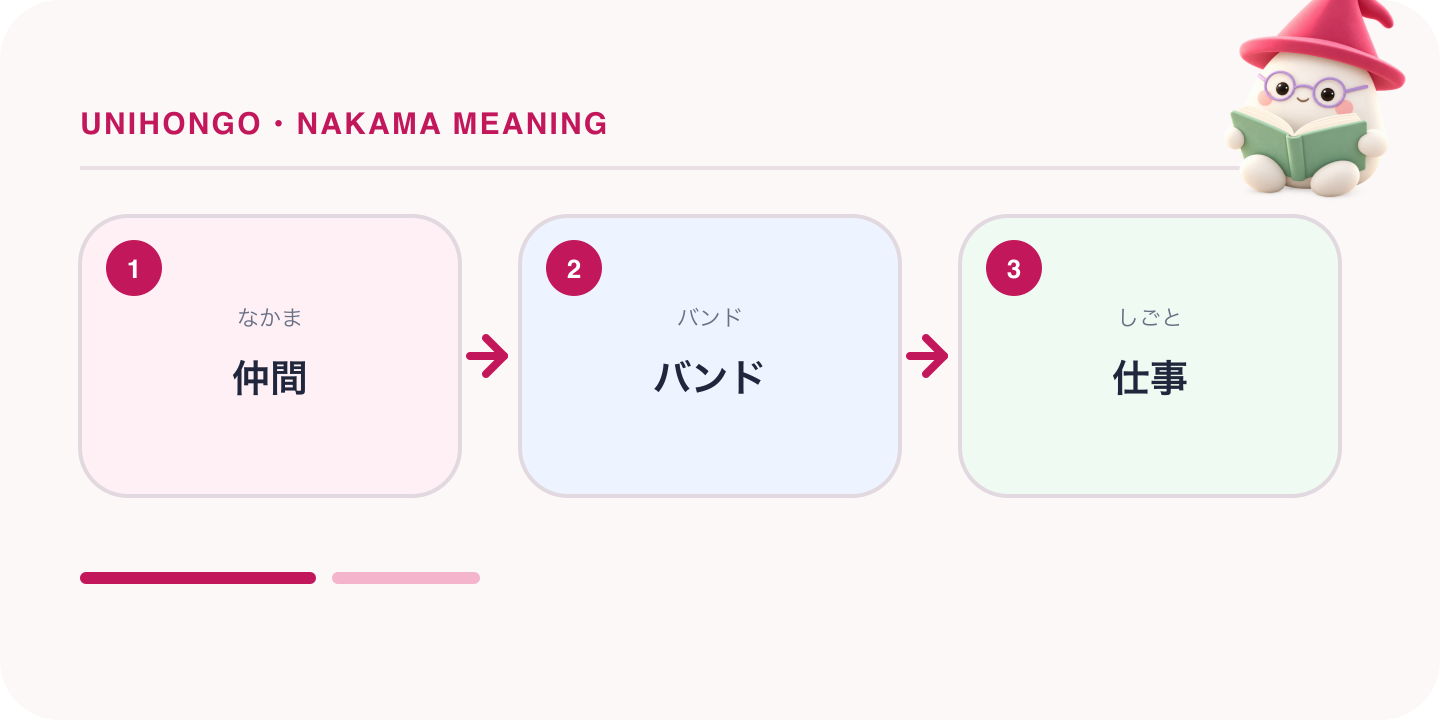
| Japanese | Romaji | Meaning |
|---|---|---|
| 仲間 | nakama | Companion, comrade, fellow member |
| バンド仲間 | bando nakama | Bandmates |
| 仕事仲間 | shigoto nakama | Workmates |
| 飲み仲間 | nomi nakama | Drinking buddies |
| 旅行仲間 | ryokō nakama | Travel companions |
| 彼は私たちの仲間です。 | Kare wa watashitachi no nakama desu. | He's one of us. |
Nakama, tomodachi, yūjin and the other friend words
Tomodachi is the everyday word for a friend: someone you like and spend time with personally. Yūjin means the same but is formal and written; you use it in speeches, formal introductions and writing, as in yūjin no Tanaka desu, I'm Tanaka, a friend of the groom. Shin'yū is a best or very close friend, and nakayoshi describes being close or a close friend, often in casual speech.
Dōryō is a colleague of similar rank in the same workplace, and it is neutral and businesslike. Nakama differs from all of these because it depends on a shared group. Your dōryō become nakama when you start to feel like a team; your tomodachi become nakama when you do something together.
| Word | Meaning | Nuance |
|---|---|---|
| 仲間 nakama | Companion, teammate | Belonging to the same group or goal |
| 友達 tomodachi | Friend | Personal friendship, everyday |
| 友人 yūjin | Friend | Formal, used in speeches and writing |
| 親友 shin'yū | Best friend | Very close, trusted |
| 同僚 dōryō | Colleague | Same workplace, neutral |
| 相棒 aibō | Partner, sidekick | A pair working together |
| 戦友 sen'yū | Comrade in arms | Went through hardship together |
Sen'yū literally means a comrade from war, but people also use it jokingly for someone they survived a tough project or exam season with.
Nakama as team and comrade
Because nakama is about a shared goal, it has a strong team flavour. Coaches talk about trusting your nakama, and sports players thank their nakama after a win. The word suggests loyalty: you support your nakama, and they support you. This is why it appears so often in school club culture, bukatsu, where students train together for years.
Nakama can also be neutral or even negative. In crime news, hannin no nakama means the culprit's accomplices. The word simply marks people on the same side, whatever that side is doing.
| Japanese | Romaji | Meaning |
|---|---|---|
| 仲間を信じる | nakama o shinjiru | To trust your teammates |
| 仲間のおかげで勝てました。 | Nakama no okage de katemashita. | We won thanks to my teammates. |
| 部活の仲間とは今も会っています。 | Bukatsu no nakama to wa ima mo atte imasu. | I still see my old club mates. |
| 犯人の仲間 | hannin no nakama | The culprit's accomplices |
| 同じ目標を持つ仲間 | onaji mokuhyō o motsu nakama | Companions with the same goal |
Nakama in anime: One Piece and beyond
Many learners first meet nakama in One Piece, where Luffy gathers a pirate crew and repeatedly calls them his nakama. The crew are not family and not just colleagues; they choose to follow the same dream and would risk everything for one another. English translations have used crew, comrades, friends and shipmates, but many fans prefer to keep nakama because none of those captures the full sense.
The same idea runs through countless sports, adventure and school stories: a group forms, faces challenges and becomes nakama. Hearing it in anime is a good way to absorb the loyalty and belonging it carries. Just remember that real conversation uses nakama in more ordinary ways, for hobby friends, workmates and teammates, without the dramatic weight.
| Japanese | Romaji | Meaning |
|---|---|---|
| 仲間になれ! | Nakama ni nare! | Join my crew! (blunt, anime style) |
| 仲間を守る | nakama o mamoru | To protect your companions |
| 大切な仲間 | taisetsu na nakama | Precious companions |
| 仲間になってくれませんか。 | Nakama ni natte kuremasen ka. | Would you join us? |
Joining and being left out: nakama ni ireru and nakama-hazure
Several set expressions describe entering or leaving the group. Nakama ni hairu is to join; nakama ni ireru is to let someone join; and the request form nakama ni irete is what children say when they want to join a game. Nakama-iri is the noun for becoming part of a group, as in nakama-iri shita, I joined them.
The opposite is nakama-hazure, being left out or excluded. It is a serious word in discussions about bullying at school or isolation at work. Nakama-hazure ni sareta means I was left out, and nakama-hazure ni suru means to shut someone out.
| Japanese | Romaji | Meaning |
|---|---|---|
| 仲間に入れて! | Nakama ni irete! | Can I join in? (children, casual) |
| 仲間に入る | nakama ni hairu | To join a group |
| 新しい仲間を紹介します。 | Atarashii nakama o shōkai shimasu. | Let me introduce our new member. |
| 仲間入りしました。 | Nakama-iri shimashita. | I've joined the group. |
| 仲間外れにされた。 | Nakama-hazure ni sareta. | I was left out. |
| 誰も仲間外れにしないで。 | Dare mo nakama-hazure ni shinaide. | Don't leave anyone out. |
Atarashii nakama o shōkai shimasu is a standard line when a manager introduces a new team member. If you are the new person, you can answer with a short self-introduction and yoroshiku onegai shimasu.
Nakama-ishiki and group feeling
Nakama-ishiki means a sense of fellowship or group solidarity: the feeling that we are in this together. It is often praised, for example when a team works well, but it can also describe a closed, insider feeling that makes newcomers feel shut out. The word itself is neutral, and the context tells you whether it is positive.
Related words include ittaikan, a sense of unity, and chīmuwāku, teamwork. Uchi and soto, inside and outside, is the broader cultural idea behind nakama: the people inside your circle are treated differently from those outside.
| Japanese | Romaji | Meaning |
|---|---|---|
| 仲間意識が強い | nakama-ishiki ga tsuyoi | Having a strong sense of fellowship |
| 一体感 | ittaikan | A sense of unity |
| チームワーク | chīmuwāku | Teamwork |
| 仲間意識が生まれた。 | Nakama-ishiki ga umareta. | A sense of fellowship developed. |
Nakama for things of the same kind
Nakama is not only for people. It groups animals, plants and objects of the same type, a use you will meet in science programmes, children's books and cooking. Kujira wa honyūrui no nakama desu means whales are mammals, literally part of the mammal group. Tomato wa nasu no nakama means the tomato belongs to the same family as the aubergine.
This use is practical in everyday conversation too. When you are learning vocabulary, asking kore wa nan no nakama desu ka, what kind of thing is this?, is a natural way to get a category.
| Japanese | Romaji | Meaning |
|---|---|---|
| クジラは哺乳類の仲間です。 | Kujira wa honyūrui no nakama desu. | Whales are mammals. |
| トマトはナスの仲間です。 | Tomato wa nasu no nakama desu. | Tomatoes are in the same family as aubergines. |
| これは何の仲間ですか。 | Kore wa nan no nakama desu ka. | What kind of thing is this? |
| イルカもクジラの仲間。 | Iruka mo kujira no nakama. | Dolphins are related to whales too. |