
Oshi and oshikatsu in one minute
Your oshi is the one you back. It can be an idol, a voice actor, a fictional character, a sumo wrestler or a football club. Oshikatsu is everything you do because of that: the concerts, the shelf of goods, the trip to a filming location.
The four cards give the words in the order a new fan meets them: the person, the activity, the choice between one member and the whole group, and the feeling. Learn them together, because they appear together.
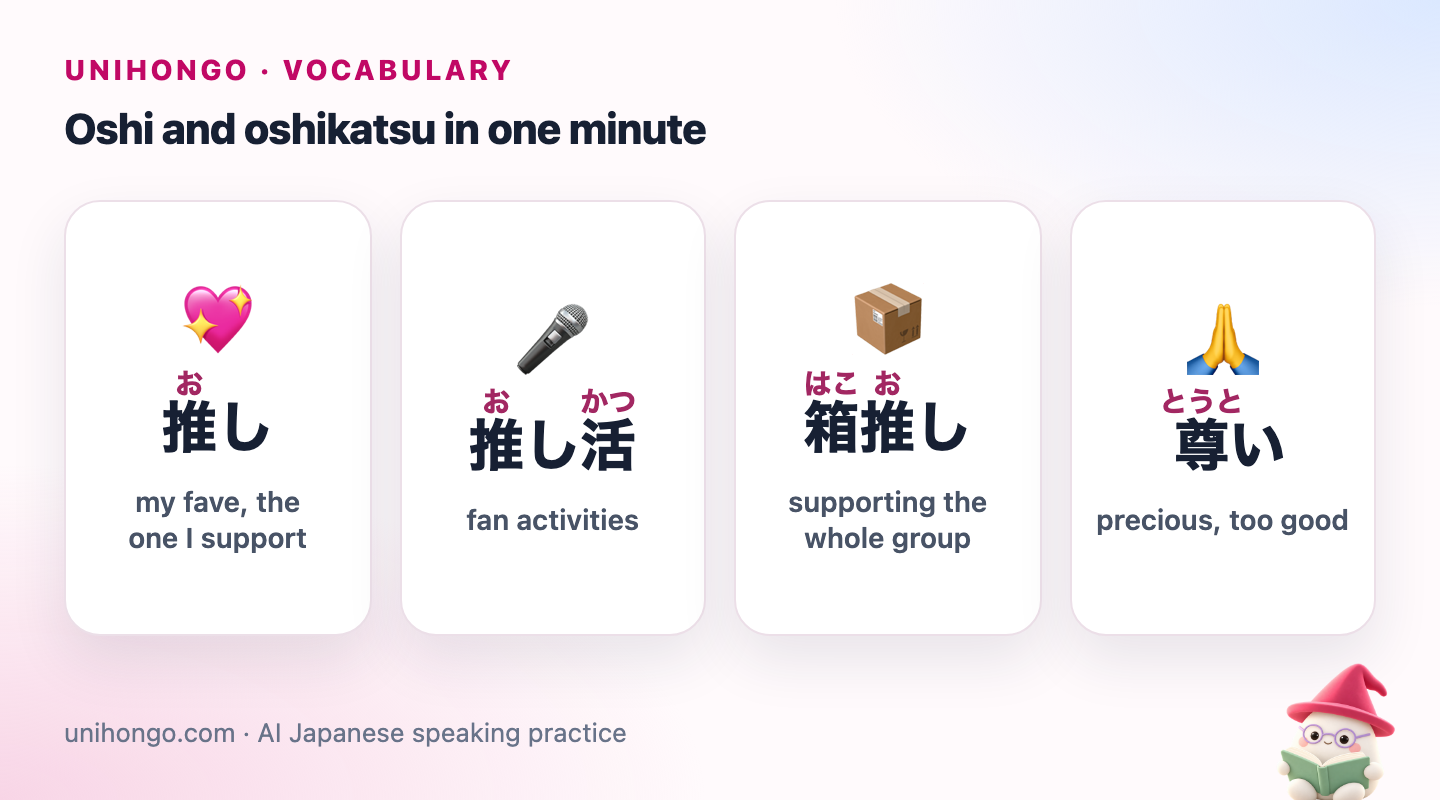
| Japanese | Romaji | Meaning |
|---|---|---|
| 推し | oshi | my fave, the one I support |
| 推し活 | oshikatsu | fan activities |
| 箱推し | hako oshi | supporting the whole group |
| 尊い | tōtoi | precious, too good |
| 推す | osu | to support, to back |
| 単推し | tan oshi | supporting one member only |
How the word is built: from osu to oshikatsu
The root is the verb osu (推す), "to recommend" or "to put forward". It is the same kanji as in suisen (推薦), "recommendation". Idol fans began calling the member they backed their oshimen, a blend of osu and menbā, "member", and the short form oshi spread from there.
The katsu (活) on the end is a productive piece of modern Japanese. It comes from katsudō (活動), "activity", and attaches to a goal to name the effort you put into it. Once you know the pattern, new words explain themselves.
| Japanese | Romaji | Meaning |
|---|---|---|
| 就活 | shūkatsu | job hunting |
| 婚活 | konkatsu | looking for a marriage partner |
| 朝活 | asakatsu | doing something useful early in the morning |
One favourite or many: hako-oshi, tan-oshi, dōtan
Fans describe the shape of their loyalty precisely. Hako (箱), "box", stands for a whole group. Tan (単) means "single". Sai (最) means "most", so your sai-oshi is your number one when you have several.
Dōtan (同担) means another fan of the same member. It is short for "same tantō", where tantō, "person in charge", is older fan slang for the member you look after. Most fans are happy to meet a dōtan. Some prefer to keep their distance, which is called dōtan kyohi.
| Japanese | Romaji | Meaning |
|---|---|---|
| 最推し | sai oshi | number one fave |
| 推し変 | oshihen | switching to a new fave |
| 同担 | dōtan | fan of the same member |
| 同担拒否 | dōtan kyohi | avoiding fans of the same member |
The feelings: tōtoi and numa
Fan Japanese enjoys overstatement. Tōtoi is a dignified word that you might use about human life or a temple treasure, borrowed to describe a smile. Numa (沼) is "swamp": an interest so deep that you sink into it and cannot climb out. Falling in is numa ni hamaru.
| Japanese | Romaji | Meaning |
|---|---|---|
| 推しが尊い。 | Oshi ga tōtoi. | My fave is too precious. |
| 沼 | numa | swamp: a deep obsession |
| 沼にハマる | numa ni hamaru | to fall deep into a fandom |
| しんどい | shindoi | it's too much (overwhelmed) |
Shindoi normally means "exhausting" or "hard to bear". Fans use it for joy that is almost painful. All four expressions are casual and a little dramatic, which is the point. Among fans they sound warm. In a formal introduction, a plain suki desu is safer.
The activities: what oshikatsu looks like
Many oshikatsu words are grand terms from religion and war, used with a wink. Fukyō is what missionaries do. Seichi junrei is a pilgrimage to a holy place. Ensei is a military expedition. Sansen is joining a battle. In fan talk they mean telling a friend about a show, visiting a real place that appears in a story, travelling to another city for a concert, and attending the concert.
| Japanese | Romaji | Meaning |
|---|---|---|
| 布教 | fukyō | winning friends over to your fave |
| 聖地巡礼 | seichi junrei | visiting real-life locations |
| 遠征 | ensei | travelling far for an event |
| 参戦 | sansen | attending a live show |
| グッズ | guzzu | merchandise |
| 推し色 | oshi iro | your fave's signature colour |
| 現場 | genba | the live event, in person |
Guzzu, from English "goods", covers everything from towels to acrylic stands. In many groups each member has an official colour, and fans wear or carry that oshi iro to show whom they support.
Telling someone your oshi, and asking theirs
This is the conversation the vocabulary exists for. The polite versions work with someone you have just met at an event. The short ones are for friends.
| Japanese | Romaji | Meaning |
|---|---|---|
| 推しは誰ですか。 | Oshi wa dare desu ka. | Who is your fave? |
| 私の推しはこの人です。 | Watashi no oshi wa kono hito desu. | My fave is this person. |
| このグループを推しています。 | Kono gurūpu o oshite imasu. | I support this group. |
| 箱推しです。 | Hako oshi desu. | I support the whole group. |
| 誰推し? | Dare oshi? | Who's your fave? (casual) |
| 最近、沼にハマりました。 | Saikin, numa ni hamarimashita. | I recently fell deep into it. |
| 推し活、楽しいですね。 | Oshikatsu, tanoshii desu ne. | Fan life is fun, isn't it? |
Notice the two grammar frames. As a noun, oshi takes wa and desu. As a verb, osu takes o and usually appears as oshite imasu, because supporting someone is a continuing state.
Beyond idols: how far the word has spread
Oshi started in idol fandom, but it no longer needs an idol. People have an oshi among anime characters, stage actors, athletes, VTubers, zoo animals and even castles or train lines. The Akutagawa Prize-winning novel Oshi, Moyu (推し、燃ゆ) by Rin Usami carried the word into literary fiction.
Because the word is cheerful and does not carry the heavier image that otaku once had, companies use it openly. Shops sell goods for oshikatsu, such as cases for carrying acrylic stands, and adverts invite you to support your oshi. For a learner that makes it a safe word. You can use it with classmates, colleagues and host families without sounding strange.