
Three verbs for the ice
If you learn only three words before your first visit to a rink, make them these native verbs. Suberu means to slide or glide and is the verb for skating, skiing and slipping. Korobu means to fall over, and tomaru means to stop. Together they describe almost everything a beginner does on the ice.
The potential forms are what you will actually say. Subereru? means can you skate?, and the honest beginner answer is mada amari suberenai, I can't really skate yet. Tomarenai! I can't stop! is the cry of every first-timer heading for the wall.
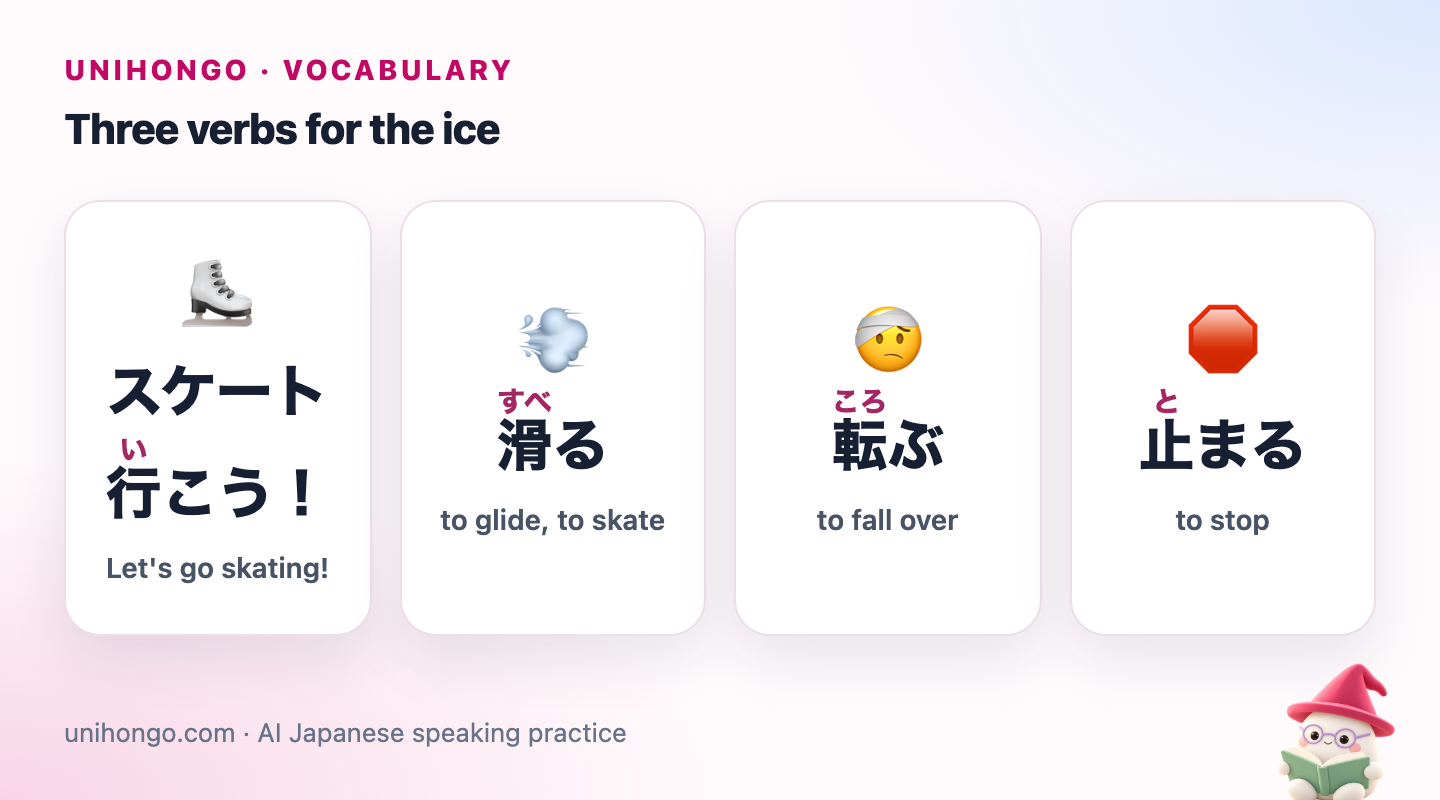
| Japanese | Romaji | Meaning |
|---|---|---|
| スケート行こう! | Sukēto ikō! | Let's go skating! |
| 滑る | suberu | to glide, to skate |
| 転ぶ | korobu | to fall over |
| 止まる | tomaru | to stop |
| 滑れる? | Subereru? | Can you skate? (casual) |
| まだあまり滑れない。 | Mada amari suberenai. | I can't really skate yet. |
| 止まれない! | Tomarenai! | I can't stop! |
At the counter: tickets and rental skates
Public rinks usually charge an entrance or skating fee, kassōryō, and a separate fee for rental skates, kashigutsu. You give your shoe size in centimetres, as everywhere in Japan, and receive a pair of skates, often figure skates or hockey-style skates. Lockers are usually coin lockers, and you leave your own shoes in them.
Many rinks ask everyone to wear gloves and may sell them at the counter, and some lend helmets to children. Rules vary, so if you are unsure, ask.
| Japanese | Romaji | Meaning |
|---|---|---|
| 大人一人お願いします。 | Otona hitori onegai shimasu. | One adult, please. |
| 貸し靴 | kashigutsu | rental skates |
| 靴のサイズは二十六センチです。 | Kutsu no saizu wa nijūroku senchi desu. | My shoe size is 26 centimetres. |
| 手袋は必要ですか。 | Tebukuro wa hitsuyō desu ka. | Are gloves required? |
| ヘルメットは借りられますか。 | Herumetto wa kariraremasu ka. | Can I borrow a helmet? |
| もう少し小さいサイズはありますか。 | Mō sukoshi chiisai saizu wa arimasu ka. | Do you have a slightly smaller size? |
Kashigutsu is made of kasu, to lend, and kutsu, shoes, with the k changing to g as it often does in compounds. The same word is used at bowling alleys for rental shoes.
Rink rules you will hear
Rinks play announcements in polite Japanese, and a few rules come up again and again. Most public rinks have everyone skate in the same direction, often counterclockwise, hantokei mawari. Stopping in the middle of a busy lane, skating fast in a crowd and sitting on the ice are discouraged. At set times the ice is resurfaced, and everyone must leave.
| Japanese | Romaji | Meaning |
|---|---|---|
| ただいまより整氷を行います。 | Tadaima yori seihyō o okonaimasu. | Announcement: We will now resurface the ice. |
| リンクから上がってください。 | Rinku kara agatte kudasai. | Please leave the ice. |
| 反時計回りでお願いします。 | Hantokei mawari de onegai shimasu. | Please skate counterclockwise. |
| Rule | Japanese | What it means |
|---|---|---|
| Direction | hantokei mawari | Skate counterclockwise |
| Resurfacing | seihyō | Leave the ice while the machine runs |
| Gloves | tebukuro chakuyō | Wear gloves on the ice |
| No speeding | supīdo no dashisugi chūi | Do not skate too fast |
| Practice area | renshū eria | A space for beginners or lessons |
Rinku kara agaru, to go up from the rink, means to leave the ice, the same verb as getting out of a bath or pool. Tadaima yori, from now, is the formal opening of many announcements.
Gliding, stopping and falling safely
Japanese beginners are taught to stop and balance with ha no ji, the shape of the katakana ハ: toes pointing in, heels apart, like a V upside down. Instructors also tell you to bend your knees, hiza o mageru, and to lean slightly forward. Falling backwards is the dangerous way to fall, so you will often hear karada o mae ni taoshite, lean your body forward.
| Japanese | Romaji | Meaning |
|---|---|---|
| ハの字にして止まって。 | Ha no ji ni shite tomatte. | Make a V with your feet and stop. |
| 膝を曲げて! | Hiza o magete! | Bend your knees! |
| 手すりにつかまって。 | Tesuri ni tsukamatte. | Hold on to the rail. |
| 後ろ向きに滑れる? | Ushiromuki ni subereru? | Can you skate backwards? |
| 大丈夫?立てる? | Daijōbu? Tateru? | Are you okay? Can you stand up? |
| 足首が痛い。 | Ashikubi ga itai. | My ankle hurts. |
Tesuri is the wall rail, and almost every beginner spends the first ten minutes holding it. Kutsuzure, a blister from the boots, is the other common complaint; if your skates hurt, ask for a different size.
A day at an outdoor rink
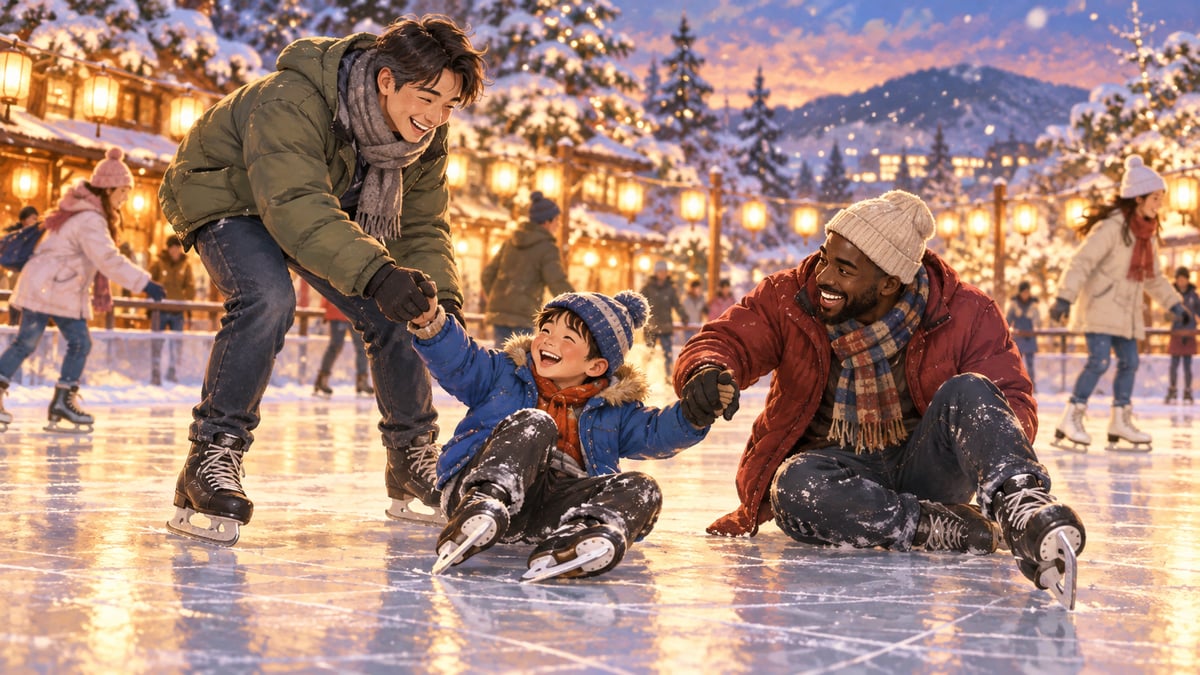
Outdoor rinks in winter are a classic date or family outing in Japan. Some are in city parks with evening lights, some at mountain resorts with snowy forests around them. The talk is about the cold, about falling and about warming up afterwards with something hot.
Outdoor ice depends on the weather. On a mild afternoon the surface can turn soft and wet, and a rink may close early or limit the hours, so it is worth checking the opening information on the day. Dress in layers, bring a spare pair of gloves and expect to get a little wet if you fall.
| Japanese | Romaji | Meaning |
|---|---|---|
| 氷が硬いね。 | Kōri ga katai ne. | The ice is hard, isn't it? |
| また転んじゃった。 | Mata koronjatta. | I fell again. |
| 上手になったね! | Jōzu ni natta ne! | You've got so much better! |
| 手をつないで滑ろう。 | Te o tsunaide suberō. | Let's skate holding hands. |
| 寒い!温かいもの飲もう。 | Samui! Atatakai mono nomō. | It's cold! Let's get something hot to drink. |
Watching figure skating on TV
Figure skating, figyua sukēto, is a big television sport in Japan, and commentary has its own vocabulary. Each skater gives an engi, performance, usually a shōto puroguramu and a furī, free skate. Jumps are named in katakana and counted with kaiten, rotations, so a quadruple jump is yonkaiten janpu. A clean landing is chakuhyō, and a fall is tentō, a more formal word than korobu.
Scores are tokuten, and the podium is hyōshōdai. Fans watching together often react with short lines rather than technical terms.
| Japanese | Romaji | Meaning |
|---|---|---|
| 四回転ジャンプ | yonkaiten janpu | quadruple jump |
| きれいに着氷しました。 | Kirei ni chakuhyō shimashita. | Commentator: A clean landing. |
| 演技 | engi | performance, programme |
| 転倒 | tentō | fall (formal, in competition) |
| 表彰台 | hyōshōdai | podium |
| 今の、すごくきれいだった! | Ima no, sugoku kirei datta! | Fan: That was so beautiful! |
The contrast between korobu and tentō is a good example of Japanese register. Friends at a rink say koronda; a TV commentator says tentō shimashita, and newspapers write 転倒.
Mini dialogue: teaching a friend to stop
| Japanese | Romaji | Meaning |
|---|---|---|
| ねえ、止まり方がわからない! | Nē, tomarikata ga wakaranai! | Friend: Hey, I don't know how to stop! |
| 足をハの字にして、膝を曲げてみて。 | Ashi o ha no ji ni shite, hiza o magete mite. | You: Put your feet in a V and try bending your knees. |
| こう?あ、止まった! | Kō? A, tomatta! | Friend: Like this? Oh, I stopped! |
| すごい!じゃあ、手すりなしで一周してみよう。 | Sugoi! Jā, tesuri nashi de isshū shite miyō. | You: Great! Now let's try one lap without the rail. |
| 転んだら笑わないでね。 | Korondara warawanai de ne. | Friend: Don't laugh if I fall, okay? |
Tomarikata, the way to stop, uses the pattern verb stem plus kata, way of doing. You can build many useful rink words with it: suberikata, how to skate, and tachikata, how to stand up. Isshū, one lap, is the natural counter for going once around the rink.
Notice how the speakers use ~ te mite, try doing. It softens instructions between friends, so hiza o magete mite sounds like a suggestion rather than an order. With an instructor or a stranger, the polite version is hiza o magete mite kudasai.
A short Mocchi routine for rink words
- Ask Mocchi to /explain a line of skating commentary you hear, such as kirei ni chakuhyō shimashita: it splits the sentence, names the pattern and gives the meaning.
- Ask for a quick /quiz on suberu, korobu and tomaru in the potential and casual forms. Mocchi keeps track of the forms you miss and brings them back next time.
- Make flashcards of the rink words with a photo you choose for each, then run them in Vocabulary Dash, the 3D word runner, so the verbs come back fast.
Common learner mistakes
- Saying suberareru for can skate. Suberu is a godan verb, so the potential is subereru.
- Using tentō in casual talk with friends. Say koronda.
- Giving shoe sizes in other systems. Japan uses centimetres.
- Staying on the ice when seihyō is announced. Everyone must leave.
- Confusing kaiten, rotation, with kaiten, opening a shop. They are different kanji, 回転 and 開店.