
What the words actually say
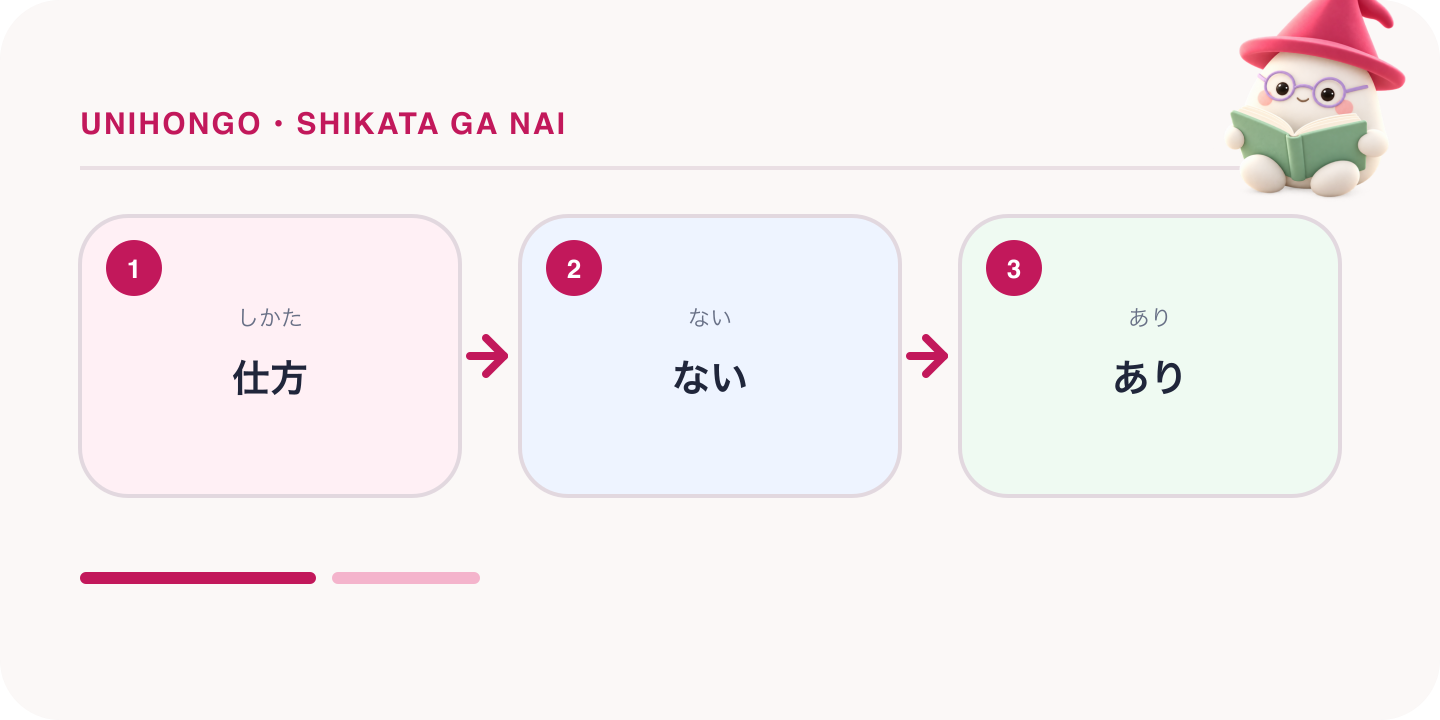
Shikata is written 仕方 and means a method or way of doing something, the same shikata you meet in tsukaikata for how to use a thing. Nai is the plain negative of aru, so shikata ga nai reads as there is no way of doing it. The polite version simply adds desu: shikata ga nai desu, or the more formal shikata ga arimasen.
The important part for a learner is what the phrase does rather than what it translates to. It does not describe an emotion the way sad or annoyed would. It marks a topic as finished: the cause is outside your control, so the discussion moves on. That is why it can follow a complaint without contradicting it, and why it works as a full turn on its own.
| Japanese | Romaji | Meaning |
|---|---|---|
| 仕方がないです。 | Shikata ga nai desu. | It cannot be helped. |
| 仕方がありません。 | Shikata ga arimasen. | There is nothing to be done. (formal) |
| 仕方ないですね。 | Shikata nai desu ne. | Well, nothing for it, is there. |
| しょうがないです。 | Shō ga nai desu. | It cannot be helped. (lighter) |
| しょうがない。 | Shō ga nai. | Oh well. (casual) |
The forms and how formal each one sounds
| Form | Register | Where it fits |
|---|---|---|
| 仕方がありません shikata ga arimasen | Formal | Written notices, speaking to a customer or a superior |
| 仕方がないです shikata ga nai desu | Polite | Colleagues, teachers, anyone you use desu with |
| 仕方ないですね shikata nai desu ne | Polite and softened | Agreeing with someone about a shared problem |
| しょうがないです shō ga nai desu | Polite but light | Small everyday setbacks with colleagues |
| しょうがない shō ga nai | Casual | Friends, family, talking to yourself |
| しゃあない shaanai | Very casual, Kansai-flavoured | Close friends; varies by region and generation |
The ga is often dropped in speech, so shikata nai and shō ga nai are what you will usually hear. Adding ne turns the phrase into an invitation to agree, which makes it much gentler than the bare form. Adding yo pushes in the opposite direction and can sound like you are telling the other person to drop it, so leave yo out until you are sure of the relationship.
Where the phrase sounds natural
The safest use is about your own situation, when the cause is genuinely outside anyone's hands and you are ready to move on. Weather, transport, a shop that closed early, a sold-out ticket, a rule the person in front of you did not write. In those cases the phrase does the work of a small shrug plus a decision, and the natural reply is agreement or a suggestion for what to do next.
It also works as an acceptance of something already settled. If a decision has been announced and there is no route to change it, saying shikata ga nai desu ne signals that you are not going to reopen it. Said about a rule you dislike, it can even carry a faint note of complaint, because you are pointing out that the outcome was imposed rather than chosen.
| Japanese | Romaji | Meaning |
|---|---|---|
| 電車が遅れています。仕方がないですね。 | Densha ga okurete imasu. Shikata ga nai desu ne. | The train is delayed. Nothing to be done about it. |
| 雨ですね。しょうがない、タクシーで行きましょう。 | Ame desu ne. Shō ga nai, takushī de ikimashō. | It is raining. Oh well, let us take a taxi. |
| チケットが売り切れでした。仕方がないです。 | Chiketto ga urikire deshita. Shikata ga nai desu. | The tickets were sold out. It cannot be helped. |
| 店がもう閉まっていました。しょうがないですね。 | Mise ga mō shimatte imashita. Shō ga nai desu ne. | The shop was already closed. Nothing for it. |
| 規則ですから、仕方がありません。 | Kisoku desu kara, shikata ga arimasen. | It is the rule, so there is nothing to be done. |
| もう決まったことなので、仕方がないですね。 | Mō kimatta koto na no de, shikata ga nai desu ne. | It has already been decided, so it cannot be helped. |
| 台風なので、中止も仕方がないです。 | Taifū na no de, chūshi mo shikata ga nai desu. | With a typhoon, cancelling it cannot be helped either. |
A short exchange about a delay
| Japanese | Romaji | Meaning |
|---|---|---|
| すみません、電車が止まっていて遅れます。 | Sumimasen, densha ga tomatte ite okuremasu. | Sorry, the train has stopped and I will be late. |
| 大丈夫ですよ。事故ですか。 | Daijōbu desu yo. Jiko desu ka. | That is fine. Was there an accident? (reply) |
| はい、人身事故だそうです。 | Hai, jinshin jiko da sō desu. | Yes, apparently there was an accident on the line. |
| そうですか。仕方がないですね。 | Sō desu ka. Shikata ga nai desu ne. | I see. Well, it cannot be helped. (reply) |
| ご迷惑をおかけして申し訳ありません。 | Go-meiwaku o o-kake shite mōshiwake arimasen. | I am sorry for the trouble this causes. |
| いえいえ、気をつけて来てください。 | Ie ie, ki o tsukete kite kudasai. | Not at all, take care on the way. (reply) |
Notice who says the phrase. The person inconvenienced says shikata ga nai desu ne, and the person causing the delay apologises instead. That split matters. If you are the one who is late, saying shikata ga nai about your own lateness sounds like you are excusing yourself, and the apology has to come first.
When it sounds cold
The main risk is timing. If someone has just told you bad news, they are usually looking for acknowledgement before conclusion. Shikata ga nai skips to the conclusion, so it can read as you telling them their feelings are not worth discussing. The same phrase they might say about themselves sounds quite different coming from you.
There is a second risk with people who are trying to fix something. If a colleague is still working on a problem and you say shikata ga nai desu, you may sound like you are telling them to stop. When effort is still possible, use a phrase that keeps the door open, such as dekiru koto o yatte mimashō, let us try what we can do.
| Situation | Does shikata ga nai fit? | Better line |
|---|---|---|
| Your own train is delayed | Yes, natural | 仕方がないですね Shikata ga nai desu ne |
| Rain cancels your own plan | Yes, natural | しょうがないですね Shō ga nai desu ne |
| A friend failed an exam | No, sounds cold | 残念でしたね Zannen deshita ne |
| A colleague is unwell | No | お大事に Odaijini |
| A colleague had a hard week | No | 大変でしたね Taihen deshita ne |
| Someone lost a family member | Never | ご愁傷様です Go-shūshō-sama desu |
| Your own mistake caused a problem | No, sounds like an excuse | 申し訳ありません Mōshiwake arimasen |
| A colleague is still trying to fix it | No, sounds like giving up | できることをやってみましょう Dekiru koto o yatte mimashō |
| A rule you both dislike blocks you | Yes, mild shared complaint | 規則ですから仕方がないですね Kisoku desu kara shikata ga nai desu ne |
| The other person said it first | Yes, agreeing is safe | そうですね Sō desu ne |
Sympathy phrases to reach for instead
These are the lines that do the job shikata ga nai cannot. They acknowledge the other person before anything else, and none of them commits you to a solution. Learn them as a set, because in real conversation you often need two in a row: a reaction, then a small offer or a wish.
| Japanese | Romaji | Meaning |
|---|---|---|
| それは大変ですね。 | Sore wa taihen desu ne. | That sounds hard. |
| 大変でしたね。 | Taihen deshita ne. | That must have been hard. |
| 残念ですね。 | Zannen desu ne. | That is a shame. |
| 残念でしたね。 | Zannen deshita ne. | That is a shame, what happened. |
| お疲れさまでした。 | Otsukaresama deshita. | You have been through a lot. / Thanks for your efforts. |
| お大事にしてください。 | Odaijini shite kudasai. | Please take care of yourself. |
| 心配ですね。 | Shinpai desu ne. | That must be worrying. |
| 何かできることがあれば言ってください。 | Nanika dekiru koto ga areba itte kudasai. | If there is anything I can do, please say. |
| 無理しないでくださいね。 | Muri shinaide kudasai ne. | Please do not push yourself too hard. |
Accepting and moving on
Japanese has a set of phrases that sit next to shikata ga nai and carry the moving-on half without the shrug. Mā softens the start of a sentence and buys you a beat. Sō iu koto mo arimasu says that such things happen, which normalises the setback rather than closing it. Tsugi ganbarimashō turns the page toward the next attempt and is the standard thing to say to someone who tried and did not succeed.
| Japanese | Romaji | Meaning |
|---|---|---|
| まあ、仕方がないですね。 | Mā, shikata ga nai desu ne. | Well, it cannot be helped. |
| そういうこともありますよ。 | Sō iu koto mo arimasu yo. | These things happen. |
| 次、頑張りましょう。 | Tsugi, ganbarimashō. | Let us do our best next time. |
| 気にしないでください。 | Ki ni shinaide kudasai. | Please do not worry about it. |
| また今度にしましょう。 | Mata kondo ni shimashō. | Let us do it another time. |
| 切り替えていきましょう。 | Kirikaete ikimashō. | Let us switch gears and move on. |
| 今回は残念でしたが、次がありますよ。 | Konkai wa zannen deshita ga, tsugi ga arimasu yo. | It is a shame this time, but there will be a next time. |
| やるだけやりました。 | Yaru dake yarimashita. | I did everything I could. |
Tsugi ganbarimashō is warm from a peer or a senior, but it can sound presumptuous said upward to someone much more senior than you. With a superior, a simple sō desu ka, zannen desu ne is safer, and you let them decide when to move on.
Two exchanges you can copy
| Japanese | Romaji | Meaning |
|---|---|---|
| 試験、だめでした。 | Shiken, dame deshita. | I failed the exam. |
| えっ、そうなんですか。残念でしたね。 | E, sō nan desu ka. Zannen deshita ne. | Oh really? That is a shame. (reply) |
| まあ、しょうがないです。次、頑張ります。 | Mā, shō ga nai desu. Tsugi, ganbarimasu. | Well, it cannot be helped. I will try again. |
| そうですね。応援しています。 | Sō desu ne. Ōen shite imasu. | Right. I am rooting for you. (reply) |
| 旅行、中止になりました。 | Ryokō, chūshi ni narimashita. | The trip has been cancelled. |
| それは大変ですね。台風ですか。 | Sore wa taihen desu ne. Taifū desu ka. | That is rough. Because of the typhoon? (reply) |
| はい。仕方がないんですけど、残念です。 | Hai. Shikata ga nai n desu kedo, zannen desu. | Yes. It cannot be helped, but it is a shame. |
| また今度行けるといいですね。 | Mata kondo ikeru to ii desu ne. | I hope you can go another time. (reply) |
In both exchanges the person affected uses shikata ga nai about themselves, and the listener supplies the sympathy. Copying that division of labour is the single most useful thing in this post. When you are the listener, react; when you are the one affected, you may close the topic yourself.
Grammar notes that make it flexible
You can attach a reason with kara or node in front: kisoku desu kara shikata ga arimasen. You can soften the whole thing with n desu kedo, which frames it as your view rather than a fact, as in shikata ga nai n desu kedo. And te mo shikata ga nai attaches to a verb to say that doing something is pointless, which is a different and very useful pattern.
That last pattern is worth drilling because it lets you say a great deal with one shape. Take the te form, add mo, then shikata ga nai: kangaete mo shikata ga nai, there is no point thinking about it. It is the natural way to tell yourself or a friend to stop turning a problem over.
| Japanese | Romaji | Meaning |
|---|---|---|
| 考えても仕方がないですよ。 | Kangaete mo shikata ga nai desu yo. | There is no point worrying about it. |
| 今言っても仕方がありません。 | Ima itte mo shikata ga arimasen. | There is no point saying it now. |
| 謝っても仕方がないので、直しましょう。 | Ayamatte mo shikata ga nai no de, naoshimashō. | Apologising will not help, so let us fix it. |
| 急いでも仕方がないですね。 | Isoide mo shikata ga nai desu ne. | There is no point rushing. |
| 雨だから、仕方がないんです。 | Ame da kara, shikata ga nai n desu. | It is because of the rain, so there is nothing to be done. |
Common learner mistakes
- Saying shikata ga nai as your first reaction to someone's bad news instead of taihen desu ne.
- Using shō ga nai with a customer or a senior manager, where the lighter form sounds careless.
- Using it about your own mistake, which reads as an excuse; apologise first, then explain.
- Adding yo, which turns a shrug into an instruction to drop the subject.
- Treating it as a translation of I do not care; it closes a topic, it does not deny that the topic mattered.
- Reading it as proof of a cultural mindset rather than as one conversational move among many.