
I am confused in Japanese: four ways to say it
These four lines describe confusion at different strengths: real confusion, losing the thread, a casual jumbled head, and confusion that has left you stuck.
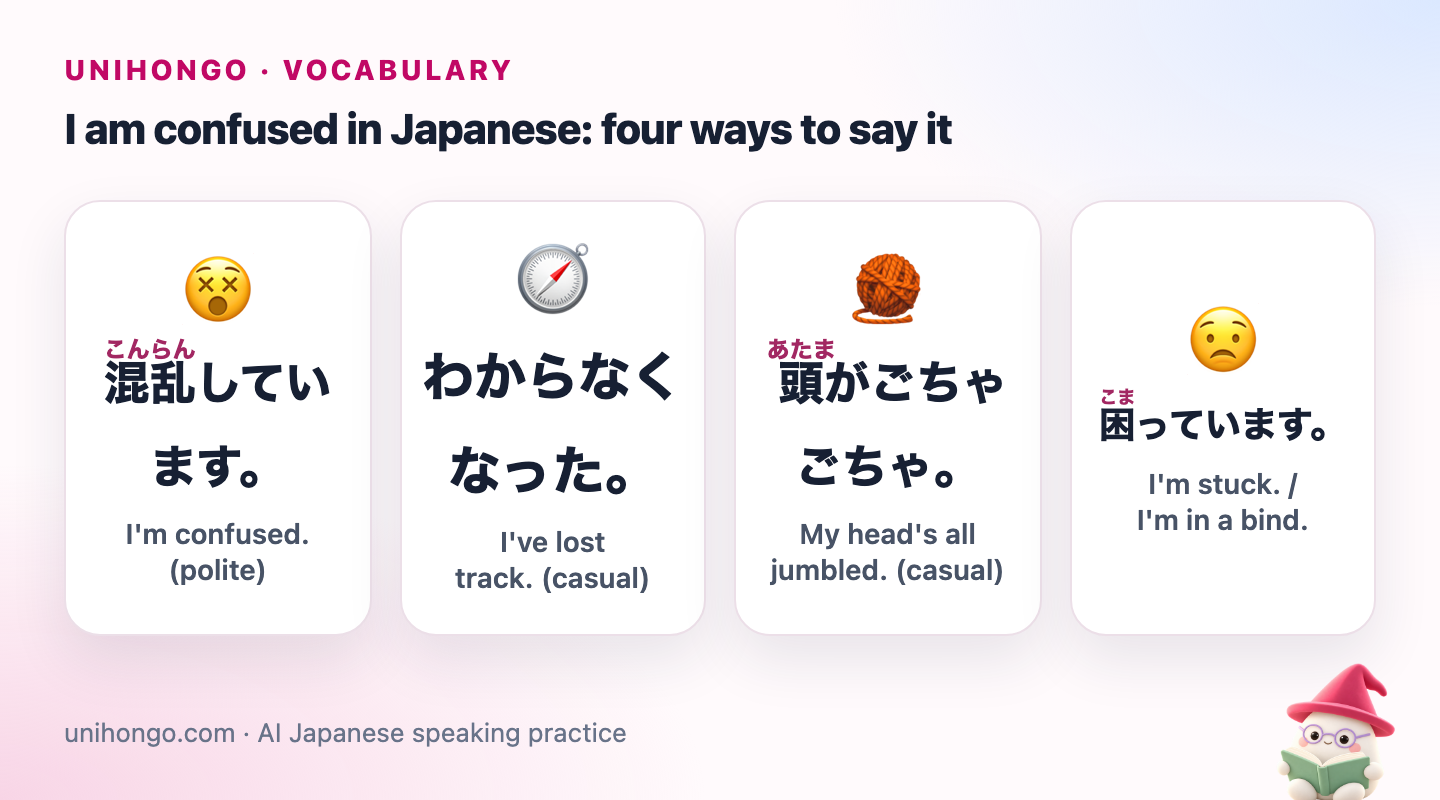
| Japanese | Romaji | Meaning |
|---|---|---|
| 混乱しています。 | Konran shite imasu. | I'm confused. (polite) |
| わからなくなった。 | Wakaranaku natta. | I've lost track. (casual) |
| 頭がごちゃごちゃ。 | Atama ga gochagocha. | My head's all jumbled. (casual) |
| 困っています。 | Komatte imasu. | I'm stuck. / I'm in a bind. |
Konran shite iru: the word for confusion
Konran (混乱) combines 混, mixed, and 乱, disorder. As a noun it describes chaos, such as kōtsū no konran, traffic chaos. With shite iru, it describes a mind in disorder: konran shite imasu, I'm confused. Atama ga konran shite kimashita, my head is getting confused, describes confusion building up.
Because the word is strong, people often soften it: chotto konran shite imasu, I'm a little confused. When you have confused someone else, konran sasete sumimasen, sorry for confusing you, is a polite apology that comes up often at work.
| Japanese | Romaji | Meaning |
|---|---|---|
| ちょっと混乱しています。 | Chotto konran shite imasu. | I'm a little confused. |
| 頭が混乱してきました。 | Atama ga konran shite kimashita. | My head is getting muddled. |
| 混乱させてすみません。 | Konran sasete sumimasen. | Sorry for confusing you. |
| 情報が多すぎて混乱しました。 | Jōhō ga ōsugite konran shimashita. | There was so much information that I got confused. |
Wakaranaku natta: I followed, then lost track
Wakaranaku naru means to stop understanding, to become unclear. It is the natural way to say you were following but lost the thread, and it sounds much less dramatic than konran. Tochū kara, from partway through, tells the other person roughly where things went wrong, which helps them explain again.
The polite form is wakaranaku narimashita, and adding shimaimashita, wakaranaku natte shimaimashita, shows mild regret, as in I'm afraid I've lost track. With te kita, the confusion is happening right now: wakaranaku natte kita, I'm starting to lose track.
| Japanese | Romaji | Meaning |
|---|---|---|
| 途中からわからなくなりました。 | Tochū kara wakaranaku narimashita. | I lost track partway through. |
| よくわからなくなってしまいました。 | Yoku wakaranaku natte shimaimashita. | I'm afraid I've lost track. |
| ちょっと待って、わからなくなってきた。 | Chotto matte, wakaranaku natte kita. | Wait, I'm starting to lose track. (casual) |
| どっちがどっちか、わからなくなりました。 | Dotchi ga dotchi ka, wakaranaku narimashita. | I can't tell which is which anymore. |
Casual pictures of a tangled head
Among friends, Japanese uses vivid images. Gochagocha is a jumble, so atama ga gochagocha shiteru is my head's all over the place. Kongaragaru means to get tangled like string: kongaragatte kita, I'm getting tangled up. Atama ga panku shisō, my head is about to burst, comes from a punctured tyre and describes overload.
Wake ga wakaranai, it makes no sense, is common but can sound frustrated or critical, as if the other person explained badly. Use it about the situation, not to the person explaining.
| Japanese | Romaji | Meaning |
|---|---|---|
| 頭がごちゃごちゃしてる。 | Atama ga gochagocha shiteru. | My head's all over the place. |
| こんがらがってきた。 | Kongaragatte kita. | I'm getting tangled up. |
| 頭がパンクしそう。 | Atama ga panku shisō. | My head's about to burst. |
| もう、わけがわからない。 | Mō, wake ga wakaranai. | Ugh, it makes no sense. (frustrated) |
Komatte iru and mayotte iru: confused and stuck
Komaru (困る) means to be troubled or at a loss. Komatte imasu adds that your confusion is a problem: you cannot move forward. Nani o sureba ii ka wakaranakute komatte imasu, I don't know what to do and I'm stuck, is a clear, polite way to ask for help at a counter or with a colleague.
Mayou (迷う) is narrower: torn between choices, or lost on the way. Dotchi ni suru ka mayotte imasu, I can't decide which one, is common in shops. It does not describe general confusion about an explanation.
| Japanese | Romaji | Meaning |
|---|---|---|
| 何をすればいいかわからなくて困っています。 | Nani o sureba ii ka wakaranakute komatte imasu. | I don't know what to do and I'm stuck. |
| 手続きがよくわからなくて困っています。 | Tetsuzuki ga yoku wakaranakute komatte imasu. | I'm stuck because I don't really understand the procedure. |
| どっちにするか迷っています。 | Dotchi ni suru ka mayotte imasu. | I can't decide which one to choose. |
Untangling it: asking for clarification
Saying you are confused is only half the job. The other half is helping the other person help you. Three moves work in almost any situation. First, summarise what you think they said and check: tsumari, ashita wa yasumi to iu koto desu ka, so you mean tomorrow is a day off? Second, ask about one point instead of everything. Third, if it is truly tangled, ask to go through it step by step or from the beginning.
Kakunin sasete kudasai, let me confirm, is the polite way to start any of these at work, and it sounds professional rather than lost.

| Japanese | Romaji | Meaning |
|---|---|---|
| 確認させてください。 | Kakunin sasete kudasai. | Let me just confirm. |
| つまり、明日は休みということですか。 | Tsumari, ashita wa yasumi to iu koto desu ka. | So you mean tomorrow is a day off? |
| 二つ目のところをもう少し詳しく教えていただけますか。 | Futatsume no tokoro o mō sukoshi kuwashiku oshiete itadakemasu ka. | Could you explain the second point in a bit more detail? |
| 一つずつ整理してもいいですか。 | Hitotsu zutsu seiri shite mo ii desu ka. | May I go through it one point at a time? |
| もう一度、最初からお願いできますか。 | Mō ichido, saisho kara onegai dekimasu ka. | Could you go through it again from the start? |
Admitting confusion politely to a teacher or a boss
With people above you, the trick is to take the blame for the confusion yourself and to make the request small. Watashi no rikai ga oitsuite inakute, my understanding hasn't caught up, puts the problem on your side rather than on the explanation. Sumimasen, ~ no tokoro de konran shite shimatte, sorry, I got confused at the part about ~, shows exactly where to start again.
Avoid saying the explanation was confusing, setsumei ga wakarinikui desu, to a teacher or a manager unless you are asked for feedback. It sounds like a complaint. If you are the one who confused others, wakarinikukute sumimasen, sorry that was hard to follow, is gracious, and it is also what a kind teacher will often say to you.
When the topic is new to you, saying so up front helps: kono bun'ya wa hajimete na node, this field is new to me, invites a slower, simpler explanation without anyone losing face.
| Japanese | Romaji | Meaning |
|---|---|---|
| すみません、二つ目のところで混乱してしまって。 | Sumimasen, futatsume no tokoro de konran shite shimatte. | Sorry, I got confused at the second part. |
| 私の理解が追いついていなくて、すみません。 | Watashi no rikai ga oitsuite inakute, sumimasen. | Sorry, my understanding hasn't caught up. |
| この分野は初めてなので、ゆっくりお願いできますか。 | Kono bun'ya wa hajimete na node, yukkuri onegai dekimasu ka. | This field is new to me, so could you go slowly? |
| わかりにくくてすみません。 | Wakarinikukute sumimasen. | Sorry, that was hard to follow. |
Mini dialogue and common mistakes
| Japanese | Romaji | Meaning |
|---|---|---|
| 会議は水曜に変更になりましたが、資料は火曜までにお願いします。 | Kaigi wa suiyō ni henkō ni narimashita ga, shiryō wa kayō made ni onegai shimasu. | Manager: The meeting moves to Wednesday, but please send the documents by Tuesday. |
| すみません、ちょっと混乱してしまいました。 | Sumimasen, chotto konran shite shimaimashita. | You: Sorry, I've got a bit confused. |
| つまり、資料の締め切りは変わらないということですか。 | Tsumari, shiryō no shimekiri wa kawaranai to iu koto desu ka. | You: So the deadline for the documents doesn't change? |
| そうです。わかりにくくてすみません。 | Sō desu. Wakarinikukute sumimasen. | Manager: That's right. Sorry, that was hard to follow. |
- Saying konfyūzu shite imasu. The katakana word is not used in everyday speech.
- Using konran for a tiny doubt: it can sound dramatic. Try chotto wakaranaku narimashita.
- Using mayotte imasu for confused by an explanation: mayou is for choices and for getting lost.
- Saying wake ga wakaranai to the person explaining: it can sound like blame.
- Stopping at I'm confused. Add where you lost track or summarise back, so the other person knows what to explain.