
Kyōryū: the dragon word for dinosaur
恐竜 (kyōryū) combines 恐, fear or terrible, with 竜, dragon. It was made as a translation of the scientific term, which means terrible lizard, so Japanese turned the lizard into a dragon. The same 竜 appears in the words for other prehistoric reptiles, which is part of why learners are sometimes confused about what counts as a dinosaur.
竜 also has an older, more complex form, 龍, used in names and temple art. For dinosaurs, always use 竜.
| Japanese | Romaji | Meaning |
|---|---|---|
| 恐竜が好き! | Kyōryū ga suki! | I love dinosaurs! |
| 恐竜博物館 | kyōryū hakubutsukan | dinosaur museum |
| 恐竜図鑑 | kyōryū zukan | dinosaur picture encyclopedia |
| 恐竜展 | kyōryūten | dinosaur exhibition |
| 竜 | ryū | dragon |
図鑑 (zukan), an illustrated encyclopedia, is a big part of Japanese childhood. Children pore over zukan of insects, trains, fish and above all dinosaurs, and many can name dozens of species before they can read many kanji, because the names are in katakana.
Four words every dinosaur fan uses
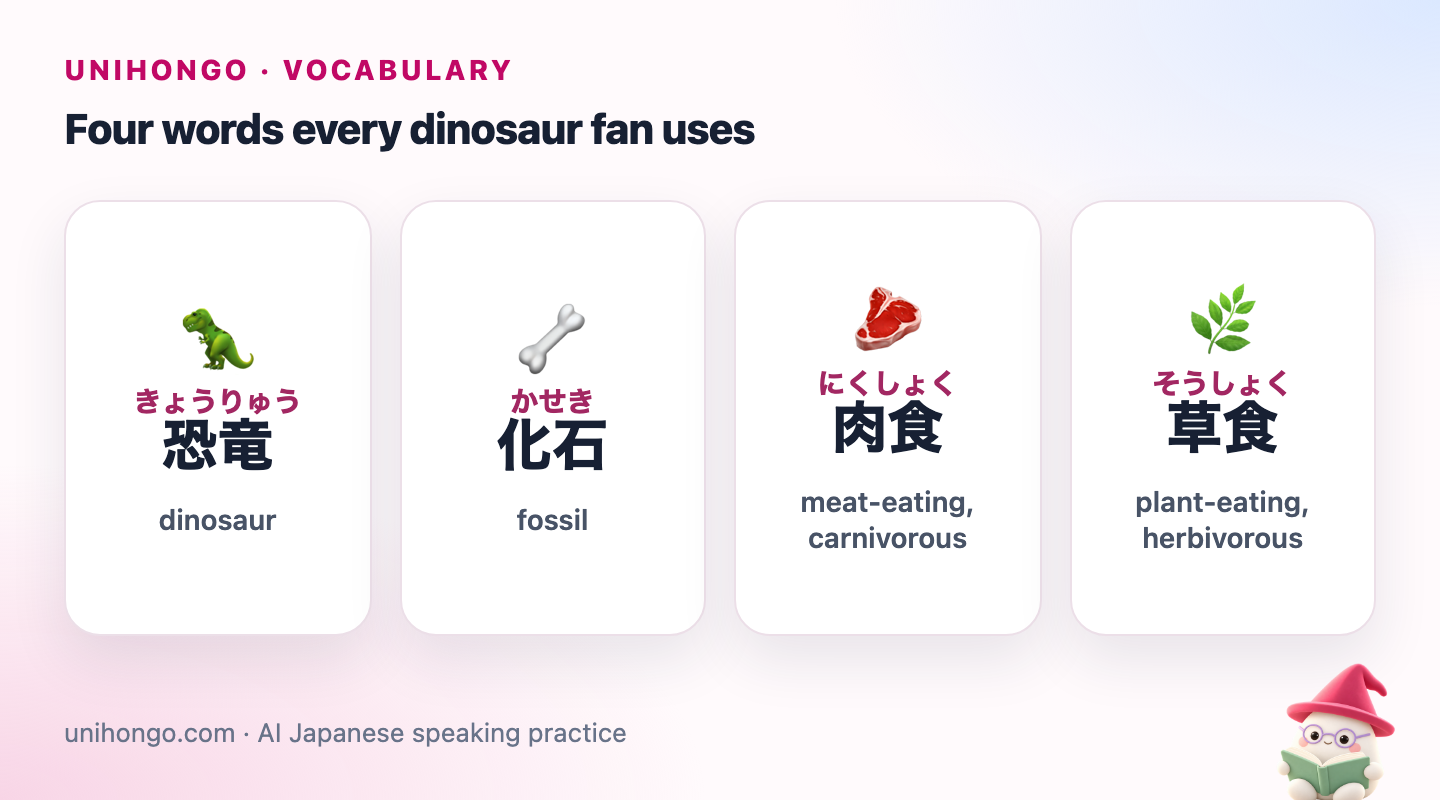
These four words come up in every museum, picture book and child's conversation about dinosaurs. The meat-eater and plant-eater distinction in particular is how Japanese children sort their favourites.
| Japanese | Romaji | Meaning |
|---|---|---|
| 恐竜 | kyōryū | dinosaur |
| 化石 | kaseki | fossil |
| 肉食 | nikushoku | meat-eating, carnivorous |
| 草食 | sōshoku | plant-eating, herbivorous |
| 雑食 | zasshoku | omnivorous |
| 肉食恐竜 | nikushoku kyōryū | meat-eating dinosaur |
| 草食恐竜 | sōshoku kyōryū | plant-eating dinosaur |
| この恐竜は肉食?草食? | Kono kyōryū wa nikushoku? Sōshoku? | Does this dinosaur eat meat or plants? |
Sōshoku has a second life in modern slang: 草食系 (sōshokukei), herbivore type, describes a gentle, unaggressive young man who is not pushy in romance, and 肉食系 (nikushokukei) is the opposite. It is common in casual talk and media, but it is a label about people, so use it with care.
Bones, teeth, horns and tails
To describe a dinosaur, you need body parts and size words. Japanese children's books use simple, vivid words, and so do museum guides for families.
| Japanese | Romaji | Meaning |
|---|---|---|
| 骨 | hone | bone |
| 骨格 | kokkaku | skeleton |
| 全身骨格 | zenshin kokkaku | complete skeleton |
| 歯 | ha | tooth, teeth |
| 角 | tsuno | horn |
| しっぽ | shippo | tail |
| 爪 | tsume | claw |
| 首 | kubi | neck |
| 鋭い歯 | surudoi ha | sharp teeth |
| 首が長い | kubi ga nagai | has a long neck |
| 大きさはどのくらい? | Ōkisa wa dono kurai? | How big was it? |
Shippo, tail, is the everyday word; 尾 (o) appears in more technical writing. For size, Japanese uses metres, so a guide might say zenchō jūni mētoru, twelve metres long. 全長 (zenchō) means total length and is the word you see on museum labels.
Dinosaur names in katakana
Dinosaur names are written in katakana, based on the Latin scientific name rather than on English pronunciation. That makes them longer than English speakers expect, with every vowel pronounced: Tyrannosaurus is ti-ra-no-sa-u-ru-su, seven morae. Saurus becomes サウルス (saurusu), so when you recognise that ending, you can guess many names.
| Japanese | Romaji | Meaning |
|---|---|---|
| ティラノサウルス | tiranosaurusu | Tyrannosaurus |
| トリケラトプス | torikeratopusu | Triceratops |
| ステゴサウルス | sutegosaurusu | Stegosaurus |
| ブラキオサウルス | burakiosaurusu | Brachiosaurus |
| スピノサウルス | supinosaurusu | Spinosaurus |
| アンキロサウルス | ankirosaurusu | Ankylosaurus |
| ヴェロキラプトル | verokiraputoru | Velociraptor |
| ティラノが一番強い! | Tirano ga ichiban tsuyoi! | Child: T. rex is the strongest! |
Velociraptor is written both ヴェロキラプトル and ベロキラプトル; the second is how most people actually pronounce it, berokiraputoru. Children shorten their favourites, tirano for Tyrannosaurus and torikera for Triceratops, and the long names are good practice for katakana reading and for keeping every mora the same length.
Prehistoric periods and extinction
Museums and books organise dinosaurs by period. The three periods of the age of dinosaurs end in 紀 (ki), period. The extinction of the dinosaurs, about 66 million years ago, is widely linked to a huge asteroid impact, and Japanese books describe it with the word 隕石 (inseki), meteorite.
| Japanese | Romaji | Meaning |
|---|---|---|
| 三畳紀 | sanjōki | the Triassic period |
| ジュラ紀 | jura ki | the Jurassic period |
| 白亜紀 | hakuaki | the Cretaceous period |
| 絶滅 | zetsumetsu | extinction |
| 隕石 | inseki | meteorite |
| 約六千六百万年前 | yaku rokusen roppyakuman nen mae | about 66 million years ago |
| 恐竜はどうして絶滅したの? | Kyōryū wa dōshite zetsumetsu shita no? | Child: Why did the dinosaurs die out? |
Big numbers in Japanese go in units of ten thousand, 万 (man), so 66 million is rokusen roppyakuman, six thousand six hundred ten-thousands. It is a good workout for counting, and children's books love to print these numbers in large type.
Not quite dinosaurs: flying and swimming reptiles
Learners, and plenty of adults, often call every prehistoric reptile a dinosaur. Japanese has handy separate words, and children who love dinosaurs often enjoy correcting adults on this point.
| Japanese | Romaji | Meaning |
|---|---|---|
| 翼竜 | yokuryū | pterosaur, flying reptile |
| プテラノドン | puteranodon | Pteranodon |
| 首長竜 | kubinagaryū | plesiosaur, long-necked sea reptile |
| プテラノドンは恐竜じゃないんだよ。 | Puteranodon wa kyōryū ja nai n da yo. | Child: Pteranodon isn't a dinosaur, you know. |
| へえ、知らなかった! | Hē, shiranakatta! | You: Really? I didn't know that! |
Hē, shiranakatta is the perfect reply when a child teaches you something, and it makes them very happy. Other reactions that work well with young dinosaur experts are sugoi, yoku shitteru ne, you know a lot, and mō ikkai oshiete, tell me again. Children who love zukan often know far more names than adults, so letting them be the teacher is a natural way to keep the conversation going.
At a dinosaur museum
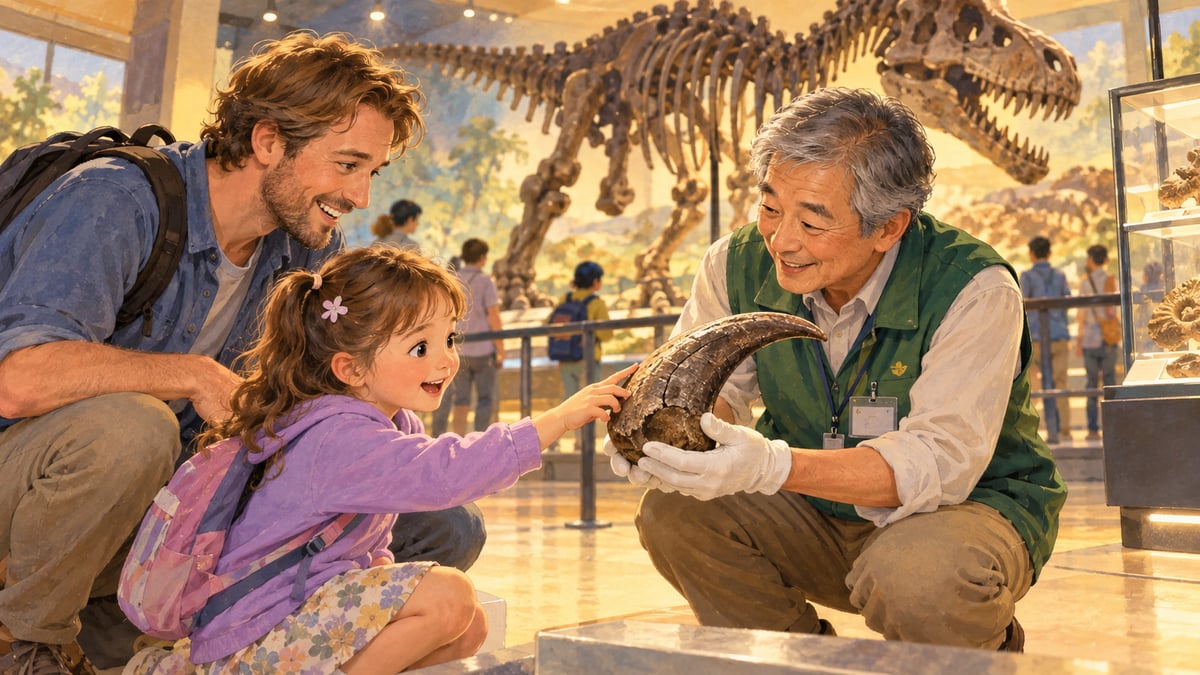
Dinosaur museums and summer exhibitions are popular family outings. Staff and volunteer guides are usually happy to answer questions, and families with children often ask whether a skeleton is a real fossil or a cast. A cast or replica is レプリカ (repurika), and a real fossil is 本物 (honmono).
Many museums also have a corner for fossils found in Japan, where you may see names that include Japanese places, such as Fukuiraptor from Fukui or Kamuysaurus from Hokkaido, whose name draws on the Ainu word kamuy, often translated as god.
| Japanese | Romaji | Meaning |
|---|---|---|
| これは本物の化石ですか。 | Kore wa honmono no kaseki desu ka. | You: Is this a real fossil? |
| こちらはレプリカです。本物はあちらです。 | Kochira wa repurika desu. Honmono wa achira desu. | Guide: This is a replica. The real one is over there. |
| 日本で見つかった恐竜はありますか。 | Nihon de mitsukatta kyōryū wa arimasu ka. | You: Are there dinosaurs that were found in Japan? |
| はい、二階に展示しています。 | Hai, nikai ni tenji shite imasu. | Guide: Yes, they're on display on the second floor. |
| 写真を撮ってもいいですか。 | Shashin o totte mo ii desu ka. | You: May I take photos? |
| フラッシュはご遠慮ください。 | Furasshu wa goenryo kudasai. | Guide: Please don't use the flash. |
Goenryo kudasai is the polite way staff ask you not to do something. You will see and hear it in museums, temples and trains, and it is softer than dame or kinshi, prohibited.
A dinosaur deck you can play with
- Ask Mocchi: /create-flashcards for 15 dinosaur words and names from this post. Pick a photo or illustration for each card.
- Review them with /review-flashcards; the long katakana names you stumble on come back sooner.
- Load the same cards into Vocabulary Dash, the 3D word runner, and race through the dinosaur names.
- Mocchi keeps track of the names that trip you up and can quiz you on them next time without being asked twice.
Common learner mistakes
- Saying dainasō. Katakana ダイナソー exists in a few product names, but the word everyone uses is kyōryū.
- Pronouncing tiranosaurusu with English stress. Keep every mora even.
- Calling Pteranodon a dinosaur. It is a yokuryū.
- Writing 龍 for dinosaurs. Use 竜 in kyōryū.
- Calling a fossil hone. Hone is any bone; a fossil is kaseki, and a fossil bone is hone no kaseki.