
Kimetsu no Yaiba: reading the title kanji by kanji
The series by Gotōge Koyoharu ran in Weekly Shōnen Jump, and its Japanese title has three kanji joined by no. 鬼 is oni, demon, read ki in compounds. 滅 is metsu, to destroy or die out, the kanji in zenmetsu (全滅), wiped out. 刃 is yaiba, a poetic word for a sword blade; the everyday reading of the same kanji is ha, the edge of a knife.
So the title is a noun phrase: the blade that destroys demons. The English title Demon Slayer names the person instead of the weapon.
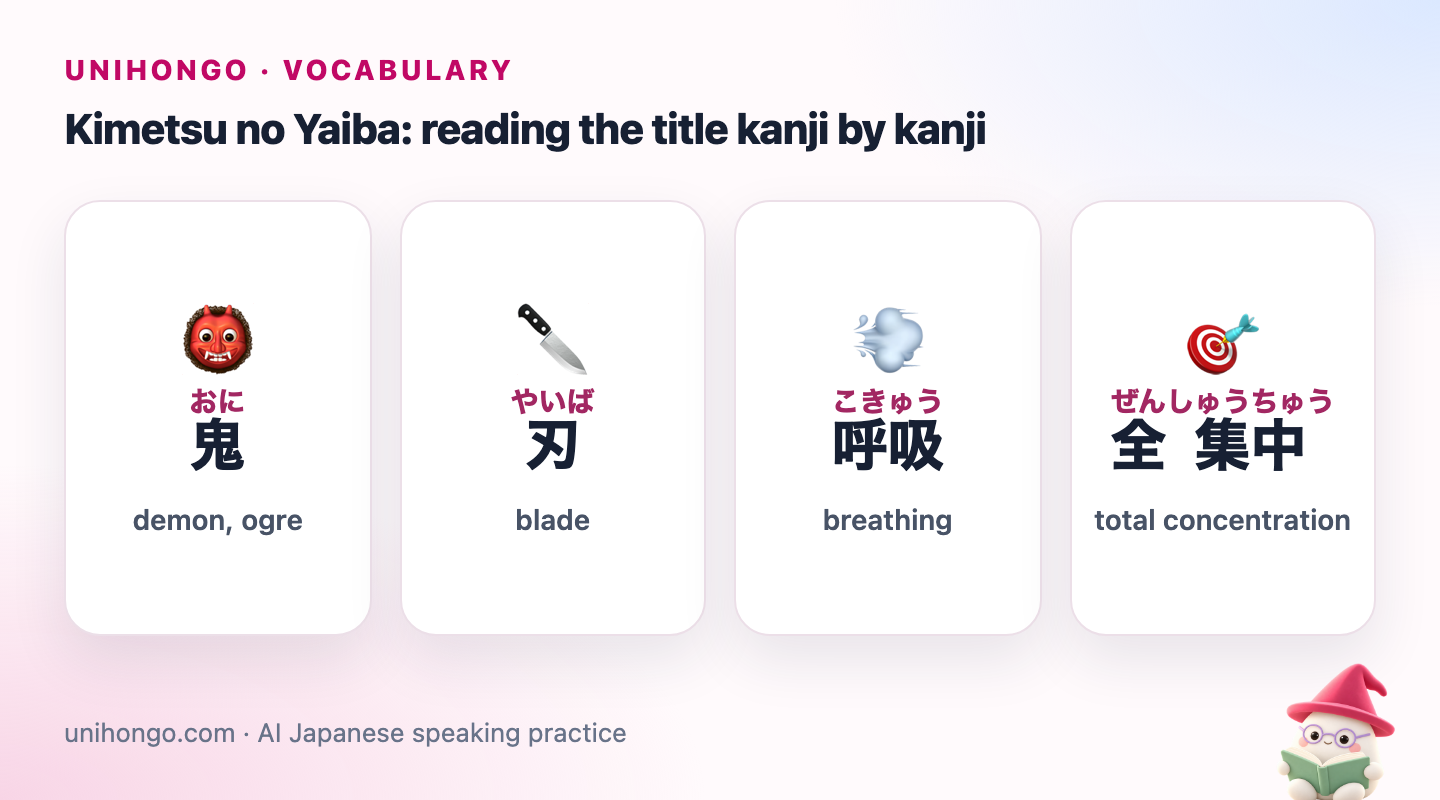
| Japanese | Romaji | Meaning |
|---|---|---|
| 鬼 | oni | demon, ogre |
| 刃 | yaiba | blade |
| 呼吸 | kokyū | breathing |
| 全集中 | zenshūchū | total concentration |
| 鬼滅の刃 | Kimetsu no Yaiba | Blade of Demon Destruction |
| 全滅 | zenmetsu | wiped out, total defeat |
Oni: the demon you already know from folklore
Oni are much older than the series. In folktales they are horned ogres with clubs, and every February at Setsubun families throw beans and shout the line below to drive them out. Children's tag is onigokko, playing oni, and the chaser is called the oni.
The series reimagines oni as former humans who eat people, but the word carries its old weight. In modern slang, oni is also stuck in front of words to mean extremely, and a strict coach is an oni kōchi.
| Japanese | Romaji | Meaning |
|---|---|---|
| 鬼ごっこ | onigokko | the game of tag |
| 鬼は外、福は内 | oni wa soto, fuku wa uchi | demons out, good luck in |
| 鬼コーチ | oni kōchi | a ruthlessly strict coach |
Kisatsutai and hashira: the Corps and its pillars
The demon hunters belong to the Kisatsutai (鬼殺隊): ki, demon, satsu (殺), kill, and tai (隊), a corps or unit. Tai is a productive ending, as in taiin (隊員), a member of a unit. English editions call it the Demon Slayer Corps.
Its strongest swordsmen are the hashira (柱), pillars. The image is architectural: remove the pillars and the house falls. Japanese uses the same picture for people in daikokubashira (大黒柱), the main pillar, meaning the person a family or team depends on. One more detail fans enjoy: hashira is also the traditional counter word for gods.
| Japanese | Romaji | Meaning |
|---|---|---|
| 鬼殺隊 | Kisatsutai | the Demon Slayer Corps |
| 柱 | hashira | pillar; top-ranked swordsman |
| 大黒柱 | daikokubashira | mainstay, breadwinner |
| 電柱 | denchū | utility pole |
Kokyū and zenshūchū: breathing and total concentration
Swordsmen fight with styles called kokyū (呼吸), breathing: mizu no kokyū is water breathing. The kanji are 呼, to breathe out or call, and 吸, to breathe in, so the word contains a full breath. It is the standard medical and everyday term.
Zenshūchū (全集中) adds zen (全), all, to shūchū (集中), concentration, literally gathering to the centre. Shūchū is one of the most useful words in the series for students: shūchū suru is to concentrate, and shūchūryoku is your power of concentration.
| Japanese | Romaji | Meaning |
|---|---|---|
| 全集中の呼吸 | zenshūchū no kokyū | total concentration breathing |
| 水の呼吸 | mizu no kokyū | water breathing |
| 集中する | shūchū suru | to concentrate |
| 集中力 | shūchūryoku | power of concentration |
| 深呼吸 | shinkokyū | a deep breath |
Kata and the old numerals 壱, 弐, 参
Each breathing style has numbered moves called kata (型), forms, the word karate uses for its set sequences. They are announced as ichi no kata, ni no kata and so on, and written with formal numerals: 壱ノ型, 弐ノ型, 参ノ型.
These numerals are real. They were designed for contracts and accounts, where a simple 一 could be turned into 二 or 三 with an extra stroke. The series continues the set through ten. In daily life you rarely need to write them, but you should recognise 壱 on a banknote.
Kata is also everywhere in ordinary words, usually voiced to gata: ketsuekigata (血液型), blood type, and kamigata (髪型), hairstyle.
| Japanese | Romaji | Meaning |
|---|---|---|
| 壱ノ型 | ichi no kata | first form |
| 弐ノ型 | ni no kata | second form |
| 参ノ型 | san no kata | third form |
| 血液型 | ketsuekigata | blood type |
| 髪型 | kamigata | hairstyle |
Nichirin swords and other coined terms
The Corps's weapon is the nichirintō (日輪刀). Nichirin (日輪) is a literary word for the sun's disc, and tō (刀) is the compound reading of katana. The name tells you the premise: sunlight is what demons fear.
This is how the series builds its vocabulary: real kanji, real readings, new combinations. If you can split a term into its kanji, you can usually guess its meaning before any character explains it. Mugen ressha (無限列車), from the title of the hit film, is simply infinite train.
| Japanese | Romaji | Meaning |
|---|---|---|
| 日輪刀 | nichirintō | sun-disc sword |
| 刀 | katana | sword |
| 無限列車 | mugen ressha | the Infinity Train |
The Taishō setting and why the speech sounds old
The story takes place in the Taishō era (大正), 1912 to 1926, when rural Japan still looked traditional and cities were filling with trains and electric light. That is why you hear so few English loanwords and so many kanji-heavy terms, and why polite characters use formal, slightly stiff phrasing.
On top of that, the main cast speak in strongly drawn styles. The gentle hero is polite to elders and earnest to a fault. The boar-masked fighter boasts with the arrogant ore-sama and charges in shouting a real four-kanji idiom. The timid one wails that everything is impossible. These are character voices, written to be recognised in one line.
| Japanese | Romaji | Meaning |
|---|---|---|
| 猪突猛進 | chototsu mōshin | charging headlong (four-kanji idiom) |
| 無理無理無理! | Muri muri muri! | No way, no way, no way! |
| 頑張れ! | Ganbare! | Hang in there! You can do it! |
| うまい! | Umai! | Delicious! (hearty, casual) |
Ganbare and umai are safe with friends. Chototsu mōshin is a genuine idiom for rushing ahead without thinking, used in writing and speeches. Shouting it mid-sprint is optional.
Taking the words into real life
Here is the same vocabulary in polite, usable sentences. None of them will make people think you are quoting anime, except perhaps the last.
| Japanese | Romaji | Meaning |
|---|---|---|
| うるさくて集中できません。 | Urusakute shūchū dekimasen. | It's noisy and I can't concentrate. |
| 深呼吸してください。 | Shinkokyū shite kudasai. | Please take a deep breath. |
| 母は家族の大黒柱です。 | Haha wa kazoku no daikokubashira desu. | My mother is the pillar of our family. |
| 血液型は何型ですか。 | Ketsuekigata wa nanigata desu ka. | What is your blood type? |
| 鬼滅の刃を見たことがありますか。 | Kimetsu no Yaiba o mita koto ga arimasu ka. | Have you ever watched Demon Slayer? |
| 今日は全集中で勉強します。 | Kyō wa zenshūchū de benkyō shimasu. | Today I'll study with total concentration. |