
The short answer
Yoroshiku onegaishimasu asks the listener to deal well with you in whatever comes next. It points forward, not backward. That is why it can close an introduction, end a request, and sign off an email without changing form: in all three cases something is being placed in the other person's hands, and the speaker is asking for goodwill in how it is handled.
This is also why an English translation cannot be reused. English marks these moments with different sentences, one for meeting, one for asking, one for thanking. Japanese marks them with the same gesture. Learn the gesture and stop hunting for the word.
| Japanese | Romaji | Meaning |
|---|---|---|
| よろしくお願いします。 | Yoroshiku onegaishimasu. | Please treat me well from here on. |
| 田中と申します。よろしくお願いします。 | Tanaka to mōshimasu. Yoroshiku onegaishimasu. | My name is Tanaka. I look forward to working with you. |
| こちらこそ、よろしくお願いします。 | Kochira koso, yoroshiku onegaishimasu. | The same from my side, please. |
Why the literal reading misleads
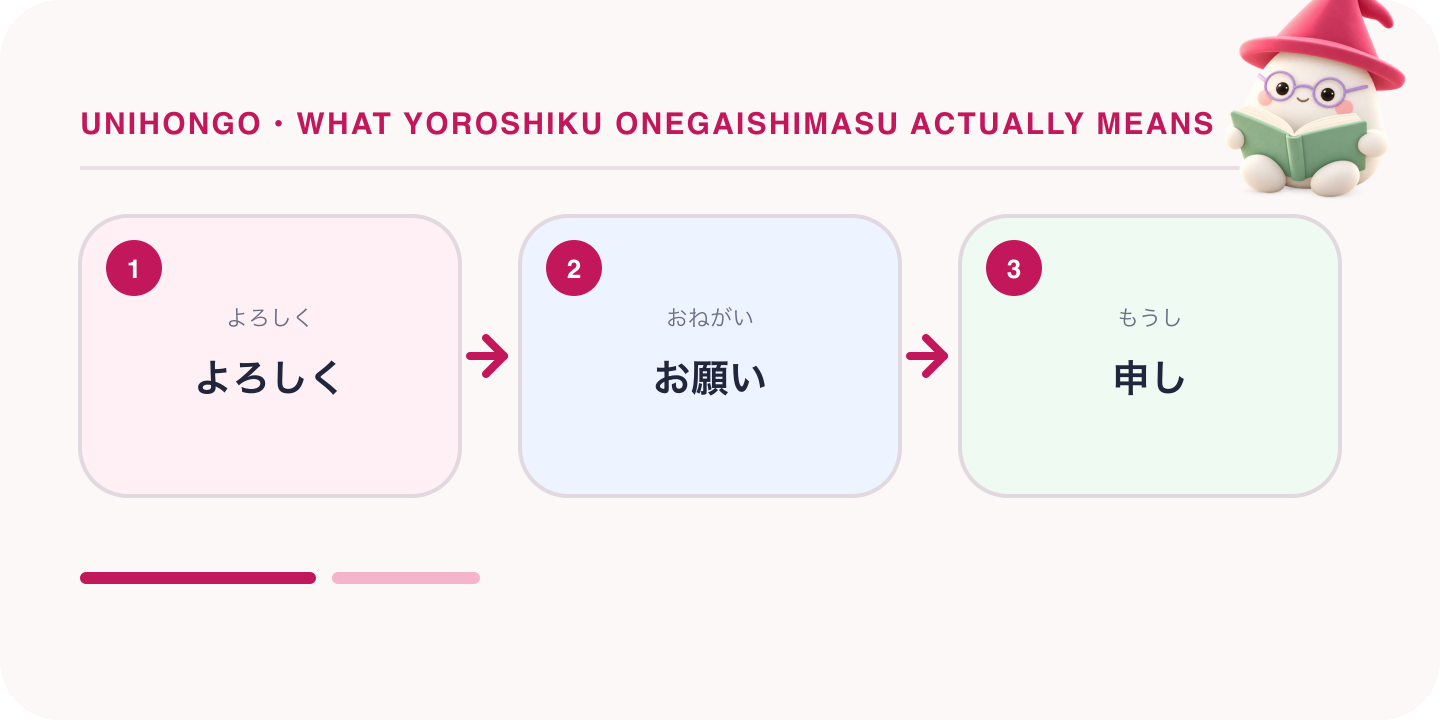
Yoroshiku is the adverbial form of yoroshii, a polite word for good or acceptable, so it means something like favourably or in a good way. Onegai shimasu is a humble request built on negau, to wish or to ask. Put together the literal sense is close to I ask you to handle this favourably, with no object stated.
The missing object is the whole point. Japanese leaves unsaid what exactly is being handled favourably, and the situation fills it in: at an introduction it is you, at the start of a project it is the work, in an email it is the request just written above. Learners who translate the parts arrive at please take care of me and then find it embarrassing to say to a client. The Japanese is not asking for care; it is asking for goodwill about a shared future task.
The jobs it does
| Situation | Version to use | What it is doing |
|---|---|---|
| First self-introduction | よろしくお願いします Yoroshiku onegaishimasu | Handing the new relationship over |
| Meeting a client or senior figure | よろしくお願いいたします Yoroshiku onegaiitashimasu | The same, with humble register |
| Ending a spoken request | よろしくお願いします Yoroshiku onegaishimasu | Asking for goodwill in carrying it out |
| Signing off a work email | よろしくお願いいたします Yoroshiku onegaiitashimasu | Standard written close after a request |
| Starting a project or a term | 今年もよろしくお願いします Kotoshi mo yoroshiku onegaishimasu | Renewing an existing relationship |
| New year greeting | 本年もよろしくお願いします Honnen mo yoroshiku onegaishimasu | Carrying the relationship into the year |
| Asking a colleague a favour | よろしくお願いします Yoroshiku onegaishimasu | Closing the ask politely |
| Parent to a class teacher | よろしくお願いいたします Yoroshiku onegaiitashimasu | Entrusting the child's schooling |
| Between friends | よろしく Yoroshiku | Casual thanks in advance |
The table is not a list of nine phrases to memorise. It is one phrase in nine positions, and the only thing that really changes is how humble the ending is. Choose the register from the person in front of you, then use the situation to decide whether anything comes before it, such as kotoshi mo or kondo no ken de.
Closing a self-introduction
A Japanese self-introduction has a shape: name, where you are from or what you do, one small piece of content, then the handover. The phrase is the full stop. Saying your name and stopping sounds unfinished to a Japanese ear in the way an English introduction sounds unfinished without any closing pleasantry.
The common learner mistake is rushing it. Leave a small beat before the phrase and let it stand on its own, often with a slight bow. Said quickly and swallowed, it reads as a memorised formula rather than a gesture toward the person.
| Japanese | Romaji | Meaning |
|---|---|---|
| はじめまして、リンと申します。 | Hajimemashite, Rin to mōshimasu. | How do you do, my name is Lin. |
| ベトナムから来ました。よろしくお願いします。 | Betonamu kara kimashita. Yoroshiku onegaishimasu. | I came from Vietnam. I look forward to knowing you. |
| 営業部の佐藤です。よろしくお願いいたします。 | Eigyōbu no Satō desu. Yoroshiku onegaiitashimasu. | I am Sato from the sales department. I look forward to working with you. |
| 今日からお世話になります。よろしくお願いします。 | Kyō kara osewa ni narimasu. Yoroshiku onegaishimasu. | I start with you today. I look forward to working here. |
| こちらこそ、よろしくお願いいたします。 | Kochira koso, yoroshiku onegaiitashimasu. | The pleasure is mine, likewise. |
| みなさん、よろしくお願いします。 | Minasan, yoroshiku onegaishimasu. | Everyone, I look forward to being with you. |
Ending a request
After you ask for something, the phrase closes the ask and softens it. It works like a spoken signature: the request is stated, then handed over. Without it, a request in a workplace can sound abrupt even when the grammar is polite, because nothing marks the moment where responsibility passes to the other person.
In speech it usually follows the request directly. In writing it goes on its own line at the end. Note that it is not thanks for something already done, so it does not replace arigatō gozaimasu after the work is finished.
| Japanese | Romaji | Meaning |
|---|---|---|
| この資料の確認をお願いします。よろしくお願いします。 | Kono shiryō no kakunin o onegai shimasu. Yoroshiku onegaishimasu. | Please check these documents. I appreciate your handling it. |
| 金曜日までにいただけますか。よろしくお願いいたします。 | Kin'yōbi made ni itadakemasu ka. Yoroshiku onegaiitashimasu. | Could I have it by Friday? I would be grateful. |
| 恐れ入りますが、よろしくお願いします。 | Osoreirimasu ga, yoroshiku onegaishimasu. | I am sorry to trouble you, but please do. |
| はい、承知しました。 | Hai, shōchi shimashita. | Yes, understood. (their reply) |
| では、その件はよろしくお願いします。 | Dewa, sono ken wa yoroshiku onegaishimasu. | Then I will leave that matter with you. |
| お手数ですが、よろしくお願いいたします。 | Otesū desu ga, yoroshiku onegaiitashimasu. | Sorry for the trouble, and thank you in advance. |
Emails, projects, and the new year
In written Japanese the phrase is the default closing line of a work email, sitting where an English sign-off would. It appears even when the message contains no explicit request, because the relationship itself is what is being commended to the reader. The written form is usually the humbler onegaiitashimasu.
The same phrase reopens an existing relationship. Adding mo, meaning also or again, turns it from a first handover into a renewal, which is why it is everywhere at new year and at the start of a school term or a project.
| Japanese | Romaji | Meaning |
|---|---|---|
| よろしくお願いいたします。 | Yoroshiku onegaiitashimasu. | Written email sign-off. |
| 今後ともよろしくお願いいたします。 | Kongo tomo yoroshiku onegaiitashimasu. | I look forward to our continued relationship. |
| 引き続きよろしくお願いします。 | Hikitsuzuki yoroshiku onegaishimasu. | Please continue to work with me on this. |
| 明けましておめでとうございます。本年もよろしくお願いします。 | Akemashite omedetō gozaimasu. Honnen mo yoroshiku onegaishimasu. | Happy new year. I look forward to this year with you too. |
| 今年もよろしくお願いします。 | Kotoshi mo yoroshiku onegaishimasu. | Looking forward to another year together. |
| このプロジェクト、よろしくお願いします。 | Kono purojekuto, yoroshiku onegaishimasu. | Let us make this project go well. |
| 新学期もよろしくお願いいたします。 | Shingakki mo yoroshiku onegaiitashimasu. | I look forward to the new term as well. |
The register ladder
| Form | Romaji | Who you say it to |
|---|---|---|
| よろしく | Yoroshiku | Friends, close peers, a junior |
| よろしくね | Yoroshiku ne | Friends, warm and light |
| よろしくお願いします | Yoroshiku onegaishimasu | The safe default with almost anyone |
| どうぞよろしくお願いします | Dōzo yoroshiku onegaishimasu | A first meeting, slightly more formal |
| よろしくお願いいたします | Yoroshiku onegaiitashimasu | Clients, seniors, written business Japanese |
| 何卒よろしくお願い申し上げます | Nanitozo yoroshiku onegai mōshiagemasu | Formal writing, ceremonies, notices |
Itashimasu is the humble form of shimasu, so onegaiitashimasu lowers the speaker rather than raising the listener. Mōshiagemasu is humbler again and belongs in writing more than in speech. If you are unsure, onegaishimasu is almost never wrong in conversation; the casual yoroshiku on its own is the one that can misfire upward.
Replying without sounding blank
When someone says it to you, silence or a nod alone can read as cold. The standard return is kochira koso, meaning it is I who should say so, which passes the gesture back. Between peers, repeating yoroshiku is enough, and in a group introduction a nod plus a short yoroshiku onegaishimasu to each person works well.
Learners often answer with hai, or reach for a thank you, and then wonder why the moment felt flat. Neither answer is wrong exactly, but neither returns the gesture, so the exchange stays one-sided. Kochira koso costs one extra second and makes the handover mutual, which is the whole point of the phrase in the first place.
| Japanese | Romaji | Meaning |
|---|---|---|
| こちらこそ。 | Kochira koso. | Likewise, on my side. |
| こちらこそ、よろしくお願いします。 | Kochira koso, yoroshiku onegaishimasu. | Likewise, I look forward to it too. |
| こちらこそ、よろしくお願いいたします。 | Kochira koso, yoroshiku onegaiitashimasu. | The pleasure is mine, formally. |
| ええ、よろしく。 | Ē, yoroshiku. | Yeah, likewise. (casual) |
| はい、頑張ります。よろしくお願いします。 | Hai, ganbarimasu. Yoroshiku onegaishimasu. | Yes, I will do my best. I look forward to it. |
| ありがとうございます。こちらこそよろしくお願いします。 | Arigatō gozaimasu. Kochira koso yoroshiku onegaishimasu. | Thank you. And likewise from me. |
When it is not appropriate
- After work is already finished: use arigatō gozaimashita instead, since the phrase points forward.
- As a general goodbye to a friend leaving a cafe: nothing is being handed over.
- To a shop assistant taking your money in a normal transaction, where it sounds heavy or strange.
- Toward someone who has just refused you, where it can read as pressure to reconsider.
- In casual form upward: yoroshiku alone to a manager or a client sounds too familiar.
- As a substitute for an apology; sumimasen and yoroshiku onegaishimasu do different jobs.
There is one useful exception in service settings. When staff will perform a specific task on you or your belongings, the phrase fits well, because that task is exactly the thing being handed over. A hairdresser about to cut, a mechanic taking your car, a photographer starting a session all commonly hear it.
Situations to rehearse aloud
| Japanese | Romaji | Meaning |
|---|---|---|
| すみません、これお願いします。 | Sumimasen, kore onegai shimasu. | Excuse me, this one please. (a plain request, no yoroshiku) |
| 短くしてください。よろしくお願いします。 | Mijikaku shite kudasai. Yoroshiku onegaishimasu. | Please cut it short. I leave it to you. (at the hairdresser) |
| 息子がお世話になります。よろしくお願いいたします。 | Musuko ga osewa ni narimasu. Yoroshiku onegaiitashimasu. | My son will be in your care. Thank you in advance. (parent to teacher) |
| 来週から新しいチームです。よろしくお願いします。 | Raishū kara atarashii chīmu desu. Yoroshiku onegaishimasu. | I join the new team from next week. I look forward to it. |
| ちょっとお願いがあるんですが。 | Chotto onegai ga aru n desu ga. | I have a small favour to ask. |
| はい、何でしょうか。 | Hai, nan deshō ka. | Yes, what is it? (their reply) |
| この書類、見ていただけますか。よろしくお願いします。 | Kono shorui, mite itadakemasu ka. Yoroshiku onegaishimasu. | Could you look at this document? I would be grateful. |
| じゃあ、明日よろしくね。 | Jā, ashita yoroshiku ne. | See you tomorrow then, thanks in advance. (casual) |
| 写真をお願いできますか。よろしくお願いします。 | Shashin o onegai dekimasu ka. Yoroshiku onegaishimasu. | Could you take a photo? Thank you kindly. |
| 本日はよろしくお願いいたします。 | Honjitsu wa yoroshiku onegaiitashimasu. | Thank you for having me today. (at the start of a meeting) |
| お先に失礼します。 | Osaki ni shitsurei shimasu. | I am leaving before you. (not a yoroshiku moment) |
| これからもよろしくお願いします。 | Kore kara mo yoroshiku onegaishimasu. | Here is to continuing together. |
Say each of these with the situation in mind rather than reading down the column. The phrase is short, so its meaning lives almost entirely in timing, in the small pause before it, and in the slight bow that usually accompanies it in person.