
Takkyū and the spin words at its heart
Takkyū is made of two kanji: 卓 (taku), table, and 球 (kyū), ball, the same kyū as in yakyū, baseball. Japanese players talk about spin constantly, and the spin words are a neat set: kaiten, rotation, with a direction word in front. Upper, lower and side give you the three basic spins.
When a ball has a lot of spin you say kaiten ga sugoi, and when it has almost none it is a nakkuru, from knuckle, a ball that floats without spin. Reading the spin of a serve is called kaiten o yomu, to read the rotation.
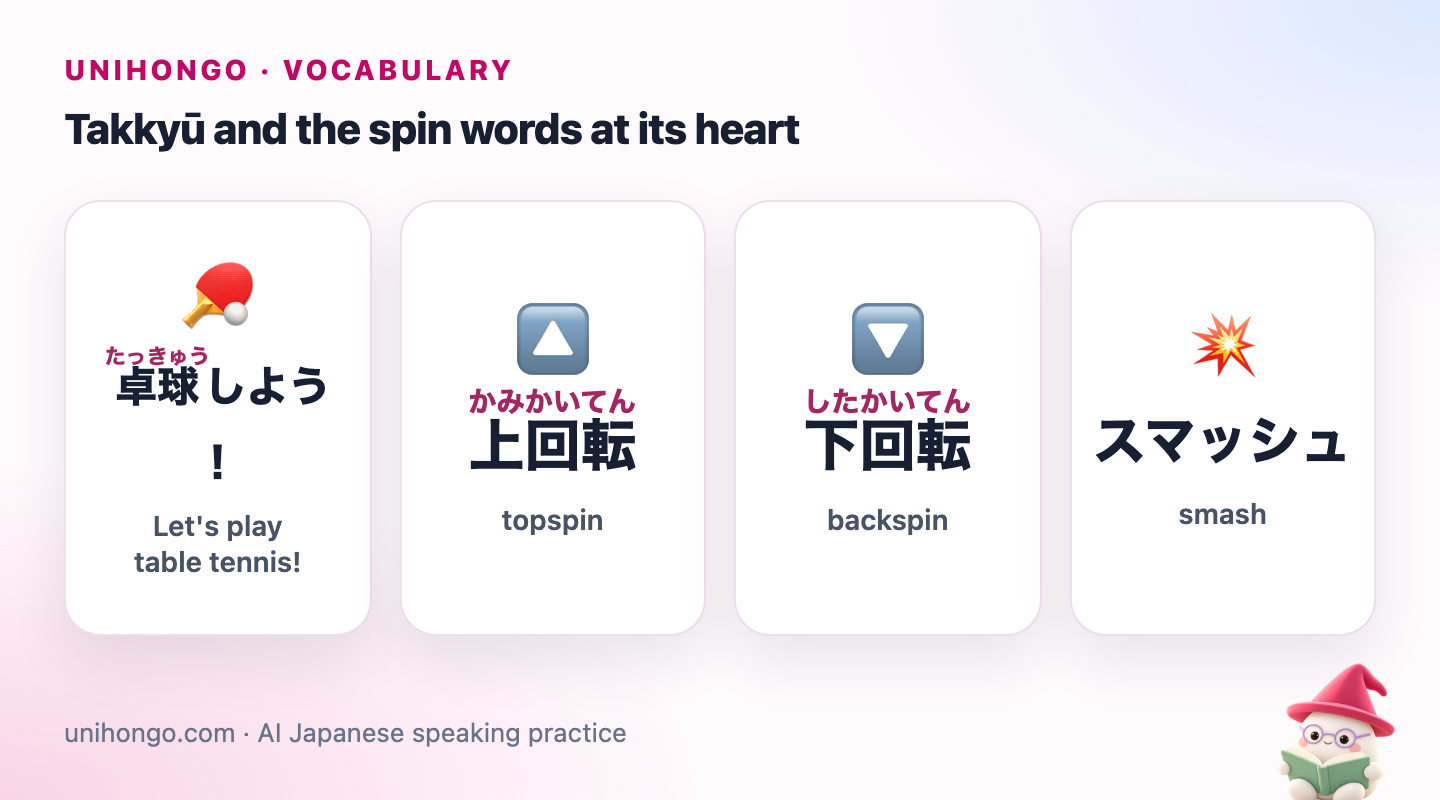
| Japanese | Romaji | Meaning |
|---|---|---|
| 卓球しよう! | Takkyū shiyō! | Let's play table tennis! |
| 上回転 | kami kaiten | topspin |
| 下回転 | shita kaiten | backspin |
| スマッシュ | sumasshu | smash |
| 横回転 | yoko kaiten | sidespin |
| 回転を読む | kaiten o yomu | to read the spin |
| 回転がすごい。 | Kaiten ga sugoi. | That's a lot of spin. |
Rackets, rubbers and grips
The racket is usually called raketto, and the wooden part is the bureido, blade. The rubber sheets are rabā, and choosing them is a whole hobby of its own. The two main types are ura sofuto, inverted rubber with the smooth side out, used by most players, and omote sofuto, pimpled rubber with the pimples out, which gives a flatter, faster ball.
There are two classic grips. Shēkuhando, from shakehand, is held like a handshake and is used by most players today. Penhorudā, penholder, is held like a pen, and was once very common in Japan and other parts of Asia; older players at a community hall may still use it.
| Japanese | Romaji | Meaning |
|---|---|---|
| ラケット | raketto | racket, paddle |
| ラバー | rabā | rubber sheet |
| 裏ソフト | ura sofuto | inverted rubber (smooth side out) |
| 表ソフト | omote sofuto | pimpled rubber (pimples out) |
| シェークハンド | shēkuhando | shakehand grip |
| ペンホルダー | penhorudā | penholder grip |
| ラバーを貼り替えました。 | Rabā o harikaemashita. | I replaced my rubbers. |
Harikaeru means to glue on a replacement, the verb for changing rubbers. If someone asks shēku desu ka, pen desu ka?, they want to know your grip, and a short shēku desu is the natural answer.
Strokes in Japanese table tennis
Stroke names are mostly katakana, but some do not match the English meaning. The big one is doraibu: in table tennis it is a topspin attack, the main attacking stroke of the modern game, not a flat drive. Katto, cut, is a defensive backspin stroke usually played far from the table, and burokku is a short block of an opponent's attack.
| Japanese | Romaji | Meaning |
|---|---|---|
| フォアドライブ | foa doraibu | forehand topspin attack |
| バックハンド | bakkuhando | backhand |
| ツッツキ | tsuttsuki | push (backspin return) |
| カットマン | kattoman | defensive chopper |
| フォアで打って! | Foa de utte! | Hit it with your forehand! |
| ツッツキが浮いちゃった。 | Tsuttsuki ga uichatta. | My push popped up too high. |
| Stroke | Japanese | What it is |
|---|---|---|
| Topspin attack | doraibu | The main attacking stroke, with heavy topspin |
| Push | tsuttsuki | A short backspin return close to the table |
| Chop | katto | Defensive backspin, often from far back |
| Block | burokku | A short return of an attack |
| Flick | furikku | A quick wrist attack over the table |
Uku, to float, is how players describe a ball that pops up too high and is easy to attack. Bōru ga uita, the ball floated, is something you will hear after almost every lost point in a club practice.
Serve, score and the rules people talk about
A game of table tennis goes to eleven points, and you must win by two. The serve changes every two points, and at ten all it changes every point. The ball must be tossed up from an open palm when you serve, and a serve that touches the net and lands correctly is a let, said netto in or retto by players.
At ten all, Japanese players usually say jūsu, deuce, in casual games. Before a match, the umpire may announce rabu ōru, love all, to start. The score is read with tai: jū tai hachi, ten to eight.
| Japanese | Romaji | Meaning |
|---|---|---|
| サーブ交代 | sābu kōtai | change of serve |
| 十一点先取 | jūitten senshu | first to eleven points |
| ジュースです。 | Jūsu desu. | It's deuce (ten all). |
| 今のはネットだよ。 | Ima no wa netto da yo. | That one touched the net. (casual) |
| 二本ずつ交代ね。 | Nihon zutsu kōtai ne. | We change serve every two, okay? |
| 次、私のサーブ。 | Tsugi, watashi no sābu. | Next one is my serve. |
Calls and encouragement during a game
Table tennis is fast, and the talk is short. Club players often shout after winning a point to pump themselves up; a plain yoshi! or yossha! is the most universal version, and you will hear many personal variations. Praise and apology lines are simple casual phrases that work with friends and in community clubs.
After a lucky net or edge ball, it is good manners in Japan, as in many countries, to raise a hand and say sumimasen, sorry, even though the point is legal. The same goes for edge balls, called ejji in Japanese.
| Japanese | Romaji | Meaning |
|---|---|---|
| よっしゃ! | Yossha! | Yes! (after winning a point) |
| ナイスボール! | Naisu bōru! | Nice shot! |
| すみません、ネットです。 | Sumimasen, netto desu. | Sorry, net ball. (apologising for luck) |
| 今のはエッジです。 | Ima no wa ejji desu. | That was an edge ball. |
| 惜しい! | Oshii! | So close! |
Ping-pong at a hot spring inn
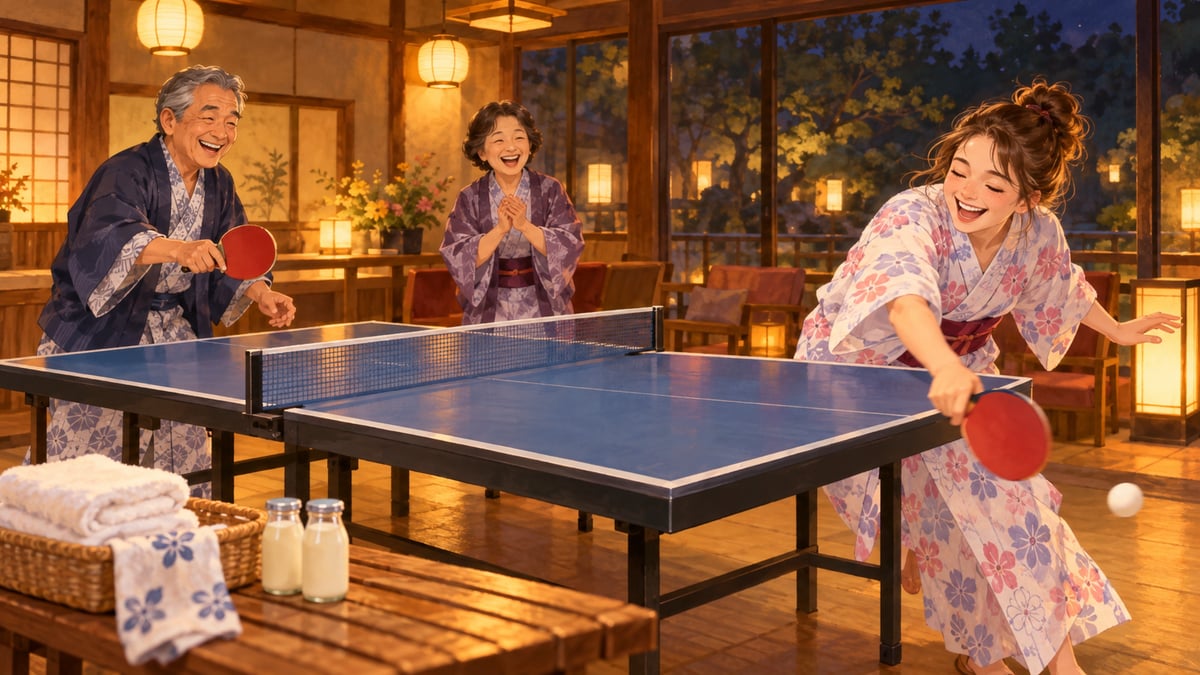
Onsen takkyū, hot spring table tennis, is a classic of Japanese holidays. After the bath, guests in yukata and inn slippers play a slow, laughing game in a corner of the inn, often on an old table with worn rackets. It is a social game, not a sport: nobody keeps strict rules, and losing gracefully is the point.
Rackets and balls are usually kept at the front desk or in the games room. Ask politely, and return them when you finish. Inns differ: some games rooms close at a set time, and some charge a small fee.
| Japanese | Romaji | Meaning |
|---|---|---|
| 卓球台を使ってもいいですか。 | Takkyū dai o tsukatte mo ii desu ka. | May we use the table tennis table? |
| ラケットを貸していただけますか。 | Raketto o kashite itadakemasu ka. | Could we borrow some rackets? (polite) |
| 何時まで使えますか。 | Nanji made tsukaemasu ka. | Until what time can we use it? |
| 浴衣だと動きにくいね。 | Yukata da to ugokinikui ne. | It's hard to move in a yukata, isn't it? |
| 負けたほうがジュースをおごる! | Maketa hō ga jūsu o ogoru! | Loser buys the drinks! |
Notice the double meaning of jūsu in that last line: here it is juice or a soft drink from the vending machine, not deuce. Ogoru means to treat someone, and the classic onsen bet is that the loser buys drinks.
Mini dialogue: a quick game at the community hall
| Japanese | Romaji | Meaning |
|---|---|---|
| 一緒に打ちませんか。 | Issho ni uchimasen ka. | Player: Would you like to hit together? |
| ぜひ。でも、下回転が苦手なんです。 | Zehi. Demo, shita kaiten ga nigate na n desu. | You: I'd love to. But I struggle with backspin. |
| じゃあ、ツッツキの練習からしましょう。 | Jā, tsuttsuki no renshū kara shimashō. | Player: Then let's start by practising pushes. |
| ありがとうございます。助かります。 | Arigatō gozaimasu. Tasukarimasu. | You: Thank you. That really helps. |
Utsu, to hit, is the natural verb for practising together: issho ni utsu, to hit together. Tasukarimasu, literally I am saved, is a warm, polite way to thank someone for help.
Put spin into your study routine
Ask Mocchi /kanji 回 to see the meaning, readings and words for the first character of kaiten, then ask for the same with 球. Seeing kaiten, kaisū and yakyū side by side makes the table tennis words feel connected rather than random. Then ask Mocchi to /create-flashcards for the spin and stroke words, choosing a photo for each, and stack them up in Kotoba Stack, which builds a tower word by word. Mocchi notes the words you miss and brings them back in your next review.
Common learner mistakes
- Using doraibu to mean a flat drive. In table tennis it is a topspin attack.
- Saying ue kaiten. The set word is kami kaiten.
- Calling the sport pinpon with club players. It is understood, but takkyū sounds right.
- Hearing jūsu at an onsen and thinking only of the score. It may just be a drink.
- Celebrating a lucky net ball. A quick sumimasen is the courteous habit.